
AI Tools for HR: How Teams Use Them to Hire Better, Manage Fairly & Stay Human
On this page
TL;DR: The best AI tools for HR automate repetitive work while helping teams hire better and manage employees more effectively. CloudHire brings AI recruitment, assessments, performance management, email conversation management, verified candidates, HR workflows and more in a single platform.
Every few years, HR is told that a new system will change everything. First, it was spreadsheets. Then portals, then cloud software & now it is AI. Most writing around this topic feels rushed, loud, and oddly disconnected from what HR teams actually face every day.
This blog takes a slower approach.
It is written for people who work inside HR, not around it. People who deal with incomplete resumes, unclear job roles, anxious candidates, stretched managers, and leadership teams asking for answers that data alone cannot give. The aim here is not to impress you with technology, but to explain where AI tools for HR genuinely help, where they quietly fail, and why the best results come when AI supports judgment rather than replacing it.
You can read this calmly!
Why HR Needed AI Before It Even Realized It
HR did not adopt AI because it wanted to be modern. It adopted AI because the work became impossible to do well at scale.
As companies grew, HR teams were expected to handle more hiring, more performance conversations, more engagement tracking, and more compliance work, often without a matching increase in time or resources. Decisions that once happened slowly now had deadlines. Context was lost. Bias crept in. Burnout followed.
AI entered HR quietly, not as a grand shift, but as assistance.
- Resume screening to save time
- Scheduling to remove friction
- Simple analytics to make sense of scattered data
What made AI stick in HR, unlike many other functions, is that HR work follows patterns. The patterns are not emotional, but the outcomes are. AI is good at patterns, humans are good at meaning, and when those two stay in balance, HR improves.
That balance explains why some teams now rely deeply on AI, while others have tried it once and stepped back.
Hiring Changed When Systems Learned to Read, Not Filter
For years, recruitment tools worked like sieves. They filtered resumes by keywords and job titles. Anyone who did not match the exact wording disappeared. This approach saved time but damaged quality.
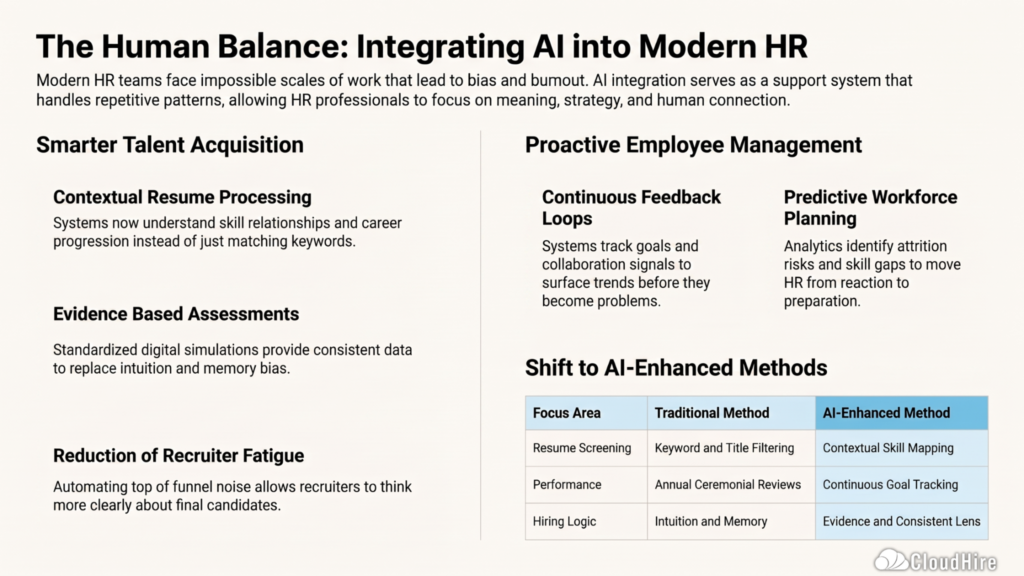
Modern hiring systems work differently. They read resumes with context. They understand skill relationships, career progression, and transferable experience. Someone who grew into a role through learning is no longer invisible next to someone with a perfect title.
This matters because good hiring is not about finding people who look right on paper. It is about finding people who can grow into the work.
Strong HR teams now use AI to reduce noise, not to make final calls. Shortlists come with explanations. Gaps are visible. Interviewers walk in prepared instead of guessing.
This is where many platforms claim to be the best AI tools for hr, but only a few actually change recruiter behavior for the better, like CloudHire. When AI reduces exhaustion, recruiters think more clearly. When recruiters think more clearly, hiring improves.
Assessments Became Fair Once Judgment Stopped Standing Alone
Hiring decisions fail most often when potential is assumed instead of tested. Interviews are limited by time, bias, and memory. AI-based assessments brought structure where intuition once dominated.
Good assessments today are practical. They simulate real work. They observe how candidates think, communicate, and respond to constraints. They do not label personalities or try to predict long-term behavior.
The value of modern hr assessment tools is not accuracy in isolation. It is consistency. Every candidate is evaluated using the same lens. That protects candidates and HR teams alike.
For HR managers, assessments create confidence. Decisions can be explained, feedback becomes specific, and hiring conversations with managers improve because evidence replaces opinion.
Used well, assessments do not dehumanize hiring. They make it more honest.
Performance Management Finally Became Continuous, Not Ceremonial
Traditional performance reviews failed because they asked managers to compress a year of observation into a single meeting. Memory replaced data. Emotions replaced patterns.
AI did not fix performance management by making it complex. It fixed it by making it quiet.
Modern systems track goals, feedback frequency, learning activity, and collaboration signals over time. Not to score people, but to surface trends. HR sees disengagement early. Managers get prompts before issues grow.
This is where artificial intelligence tools for hr show their real strength. They notice what humans miss when work becomes busy.
The result is not constant monitoring. It is timely support. Performance conversations become calmer because surprises disappear.
Engagement Listening Replaced Engagement Guessing
Asking employees how they feel once a year was never enough. By the time results came back, the moment had passed.
AI-enabled engagement systems listen continuously through short pulses, open feedback, and participation trends. More importantly, they interpret tone and change over time.
What makes these tools useful is not the data itself. It is a restraint. Strong HR teams do not react to every signal. They look for patterns. They intervene thoughtfully.
When engagement insights lead to visible, reasonable changes, trust grows. When they lead to noise, trust disappears.
Technology does not build engagement. Response does.
Workforce Planning Stopped Reacting and Started Preparing
HR used to respond after problems had happened. Attrition, skill gaps, and leadership shortages, but AI shifted this from reaction to preparation.
Predictive models now show risk areas. Internal mobility systems show where skills already exist. Learning data reveals which roles need investment.
This changes the way HR speaks to leadership. Instead of reporting issues, HR presents scenarios.
- What happens if hiring slows?
- What happens if growth accelerates?
- What happens if learning budgets shrink?
Planning becomes grounded, not speculative.
A leadership insight from our CEO, Sufiyan – “If a role is already hurting, the decision to hire was missed months ago.” – Click here to see the full post
Why Integrated Platforms Quietly Outperform Scattered Tools
Many HR teams use multiple systems that do not speak to each other. Hiring lives in one place, assessments in another, performance somewhere else, and insights get lost in between.
Integrated platforms change this by keeping context intact. Hiring data connects with assessment results. Assessment results connect with performance. Performance connects with development.
This is where the idea behind Cloudhire fits naturally. Assessment, management, and AI logic live together. Not as add-ons, but as connected workflows. The benefit is not convenience. It is clarity.
When systems share understanding, HR stops translating and starts guiding.
Choosing AI Without Losing Trust
The biggest risk with AI in HR is not technology. It is perception. Employees fear being reduced to numbers. Candidates fear being filtered unfairly.
Good HR teams ask hard questions before adoption:
- Can this system explain its outcomes clearly?
- Does it support human decisions instead of replacing them?
- Does it reduce effort without reducing dignity?
If trust is protected, adoption succeeds. If not, even the best tool fails.
A Quieter Way Forward
The success of AI tools for hr does not come from bold promises. It comes from steady improvement.
Better hiring conversations, fairer assessments, earlier support, clearer planning, and calmer HR teams.
AI did not make HR powerful. It made HR thoughtful again.
That is the change that lasts.
Frequently Asked Questions
1. What are AI tools for HR?
AI tools for HR are software systems that use algorithms and machine learning to automate tasks like sourcing, screening, scheduling, onboarding, and HR reporting. They help HR teams save time, reduce manual errors, and make people decisions based on data instead of guesswork.
2. How can AI help HR with recruitment?
AI can scan large volumes of resumes, match candidates to job requirements, rank them by fit, and even draft outreach messages. It also automates interview scheduling and reminders. This lets HR teams spend less time on admin and more time speaking with high-potential candidates.
3. How do AI tools support candidate experience?
AI can respond quickly to candidate questions, send status updates, and personalize communication at scale. It can recommend roles that better match a candidate’s profile and keep them informed instead of leaving them in silence. This makes the process feel more transparent and respectful.
4. What should HR teams check before using AI?
HR should check:
- What data the tool uses and how it is stored
- Whether you can see and explain why candidates are ranked a certain way
- How easy it is to adjust the criteria and exclude sensitive attributes
- If there are options to review and override AI suggestions
This keeps AI as a helper, not the sole decision-maker.
5. Will AI tools replace HR jobs?
AI will likely replace repetitive HR tasks, not the whole profession. Routine work like initial screening, scheduling, and basic FAQs can be automated. HR professionals stay essential for interviews, judgment calls, conflict handling, strategy, and relationship building areas where human context and care matter most.
Good HR has never been about doing more. It’s about making better decisions. CloudHire simply helps make those decisions a little easier.
Book a Demo and see it for yourself
Hire faster with CloudHire
Search 700M+ profiles, run AI interviews and launch outreach on one platform — free to start, no demo call required.