
Best Strategies for Job Searching While Employed – High-ROI Career Move
On this page
TL;DR: Job searching while employed isn’t about applying more it’s about protecting your privacy, using your limited time wisely, knowing when it’s time to leave, avoiding mistakes that expose your search, and understanding why recruiters often value employed candidates.
Searching for a job while you already have one sounds like it should be easier than searching while unemployed. In practice, it often feels harder. You have less time, less energy after work, and the constant fear of being found out by your current employer. The real enemy here is not your ambition. It is time scarcity, the simple fact that a full-time job leaves very little room for a proper search.
This blog covers confidential job search strategies built for people who need to search smart, not search all day.
Why Employed Job Searching Feels So Hard
When you are unemployed, the job search is your full-time job. When you are employed, it becomes a second one, squeezed into evenings, lunch breaks, and weekends. On top of that, there is the added pressure of discreet job searching, making sure your current employer does not find out before you are ready to tell them.
This combination of low time and high discretion is why so many employed job seekers either burn out fast or give up on searching altogether. Neither has to happen.
The Time Scarcity Problem, Broken Down
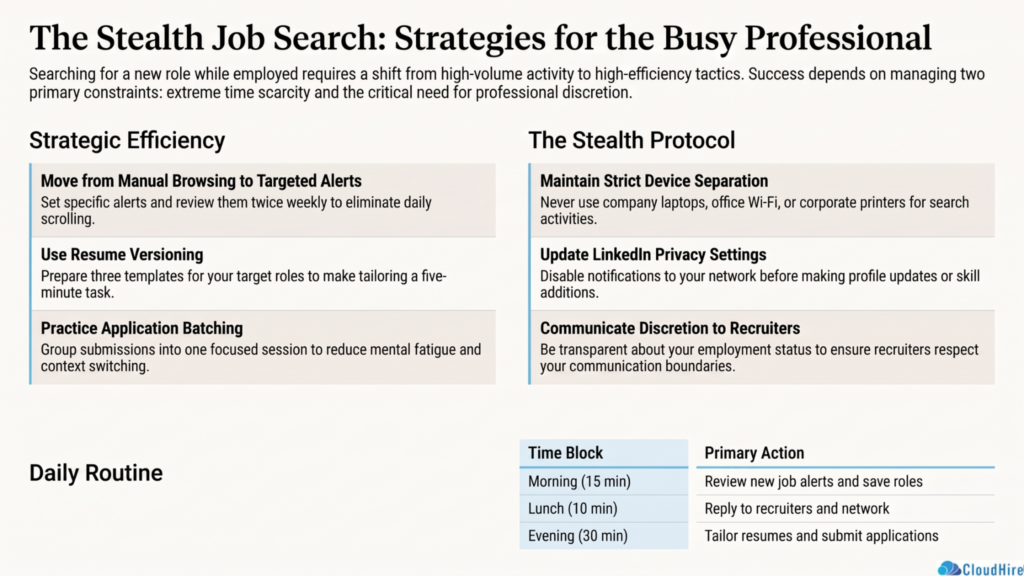
| Common time drain | Smarter alternative |
| Manually browsing job boards daily | Setting targeted alerts and checking twice a week |
| Customizing every resume from scratch | Building three to four resume versions for your target role types |
| Networking with no clear ask | Sending short, specific outreach messages |
| Applying to everything remotely related | Applying only to roles that closely match your target criteria |
| Scheduling interviews without a plan | Batching interview requests into specific days or times |
The goal is not to search less seriously. It is to remove the wasted motion that eats up hours without moving you closer to an offer.
Keeping Your Search Confidential
Discretion matters here, both for your peace of mind and your current job security. A few practical steps for confidential job search strategies:
- Adjust your LinkedIn settings so connections are not notified when you update your profile
- Avoid using your work email or work devices for any part of your search
- Be selective about who you tell, even among close colleagues
- Schedule interviews before or after work hours where possible, or use planned personal time rather than vague excuses repeated often
None of this requires deception. It simply protects your current position while you explore what is next.
Should You Tell Recruiters You’re Currently Employed?
Being employed is not something you need to hide from recruiters. In fact, many recruiters see it as a positive sign. It tells them you have recent experience, are actively working in your field, and are likely leaving for career growth rather than because you have no options.
Be honest about your situation from the beginning. Let recruiters know that you are currently employed and would appreciate confidential communication. Most recruiters deal with employed candidates every day and understand the need for discretion.
If interviews are difficult to schedule, explain that you are available before work, after work, during lunch breaks, or on planned leave. Clear communication helps recruiters plan around your schedule and shows professionalism.
Being honest also avoids problems later. If you receive an offer, the recruiter will already understand your notice period and availability, making the hiring process much smoother.
Mistakes That Get Employees Caught Job Searching
Most people don’t get caught because they are job searching. They get caught because they forget that company devices and systems often belong to their employer.
Avoid these common mistakes:
- Using your work laptop or office computer to search for jobs. In many companies, device activity can be monitored, and using company equipment for personal job hunting may even violate company policies.
- Applying through the office Wi-Fi instead of your personal internet connection.
- Printing resumes or interview documents using office printers.
- Scheduling interviews during working hours without planning personal leave.
- Adding interview meetings to your work calendar.
- Leaving LinkedIn or job boards open on your office computer during meetings or when stepping away from your desk.
Keeping your search private is usually about being organized, not secretive. Using your own devices and personal time is the safest approach.
Time-Efficient Search Tactics
Here is a practical weekly structure that respects the limits of job searching with limited time.
- Spend fifteen minutes twice a week reviewing curated job alerts, instead of daily open-ended browsing
- Reserve one focused block, ninety minutes to two hours, on a weekend for applications and follow-ups
- Keep three resume versions ready for your most likely target role types, so tailoring takes minutes, not hours
- Use lunch breaks for short, specific networking messages rather than long browsing sessions
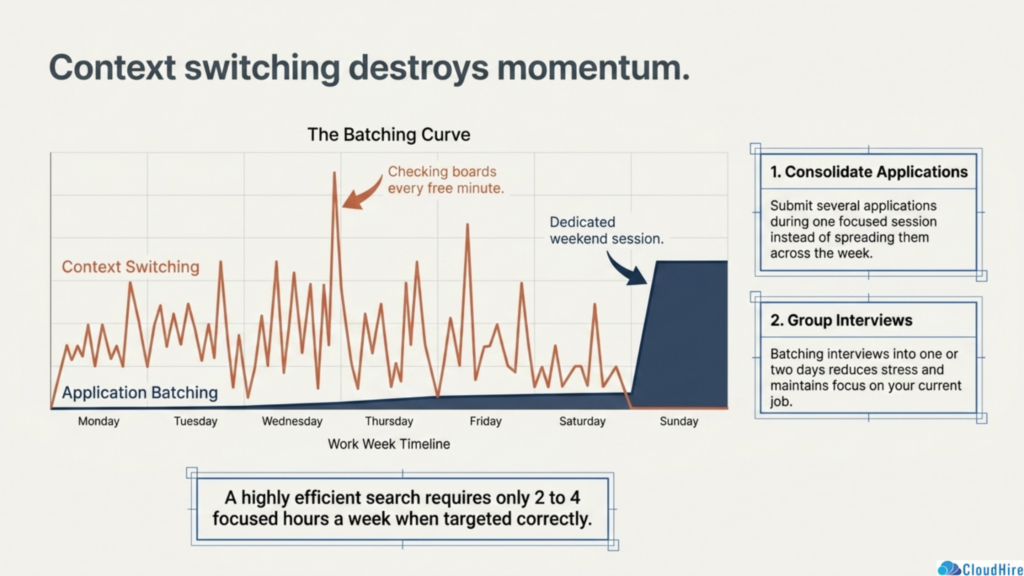
- Batch interview scheduling into one or two days a week to avoid constant context switching
This structure turns an overwhelming, open-ended task into something that fits realistically around a full-time job.
Best Times to Apply When You Already Have a Job
Finding time is often harder than finding jobs. Instead of checking job boards whenever you get a free minute, build a routine that fits around your work.
Morning (15–20 minutes): Review new job alerts and save interesting roles for later.
Lunch Break (10–15 minutes): Reply to recruiters, send networking messages, or confirm interview schedules.
Evening (30–45 minutes): Tailor your resume and submit one or two high-quality applications instead of rushing through many.
Weekend (1–2 hours): Update your resume, prepare for interviews, follow up on previous applications, and plan the week ahead.
Try application batching by submitting several applications during one focused session instead of spreading them across the week. Do the same with interviews whenever possible. Grouping interviews into one or two days reduces stress and helps you stay focused on your current job.
Networking Without Burning Extra Hours
Networking often feels like the most time-consuming part of a search, but it does not have to be. Passive networking strategies work well for employed job seekers:
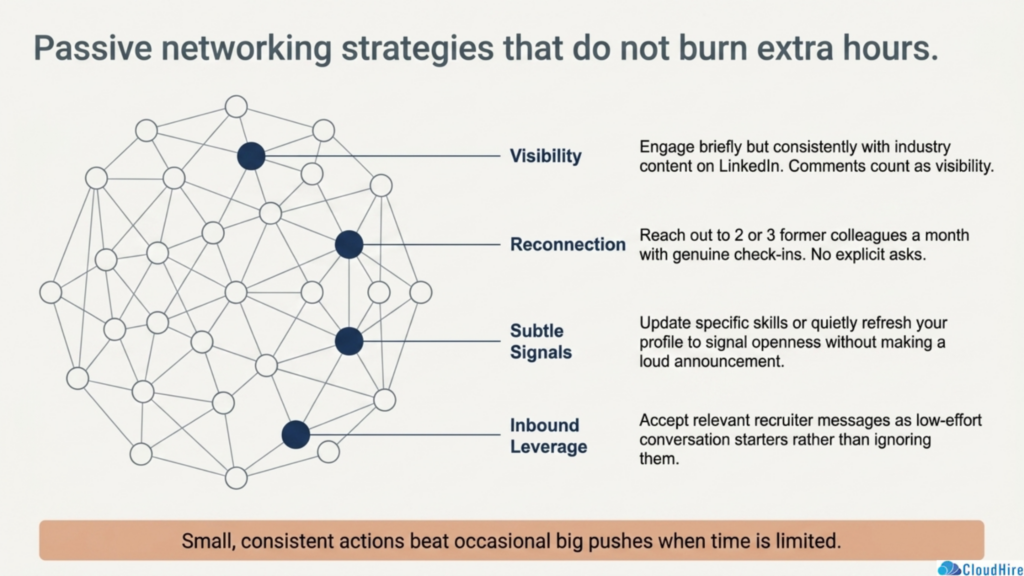
- Engage briefly but consistently with industry content on LinkedIn, comments count as visibility
- Reconnect with two or three former colleagues a month with short, genuine check-ins, not asks
- Let people know you are open to new opportunities without a big announcement, using subtle signals like updated skills or a quiet profile refresh
- Accept relevant recruiter messages as low-effort entry points into conversations, rather than ignoring them
Small, consistent actions beat occasional big pushes, especially when time is limited.
What Recruiters Think About Candidates Who Already Have Jobs
After years of building hiring technology and working with recruiters, we’ve seen firsthand that employed candidates are often viewed more positively than most job seekers realize. – Clara from HR, CloudHire.
Many candidates worry that being employed makes changing jobs more difficult. In reality, recruiters often see employed candidates as attractive hires. See how:
- They know your skills are current because you’re already working in the industry.
- They often assume you’re leaving for career growth rather than out of desperation.
- Hiring managers may see employed candidates as a lower hiring risk because they have a recent track record and active experience.
- Many also expect employed candidates to negotiate thoughtfully, which is a normal part of the hiring process.
That doesn’t mean unemployed candidates are at a disadvantage. Recruiters care most about finding the right person for the role. Being employed simply changes the conversation it doesn’t guarantee or prevent an offer.
Managing the Emotional Side of a Hidden Search
Searching quietly while showing up normally at your current job takes a toll that people rarely talk about. It helps to:
- Set a private goal or timeline so the search does not feel endless
- Talk to someone outside your workplace about the process, even just for support
- Remind yourself that discretion is professional, not dishonest
- Celebrate small progress, a good interview, a strong referral, rather than only counting the final offer
This kind of stealth job search is common and normal. Most employed professionals go through it at some point in their careers.
Frequently Asked Questions
How do I job search while working full time without getting caught?
Keep the search off work devices and work email, adjust LinkedIn notification settings, and schedule interviews outside work hours or during planned personal time. Being selective about who you tell also reduces risk.
Is it unethical to job search while employed?
No. Searching for better opportunities while employed is standard and expected in most industries, as long as you continue to meet your current job responsibilities honestly.
How much time should I spend job searching each week while employed?
Two to four focused hours a week is often enough if the time is used efficiently, targeting the right roles and avoiding open-ended browsing.
Should I tell my manager I am job searching?
In most cases, no, not until you have an offer or are ready to resign. Exceptions exist in unusually transparent workplace cultures, but discretion is the safer default.
Takeaway
Time scarcity, not lack of ambition, is what makes searching while employed hard. A focused, efficient system, built around a few hours a week instead of constant browsing, respects both your current job and your future one.
How CloudHire Helps
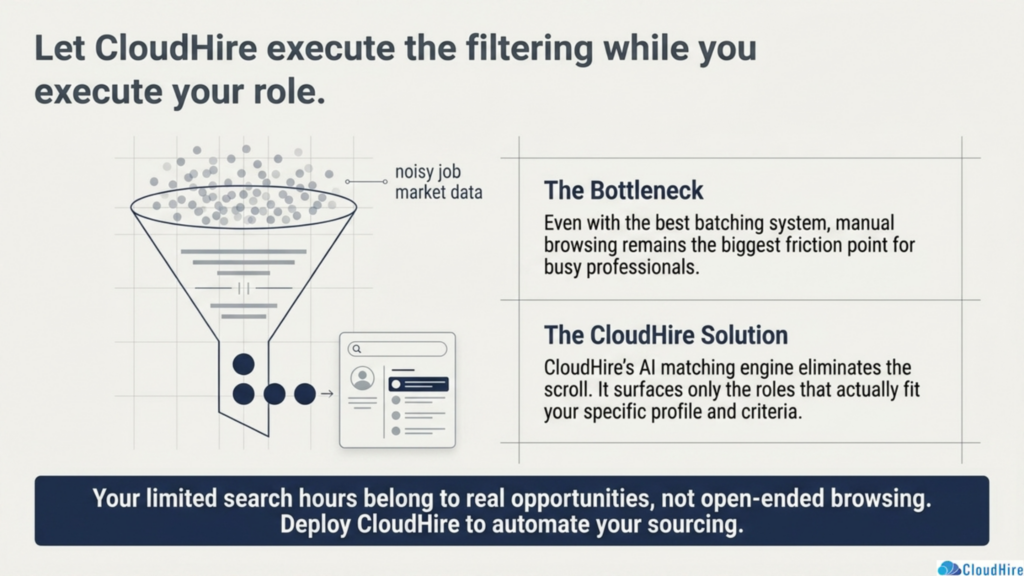
CloudHire’s AI matching cuts down the browsing time by surfacing roles that actually fit your profile, so your limited search hours go toward real opportunities instead of scrolling.
Searching on a tight schedule?
Let CloudHire do the filtering while you focus on your current role.
Put your job search on autopilot
CloudHire Smart Apply tailors your resume and applies to matching roles for you — so you spend your time interviewing, not scrolling.