
How do I overcome Interview Burnout?
On this page
TL;DR: 66% of job seekers report interview burnout. But the standard advice to take breaks, set limits, and remember you’re not alone addresses only one of three distinct layers burning candidates out simultaneously. This piece names all three, explains the specific mechanism behind each, and gives you a practical fix for each layer instead of a rest day that restores nothing.
The Number That Doesn’t Get Said Clearly Enough
Our internal analysis found that sixty-one percent of candidates are ghosted after job interviews in 2025-2026. Candidates typically spend 3–8 hours preparing for and participating in a single interview process. The average time from application to offer is now 68.5 days, a 22% increase from two years ago. Companies are running 5–8 interview rounds, where two used to be standard.
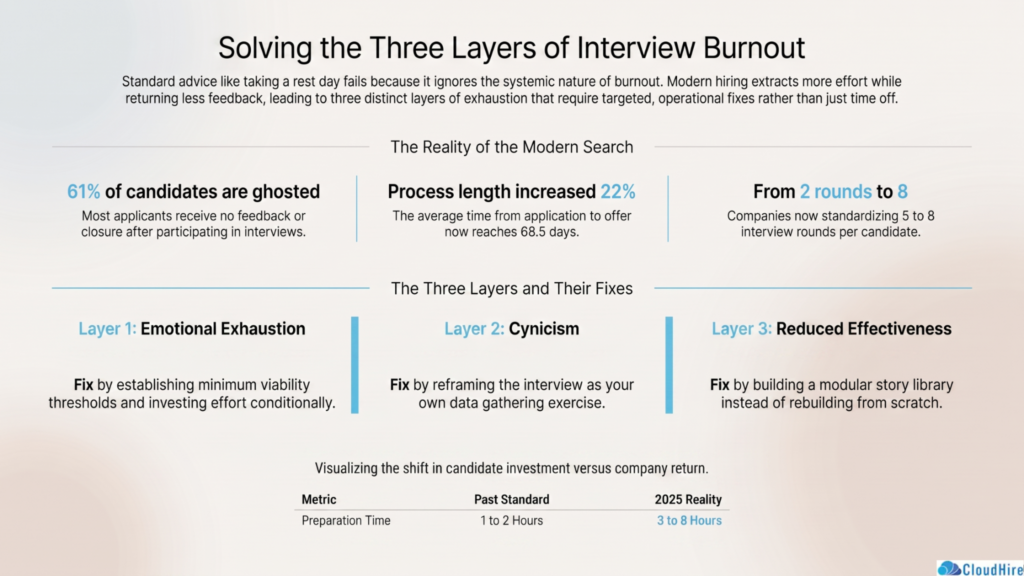
All of those data points to one thing: the modern interview process is extracting more from candidates than ever before and returning fewer decisions, less feedback, less transparency, and less closure.
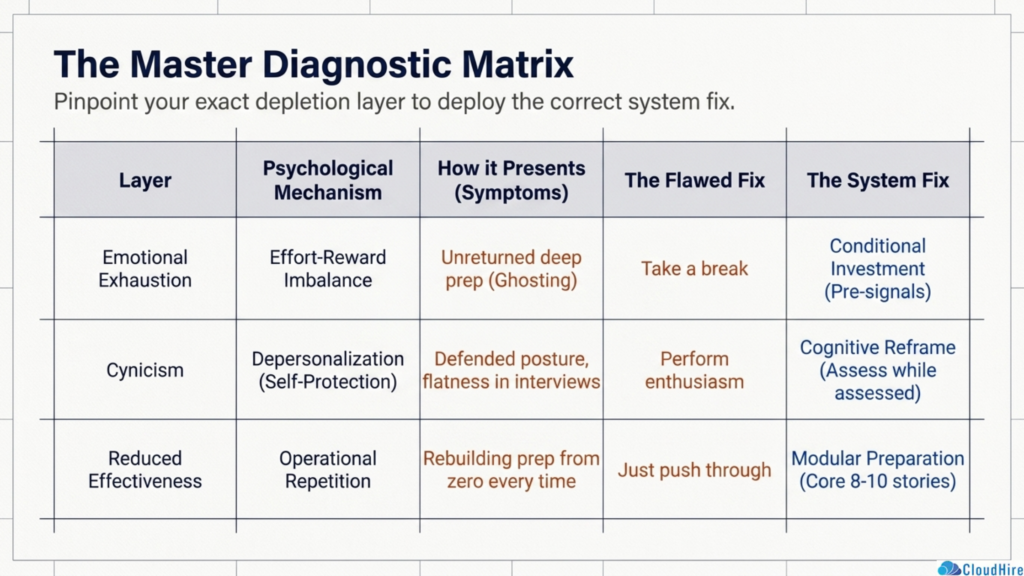
Interview burnout is the predictable outcome. What the content space consistently gets wrong is treating it as one undifferentiated feeling, a general exhaustion to be managed with rest and perspective. Three clinically distinct dimensions: emotional exhaustion, cynicism, and reduced sense of effectiveness. All three are operating simultaneously in interview burnout. All three have different triggers. And critically, all three have different fixes.
Understanding which layer is hitting hardest right now changes what you do about it.
Layer 1: Emotional Exhaustion The Unreturned Investment Problem
Emotional exhaustion in interview burnout is not simply tiredness. It has a specific mechanism: effort-reward imbalance.
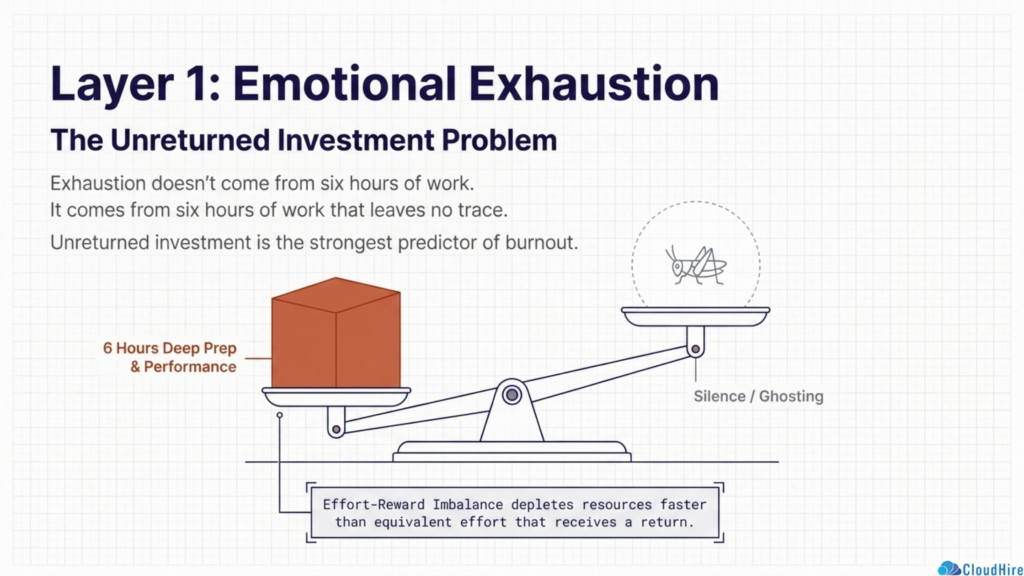
Occupational psychology research on burnout consistently identifies unreturned investment expending significant effort that produces no corresponding return as the strongest single predictor of exhaustion-type burnout. In the interview context, this looks precise: A candidate spends six hours preparing for a process, performs well by their own assessment, and receives complete silence. Not a rejection, information, or closure. No indication that the investment was even registered.
The exhaustion that follows is not from the six hours of work. It’s from six hours of work that left no trace and produced nothing usable, not even the data point of a clear no. Effort-reward imbalance research shows that this pattern, repeated across multiple cycles, depletes emotional resources significantly faster than equivalent effort that receives any form of return.
The fix for Layer 1 is not rest. It’s restructuring investment before it’s lost.
Practically: Before committing deep preparation energy to any process, establish a minimum viability threshold.
- Does the company communicate its timeline?
- Does the JD contain specific, verifiable claims or vague marketing language?
- Are there Glassdoor reviews from the last six months that show the process respects candidate time?
These are not deal-breakers. They’re pre-investment signals that tell you how much to stake before the process proves itself trustworthy.
The candidates who avoid Layer 1 burnout don’t invest less. They invest conditionally, staging their preparation in proportion to the signal the process returns at each step. Full preparation goes in after Stage 1 delivers something. Not upfront in expectation of a process that may ghost them after Round 3.
Layer 2: Cynicism The Self-Protection Loop
Cynicism in burnout research is depersonalization: emotional distancing as a response to repeated disappointment. In the interview context, it shows up as something that looks like professionalism but is functionally the opposite.
The burned-out, cynical candidate stops bringing genuine engagement to interviews. They show up defended. They answer competently but not specifically. They perform the shape of enthusiasm without the substance of it. They protect themselves from another disappointment by not fully investing, which means they’re no longer in the interview the same way they were in their first few applications.
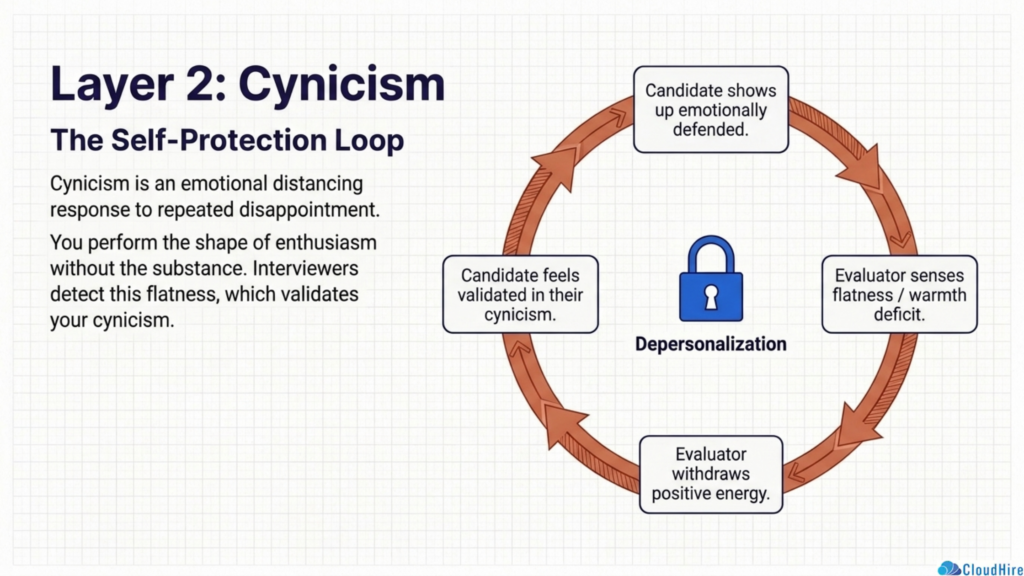
Here’s what makes this particularly costly: Interviewers detect defended candidates. Not consciously. But the warmth deficit, the flatness, the absence of genuine curiosity, all of these register as reduced interest and reduce the evaluator’s engagement in return. The candidate receives less positive energy back, which deepens the cynicism. This produces more defensive behavior in the next round.
This is a self-reinforcing loop. And rest alone doesn’t break it because the candidate who takes two weeks off and returns to the same emotionally defended posture will re-enter the loop within a few interviews.
The fix for Layer 2 is not to be more confident. It’s a deliberate reset of the interview’s emotional stakes through a specific cognitive reframe:
- The interview is a data-gathering exercise on both sides. What do I learn about this company in this conversation?
- What does the way they interview tell me about the way they manage?
This reframe isn’t passive acceptance. It’s an active repositioning of what you’re doing in the room from performing-for-judgment to assessing-while-being-assessed. Candidates running this frame stay engaged because they have a genuine task of their own. The defended posture has no function when you’re actually curious about what you’re finding out.
Layer 3: Reduced Effectiveness When Preparation Stops Compounding
This is the least-discussed layer of interview burnout and the most practically fixable.
A significant portion of interview burnout comes not from the emotional or psychological toll but from sheer operational repetition: rebuilding the same preparation materials from scratch for every new process. Rewriting the tailored story library. Relearning the company’s business. Redoing the research that was done three companies ago. Recreating the answers that were perfectly calibrated for a similar role two weeks earlier.
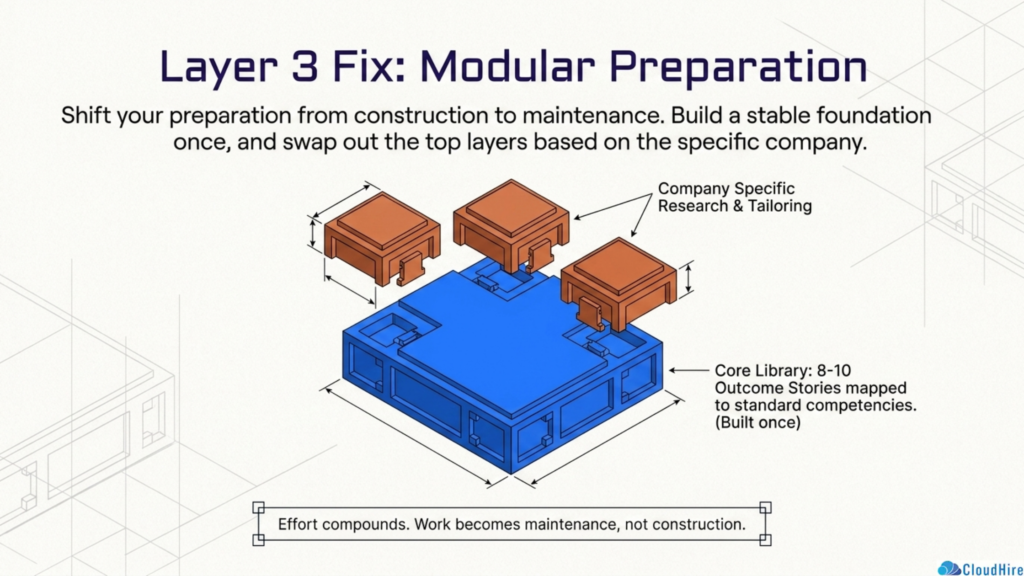
This work doesn’t accumulate. Each preparation cycle starts from zero. The effort is equivalent across every interview but produces no compound return, no library that grows, no framework that improves, no skills that sharpen.
The exhaustion this produces is real but different from Layer 1. It’s the burnout of repetitive manual labor rather than unreturned emotional investment. And it has a clean, operational fix: Modular preparation.
Modular preparation means building a core library once your top 8–10 outcome stories covering the competencies most roles in your target field evaluate for and adapting it, rather than rebuilding it for each application. Company-specific research becomes a layer added on top of a stable foundation, not a replacement for it. A new role’s behavioral questions pull from the same story library, with story selection adjusted to match the competency profile, not rewritten from scratch.
Candidates who build this infrastructure report a specific change in their interview experience: preparation stops feeling like a drain on their week and starts feeling like a check on a stable system. The work is maintenance rather than construction. And maintenance doesn’t burn you out the same way.
Recovery That Actually Repairs Not Just Rests
Taking a break from job searching stops the depletion temporarily. It doesn’t change the process that created it. Returning after two weeks to the same unconditional investment pattern, the same defended interview posture, and the same from-scratch preparation cycle produces the same burnout on a shorter timeline because the threshold for the next cycle is already lower.
Repair means changing the process before re-entry. That’s different from the rest.
At CloudHire, the conversations I have with candidates who come in burned out almost always start in the same place: not with a pep talk and not with a new batch of applications, but with an honest audit of where the energy is actually going and what it’s returning. Which layer is most depleted? What in the preparation process is being rebuilt from zero every time? What would a conditional investment structure look like for the specific roles being targeted?
Once that’s mapped, we build the modular story library, establish the pre-investment signals that make conditional investment practical, and work through the cognitive reframe that breaks the cynicism loop before the next first interview. The goal isn’t enthusiasm manufacture. It’s genuine capability confidence, which is what shows up in interviews as the kind of presence that interviewers respond to, and which produces better outcomes faster, which closes the burnout loop from the other end.
Interview burnout is not a sign that you’re not built for this. It’s a sign that the process has been extracting more than it’s returning. That’s a system problem. And system problems have system solutions, which is a much more useful frame than “take care of yourself and keep going.”
Frequently Asked Questions
What is interview burnout and how is it different from regular job search stress?
Job search stress is anticipatory; it’s about outcomes. Interview burnout is depletion, it’s about the cumulative cost of repeated high-stakes effort that returns little: no feedback, no decisions, no closure. Stress peaks before interviews. Burnout builds after enough of them produce nothing.
How many interview rounds before burnout typically sets in?
There’s no fixed number; it’s an effort-to-return ratio, not round count. A candidate who completes three ghosted six-round processes burns out faster than one who completes eight two-round processes with consistent feedback. The absence of return, not the volume of interviews, drives the depletion.
Is it normal to stop caring about roles you were excited about once burnout hits?
Yes, and it’s Maslach’s cynicism dimension working as designed. The brain depersonalizes emotionally costly situations as a protective mechanism. It’s not character failure. It is, however, actively hurting your interview performance. The fix is the reframe in Layer 2 giving yourself a genuine task in the room beyond being evaluated.
Should I tell an interviewer I’m experiencing interview burnout?
No but you also don’t need to perform enthusiasm you don’t have. Instead, redirect your energy into genuine curiosity about the company and role. Authentic interest in what you’re learning from the conversation reads far better than performed excitement, and it’s sustainable through burnout in a way that performed energy isn’t.
How does CloudHire help candidates who are experiencing interview burnout?
CloudHire helps you prepare with AI mock interviews, verified skill certifications, an ATS-optimized profile, and a Cloud ID that showcases your strengths to recruiters. This helps you spend less time chasing opportunities and more time succeeding in the right interviews.
Burnout often comes from walking into interviews feeling unprepared. CloudHire helps you prepare before you apply with AI mock interviews, verified skill certifications, ATS-ready profiles, and a Cloud ID that helps recruiters understand what you can actually do not just what’s on your resume.
Build your Cloud ID and start preparing for interviews that matter
Put your job search on autopilot
CloudHire Smart Apply tailors your resume and applies to matching roles for you — so you spend your time interviewing, not scrolling.