
Are Recruiters Selecting the Best Candidate Or Just Rejecting Everyone Else?
On this page
TL;DR: Most hiring teams don’t actually select the best candidate, they reject everyone who doesn’t fit an increasingly long checklist. That approach slows hiring, drives away top talent, and rewards the safest resume instead of the strongest performer. A better process starts by defining what success looks like, measuring candidates against real evidence, using structured interviews and scorecards, and evaluating strengths before focusing on gaps. Hiring becomes more consistent, fair, and accurate when the goal is identifying capability instead of eliminating imperfections.
There’s a difference and most hiring teams don’t realize which mode they’re operating in.
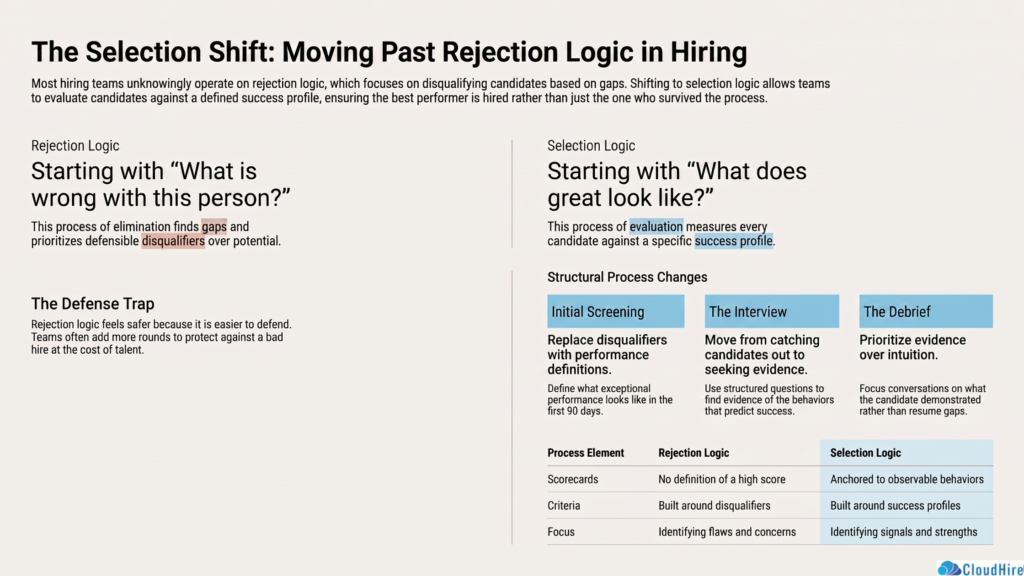
Selection logic starts with a question: What does great look like for this role? Every decision made through the process is measured against that answer.
Rejection logic starts from the opposite end: What’s wrong with this person? It’s a process of elimination, not evaluation.
Both approaches can produce a hire. But they produce very different hires, for very different reasons. And one of them is quietly burning your pipeline.
Let Me Give You a Real Example
Imagine two hiring managers reviewing the same candidate. Same resume, same interview, same scorecard.
Hiring Manager A (rejection logic): “They’ve never managed a team larger than 5. We need someone for a team of 12. Pass.”
Hiring Manager B (selection logic): “They haven’t managed 12 people yet, but they scaled a team from 2 to 5 in under a year, built the onboarding process from scratch, and their team had zero attrition. That’s exactly the pattern we need.”
Same candidate and opposite outcomes.
This isn’t about being lenient or lowering the bar. It’s about what question you’re asking when you look at a profile. Rejection logic finds the gap but selection logic finds the signal.
Why Rejection Logic Feels Safe (But Isn’t)
Here’s why most teams default to it: Rejection is easier to defend.
If you reject someone for lacking a specific skill, nobody questions that decision. But if you hire someone who doesn’t work out, every earlier “yes” gets scrutinized.
So unconsciously, teams build processes that protect against the second outcome at the cost of the first. They screen harder. They add more rounds. They look for reasons to cut rather than reasons to keep.
The result? Candidate filtering bias, where your process is better at removing people than finding them. You end up hiring whoever survived, not whoever was best.
And in competitive hiring markets, the candidates with the cleanest, most defensible resumes aren’t always the strongest performers. They’re just the most practiced at looking good on paper.
The Structural Difference Between the Two
This is where it gets practical.
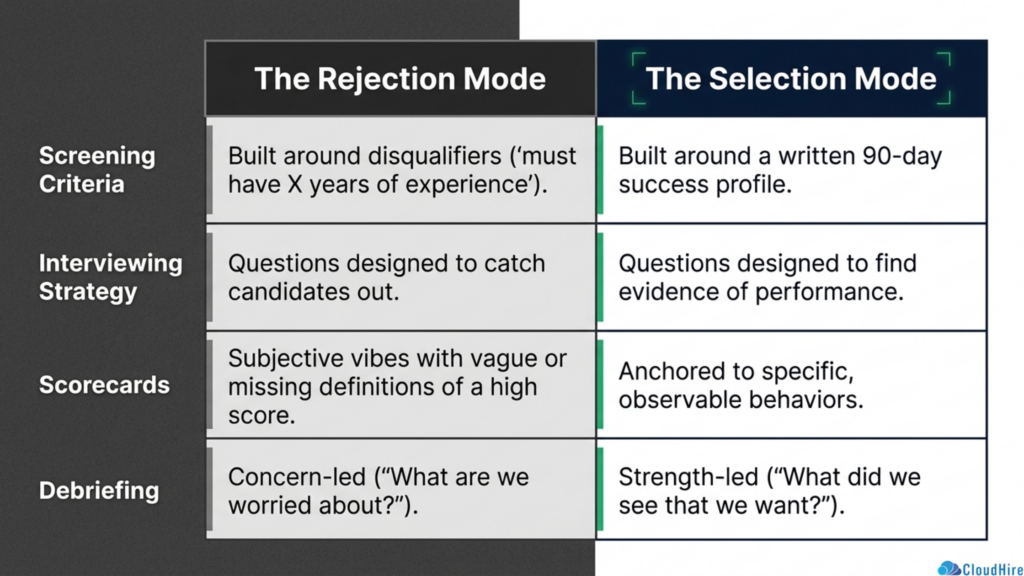
Rejection logic shows up in your process as:
- Screening criteria built around disqualifiers (“must have X years of experience”)
- Interview questions designed to catch candidates out
- Debrief conversations that focus on concerns rather than strengths
- Scorecards with no definition of what a high score actually looks like
Selection logic looks like this instead:
- A written definition of what exceptional performance looks like in 90 days
- Interview questions designed to find evidence of that performance
- Scorecards anchored to specific, observable behaviors
- Debrief conversations that open with “what did we see that we want?” before moving to concerns
The shift isn’t philosophical. It’s structural. You’re changing what your process is optimized to find.
The Hidden Cost: Your Best Candidates Leave First
Here’s something that almost never gets discussed.
When your process runs on rejection logic, it tends to be slow and skeptical by design. Every stage is another filter. Every interviewer is looking for reasons to cut.
Strong candidates, the ones with options, read that energy. They feel the skepticism. And when another company moves faster and asks different kinds of questions (“tell me about a time you built something from nothing” versus “why don’t you have an MBA”), they go there instead.
Passive candidate engagement drops. Candidate experience suffers. And you’re left with a finalist pool made up mostly of people who needed the job badly enough to tolerate the friction.
That’s not a pipeline problem. That’s a logic problem.
How to Know Which Mode Your Team Is In
Honest answer: Run this check after your next debrief.
Write down every comment made about the finalist candidates. Then sort them: how many were about what you saw versus what you didn’t see?
If 70% of the conversation was about gaps, missing experience, or concerns, you’re running on rejection logic.
If the conversation opened with what each person demonstrated and why that maps to the role, you’re closer to selection logic.
Most teams, when they run this exercise honestly, are shocked by the ratio.
Where Structured Hiring Decisions Come In
Switching from rejection to selection logic doesn’t mean being optimistic about every candidate. It means building a process that forces the right question at every stage.
That’s exactly the problem we work on at CloudHire.
When a role opens on our platform, the first thing we help the hiring team do isn’t write a job description, it’s define the success profile. What does this person need to accomplish in the first 30, 60, 90 days? What behaviors predict that? What’s the difference between someone who’d be okay in this role and someone who’d be exceptional?
Every interview, scorecard, debrief is anchored to those answers.
What I’ve seen happen consistently is that when teams build their process this way, the debrief conversation changes. Instead of “I wasn’t sure about the gap in 2021,” it becomes “Candidate A showed X and Y. Candidate B showed Y, but not X. For this role, X matters more. So it’s Candidate A.”
That’s a decision made on evidence, not intuition or elimination.
CloudHire also tracks where candidate drop-off happens across stages. If strong candidates are consistently exiting after round two, that’s a signal worth investigating and we surface it so teams can ask why, rather than assuming the candidates weren’t good enough.
One Practical Thing You Can Change This Week
Before your next interview, write this down and share it with every interviewer:
“At the end of this conversation, I should be able to answer: what specific evidence did I see that this person can or cannot do [the thing that matters most in this role]?”
That single reframe from “what’s wrong with them” to “what evidence did I gather” is the foundation of evidence-based hiring. It doesn’t require a new ATS or a training program. It requires a different question going in.
Everything else builds from there.
Frequently Asked Questions
How does CloudHire help teams move from rejection logic to selection logic in practice?
We start by helping teams build a success profile before the first interview is scheduled. Inside CloudHire, that profile becomes the backbone of every scorecard. Interviewers aren’t asked “what do you think?” at the end, they’re asked to rate specific, observable behaviors against a defined benchmark. That structure makes selection logic the default, not the exception.
Can CloudHire flag when a hiring process is skewing toward over-filtering?
Yes. One of the things we track is stage-by-stage conversion rates alongside the quality of eventual hires. If a team is cutting 90% of candidates before the hiring manager even sees them, and the eventual hires are underperforming, that’s a pattern we can surface. It’s not always obvious from inside the process that the data makes it visible.
Does CloudHire’s scorecard system work for roles without clear technical benchmarks like sales or operations?
Absolutely. The scorecard structure works best when it’s built around behaviors and outcomes, not credentials. For a sales role, the observable signal might be how a candidate structures an unknown problem, how they handle pushback, or how they talk about deals they lost. We help teams define those signals before the process starts, so interviewers know what they’re looking for regardless of the role type.
What’s the actual difference between selection logic and just “lowering the bar”?
This is the most common pushback, and it’s a fair one. Lowering the bar means accepting less. Selection logic means measuring the right things. A team running rejection logic might reject a future top performer because they don’t have a specific certification. A team running selection logic might hire the same person because they demonstrated the underlying capability the certification was meant to proxy. The bar isn’t lower, it’s more accurate.
Why do structured interviews outperform unstructured ones for hiring decision accuracy?
Unstructured interviews are essentially vibes dressed up as an evaluation. Two interviewers talking to the same candidate for 45 minutes each will walk away with completely different impressions, weighted by whatever was most salient to them personally. Structured interviews ask the same questions, in the same order, measured against the same criteria. The research on this is consistent, structured interviews predict job performance significantly better because they reduce the noise that unconscious bias in hiring introduces. You’re comparing the same data across candidates, not different conversations.
Hire faster with CloudHire
Search 700M+ profiles, run AI interviews and launch outreach on one platform — free to start, no demo call required.