
Video Interview Analysis With AI: What It Gets Right and Where It Still Struggles
On this page
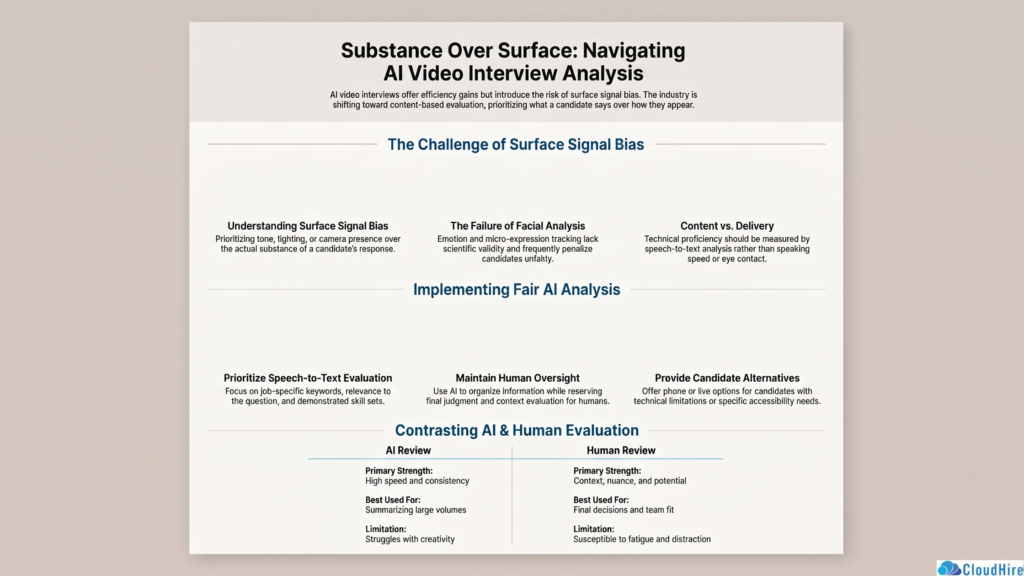
Video interviews promised to save recruiting teams enormous amounts of scheduling time, and largely delivered on that. But adding AI analysis on top of video interviews introduced a new and less discussed problem. The real enemy here is surface signal bias, the risk that a tool, or even a human reviewer, ends up weighing how someone comes across on camera more heavily than what they actually say.
This blog looks at how AI video interview analysis actually works today, where the well-documented backlash came from, and how to use these tools in a way that stays fair and genuinely useful.
After years of building AI video interview technology and watching thousands of interviews move through the hiring process, we’ve learned that the biggest risk isn’t AI itself but measuring the wrong signals. That’s why modern hiring is shifting away from appearance-based analysis and toward evaluating real skills and answer quality
Surface Signal Bias – Explained
When you watch someone answer an interview question on video, it is very easy to be influenced by tone of voice, eye contact, lighting, background, and general camera presence, separate from the actual content and quality of their answer. This happens naturally to human interviewers too, but AI models trained on these surface signals can encode the same bias more systematically and at greater scale.
Someone with strong technical answers but a shaky internet connection, poor lighting, or discomfort with being on camera can score lower than someone with weaker answers delivered smoothly and confidently. That is a real fairness problem, not a hypothetical one.
How AI Video Interview Analysis Actually Works
Most AI video interview tools follow a fairly simple process. First, the candidate records their answers to a set of interview questions. The system converts those spoken answers into text using speech recognition technology. Once the answers are in text form, AI evaluates the content, looking for relevant skills, keywords, experience, and whether the response actually answers the question.
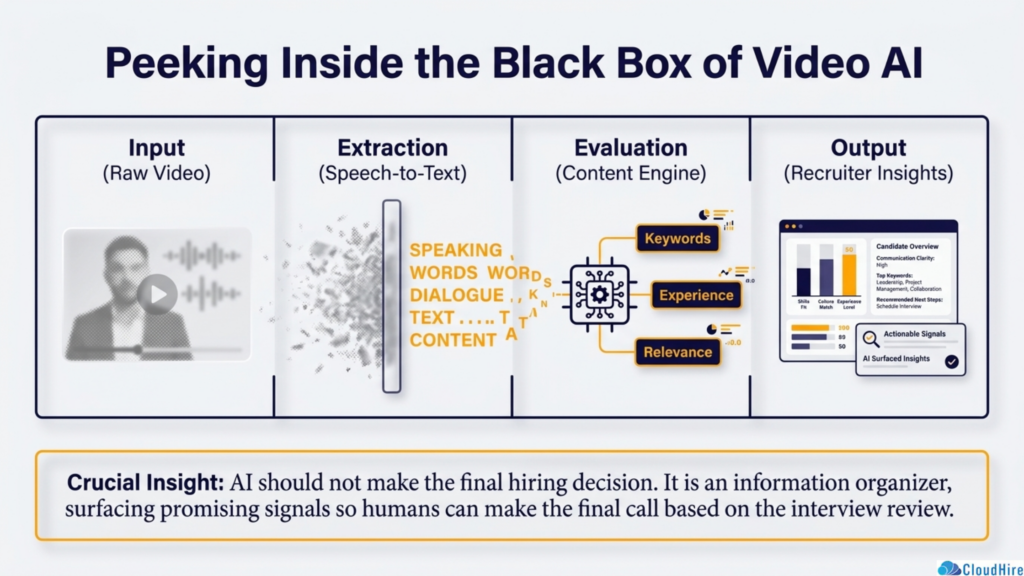
Some platforms also generate summaries, highlight strengths, and score each response based on the employer’s hiring criteria. Recruiters receive these insights alongside the recorded interview, allowing them to review candidates much faster.
In most hiring processes, AI does not make the hiring decision. It helps organize information and surface promising candidates, while recruiters and hiring managers make the final call after reviewing the interview themselves.
What AI Video Interview Tools Actually Analyze
Modern video interview AI tools vary widely in what they evaluate. Broadly, they fall into a few categories.
| Analysis type | What it evaluates | Fairness risk level |
| Speech to text content analysis | The actual words and substance of answers | Low, closest to evaluating real content |
| Keyword and relevance matching | Whether answers cover expected topics or skills | Low to moderate |
| Tone and pacing analysis | Speaking speed, pauses, vocal energy | Moderate, can penalize non-native speakers or nervous candidates |
| Facial expression and emotion analysis | Micro-expressions, eye contact, smiling patterns | High, most criticized and least reliable |
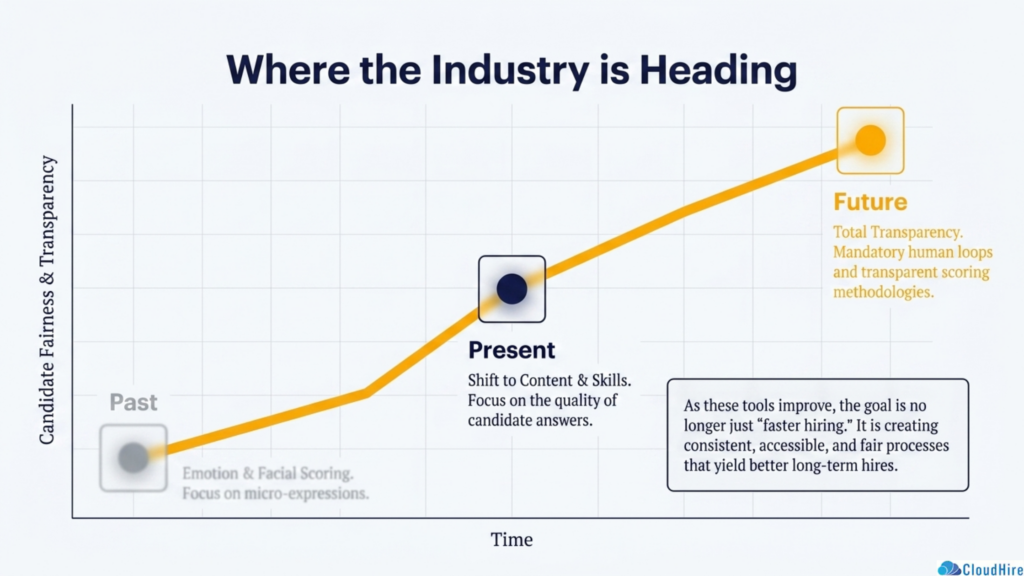
The industry has moved noticeably away from facial and emotion analysis over the past few years, following public criticism and research questioning its scientific validity and fairness. Several major vendors have scaled back or removed these features entirely. Content and skill-based analysis, focused on what candidates actually say, is the more defensible and increasingly standard approach.
What AI Can and Cannot Measure
AI has become very good at measuring certain parts of an interview, especially when the evaluation is based on the content of a candidate’s answers.
AI is generally good at measuring:
- Whether the answer addresses the question
- Job-specific knowledge and terminology
- Communication clarity
- Following instructions
- Consistency across multiple answers
However, there are important limits to what AI can understand.
AI still struggles with:
- Leadership potential
- Creativity and original thinking
- Cultural context
- Problem-solving in completely new situations
- Long-term growth potential
These qualities often become clear only through conversations, follow-up questions, and real-world work. AI can support recruiters, but it cannot fully replace human judgment.
The Backlash Against Facial Analysis
It is worth understanding this history before adopting any video AI tool. Early video interview platforms marketed facial and emotional analysis as a way to predict traits like confidence or trustworthiness from micro-expressions. Researchers and civil rights groups raised serious concerns, pointing out that this kind of analysis lacked strong scientific backing and risked penalizing candidates based on disability, cultural background, or simple camera discomfort, none of which relate to job performance.
This is a useful cautionary example of AI ethics in hiring. Just because a technology can measure something does not mean that measurement is meaningful or fair. Any vendor still leaning heavily on facial or emotional scoring today deserves direct, skeptical questions about their evidence.
Candidate Comfort and Video Interviews
Beyond bias concerns, video interviews carry practical candidate accessibility issues worth planning for:
- Unequal access to strong internet connections, quiet spaces, or good recording equipment
- Discomfort or genuine difficulty for candidates with certain disabilities, including some forms of social anxiety or communication differences
- Time zone and scheduling friction for asynchronous video formats, especially across global teams
- General unfamiliarity or nervousness with the format itself, separate from actual job skills
A thoughtful process accounts for these factors rather than treating video interview performance as a clean, unbiased signal on its own.
How Candidates Can Prepare for an AI Video Interview
Preparing for an AI video interview is not very different from preparing for a live interview. The goal is to communicate your experience clearly, not to impress the software.
Before the interview, test your camera, microphone, and internet connection. Choose a quiet place with good lighting so your answers can be recorded clearly. Read each question carefully before answering, and keep your responses focused and structured.
Avoid memorizing scripts word for word. Over-rehearsed answers often sound unnatural. Instead, practice explaining your experience in your own words using clear examples. Most importantly, focus on answering the question completely rather than trying to guess what the AI wants to hear.
Best Practices for Fair Video Interview Analysis
To use video interview technology responsibly, a few practices consistently help.
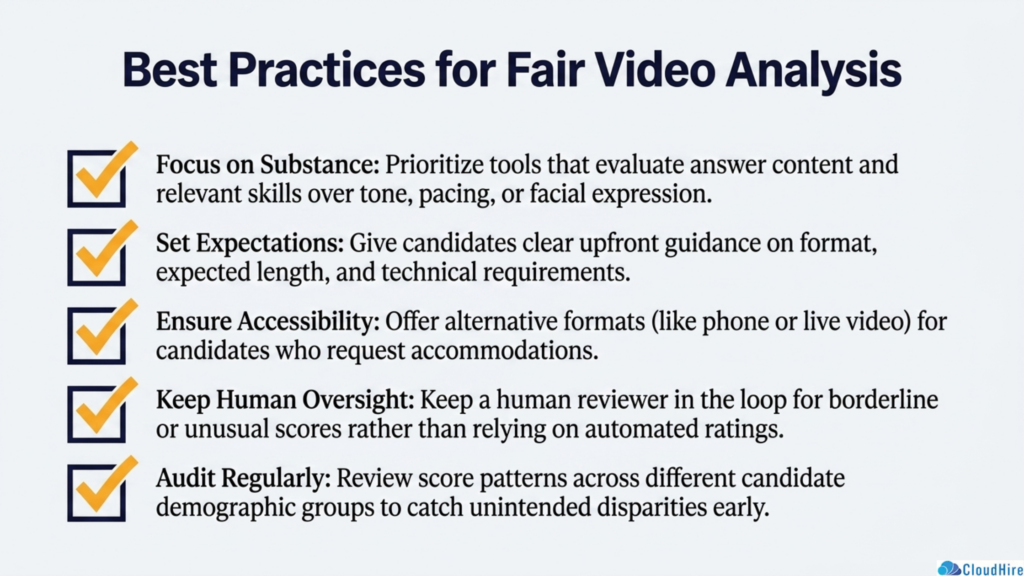
- Prioritize tools that focus on answer content and relevant skills over tone, pacing, or facial expression
- Give candidates clear guidance beforehand on format, expected length, and technical requirements
- Offer an alternative format, like a phone or live video option, for candidates who request it
- Keep a human reviewer in the loop for borderline or unusual scores rather than relying purely on an automated rating
- Regularly review score patterns across different candidate groups to catch unintended disparities early
AI vs Human Interview Review: What’s the Difference?
AI and human interviewers each bring different strengths to the hiring process. The best results usually come from using both together rather than relying entirely on one.
| AI Review | Human Review |
| Reviews candidates quickly | Understands context and nuance |
| Applies the same criteria consistently | Can ask follow-up questions |
| Never gets tired or distracted | Recognizes potential beyond the resume |
| Summarizes large numbers of interviews | Makes final hiring decisions using judgment |
AI is excellent at handling repetitive evaluation and helping recruiters save time. Human reviewers remain essential for understanding personality, motivation, team fit, and qualities that cannot be measured by software alone.
Questions to Ask Before Adopting a Video AI Tool
Before bringing any video interview screening software into your hiring process, ask the vendor directly:
- Does the tool analyze facial expressions or emotional signals, and if so, what evidence supports its validity?
- Can we disable or de-weight tone and pacing analysis if we choose to focus purely on content?
- What accessibility accommodations exist for candidates with disabilities or technical limitations?
- Has the tool been independently audited for bias across different demographic groups?
In CloudHire, we build video analysis around answer content rather than surface delivery tend to give clearer, more confident answers to these questions, which is itself a useful signal during evaluation.
Balancing Efficiency With Candidate Experience
Video interviews genuinely save time, particularly for high-volume early-stage screening. The goal is not to abandon them, but to be deliberate about what is being measured. A process that values substance over polish tends to produce both fairer outcomes and, often, better hires, since strong communicators are not always the strongest performers once actually on the job.
People Also Ask
Is AI video interview analysis biased?
It can be, particularly tools that rely on facial expression or emotional analysis, which have faced significant criticism for weak scientific validity and unequal impact across candidate groups. Content-focused analysis carries lower risk.
Do companies still use facial expression analysis in video interviews?
Some do, but many major vendors have scaled back or removed this feature following public and research criticism. It is reasonable to ask any vendor directly whether facial analysis is part of their scoring.
Are video interviews fair to candidates with disabilities?
They can present real challenges depending on the disability and the format. Offering alternative interview formats and reviewing accessibility accommodations is an important part of a fair hiring process.
What should companies look for in a fair video interview AI tool?
Look for tools that prioritize the content and substance of answers over tone, pacing, or facial expression, and that are transparent about their scoring methodology and any independent bias audits.
The Future of AI Video Interviews
AI video interviews are changing quickly. Across the industry, there is less focus on facial expressions and emotional analysis, and much more attention on the quality of a candidate’s answers and job-related skills.
Employers are also asking for greater transparency around how AI scores candidates, what information is being evaluated, and how those scores should be interpreted. Human oversight is becoming a standard expectation rather than an optional feature.
As these tools continue to improve, the goal is not simply faster hiring. It is creating interview processes that are more consistent, more accessible, and fairer for every candidate while still giving recruiters the information they need to make better hiring decisions.
Takeaway
Surface signal bias is a real and well documented risk in video interview analysis, but it is not a reason to avoid the format altogether. Choosing tools that focus on substance over delivery, offering flexible formats, and keeping human oversight in place lets you keep the efficiency benefits of video interviews without repeating the fairness mistakes the industry has already learned from.
Want video screening that focuses on substance, not surface? See how CloudHire’s video analysis is built around answer content and skill relevance.
Hire faster with CloudHire
Search 700M+ profiles, run AI interviews and launch outreach on one platform — free to start, no demo call required.