
Which Jobs Will Survive AI? Using the Task vs. Judgment Framework
On this page
You’ve probably Googled this already. And you’ve probably gotten the same recycled list: “creative jobs are safe,” “empathy-driven roles will survive,” “learn to code (wait, AI does that now too).”
Not helpful.
So let me tell you what’s actually happening as someone who works inside hiring every day at CloudHire, and sees firsthand which candidates are thriving, which are panicking, and which are quietly building something AI can’t replace.
You Are Asking the Wrong Question
Most people are asking, “Will my job survive AI?” and that’s the wrong frame. A better question is: “What part of my job is a task vs. what part requires judgment?”
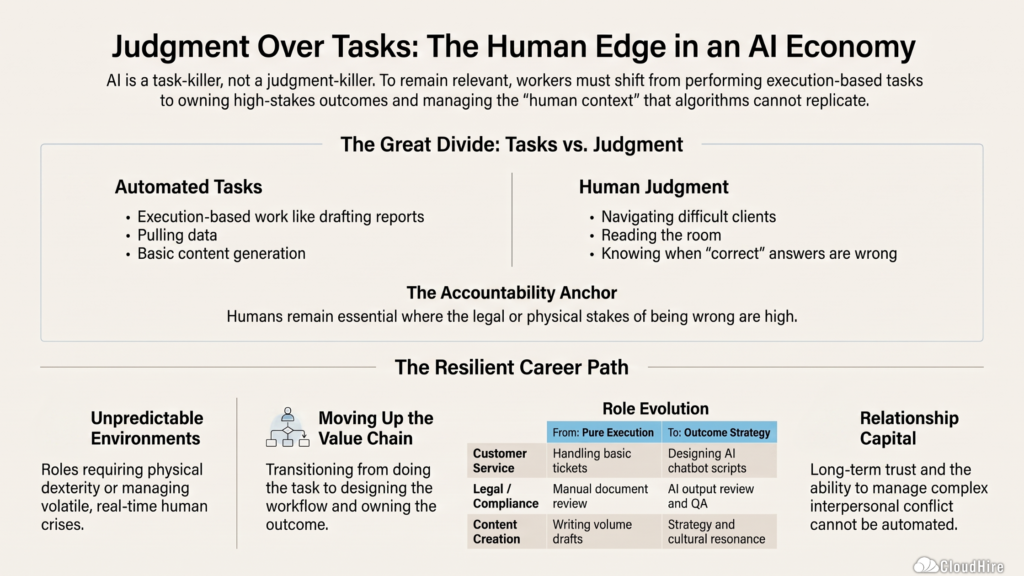
AI is a task-killer. It is not a judgment-killer, at least not yet, and not in the ways that matter most to employers right now.
Tasks: Writing a first draft, formatting a report, scheduling, pulling data, and summarizing a meeting.
Judgment: Deciding which data matters, navigating a difficult client, knowing when a “technically correct” answer is the wrong one, and reading a room.
Once you split your role into these two columns, you’ll see exactly where you stand.
Jobs That Are Genuinely Holding Ground (And Why)
Let’s get specific because “creative” and “empathetic” are too vague to be useful.
1. Roles Where the Stakes of Being Wrong Are High
Think surgeons, structural engineers, legal counsel, and clinical pharmacists. These aren’t safe because AI can’t do parts of them. They’re safe because when AI gets it wrong here, someone gets hurt. Accountability and liability live with humans. That’s not changing soon.
2. Roles Built on Real-Time Human Unpredictability
Crisis counselors, emergency responders, negotiators, conflict mediators these jobs exist because humans are irrational, volatile, and contextual. AI trained on historical data doesn’t know how to handle the thing that’s never happened before and in these roles, that’s every Tuesday.
3. Roles That Require Physical Presence + Skilled Judgment
Electricians, plumbers, HVAC technicians, and dental hygienists. The coordination required to work in an unpredictable physical environment, such as a crawl space, someone’s mouth, or a flooded basement, is extraordinarily hard to automate. These trades are chronically understaffed and increasingly well-paid.
4. Roles That Manage or Prompt AI Itself
This is the new category everyone should pay attention to. AI prompt engineers, automation workflow designers, and AI output reviewers didn’t exist five years ago and are now one of the fastest-growing areas in tech hiring. The skill isn’t coding. It’s knowing what to ask and whether the answer is actually good.
5. Roles That Depend on Relationships Built Over Time
Senior account managers, executive recruiters, therapists, and financial advisors with long-term clients, the product is the trust. You can’t automate a 10-year relationship.
The Jobs That Are Actually Getting Replaced (Be Honest With Yourself)
I’d rather say this plainly than dance around it.
- Data entry and processing roles are not “at risk” already being replaced at scale
- Junior copywriting and content generation volume content is largely automated now
- Basic customer service tier-1 support is increasingly handled by AI chatbots
- Paralegal research and document review: AI does this faster and more thoroughly
- Some entry-level coding tasks, junior devs who only write boilerplate, are vulnerable
This doesn’t mean people in these roles are done. It means the task is being automated and the humans who survive are the ones who moved up the value chain fast.
What “Moving Up the Value Chain” Actually Looks Like
Here’s where I see candidates get stuck. They hear “upskill” and imagine going back to school for two years or getting a certification that may already be outdated by the time they finish.
That’s not what I mean.
Moving up looks like:
- A customer service rep who becomes the person designing the AI chatbot scripts using their frontline knowledge, no AI has
- A junior copywriter who becomes an AI content strategist, knowing what to create and why, even if the drafting is automated
- A paralegal who becomes a specialist in AI output review and legal QA because firms can’t just trust the model
- A recruiter who uses AI-assisted sourcing to work 5x faster instead of competing against it
The shift is always from doing the task to owning the outcome.
One Thing Candidates Consistently Underestimate
Soft skills aren’t just “nice to have” anymore, they’re the last true differentiator.
Not soft skills in the resume-buzzword sense. I mean specifically:
- The ability to disagree with a client and keep the relationship
- Knowing how to give feedback that changes behavior instead of triggering defense
- Being the person in the room who can simplify something complicated without losing accuracy
These are absurdly hard to train. They’re nearly impossible to automate. And right now, most hiring managers I speak with say finding candidates with these at a senior level is harder than finding technical talent.
How We Think About This at CloudHire
At CloudHire, I work with companies across industries who are actively reshaping what their teams look like, not in a “cut everyone and use AI” way, but in a “we need to find people who can work with these tools intelligently” way.
What I’ve seen shift in talent acquisition over the last 18 months:
- Fewer postings for roles that are purely execution-based
- Far more demand for hybrid skill profiles, someone who understands both the domain and the tooling
- A spike in companies asking us to find candidates who’ve actually built workflows using AI, not just used ChatGPT casually
At CloudHire, we help candidates position themselves for exactly this reality. When you work with us, we don’t just match your CV to a job description. We look at where your actual experience sits on the human-vs-task spectrum and help you target roles and frame your resume in a way that speaks directly to what employers are prioritizing right now. If you’ve been wondering whether your background is “AI-proof enough,” that’s a conversation we can have specifically, not generically.
The Practical Checklist (Save This)
Before you spiral, run through these:
- List your daily tasks – Which ones could an AI do in 10 seconds? Which ones require you to know something the AI doesn’t have access to?
- Identify your irreplaceable context – Client relationships, institutional knowledge, and political awareness within your industry are assets.
- Try the tools before you fear them – Use AI in your current role. The fastest way to become valuable in an AI world is to be someone who’s already working in it.
- Get specific about your next move – “Upskilling” isn’t a plan. “I’m going to spend the next 90 days learning how to build automated workflows in my industry using [specific tool]” is a plan.
Frequently Asked Questions
Which jobs will survive AI in the next 5 years?
The jobs that will still be standing in five years share one trait: They require humans to be accountable for outcomes that matter. Roles in healthcare, infrastructure, complex B2B sales, mental health, skilled trades, and AI governance are all strong. Survival isn’t about the job title; it’s about how much judgment, relationship capital, or physical dexterity the role demands at its core.
Is my job safe if it’s “creative”?
Partially. AI is very good at producing volume creative work, blog drafts, social posts, and ad copy variations. Where it struggles is originality with stakes attached: a brand strategy that has to resonate with a specific culture, a design that has to work within a regulatory context, a campaign tied to a controversial topic. Creatives who understand the why behind the work, not just the execution, are in a genuinely strong position.
Should I learn to code to survive AI?
Only if coding is actually adjacent to where you want to go. The more useful skill right now is AI literacy, understanding what these tools can and can’t do, how to prompt effectively, and how to evaluate their output critically. That’s transferable across almost every industry and doesn’t require a computer science background.
What’s the fastest way to make myself more hirable in an AI-heavy job market?
Pick one AI tool that’s directly relevant to your field and get genuinely good at it, not surface-level good, but “I built something with this” good. Then talk about it in interviews. Most candidates are still in the “I’ve heard of ChatGPT” stage. Demonstrating actual applied experience, even in a small project, puts you ahead of most of the competition immediately.
How does CloudHire help candidates figure out where they fit in an AI-changing market?
At CloudHire, we go beyond matching resumes to open roles. We have direct conversations with hiring managers across industries about what they’re actually struggling to find, which is usually people who combine domain expertise with a willingness to work differently. When you come to us, we help you identify the intersection of what you’re good at and where genuine market demand is shifting, so you’re not just applying broadly and hoping. We work with you to position your background in a way that’s specific, credible, and relevant to where hiring is actually going.
Knowing which jobs will survive AI is only the first step. The next is building the skills employers are looking for today. Whenever you’re ready for that next opportunity, CloudHire is ready to help you find it.
Book a Demo: CloudHire
CloudHire works both sides of the table
Hiring teams search 700M+ profiles and run AI interviews. Candidates put their job search on autopilot. Pick your side.