
How to Find Jobs by Commute Distance: Tools, Tips & Filters
On this page
TL;DR: The closest job isn’t always the best, and the highest-paying job isn’t always worth the commute. Travel time, traffic, transport costs, office days, and career growth all matter when deciding whether a job is truly worth accepting.
Commute distance is one of the most underrated factors in job satisfaction, and most job seekers don’t filter for it until after they’ve already accepted an offer. This guide shows you how to search by commute time and distance on major platforms, how to calculate the real cost of a long commute, and why applying for jobs close to home can actually improve your chances.
Why Commute Distance Matters More Than People Think
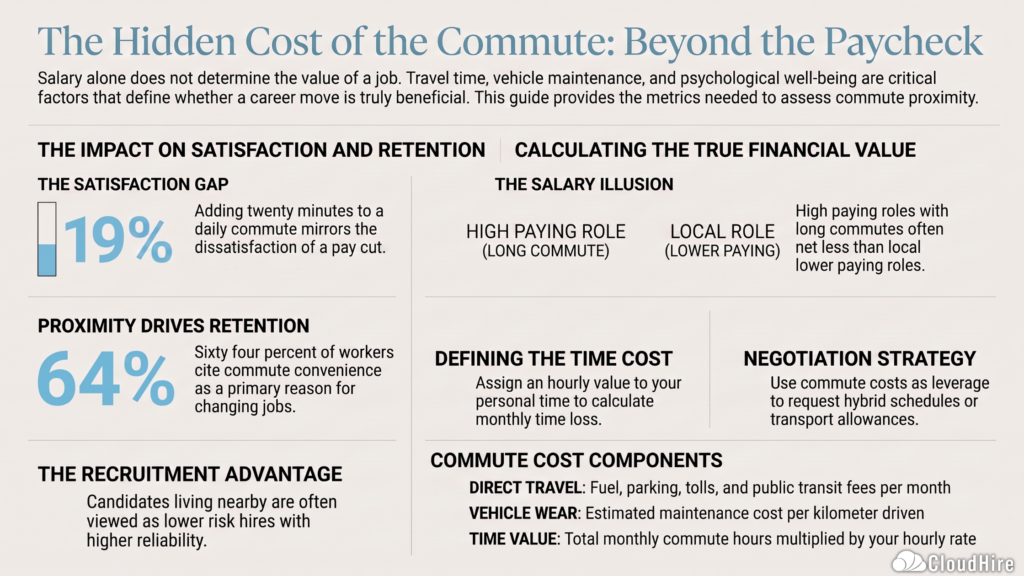
Most candidates look at salary, role, and company before they think about commute. But our internal analysis found 64% of workers who change jobs cite commute convenience as a primary reason, outranking even pay and team support in some cases.
There’s a financial dimension too. A job that pays 15% more but adds 90 minutes a day in commuting costs more than it earns once you account for fuel, parking, vehicle wear, and the time you’re not spending on anything else.
Adding 20 minutes to a daily commute has the same measurable effect on job satisfaction as a 19% pay cut. That’s not a small number.
So before you apply, it’s worth knowing how to search by location correctly and how to calculate what a commute actually costs you.
Jobs Where Commute Matters the Most
Not every job is affected by commute in the same way. Some roles can handle a longer journey, while others become difficult if you’re spending hours on the road every day.
| Job Type | Why Commute Matters |
| Customer Support | Shift work often starts early or ends late, so living nearby makes it easier to stay on schedule. |
| Nurse or Healthcare Worker | Long shifts and emergency call-ins make a shorter commute much more practical. |
| Retail | Weekend, evening, and holiday shifts are common, making nearby locations more convenient. |
| Sales | If you’re already travelling to meet clients, adding a long commute to the office can be exhausting. |
| Software Engineer | A longer commute may be manageable if the role is hybrid or remote most of the week. |
| Construction | Job sites can change often, so commute time may vary from project to project. |
| Consultant | Travel is often part of the job, so office location is usually less important than client locations. |
| Designer (Hybrid) | Many design roles only require office visits a few days a week, making longer distances easier to manage. |
Think about how often you’ll travel, when you’ll travel, and whether the commute fits the way the role actually works.
How to Filter Jobs by Commute Distance on Major Platforms
Different platforms handle location-based job search differently. Here’s what each one offers.
| Platform | Commute Filter Options |
|---|---|
| Indeed | Search by city + set a radius (5, 10, 25, 50 miles). Use the “Distance” filter in search results. |
| Filter by “On-site” or “Hybrid,” then set location. Doesn’t have commute time but lets you sort by city/region. | |
| Google Jobs | Automatically pulls job listings near your search location. Type “jobs near me” or “marketing jobs in [city]” for proximity results. |
| Glassdoor | Location + radius filter. Also shows office addresses directly in listings. |
| Naukri (India) | City-level search with locality filters. Useful for metro neighborhoods. |
| CloudHire | When you search by a city, it automatically shows remote jobs within and with 25-mile radius. You can adjust the slider to change how many miles out you want to search. |
| CareerBuilder | Offers a commute time filter using your starting address and transportation mode (car, transit, walking). |
Pro tip: Always enter a specific neighborhood or zip code rather than just a city name. “Bangalore” pulls jobs across 30+ kilometers. “Koramangala, Bangalore” keeps results tight to where you actually are.
Step-by-Step: Searching by Commute Distance
Step 1: Define your maximum commute before you start searching.
Be honest with yourself. “I can do 45 minutes” often becomes “I hate my life” at month three. Consider:
- Door-to-door time, not just distance
- Whether the route involves traffic, not just distance on a map
- Whether you’ll be doing this 5 days a week or 2–3 (hybrid)
Step 2: Use Google Maps to test the actual commute.
Once you find a role you’re interested in, paste the office address into Google Maps from your home. Check it at your expected departure time on a weekday morning. Real traffic data will show you what the commute actually looks like, not the best-case scenario.
Step 3: Use Google Jobs for proximity search.
Type your job title + “near me” or “jobs within [X] km of [your area]” directly into Google Search. Google’s job results will automatically prioritize listings closest to your detected location and show the address of each employer clearly.
Step 4: Filter by hybrid or remote to extend your realistic radius.
A job 45 km away that requires 3 office days a week is very different from the same distance with only 1 day in-office. When you filter platforms to show hybrid jobs, your effective search radius expands significantly because the commute frequency drops.
Best Free Tools for Planning Your Commute
Before accepting an offer, spend a few minutes checking what your daily journey will actually look like. These free tools can help you make a better decision.
- Google Maps – Check travel time during your usual working hours and compare driving, public transport, walking, or cycling.
- Waze – Useful if you drive, with live traffic updates and better route planning.
- Moovit – Shows public transport routes, schedules, and walking directions in many cities.
- Citymapper – Great for metro cities where you have multiple transport options like buses, trains, and metro services.
- Transit – Helps you compare buses, trains, and other public transport with real-time arrival information.
- Rome2Rio – Useful if you’re comparing jobs in different cities or planning a longer journey using different types of transport.
Checking your commute before accepting a job takes only a few minutes but can save you hours every week.
Calculating the Real Cost of a Long Commute
Before you accept a role with a long commute, do this calculation. It takes about 5 minutes and can completely change how you evaluate an offer.
Monthly commute cost formula:
| Cost Component | How to Calculate |
|---|---|
| Fuel | (Daily km ÷ fuel efficiency) × fuel price × working days in month |
| Parking | Daily parking fee × working days |
| Toll / Metro / Bus | Daily cost × working days |
| Vehicle wear | Estimate ₹2–3 per km or use IRS mileage rate for reference |
| Total Direct Cost | Add all of the above |
Then calculate the time cost:
- Daily commute time (both ways) × 22 working days = monthly commute hours
- Assign an hourly value to your personal time (your salary divided by working hours is a reasonable benchmark)
- That’s your monthly time cost, in addition to money
A job that pays ₹80,000/month but costs ₹12,000 in commuting and 30 hours of your time each month is paying you less than a ₹72,000 job 10 minutes from home. Run the numbers before you sign.
When a Long Commute Is Worth It
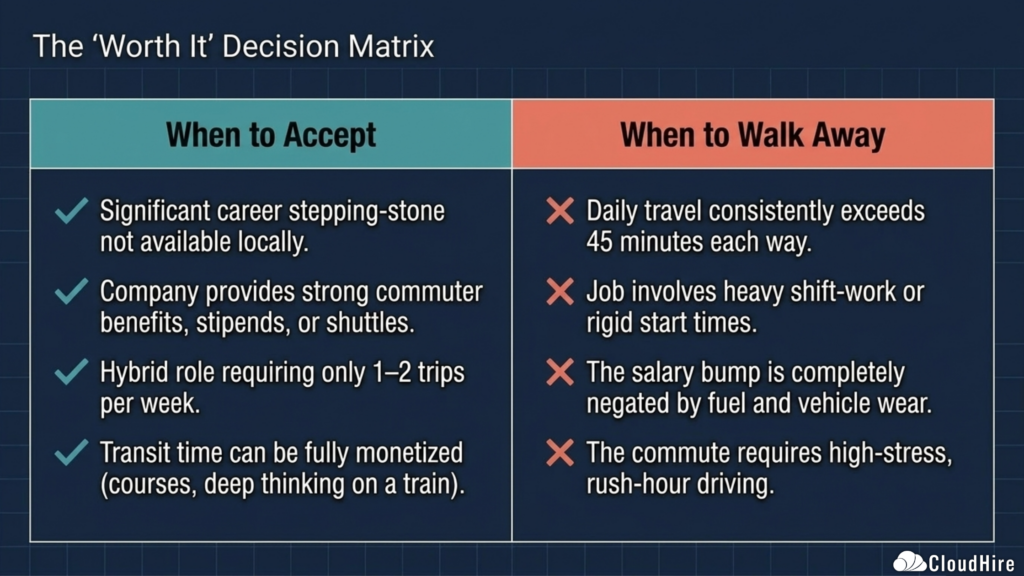
Not every long commute is a bad deal. There are situations where accepting the distance makes sense:
- The role is a significant career step that opens doors the closer job can’t
- The company offers commuter benefits, transport reimbursement, or a shuttle
- It’s a hybrid role and you’ll only commute 1–2 days a week
- You can use the commute time productively (podcasts, courses, deep thinking time during public transit)
- The salary difference genuinely covers the cost and then some
The key is making the decision with full information, not finding out six months in that the commute is unsustainable.
How Recruiters View Candidates Who Live Nearby
Commute distance doesn’t only matter to candidates. Recruiters often think about it too.
Someone who lives closer to the office may be seen as a lower-risk hire because they’re less likely to struggle with long daily travel. For roles that require shift work, fixed office hours, or occasional in-person meetings, living nearby can also make scheduling easier.
A shorter commute can also reduce the chances of late arrivals, weather-related delays, or candidates leaving the job because the travel becomes too much over time.
This doesn’t mean employers only hire local candidates. Skills and experience always come first. But if two candidates have similar qualifications, being closer to the workplace can sometimes become an advantage.
If you already live close to the office, it’s worth mentioning it during the hiring process, especially for on-site or hybrid roles. It can reassure employers that you’re ready to start quickly and are comfortable with the location.
Using Commute Distance as a Negotiation Point
If you receive an offer where the commute is a genuine concern, it’s a legitimate item to raise during negotiation. You can:
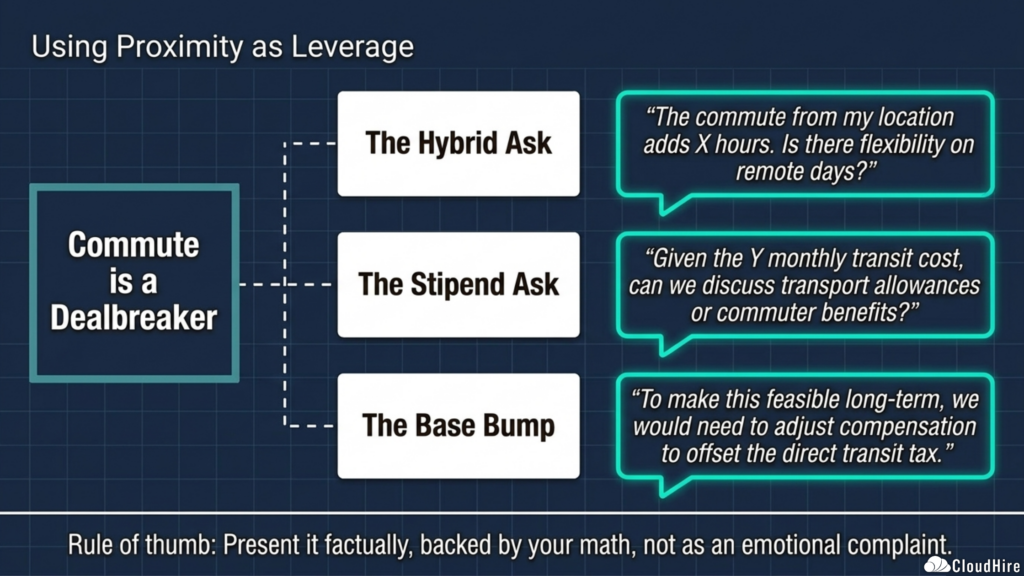
- Request a hybrid or flexible arrangement to reduce office days
- Ask for a commuter stipend or transport allowance
- Negotiate a slightly higher salary to offset the cost
- Ask whether the company plans to open offices in other locations
Present it factually. “The commute from my location adds approximately X hours and Y in monthly costs. Is there flexibility on remote days, or can we discuss the compensation accordingly?” That framing is professional and specific.
Frequently Asked Questions
What is a reasonable commute to work?
Most research points to under 30 minutes each way as the threshold where job satisfaction holds steady. Beyond 45 minutes each way, studies show measurable declines in well-being and engagement. That said, it’s personal and depends on how you commute (train reading vs. driving in traffic are very different experiences).
How do I search for jobs near me on Google?
Search “job title + near me” or “job title + city/neighborhood” directly in Google. Google’s Jobs panel pulls nearby listings automatically based on your location. You can filter by date posted, job type, and distance directly in the results.
Can I filter LinkedIn jobs by commute time?
LinkedIn does not currently offer a commute time filter. You can filter by city, on-site vs. hybrid vs. remote, and experience level. For commute-specific filtering, Indeed and CareerBuilder offer better options.
How do I find jobs within 10 km of my home?
On Indeed, enter your city and set the distance filter to the closest option available. On Google Jobs, search “jobs near [your neighborhood]” for tightly localized results. You can also use Naukri’s locality filter if you’re in India.
Does commute distance affect hiring decisions?
Yes, from the employer’s side too. Hiring managers increasingly value candidates who live nearby because local hires show up more reliably, handle shift changes with less disruption, and tend to stay longer. If you live close to a company’s office, it’s worth mentioning in your application.
A Better Way to Find Jobs That Fit Your Location
The honest challenge with proximity-based job search is that most platforms weren’t built with commute time as a first-class filter. You end up doing a lot of manual checking, mapping addresses in a separate tab, and calculating whether a job that looks good on paper is actually workable in real life.
CloudHire is built differently. Candidates create a structured profile. Recruiters searching for candidates on CloudHire can filter by these preferences, which means you stop getting contacted about roles that are 2 hours away when you’ve made clear you want something within 30 minutes or Remote.
It puts the commute conversation at the start, not after you’ve gone through three interview rounds.
CloudHire and match with jobs that actually work for your life →
Put your job search on autopilot
CloudHire Smart Apply tailors your resume and applies to matching roles for you — so you spend your time interviewing, not scrolling.