
10 Tips Working From Home Was Supposed to Make You Happier – So What Happened?
On this page
TL;DR: Working from home becomes exhausting when every room feels like the office and work slowly takes over your mornings, lunches, evenings, and weekends. Small rituals like packing your laptop away each day, working near natural light, taking real lunch breaks, moving regularly, creating a clear end-of-work routine, protecting your personal time, making space for hobbies, and setting healthy boundaries make remote work feel sustainable again. The goal isn’t to become more productive it’s to make work fit into your life instead of letting it take over.
Working from home once felt like a small miracle. No commute meant extra sleep. Coffee tasted better when it came from your own kitchen. Mornings felt spacious, almost indulgent. Then, quietly, reality settled in. Days began to blur. The couch turned into an office, then a bedroom. Emails crept into dinner time. What started as freedom slowly tightened into a sense that work was everywhere, all the time.
If you’ve felt that shift, you’re not alone. It often shows up in small, familiar moments: the mid-afternoon slump when sunlight fades, and your energy disappears with it, or the third interruption during an important call that leaves you apologizing to a client while quietly questioning whether you’re failing at both work and home. None of these moments are dramatic on their own, but together they erode focus, confidence, and joy.
This isn’t a post about radical productivity hacks or reinventing your routine overnight. It’s about small, human rituals that took shape for me only after months of trial and error. These shifts didn’t turn my dining table into a perfect office, but they made it sustainable. More importantly, they helped work feel like one part of life again, not the background noise of everything else.
When Your Kitchen Table Becomes a Black Hole
Most people don’t have the luxury of a separate home office. The kitchen table works until it doesn’t. Papers begin to spread. Charging cables tangle. Yesterday’s dishes linger in your peripheral vision while you try to focus on a meeting that deserves more attention than you can give it.
One small ritual makes a surprising difference: packing everything away at the end of the day. Each evening, the laptop goes into its sleeve, the notepad gets stacked, and the charger is neatly coiled. Everything lives in a single box or drawer. Closing it feels like ending a chapter, not just pausing mid-sentence.
In the morning, opening that box creates a sense of intention. There’s no visual reminder of unfinished work, no mental carryover from yesterday’s stress. One friend added a simple plant to the table, a trailing pothos, nothing elaborate. Watering it became the signal that work was beginning. Over time, the table stopped feeling like a battlefield and started feeling neutral, even welcoming.
Five minutes of packing up doesn’t sound like much, but it changes how mornings feel. The space breathes again.
| Ritual Category | Specific Ritual | Problem Addressed | Benefits and Impact | Tools or Cues Needed | Actionability (Inferred) |
| Physical Workspace Management | End-of-day pack away | Visual clutter, work-life bleed, and the ‘black hole’ kitchen table | Creates a sense of intention, ends the work chapter, and removes reminders of stress | Laptop sleeve, single box or drawer, and a notepad | High; requires only a designated container and 5 minutes daily |
| Transition Rituals | Workday closure signals | Lack of natural signals to end the workday at home | Tells the brain the work chapter is closed and anchors daily progress | Cleaning supplies (desk wipes), a candle, or a change of clothes | High; simple sensory triggers to mark the shift in roles |
| Boundary Management | Visual status signals for family | Unprofessional interruptions from kids or pets during video calls | Reduces emotional tax, teaches boundaries, and maintains professional confidence | Red/green ‘busy light’ or high-value pet treats | High; simple visual aids and rewards are easy to implement |
| Nutrition and Mental Health | Fixed-time lunch away from desk | Afternoon crashes, mental fog, and poor digestion from desk-eating | Clears mental clutter, settles digestion, and makes the afternoon usable | Real plates and pre-prepared healthy snacks (nuts, fruit, eggs) | High; requires discipline to step away at a specific time |
| Physical Well-being | Micro-movement breaks | Tight necks, aching hips, and low-grade fatigue from sitting | Improved circulation, mental clarity, and increased creativity | 30-second intervals for shoulder rolls or wrist circles | High; can be done anywhere without special equipment |
| Environmental Health | Natural light exposure | Afternoon energy slumps, loss of time sense, and ‘dark corner’ workspace | Improved focus, better sleep, and warmer social presence during calls | Proximity to a window or a full-spectrum lamp on a timer | Medium; depends on home layout but lamps are a viable workaround |
| Digital Boundaries | Friction-based email limits | The ‘evening email trap’ and open mental loops | Allows the mind to rest and restores evening personal time | Inbox-blocking tools and a paper notepad for urgent thoughts | Medium; requires setting up software or changing communication signatures |
| Personal Growth | Non-negotiable scheduled hobby | Disappearance of joy and work-life imbalance | Increases work output through joy; provides progress and pride | Scheduled time (at least 30 minutes) and hobby materials (e.g., painting, music) | Medium; requires strict time-blocking and commitment |
The Forgotten Need for Natural Light
Remote work quietly pushes us into darker corners. Screens dominate our days, and natural light becomes an afterthought. When that happens, the body loses its sense of time. Energy dips hard in the afternoon, no matter how much coffee you drink.
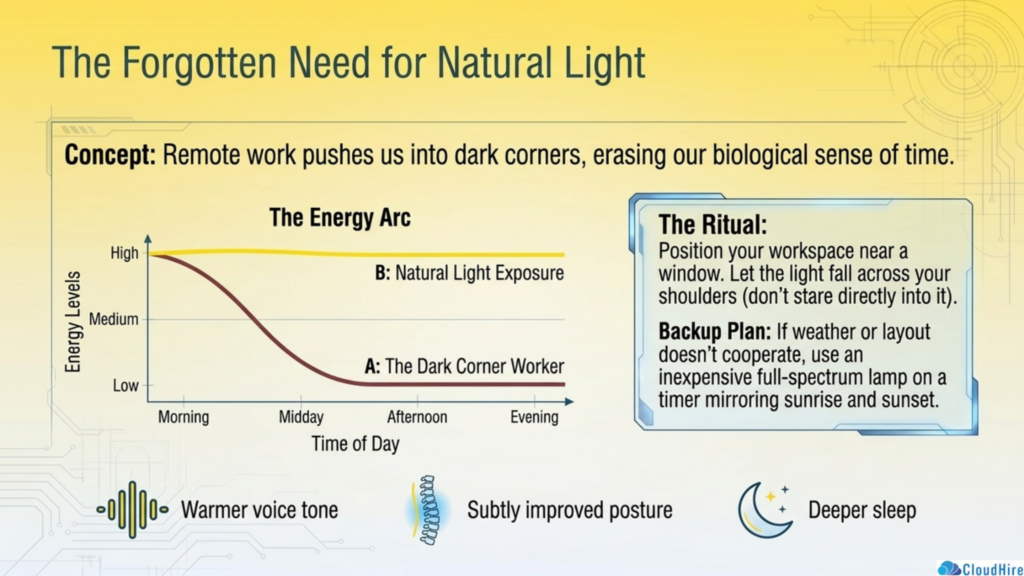
Positioning your workspace near a window- not staring directly into it, but letting light fall across your shoulders- can shift the entire rhythm of your day. Mornings feel more awake, and focus tends to hold longer into the afternoon. Even standing near a window during calls subtly improves posture and presence. Voices sound warmer. Conversations feel less transactional.
On days when the weather doesn’t cooperate, full-spectrum lamps can help. They don’t need to be expensive or sophisticated. Set them on timers that roughly follow sunrise and sunset. Over time, sleep improves, and days feel longer without feeling more exhausting.
Light costs nothing to notice, but it resets your biology in ways most productivity tools can’t. Give it a week and pay attention.
When Your Dog (or Kid) Steals the Show on Video Calls
Interruptions are one of the most emotionally taxing parts of working from home. A barking dog or a child asking for snacks mid-sentence can feel deeply unprofessional, even when everyone claims to understand. The apologies pile up, and confidence takes a hit.
Preparation helps turn chaos into something manageable. For pets, high-value treats kept near your chair can redirect behavior quickly. Consistency matters more than perfection. For kids, visual cues work wonders. A simple “busy light” outside the room, red for wait, green for okay, teaches boundaries without constant negotiation.
A few tools and habits help calls stay smooth:
- Noise-canceling headphones reduce background distractions for both you and the listener.
- Clear check-in breaks with kids (even five minutes every hour) lower anxiety for everyone.
- Praise when boundaries are respected reinforces the system faster than frustration ever could.
Interruptions don’t disappear, but with structure, they stop feeling like personal failures.
Lunch: The Meal That Quietly Disappears
One of the first things remote work erases is lunch. Eating at your desk feels efficient, but it almost always leads to afternoon crashes and mental fog. Digestion suffers, and focus drifts long before the workday is actually over.
A simple rule helps:
- Step away at a fixed time, even if only briefly.
- Eat somewhere that isn’t your workspace.
- Use real plates. Put the screen down.
- Preparation doesn’t have to be elaborate, like chopped vegetables from the night before, boiled eggs, fruit, and nuts within reach are enough.
A short walk afterward, even five minutes around the block, settles digestion and clears mental clutter. Many people find that listening to an audiobook or podcast during these walks keeps the break refreshing without pulling them back into screens. More than one stubborn work problem has quietly solved itself mid-stride.
Lunch isn’t lost time. It’s what makes the afternoon usable.
The Evening Email Trap
One last email check rarely stays that way. It opens a loop the brain can’t close, and suddenly the evening belongs to work again.
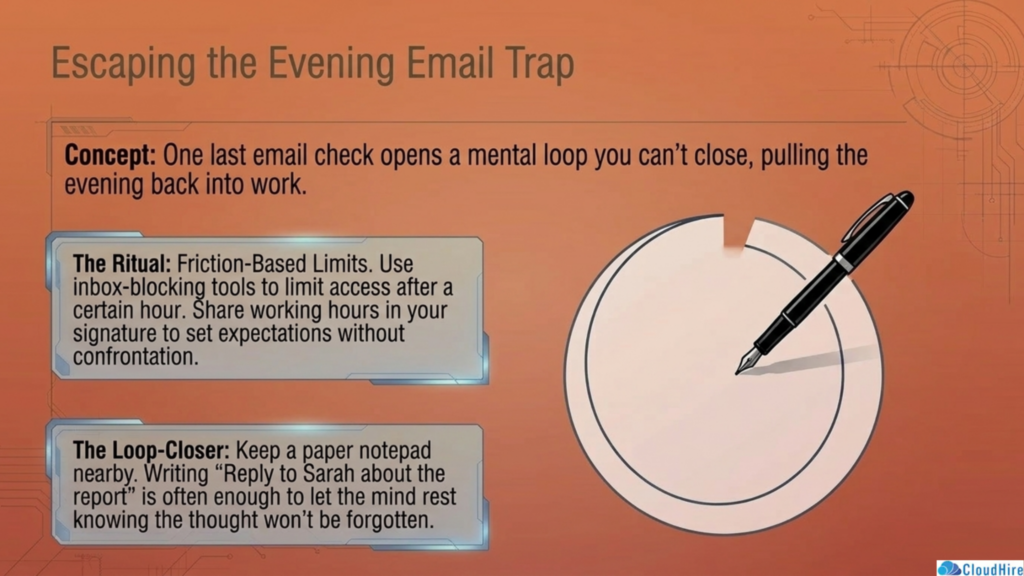
Creating friction helps. Inbox-blocking tools can limit access after a certain hour, even if it’s just for short windows at first. For thoughts that feel urgent, keep a paper notepad nearby. Writing “reply to Sarah about the report” is often enough to let the mind rest, knowing it won’t be forgotten.
Sharing your working hours in your email signature sets expectations without confrontation. Most teams adapt faster than we fear. Over time, evenings feel like evenings again, and Mondays arrive without the weight of a half-worked Sunday.
Boundaries feel uncomfortable at first. They quickly become relieved.
When Stretching Becomes a Secret Weapon
Sitting all day reshapes the body in quiet, unpleasant ways. Tight necks, aching hips, and low-grade fatigue become normal before we notice them.
Micro-movement breaks thirty seconds at a time, resetting more than posture. Simple actions like shoulder rolls, wrist circles, or gentle neck stretches improve circulation and mental clarity. A few desk-friendly stretches during the day and a longer wind-down sequence in the evening can noticeably improve sleep and creativity.
One designer mentioned that their best ideas started appearing after stretching sessions, not brainstorming meetings. The body loosens, and the mind follows.
Movement doesn’t need to be intense to be effective. It just needs to be consistent.
Creating a Clear “Done for Today” Signal
Unlike offices, homes don’t naturally signal the end of the workday. Without intention, work simply fades into the evening.
A visual or sensory ritual helps mark the transition. Wiping down the desk, lighting a candle, or changing clothes can be enough to tell the brain that the work chapter is closed. A short walk around the block or even down the street adds a physical boundary between roles.
Many people find it helpful to write down three wins from the day, no matter how small. This anchors progress and prevents the mind from replaying unfinished tasks at night.
Closure isn’t automatic at home. It has to be created.
Weekends That Actually Restore You
Remote work has a way of bleeding into weekends through “quick checks” that rarely stay quick. Creating distance starts with small systems, like charging phones in another room on Friday nights or limiting access to work apps entirely.
Loose plans work better than rigid schedules. A market visit, an afternoon with a book, or a guilt-free nap does more for recovery than packed itineraries. Sundays benefit from gentleness, too light preparation, not full productivity, which helps Monday arrive calmly instead of abruptly.
Rest isn’t laziness. It’s maintenance.
The Power of One Non-Negotiable Hobby
When work fills every open space, joy is often the first thing to disappear. Choosing one hobby and treating it as non-negotiable restores balance faster than trying to fix everything at once.
It doesn’t matter what it is, music, painting, gardening, knitting, as long as it’s scheduled before work claims the day. Even thirty minutes, done consistently, compounds into progress and pride. More than one person has noticed that protecting joy actually increases work output, not the other way around.
Hobbies remind us that work supports life. It isn’t life itself.
Reflections After Months of Remote Work
None of these rituals works on its own. Their power comes from accumulation. Over time, small, repeated actions transform overwhelm into rhythm. Kitchen tables feel usable again. Calls feel calmer. Evenings return to being personal.
Remote work tests our humanity precisely because it removes natural boundaries. Rituals put them back, gently and intentionally.
Try a few this week. Notice what shifts. Adjust without judgment. Sustainable days are built quietly and they’re what make long careers possible.
Frequently Asked Questions
1. Signs Your Work From Home Routine Is Hurting You
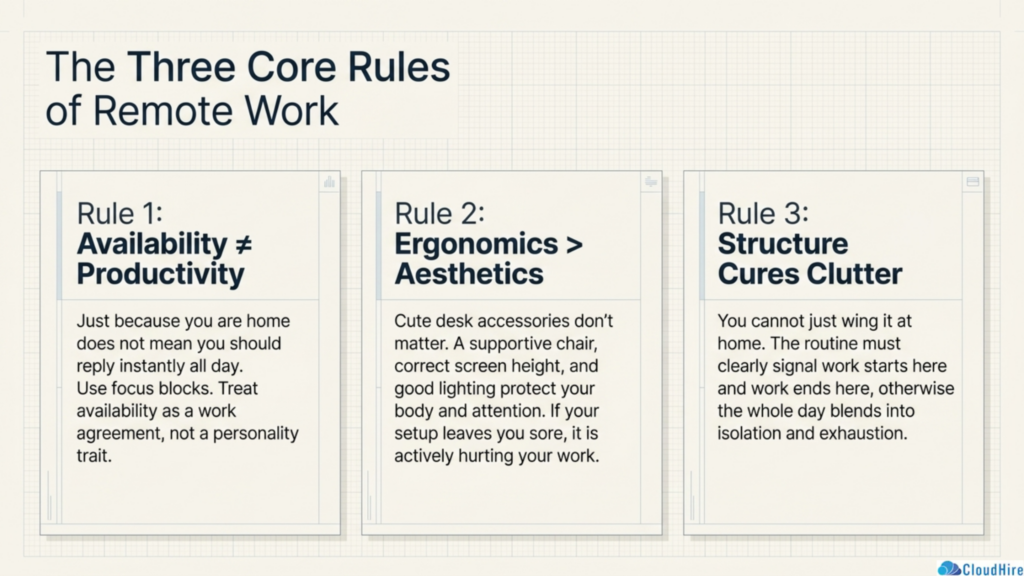
If your “flexible” routine is making you feel slower, more tired, and weirdly behind all the time, it is not helping you. The biggest signs are: you start work without a real start, you end work without a real stop, meals become random, and your body feels stiff by afternoon because you keep staying in the same position too long. A good remote routine should reduce mental clutter, not create it.
2. Common Work From Home Mistakes
The most common mistake is thinking you can just “wing it” at home and still stay sharp. That usually turns into working from the bed or sofa, checking messages all day, skipping real breaks, and never making it obvious when work is over. Another big mistake is confusing being available with being productive; remote work works better when you have focus blocks, break blocks, and clear end-of-day boundaries.
3. Best Daily Routine for Remote Workers
The best routine is not fancy. It is a repeatable one: wake up at the same time, get dressed, do something that marks the start of work, block focus time early in the day, take a real lunch break away from your desk, and finish work at a fixed time. People on remote work forums and wellbeing guides keep coming back to one thing: the routine has to signal “work starts here” and “work ends here,” or the whole day blends together.
4. Mental Health While Working From Home
Working from home can quietly mess with your mental health because the day has fewer natural boundaries and less human contact. That can lead to isolation, low mood, overworking, and the feeling that you are never fully off. What actually helps is not motivational advice; it is small, real habits like a proper lunch break, regular check-ins with people, stepping outside, and creating a shutdown ritual at the end of the workday so your brain can leave work behind.
5. Remote Work Doesn’t Mean You’re Always Available
This is one of the most important remote-work rules. Just because someone works from home does not mean they should reply all day instantly, skip lunch, or stay online after hours; that is not flexibility, that is boundary loss. The healthiest remote teams make response windows clear, use focus time on purpose, and treat availability as a work agreement, not a personality trait.
6. Home Office Essentials That Actually Matter
The essentials that matter most are not the cute desk accessories; they are the things that protect your body and your attention. A supportive chair, a desk or table at the right height, screen position that does not strain your neck, good lighting, and a setup that keeps you away from constant distractions will matter more than almost anything else. If your setup leaves you sore, tired, or distracted every day, it is hurting your work more than helping it.
A healthier work routine starts with the right workplace. CloudHire connects you with verified remote work opportunities, prepares you for interviews with AI practice, and helps recruiters discover your skills through your Cloud ID and verified certifications so you can build a career that works for your life.
Put your job search on autopilot
CloudHire Smart Apply tailors your resume and applies to matching roles for you — so you spend your time interviewing, not scrolling.