
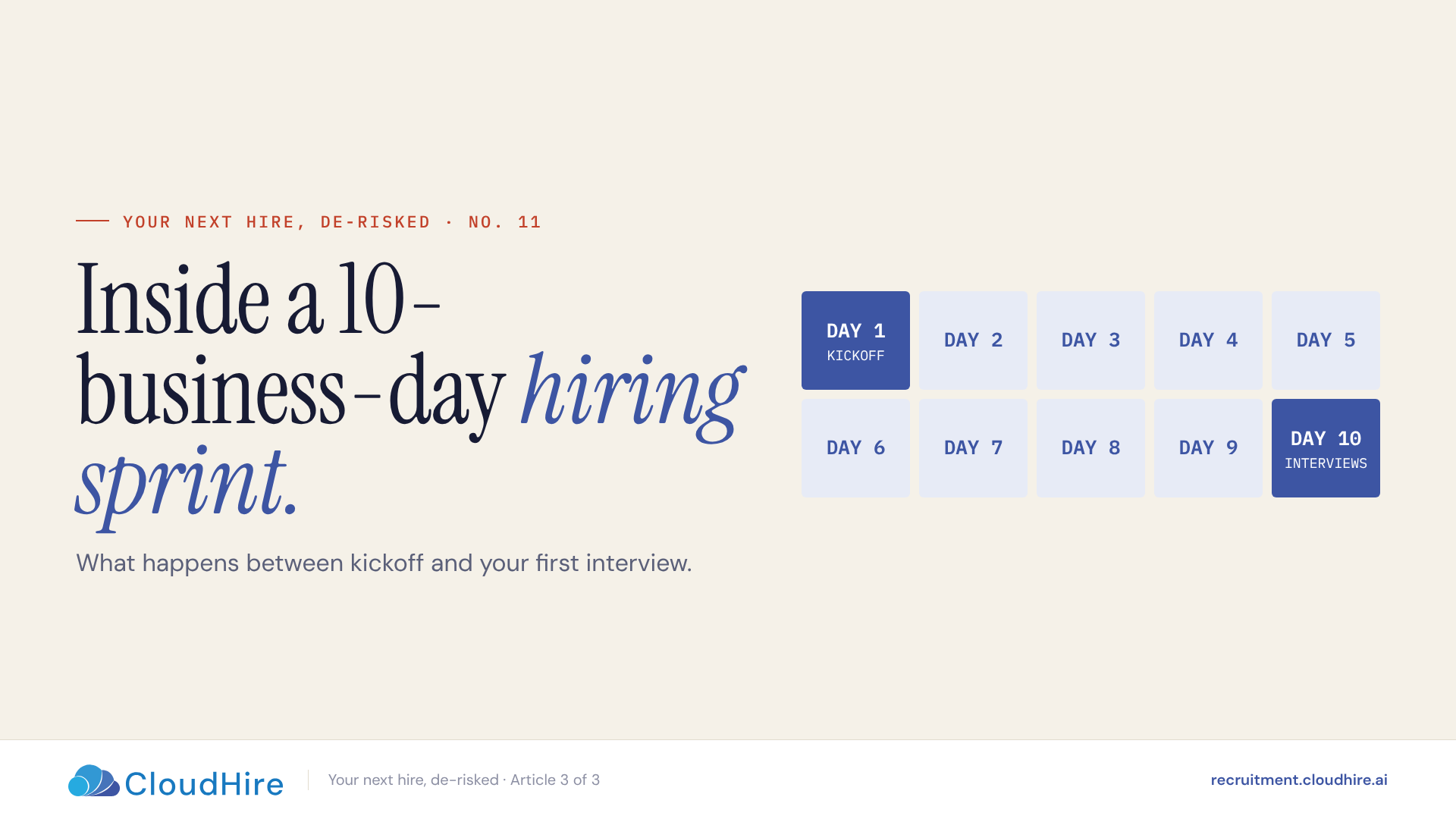
Inside a 10-Business-Day Hiring Sprint
On this page
By CloudHire Editorial · 21 November 2026 · 6-minute read
Quick answer: A 10-business-day hiring sprint goes from kick-off to scheduled interviews in four stages: a role intake with a dedicated recruiter, AI sourcing with identity and background verification, an AI interview for every candidate against your requirements, and a shortlist of 5 interview-ready candidates booked into your calendar. It works because AI does the high-volume screening and a human recruiter holds the bar. Your part is a one-hour kick-off and fast decisions on the shortlist.
Under a traditional agency, “how long until I see someone good?” rarely has a straight answer. Weeks is normal. Silence is common. And when resumes do arrive, the screening is still yours to do.
A sprint flips that. There’s a start date, a number and a deadline: 5 interview-ready candidates, with interviews scheduled within 10 business days of kickoff. Here’s what happens in between, and what it asks of you.
Stage 1: Kick-off and role intake
Day one is a working session with your dedicated recruiter. The goal is to turn a job description into a hiring bar a machine and a person can both apply.
- Must-haves versus nice-to-haves: What would make you reject a candidate on the spot?
- The interview bar: Which skills will the AI interview test, and what does a good answer sound like?
- Compensation band and location: A salary range and whether you are open to remote talent.
- Decision-makers and calendar: Who interviews, and which slots are open in week two.
Stage 2: AI sourcing and Cloud-ID verification
AI-powered sourcing searches for people who match the bar, not just the keywords. Every match then goes through Cloud-ID, which checks identity and background signals before anyone spends time on them. This step matters more every year: in a 2025 Gartner survey of 3,000 candidates, 6% admitted to interview fraud.
Every shortlist also includes 2 pre-vetted remote candidates from India, beyond the guaranteed 5, so you can compare local and remote talent side-by-side.
Stage 3: AI interviews against your bar
Every verified candidate completes an AI interview built around the requirements from stage 1. You get structured scores (for example, skill, communication and fit) and the evidence behind them, so you can see why someone made the cut. Your recruiter reviews the results and removes anyone who scores well on paper but isn’t right for the role.
Stage 4: Interviews on your calendar
By business day 10, 5 interview-ready candidates are booked into the slots you shared at kickoff. If we miss that, your next 30 days are free. You may hire more than one person from the same shortlist at no extra fee.
| Stage | Who does the work | What you get |
| 1. Kick-off and role intake | You and your dedicated recruiter (about 60min) | A written hiring bar |
| 2. AI sourcing and Cloud-ID | AI, checked by dedicated recruiter | Verified matches |
| 3. AI interviews | AI, reviewed by your recruiter | Scores and evidence for every candidate |
| 4. Interviews scheduled | Your recruiter | 5 interview-ready candidates in your calendar |
What does the sprint need from you?
The guarantee has one condition, and it’s a fair one: it applies when you review candidates and share decisions on time. A sprint moves at the speed of its slowest decision. Three habits keep it on track:
- Attend the kick-off with the decision-makers, not just the job description.
- Block interview slots in week two before the sprint starts.
- Give feedback within a day. A “no, because…” helps the recruiter tune the search as much as a “yes.”
Is 10 business days realistic?
It is, when screening isn’t a manual bottleneck. For CloudHire clients, it has often been faster:
A New York e-commerce brand had candidate options within 1–2 days and built a five-role team in one week.
An AI data company built a team of curators from India, with backgrounds at Amazon and Meta, and raised data accuracy from 87% to 95%.
What happens after the sprint?
Once the role is filled, the work doesn’t stop. While you’re subscribed, a 60-day replacement covers you if a hire leaves early, and a pipeline agent keeps sourcing and AI-interviewing matches for 90 days, so your next opening starts warm. Everything lives in your own CloudHire account.
What next?
Fast hiring isn’t about cutting corners. It’s about moving the slow, repetitive work to software and keeping human judgment where it counts. That’s how a hire goes from “we’ll get back to you” to a date in your calendar. Your next hire, de-risked.
Next step: walk through the sprint for your role. You leave the 30-minute call with a scoped hiring plan.
Frequently asked questions
How long does it take to hire through a recruiting agency?
It varies widely, and most traditional agency agreements don’t commit to a date. A managed recruiting sprint commits to interview-ready candidates, with interviews scheduled, within 10 business days of kick-off.
What is an AI interview in recruiting?
An AI interview is a structured first-round interview run by software against the requirements for the role. Every candidate answers the same questions and receives scores with supporting evidence, which a human recruiter then reviews.
How are candidates verified before interviews?
Through Cloud-ID, CloudHire checks identity and background signals for every candidate before they reach your shortlist.
What do I need to do during a 10-day hiring sprint?
Join a kick-off of about an hour, block interview slots for week two, and review candidates and share decisions on time. The guarantee applies when you do.
Sources
Hire faster with CloudHire
Search 700M+ profiles, run AI interviews and launch outreach on one platform — free to start, no demo call required.