
How Do Candidates Feel About Being Screened by AI?
On this page
TL;DR: Candidates generally accept AI hiring, but they want to understand how it affects their application. Trust breaks down when companies use AI resume screening without explaining the process, send generic rejection emails, or leave applicants waiting without updates. The article explains why people distrust invisible decisions, how human oversight, Explainable AI, and better communication improve the candidate experience, and what employers can do to build a hiring process that feels transparent and fair without giving up the efficiency of AI.
Your hiring team might be sold on AI screening. Your candidates are a different audience entirely, and their experience of the process shapes whether they accept an offer, refer a friend, or leave a public review calling your process cold and confusing. The real enemy here is the trust gap, the distance between what your AI tool is actually doing and what candidates believe is happening to their application once they hit submit. Let’s look at what candidates genuinely feel about AI candidate screening, why it matters more than most hiring teams realize, and practical ways to close that gap.
Trust Gap – Explained
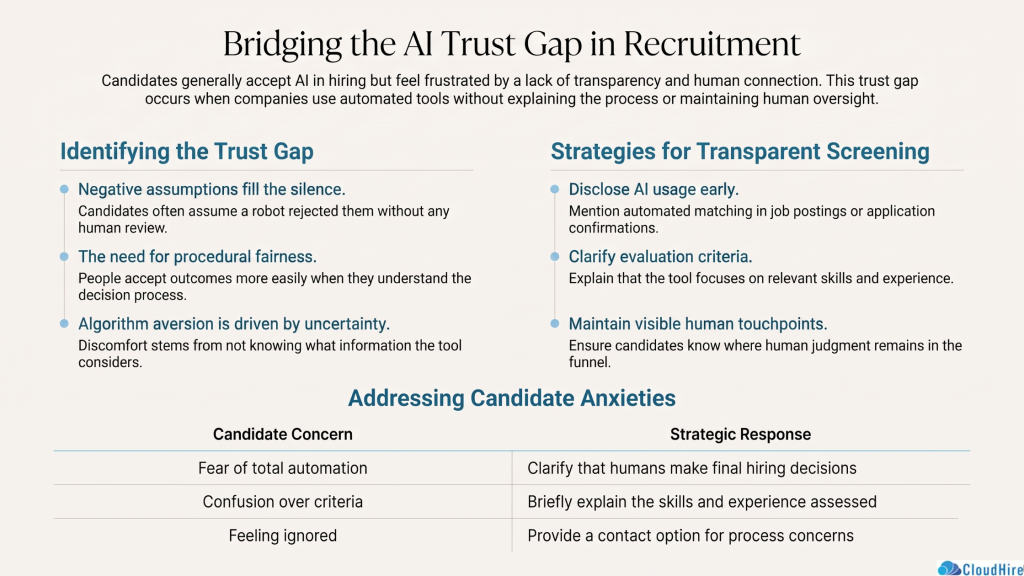
Most candidates have no idea how their resume is evaluated once it enters your system. When silence follows an application, people fill that gap with assumptions, usually negative ones. “A robot rejected me and nobody ever looked at my resume” is a common and understandable fear, even when the reality is more nuanced.
This gap grows wider when companies use AI screening quietly, without any mention of it in the application process. Candidates who later find out, often through news coverage or word of mouth, tend to feel misled, even if nothing unfair actually happened.
Why Candidates Distrust AI (And It Isn’t Really About AI)
Most candidates don’t distrust AI hiring because it’s artificial intelligence. They distrust decisions they can’t understand.
Researchers call this procedural fairness. People are more likely to accept an outcome, even an unsuccessful one, when they understand how the decision was made and believe the process was fair. The opposite happens when decisions feel invisible or impossible to question.
There’s also something known as algorithm aversion. People are often less comfortable trusting automated decisions than human ones, especially when they don’t know what information was considered or whether a person reviewed the outcome.
This is why hiring transparency, human oversight, and Explainable AI matter. Candidates don’t expect companies to remove technology from the recruitment process. They expect companies to explain how it’s being used and where human judgment still plays a role.
What Candidates Actually Report Feeling
Surveys and candidate feedback across industries point to a consistent pattern in candidate experience with AI:
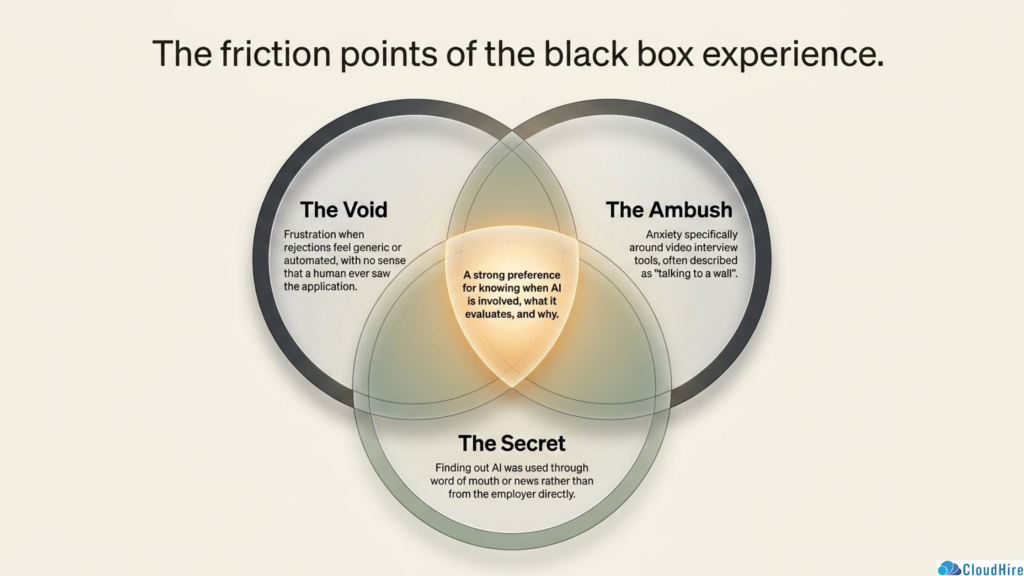
- A strong preference for knowing when AI is involved in any part of the process, even a brief mention
- Frustration when rejections feel generic or automated, with no sense that a human ever saw their application
- Anxiety around video interview tools specifically, more so than resume screening tools
- Higher trust when companies explain, even briefly, what the tool is evaluating and why
None of this means candidates reject AI screening outright. Most accept it as a normal part of modern hiring. What frustrates them is not the technology itself. It is the silence around it.
Candidates Don’t Actually Hate AI
The conversation is often framed as people versus technology, but that’s rarely the real issue.
Candidates usually accept AI recruitment as part of a modern hiring process. What creates frustration is everything surrounding it.
Most negative experiences come from:
- Long periods of silence after applying.
- Generic rejection emails that explain nothing.
- No indication whether a recruiter reviewed the application.
- No opportunity to ask questions or request clarification.
The problem isn’t AI resume screening itself. It’s uncertainty. When companies combine recruitment automation with clear communication and visible human oversight, candidates are far more likely to view the process as fair.
Why Transparency Changes the Experience
Transparency is not just a courtesy. It measurably changes how candidates perceive fairness. A short line in your job posting or application flow, something like “initial applications are reviewed using automated matching, with human review before any final decision,” does a lot of quiet work.
This single sentence addresses the core fear directly: that no human is involved at all. It also sets a realistic expectation, so a rejection does not feel like a mystery.
Common Candidate Concerns and How to Address Them
| Candidate concern | What actually helps |
| “A robot decided I’m not good enough” | Clarify that AI narrows the pool, humans make final decisions |
| “I don’t know what the AI is even looking at” | Briefly explain the criteria, skills and experience relevance, not vague scoring |
| “I got an instant rejection with no explanation” | Send a short, specific reason where possible, even a general one |
| “The video interview felt like talking to a wall” | Set clear expectations beforehand about format and what is assessed |
| “I have no way to ask a question or flag an issue” | Provide a simple contact option for technical or process concerns |
Addressing even two or three of these directly in your process removes a large share of candidate frustration, often without any change to your actual screening criteria.
Communication Checklist Before, During, and After Screening
A simple checklist keeps applicant communication transparency consistent across your hiring team.
- Mention AI involvement briefly in the job posting or application confirmation
- Explain, in one or two sentences, what the tool evaluates, skills and relevant experience, not personal characteristics
- Set expectations for response time so silence does not feel like rejection
- Offer a simple way to flag technical issues, especially for video interview tools
- Send a short, specific note on rejection where feasible, even a general reason beats none at all
Teams that follow even a version of this checklist consistently report fewer complaints and better employer review scores over time.
Why Employers Use AI Screening
Most hiring teams don’t adopt AI recruiting software to replace recruiters. They adopt it because hiring at scale is difficult.
A single role can receive hundreds or even thousands of applications. Reviewing every resume manually slows the recruitment process, delays hiring decisions, and creates inconsistent evaluations.
Used responsibly, Artificial Intelligence in Recruitment helps recruiters organize applications, identify relevant skills, reduce repetitive administrative work, and spend more time interviewing qualified candidates. The goal should never be replacing people. It should be helping recruiters make better and faster decisions with consistent human oversight.
How This Affects Your Employer Brand
Candidate experience does not stay contained to one application. People talk. Review sites, social media, and word of mouth carry stories about hiring processes far beyond the specific role in question. A cold, opaque AI screening experience can quietly damage your employer brand reputation, even if your actual hiring outcomes are fair and sound.
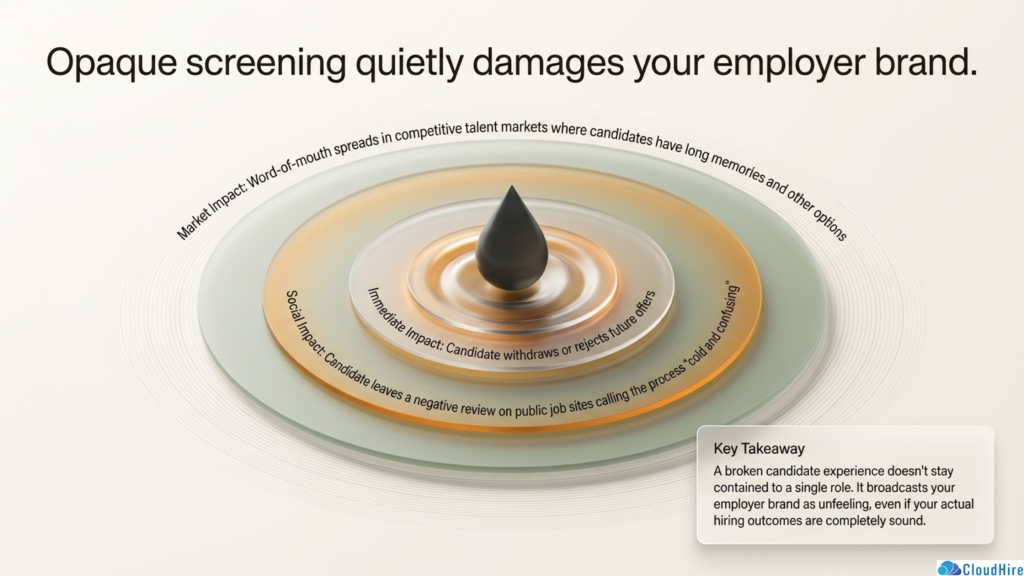
This matters even more for high-volume roles, where a large number of applicants experience your process directly, and even more so in competitive talent markets where candidates have other options and long memories.
A Pattern We’ve Seen
In our internal hiring conversations, we’ve noticed that candidates rarely complain about AI itself. Most questions come after long periods without communication or when rejection emails provide no context. The hiring teams that receive the most positive candidate feedback are usually the ones that explain the process early, set clear timelines, and make it obvious when a recruiter is involved.
Building an AI Screening Process Candidates Actually Trust
The goal is not to abandon AI screening. It is to design it in a way that respects the candidate on the other end. Some practical principles for ethical AI recruiting worth adopting:
- Be upfront that AI is part of the process, without over-explaining or sounding defensive
- Keep a visible human touchpoint somewhere in the funnel, even for high-volume roles
- Regularly ask candidates, through short surveys, how the process felt, and act on real patterns in the feedback
- Choose tools, like CloudHire, that are built with candidate-facing transparency in mind rather than treating candidates as an afterthought in the design process
Small changes here tend to matter more to candidates than the specific technology used behind the scenes.
Frequently Asked Questions
Do candidates dislike being screened by AI?
Not universally. Most candidates accept AI screening as a normal part of hiring today, but they respond negatively to a lack of transparency and generic, unexplained rejections rather than to the technology itself.
Should companies tell candidates that AI is used in hiring?
Yes, a brief mention in the job posting or application process is generally recommended. It sets realistic expectations and reduces the sense that decisions are happening invisibly.
What is the biggest candidate complaint about AI screening?
The most common complaint is a lack of clarity, not knowing whether a human ever reviewed the application, combined with generic rejection messages that offer no real feedback.
Can AI reject my resume automatically?
Some companies use AI resume screening to rank or filter applications, but many still include human oversight before making final hiring decisions. The exact process depends on the employer and the Applicant Tracking System they use.
Can recruiters override AI recommendations?
Yes, in most modern AI recruiting software, recruiters can review applications, override recommendations, and make the final hiring decision. AI is intended to support recruiters, not replace them.
Is AI hiring legal?
Yes, provided employers comply with local employment, privacy, and anti-discrimination laws. Many organizations are also adopting Responsible AI and Ethical AI practices to improve transparency, fairness, and accountability.
The Real Takeaway
The trust gap between what your AI tool does and what candidates believe it does is a fixable problem, not an inherent flaw in AI screening itself. A few sentences of honest communication, paired with a visible human touchpoint, closes most of that gap and protects both your candidate experience and your employer brand.
Want a screening process candidates actually trust?
See how CloudHire builds transparency into every stage of the hiring funnel.
Hire faster with CloudHire
Search 700M+ profiles, run AI interviews and launch outreach on one platform — free to start, no demo call required.