
How to Research Company Culture Before Applying (Beyond the Careers Page)
On this page
Every company says its culture is collaborative, innovative, and people-first. Almost none of that tells you anything real. If you want to know what it is actually like to work somewhere, you need to look past the marketing copy and dig into the details that companies do not write on their careers page.
We reviewed the signals candidates can realistically verify before applying, from employee-review patterns and LinkedIn tenure to hiring-process behavior and interview responses. So this guide walks through practical ways to do company culture research before you apply, so you can walk into interviews with real questions instead of guesses.
The 5-Signal Company Culture Check
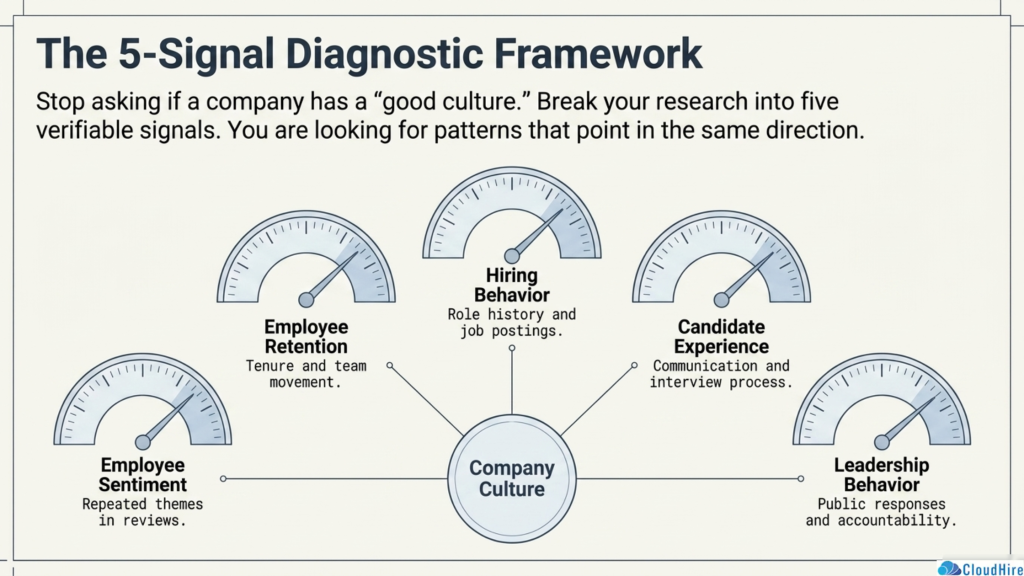
Instead of asking whether a company has a “good culture,” break your research into five signals you can actually check:
- Employee sentiment
- Leadership behavior
- Hiring behavior
- Employee retention
- Candidate experience
These give you a better picture than a careers page alone.
How we built this checklist
We reviewed the signals candidates can realistically verify before applying, from employee-review patterns and LinkedIn tenure to hiring-process behavior and interview responses.
Based on conversations with candidates and hiring teams, these are the signals we recommend checking before deciding whether to pursue a role.
The goal is not to prove that a company is good or bad. It is to look for patterns across different sources and decide what needs more investigation.
| Signal | What to check | Potential red flag | Strong signal |
| Employee sentiment | Repeated themes in employee reviews | Same complaint across multiple recent reviews | Consistent positive patterns |
| Employee retention | LinkedIn employment dates | Many employees leave after short periods | Long tenure across teams |
| Hiring behavior | Role history and job postings | Same role repeatedly advertised | Clear growth or new positions |
| Candidate experience | Communication and interview process | Rescheduling, vague answers, poor communication | Clear process and expectations |
| Leadership behavior | Public communication and responses to problems | Blame-heavy or defensive communication | Specific accountability and clear communication |
No single signal tells you the whole story. What matters is when several signals point in the same direction.
Why Culture Research Actually Matters
Skills and salary get most of the attention in job hunting, but workplace culture fit is often the reason people leave a job within the first year. A role that looks perfect on paper can be a poor fit if the pace, communication style, or management approach clashes with how you work best.
Doing this research early is not about being suspicious of every company. It is about informed decision making before you invest months of your career somewhere.
Where to Find Real Information
| Source | What to check | What it can tell you |
| Employee review sites | Repeated themes in recent reviews | Management, workload, pay, growth and work-life balance |
| LinkedIn employees | Tenure, team movement and leadership | Retention, hiring patterns and team structure |
| Company social media | How leaders and employees communicate | Values, personality and leadership behavior |
| Google and news coverage | Layoffs, funding, acquisitions and leadership changes | Business stability and recent changes |
| Current or former employees | Specific experiences and examples | Day-to-day reality that public sources may miss |
| Job postings | Responsibilities, requirements and wording | Expectations, workload and possible culture signals |
| Interview process | Communication, timelines and consistency | Candidate experience and how the company operates |
No single source tells the whole story. Employee review site analysis works best when you look for repeated patterns across many reviews, not one angry post or one glowing testimonial.
Reading Between the Lines of Employee Reviews
When you check review sites, do not just read the star rating. Look for specific, repeated themes.
Look specifically for:
Management
- micromanagement
- unclear ownership
- manager turnover
- poor communication
Workload
- recurring overtime
- weekend expectations
- unrealistic deadlines
- understaffing
Career growth
- unclear promotion criteria
- limited internal mobility
- stagnant roles
- favoritism
Compensation
- salary competitiveness
- delayed raises
- bonus issues
- pay transparency
Leadership
- frequent strategic changes
- layoffs
- leadership turnover
- communication during difficult periods
One negative review does not prove that a company has a bad culture. Ten recent reviews describing the same problem are much harder to ignore.
Look at how recent the reviews are, which teams they come from, and whether the same issue appears across different periods.
That is what makes employee review site analysis useful. You are looking for patterns, not trying to find one perfect review.
Are Glassdoor Reviews Reliable?
They can be useful, but they should not be treated as a perfect measurement of company culture.
Positive reviews can be biased. Negative reviews can be biased. Companies change. Teams differ. Managers leave. A review written three years ago may describe a very different company from the one you would join today.
Instead of asking:
“Is the company rated 4.2?”
Ask:
“What complaints repeatedly appear across different years, teams, and job functions?”
It also helps to separate what you find into different types of signals:
- Isolated complaint – One person reports an issue
- Recurring complaint – The same issue appears repeatedly
- Recent complaint – The issue appears in newer reviews
- Historical complaint – The issue was common in older reviews
- Department-specific complaint – The issue appears mainly in one team
- Company-wide complaint – The same issue appears across different teams
The goal is not to find a company with zero negative reviews. That company probably does not exist.
The goal is to find out whether the same problems keep appearing and whether you can confirm them through other sources.
Research Employee Retention on LinkedIn
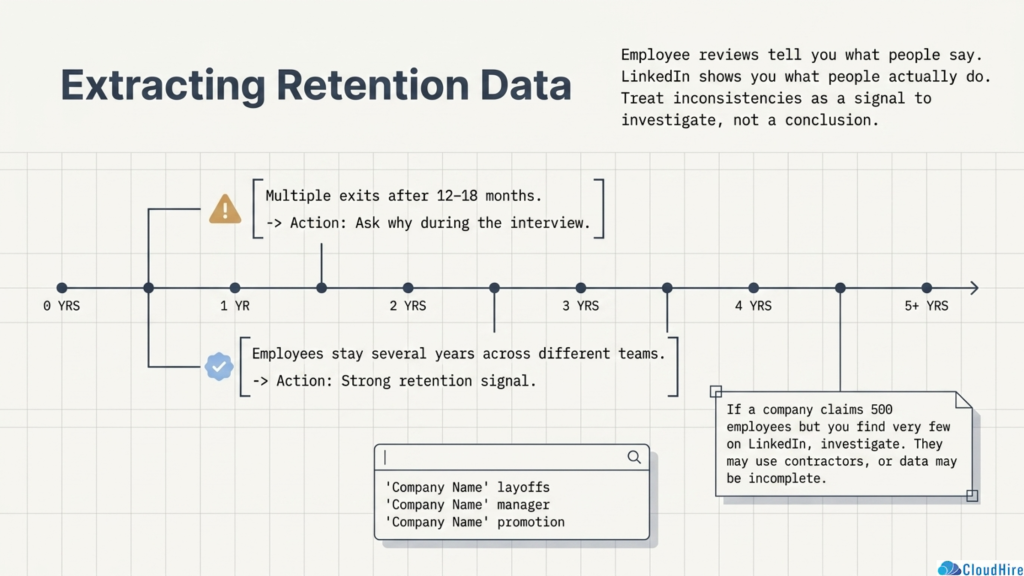
Employee reviews tell you what people say. LinkedIn can show you what people actually do.
Look at current and former employees and pay attention to how long they stayed at the company.
You are not looking for one person who left after six months. You are looking for a pattern.
If many employees leave after 12–18 months, it is worth asking why. If people stay for several years across different teams, that can be a stronger retention signal.
It is not proof either way. People leave jobs for many reasons, and LinkedIn information is not always complete.
You can also use Google to search for information that may not appear on the company’s own website.
Try searches like:
“Company Name” layoffs
“Company Name” promotion
“Company Name” manager
“Company Name” employees
“Company Name” Glassdoor
You can also check whether the company’s claimed employee size seems reasonably consistent with the employees you can actually identify on LinkedIn.
For example, if a company says it has 200–500 employees but you can find very few identifiable employees, that is not automatically proof that something is wrong. Employees may not have LinkedIn profiles, the company may use contractors, or its public information may simply be incomplete.
Treat it as a signal to investigate, not a conclusion.
This kind of company research is about finding questions, not making accusations.
Questions to Ask During the Interview
Interviews are not just for the employer to evaluate you. They are your chance to do interview due diligence. A few useful questions:
- What does a typical week look like for someone in this role?
- Can you tell me about a time the team disagreed on something, and how it was handled?
- What does growth or promotion usually look like here?
- Why is this position open, is it new or a replacement?
- How would you describe the management style on this team?
Watch not just the answers, but how comfortable the interviewer seems answering them. Hesitation or vague responses to direct questions are worth noting.
Culture Signals You Can Spot Before You Even Apply
Some signals show up before you have spoken to anyone at the company. This is useful pre-interview research you can do from your desk.
- How the job posting is written (see our earlier post on job posting red flags for more detail here)
- How quickly and clearly the company responds to your application
- Whether the interview process is respectful of your time, with clear steps and timelines
- Employee tenure patterns on LinkedIn, meaning do people tend to stay two years or two months
None of these alone confirm a culture fit or mismatch. Together, they build a reasonably accurate picture, which is the whole point of company culture due diligence.
A 30-Minute Company Culture Research Workflow
Based on conversations with candidates and hiring teams, these are the signals we recommend checking before deciding whether to pursue a role.
You do not need to spend hours researching every company before you apply.
Start with a simple process:
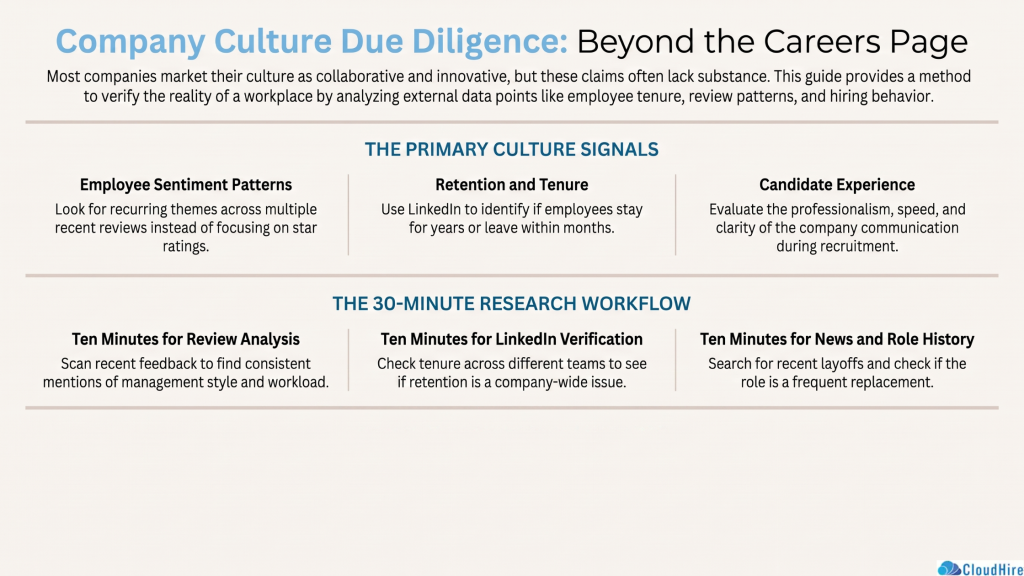
10 minutes → Employee reviews
Look for recent complaints and repeated themes.
10 minutes → LinkedIn
Check employee tenure, leadership, team movement and hiring patterns.
5 minutes → News
Search for layoffs, funding, acquisitions, leadership changes and other recent events.
5 minutes → Job history
Look at the role itself. Has the same position appeared repeatedly? Does the current opening look like growth, expansion or a replacement?
Interview → Validate what you found
If reviews repeatedly mention poor management, ask how the manager gives feedback.
If the same role has appeared several times, ask why the position is open.
If employees appear to leave quickly, ask about typical tenure on the team.
The point is not to make a decision based only on online research. Use your research to find the questions you should ask during the interview.
A Simple Culture Fit Checklist
The 5-Signal Culture Audit
Once you have done your research, score each signal from 1 to 5.
| Signal | Score |
| Employee sentiment | /5 |
| Leadership behavior | /5 |
| Hiring behavior | /5 |
| Employee retention | /5 |
| Candidate experience | /5 |
| Total | /25 |
Use the score as a decision aid, not a scientific measurement.
20–25: Strong evidence
The signals you found are generally consistent, with few unexplained concerns.
15–19: Investigate further
There are some positive signals, but you still have unanswered questions. Use the interview or conversations with employees to validate them.
Under 15: Significant uncertainty
You have several concerns or inconsistent signals. That does not automatically mean you should reject the company, but you should investigate before making a serious commitment.
The most important part is not the number.
It is why you gave each signal its score.
A company with a high employee-review score but poor candidate experience should not automatically get a pass. A company with a few negative reviews but strong retention, transparent leadership and a good interview process may deserve a closer look.
The value of the audit is seeing the whole picture.
People Also Ask
How can I research a company before applying?
The best way to research a company’s culture before applying is to compare several independent signals: recent employee reviews, employee tenure on LinkedIn, public communication from leaders, recent news, job-posting language, and the company’s hiring process. Look for repeated patterns rather than relying on a single review or rating.
How do I tell if a company has a toxic work culture?
Look for repeated evidence of excessive workload, poor management, unclear expectations, high employee turnover, weak communication or recurring complaints across different sources. One negative review is not enough to establish a pattern.
How reliable are Glassdoor reviews?
Glassdoor reviews can help you identify patterns, but individual reviews can be biased or outdated. Compare recent reviews across different teams and time periods, and look for recurring complaints rather than relying on the company’s overall rating.
How do I research a manager before accepting a job?
Look at the manager’s LinkedIn profile, career history, tenure and public communication when that information is available. During the interview, ask how they give feedback, handle disagreement and measure performance.
What are red flags in a job description?
Potential red flags include vague responsibilities, unrealistic combinations of skills, repeated references to working under pressure or outside normal hours, and unclear expectations. These phrases are not automatically negative, but several warning signs together deserve follow-up questions.
How do I know if a job is a replacement hire?
Ask directly why the position is open and what happened to the previous person. A replacement may result from a resignation, promotion, transfer, termination or restructuring. The reason itself does not determine whether the role is good or bad. The context does.
How can I research company culture without knowing anyone there?
Use several public sources, including employee reviews, LinkedIn profiles and tenure, company news, leadership communication, job postings and the interview process itself. You can build a useful picture without having a personal connection inside the company.
What should I ask in an interview to assess company culture?
Ask questions that require specific examples, such as how the team handles disagreement, what happens when someone makes a mistake, why the role is open, how performance is measured and what a typical week looks like. Specific answers are usually more useful than general descriptions of company values.
How can I tell if a company’s culture is changing?
Compare recent employee reviews with older reviews, look for changes in leadership and employee tenure, and check recent company news for acquisitions, layoffs, rapid hiring or restructuring. Major changes in leadership or business direction can change the experience of working there.
Can LinkedIn reveal company culture?
LinkedIn cannot tell you a company’s culture directly, but it can provide useful signals about employee tenure, hiring patterns, leadership changes, team structure and employee movement. Use those signals alongside reviews, news and interview behavior rather than treating LinkedIn alone as proof.
Final Thought
Every company will tell you their culture is great. Your job is to verify that with sources they do not control. A little bit of due diligence before applying protects your time, your energy, and often your next year of career growth.
CloudHire connects you with verified employers and gives you visibility into roles that are transparent about the work, the team, and the expectations from the start. That means less guesswork on culture fit before you even apply.
Want roles that are upfront from day one? Check out verified opportunities on CloudHire and apply with more confidence.
Put your job search on autopilot
CloudHire Smart Apply tailors your resume and applies to matching roles for you — so you spend your time interviewing, not scrolling.