
HR for Non-HR Managers: What You Can Handle, Document & When to Escalate
On this page
Before We Wrote This Guide
I sat down with our HR Director and asked a simple question: What do managers actually get wrong when they have to deal with HR issues without being HR professionals?
The conversation was more honest than I expected.
We talked about the situations managers tend to underestimate, the things they try to handle themselves when they should have involved HR, the documentation that gets written too late, and the promises managers make with the best intentions but without realizing they may not be theirs to make.
This guide came directly from that conversation.
It isn’t meant to turn managers into HR professionals or give them a crash course in employment law. It’s meant to answer the practical questions managers actually face: What can I handle myself? What should I document? When do I need to stop and involve HR?
The framework you’ll see throughout this guide Handle → Document → Escalate came from that discussion. It is a simple way to think about the line between managing your team and taking on an HR issue you shouldn’t be handling alone.
Key Takeaways
- Most day-to-day people issues coaching, scheduling, minor conflict sit squarely in a manager’s job description and don’t need HR involvement.
- Anything touching harassment, discrimination, retaliation, accommodation, protected leave, safety, or termination should go to HR immediately, regardless of how minor it seems.
- Documentation isn’t optional. If a conversation could matter in six months, it needs to be written down the same day, in facts, not opinions.
- The biggest legal risks for companies don’t come from HR; they come from well-meaning managers who promised something, said something, or ignored something they shouldn’t have.
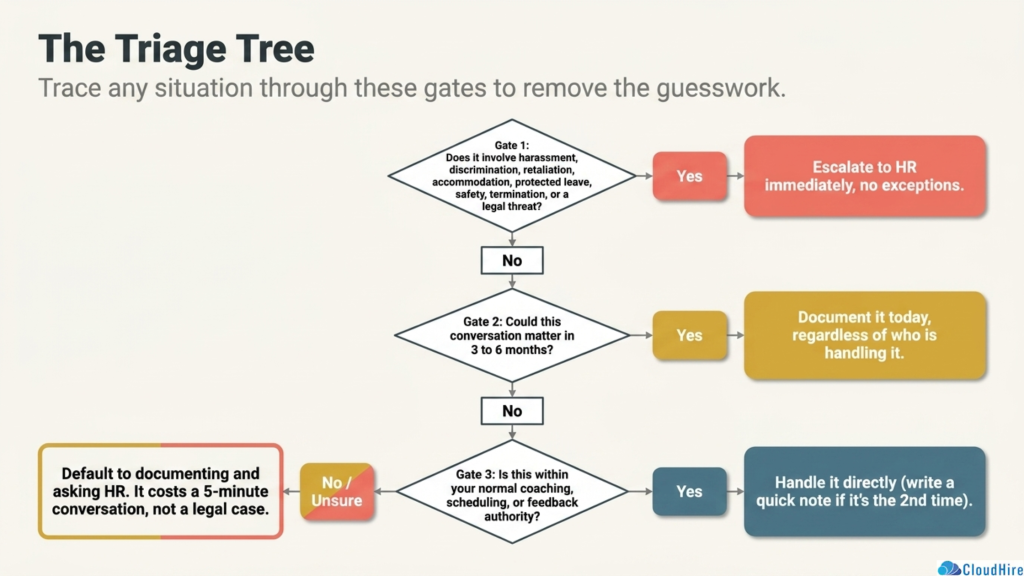
- A short decision tree (below) removes the guesswork: when in doubt, the answer is almost always “document and ask.”
Most people who become managers didn’t sign up to be part-time HR practitioners. You were promoted because you were good at the job, good with people, or good at getting results, not because you’d studied labor law or knew the difference between an accommodation request and a performance conversation. And yet, the moment you have direct reports, HR questions start landing on your desk anyway: an employee wants three months off, a teammate complains about another teammate, someone’s performance has quietly slipped for two quarters running.
The gap between “manage people” and “manage HR risk” is where most first-time and mid-level managers get stuck. They either handle everything themselves and accidentally create legal exposure, or they escalate everything to HR and lose the trust of their team. Neither extreme works.
What Is HR for Non-HR Managers?
“HR for non-HR managers” is shorthand for the working knowledge a manager needs to handle people issues responsibly without being an HR professional themselves. It’s not a certification and it’s not a substitute for an actual HR function; it’s the practical layer of judgment that sits between “I’m a manager” and “I know when to call HR.”
In practice, this covers four things: recognizing which situations are safe to handle directly, knowing how to document what happens so there’s a clean record, understanding which categories of issues carry legal or compliance risk, and knowing exactly who to escalate to and how fast. Companies that train managers on this consistently see fewer escalations that arrive too late, fewer inconsistent decisions across teams, and fewer situations where a manager’s good intentions created a legal problem nobody wanted.
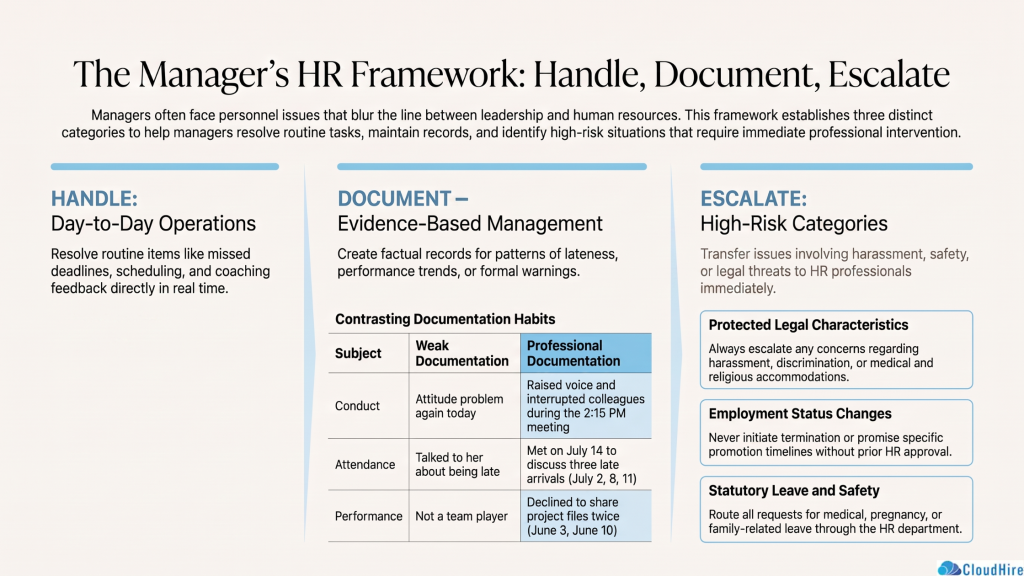
The Manager HR Rule: Handle → Document → Escalate
Every people issue a manager runs into falls into one of three buckets. The skill isn’t memorizing every HR policy; it’s getting fast and accurate at sorting an issue into the right bucket.
Handle
These are situations within a manager’s normal authority: missed deadlines, a dip in quality, scheduling conflicts, day-to-day friction between teammates, routine feedback. A manager handles these directly, in real time, without needing sign-off.
Document
Anything that could resurface later a formal warning, a pattern of lateness, a performance conversation, a leave request needs a written record, even if the manager is handling it themselves. Documentation is what turns “I remember telling them” into something that actually holds up.
Escalate
Certain categories are never a manager’s call to make alone: harassment, discrimination, retaliation, accommodation requests, protected leave, safety concerns, termination, and anything that sounds like a legal threat. These go to HR the same day, not after the manager has “tried to handle it first.”
The rule of thumb: if you’re unsure which bucket something belongs in, treat it as Document → Escalate. Under-escalating is far more costly than over-escalating.
What HR Responsibilities Do Managers Have?
Managers touch almost every stage of the employee lifecycle, even without an HR title. Here’s where their responsibility actually sits.
| Area | What the manager typically owns | What HR typically owns |
| Hiring | Interviewing, assessing fit, final hire decision | Job posting compliance, offer letters, background checks |
| Onboarding | Setting expectations, day-to-day ramp-up | Paperwork, benefits enrollment, policy walkthroughs |
| Performance | Ongoing feedback, coaching, goal-setting | PIP process design, calibration, compensation guardrails |
| Leave | Approving routine time off, coverage planning | Statutory leave eligibility, protected leave tracking |
| Conflict | Day-to-day mediation between team members | Formal grievance processes, investigations |
| Conduct | Setting behavioral expectations | Policy violations, disciplinary escalation |
| Documentation | Writing down what happened, when | Maintaining the official employee file |
| Offboarding | Managing the transition, knowledge handoff | Exit process, final pay, compliance sign-off |
Hiring
A manager’s job in hiring is judgment: evaluating skills, fit, and potential. What managers shouldn’t do without guidance is ask questions that touch protected characteristics, make informal promises about pay or promotion timelines, or move a candidate through the process outside the agreed structure.
Onboarding
Managers set the tone in the first weeks: clear expectations, early feedback, access to the right people. The paperwork and compliance side tax forms, benefits, policy acknowledgments sits with HR, and a manager shouldn’t need to chase it.
Performance
This is where managers spend most of their people-management time, and it’s covered in detail further down. The short version: performance issues are almost always a manager’s to handle, as long as they’re documented properly.
Leave
Routine, planned time off is a scheduling conversation. Leave tied to a medical condition, pregnancy, a death in the family, or anything that could qualify as protected leave is not something that needs HR eyes before anything is approved or denied.
Conflict
Everyday friction a disagreement over process, a personality clash, competing priorities is normal team management. Conflict that involves a power imbalance, repeated behavior, or anything that could be read as harassment stops being a “team dynamics” issue.
Conduct
Managers set and reinforce standards of behavior day to day. Formal conduct violations, policy breaches, safety issues, anything that could lead to discipline, need HR involved before action is taken.
Documentation
Covered in full below, but worth repeating here: documentation is a manager responsibility whether or not HR is involved yet. It’s the single most protective habit a manager can build.
Offboarding
Managers handle the human side of an exit: the transition plan, the conversation with the team, knowledge transfer. The mechanics of the exit itself, including anything that touches final pay or legal risk, should never be improvised by a manager alone.
When Should a Manager Involve HR?
Some categories carry enough legal and reputational risk that they should never be handled solo, no matter how confident or well-intentioned the manager is.
Harassment
Any complaint or observation involving harassment, sexual or otherwise, goes to HR immediately. Managers shouldn’t investigate, mediate, or attempt to resolve it themselves, even informally.
Discrimination
Anything involving a protected characteristic age, gender, religion, disability, and similar categories needs to be escalated the moment it surfaces, whether it’s a complaint, an offhand comment, or a pattern the manager has noticed.
Retaliation
If an employee raises a concern and something changes for them afterward a shift in assignments, tone, or opportunities that needs HR review, even if the manager is confident the two things are unrelated.
Accommodation
Any request tied to a disability, medical condition, religious practice, or similar needs goes to HR before a manager agrees to or declines anything.
Protected Leave
Leave connected to a serious health condition, a new child, or similar statutory categories needs to be routed through HR to confirm eligibility and rights before a manager makes any commitment.
Safety
Physical safety concerns, threats, or anything that could put an employee at risk should be escalated immediately and treated as urgent.
Termination
No manager should tell an employee they’re being let go, or take steps toward it, without HR involved in the process from the start.
Legal Threats
If an employee mentions a lawyer, a complaint to a labor authority, or anything that sounds like a legal threat, that conversation gets reported to HR the same day, worded as closely to verbatim as possible.
How Should Managers Document Employee Issues?
Good documentation isn’t about writing more; it’s about writing the right things, in a format that holds up months later when memory has faded.
Facts
What happened, when, and where described in observable, neutral terms. Not “she was being difficult,” but “she raised her voice and left the meeting before it ended.”
Action
What the manager did in response: A conversation, a verbal warning, a coaching note recorded the same day it happened.
Employee Response
What the employee said in response, in their own words where possible. This protects both sides and shows the record isn’t one-sided.
Next Steps
What happens next, by when, and who’s responsible for following up.
Bad vs Good Documentation
| Bad documentation | Good documentation |
| “Attitude problem again today.” | “At 2:15pm during the team standup, Raj interrupted two colleagues and raised his voice when asked to wait his turn.” |
| “Talked to her about being late.” | “Met with Priya on July 14 to discuss three late arrivals this month (July 2, 8, 11). She said her commute changed; agreed to a revised start time and a check-in in two weeks.” |
| “Not a team player.” | “Declined to share project files with the team twice (June 3, June 10) despite two direct requests.” |
How Should Managers Handle Performance Problems?
Performance issues follow a five-step sequence that keeps the process fair, consistent, and defensible.
Expectation → Evidence → Conversation → Support → Follow-up
Start by confirming the expectation was actually clear and communicated. Wague expectations are the root cause of most performance disputes. Gather specific evidence: Dates, examples, outcomes, not impressions. Have the conversation privately, focused on facts rather than character. Offer concrete support training, resources, adjusted workload rather than just naming the problem. Then follow up on a set timeline to check whether things have actually improved, and document each step along the way.
How Should Managers Handle Employee Conflict?
Most conflict between employees is normal and doesn’t need HR it needs a manager willing to have the conversation early instead of letting it fester. The approach that tends to work: talk to each person separately first to understand their side, then bring them together only once you understand what’s actually driving the disagreement. Focus on the specific behavior or friction point, not personalities. Agree on what changes going forward, and follow up within a couple of weeks to confirm it stuck.
The moment conflict involves repeated behavior toward one person, a power imbalance, or language that could be read as harassment or discrimination, it stops being a team-dynamics issue and needs HR.
How Should Managers Handle Leave Requests?
For routine, planned leave, vacation, personal days, a manager can approve based on coverage and timing without involving HR. The moment a leave request is connected to a medical condition, a birth or adoption, a family emergency, or anything that sounds like it could be protected leave, the right move is to pause, thank the employee for letting you know, and loop in HR before confirming anything. Managers shouldn’t ask for medical details themselves; that’s specifically HR’s role, both for compliance and for the employee’s privacy.
What Should Managers Never Promise Employees?
Well-meaning managers create some of the biggest HR headaches by promising things they don’t have the authority or full information to guarantee.
- A specific promotion timeline
- Guaranteed job security during a reorg or downturn
- A specific salary increase or bonus amount
- Approval of a leave request before HR confirms eligibility
- Confidentiality on a complaint that legally needs to be escalated
- A permanent remote or hybrid arrangement outside policy
- That a complaint “won’t go anywhere” or “stays between us”
- Termination or firing decisions before HR sign-off
- Special treatment that isn’t applied consistently across the team
- That a probation or PIP outcome is already decided
How Can Managers Hire Without HR Training?
Hiring well doesn’t require an HR background it requires a structure that removes guesswork and keeps decisions defensible.
Structured hiring framework
A simple structure covers most of what a non-HR manager needs: a written scorecard of the skills and traits the role actually requires, the same core questions asked of every candidate, notes taken during the interview rather than reconstructed afterward, and a decision based on evidence against the scorecard rather than gut feel alone. This is also where a structured hiring platform earns its keep. When interview notes, scorecards, and candidate evaluations live in one place instead of scattered inboxes, it’s far easier for a manager to explain why a decision was made, and far harder for bias to creep in unnoticed.
What Should Managers Do Before Terminating an Employee?
Termination should never be a manager’s solo decision, but managers play a real role in getting the groundwork right before it happens. That means a documented history of the performance or conduct issue, evidence that expectations were communicated clearly, a record of support offered along the way, and confirmation from HR that the process followed is consistent with how similar situations have been handled elsewhere in the company. Skipping any of these steps is what turns a routine termination into a legal exposure.
The Non-HR Manager Decision Tree
A quick way to sort any situation in the moment:
- Does it involve harassment, discrimination, retaliation, accommodation, protected leave, safety, termination, or a legal threat? → Escalate to HR immediately, no exceptions.
- Could this conversation matter in three to six months? → Document it today, regardless of who’s handling it.
- Is this within your normal coaching, scheduling, or feedback authority? → Handle it directly, and still write a quick note if it’s the second time it’s come up.
- Are you unsure which category it falls into? → Default to documenting and asking HR it costs a five-minute conversation, not a legal case.
The One-Page HR Cheat Sheet
| Situation | Manager can handle | Document | Escalate to HR |
| Missed a deadline | Yes | If repeated | No |
| Complaint about harassment | No | Yes | Immediately |
| Requesting medical leave | No | Yes | Immediately |
| Personality clash on the team | Yes | If ongoing | If it escalates |
| Repeated lateness | Yes | Yes | If it continues |
| Disability accommodation request | No | Yes | Immediately |
| Wants to discuss a raise | Yes (conversation) | Yes | No, unless a promise is needed |
| Mentions a lawyer or legal complaint | No | Yes, verbatim | Immediately |
| Underperformance over a quarter | Yes | Yes | If it leads to a PIP |
| Safety concern | No | Yes | Immediately |
Common Mistakes
Managers most often go wrong in a handful of predictable ways: trying to “handle it themselves” on issues that legally required HR from the start, promising outcomes they don’t control, documenting nothing until a problem has already escalated, treating every minor disagreement as a formal conflict that needs mediation, and waiting too long to escalate because they didn’t want to seem like they couldn’t manage their own team. Nearly all of these come from uncertainty about which bucket a situation belongs in, which is exactly what the Handle → Document → Escalate model is designed to fix.
HR Terms Every Manager Should Know
- PIP (Performance Improvement Plan): A formal, time-bound plan addressing a specific performance gap, typically designed with HR.
- Protected characteristic: A trait such as age, gender, religion, or disability that employment law protects against discrimination.
- Reasonable accommodation: A change to a role or workplace that allows an employee with a disability or condition to perform their job.
- Retaliation: Any negative action taken against an employee because they raised a concern or participated in an investigation.
- At-will employment: An employment arrangement where either party can end the relationship at any time, subject to legal exceptions.
- Constructive dismissal: A situation where working conditions become so difficult that an employee is effectively forced to resign.
- Progressive discipline: A step-by-step disciplinary process, moving from informal feedback to formal warnings before termination.
Frequently Asked Questions
Can a manager fire someone without HR?
No, even when a manager has full authority over their team, termination should always go through HR first to confirm the process is documented, consistent, and legally sound.
What should a manager do if an employee complains about harassment?
Listen without judgment, thank them for coming forward, and escalate to HR the same day. A manager shouldn’t investigate or try to resolve it directly.
Does a manager need to document every conversation with an employee?
No, routine feedback doesn’t need a paper trail. Anything tied to performance, conduct, attendance, or a formal conversation should be documented the same day.
What’s the difference between coaching and a formal warning?
Coaching is informal, forward-looking feedback meant to help someone improve. A formal warning is a documented step in a disciplinary process, usually created with HR involvement.
Should a manager approve leave requests on their own?
Routine, planned leave, yes. Leave connected to a medical condition, a new child, or a family emergency should be routed through HR first.
What happens if a manager promises something HR can’t back?
It creates a gap between what the employee expects and what the company can deliver often the root cause of disputes and formal complaints down the line.
If your managers are making hiring decisions, give them a process they don’t have to reinvent for every candidate. CloudHire provides structured hiring workflows that help teams screen candidates, run consistent evaluations, and keep interview and hiring decisions organized in one place.
Hire faster with CloudHire
Search 700M+ profiles, run AI interviews and launch outreach on one platform — free to start, no demo call required.