
HR Manager Responsibilities: What the Job Really Demands When No One Is Watching
On this page
TL;DR: An HR manager does far more than recruit employees or enforce policies. The role covers the entire employee lifecycle: hiring the right people, improving onboarding, managing performance, developing future leaders, strengthening employee engagement, ensuring compliance, planning workforce growth, and supporting managers through difficult decisions. As companies grow, HR shifts from solving daily people problems to building systems that improve retention, leadership, culture, and long-term business performance.
There is a version of HR that lives on career pages. It talks about hiring, policies, engagement, and culture. Then there is the version that exists inside companies, where decisions feel messy, people feel emotional, and no situation arrives neatly labeled.
Understanding hr manager responsibilities means understanding that most of the work happens quietly, between moments, and often without credit.
This role is not about ticking boxes. It is about keeping a company human while it grows, changes, and sometimes breaks.
When Leaders Disagree but Expect HR to Stay Neutral
One of the least discussed realities of the job appears early.
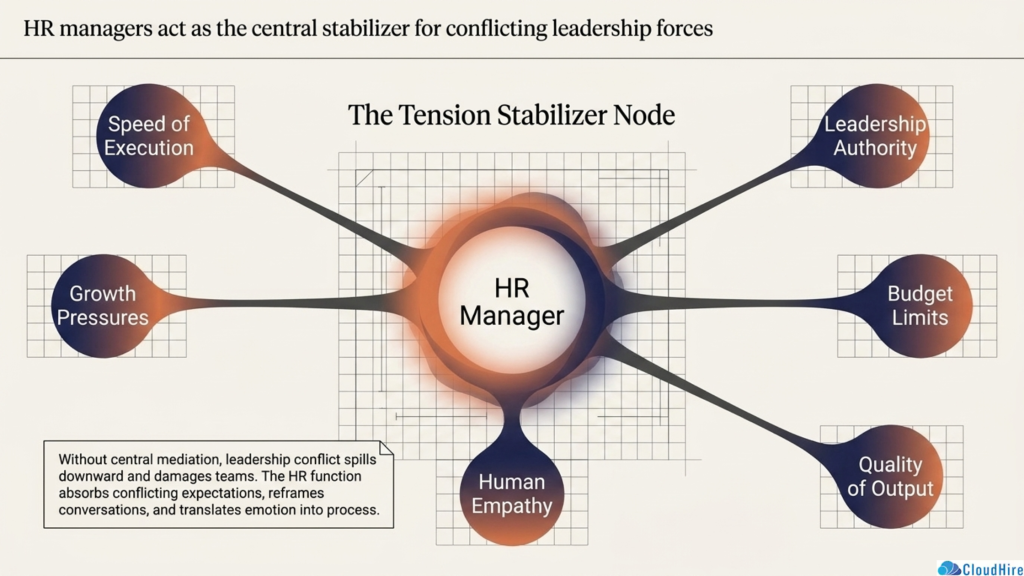
- Leadership rarely agrees fully.
- Growth pressures clash with budget limits.
- Speed clashes with quality.
- Authority clashes with empathy.
An HR manager becomes the stabilizer inside this tension. This is where people usually ask, what does an hr manager do, assuming the answer starts with people operations. In reality, it often starts with leadership dynamics. HR managers absorb conflicting expectations, reframe conversations, and guide decisions without choosing visible sides.
They translate emotion into process and intent into action. Without this mediation, leadership conflict spills downward and damages teams.
Hiring Is Not the Hard Part, Choosing Standards Is
Recruitment looks simple on the surface. Post a role. Screen candidates. Hire someone capable.
The responsibility lies deeper. HR managers decide what “good enough” means. They decide when urgency should win and when standards must hold. They decide how much risk a company can afford in a hire.
Within the roles and responsibilities of hr manager, this judgment matters more than any tool or interview question. A rushed hire does not fail immediately. It fails slowly, through morale drops, rework, and exits.
HR managers protect the long view, often against pressure.
The First Thirty Days Tell More Truth Than Annual Reviews
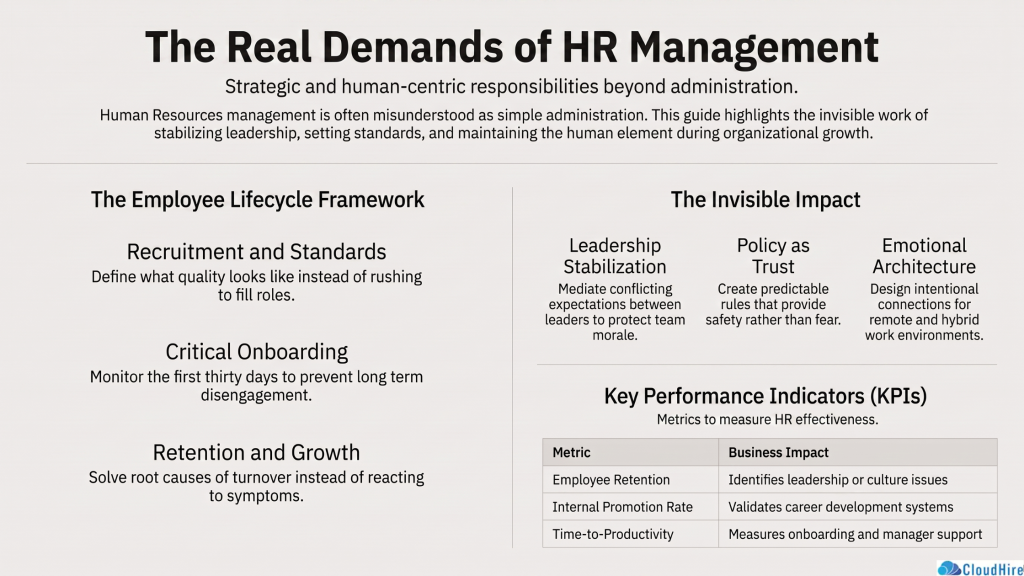
Performance reviews get attention. Onboarding rarely does, even though it shapes outcomes faster.
HR managers watch how new hires experience their first month. Who checks in. Who disappears. Who offers clarity. Who avoids responsibility.
This is part of what are the job responsibilities of a hr manager that never shows on charts. Early intervention saves careers and prevents resentment from forming.
A disengaged employee at six months was usually confused or unsupported at one.
HR Responsibilities Across the Employee Lifecycle
Good human resources management is not a series of isolated tasks. It follows employees through every stage of their journey with the company. The responsibilities change as people move through the employee lifecycle, but the goal stays the same: help people succeed while supporting the organization’s objectives.
| Employee Lifecycle Stage | HR Responsibility |
| Recruitment | Define hiring standards, support workforce planning, attract candidates, and make informed hiring decisions. |
| Onboarding | Introduce new employees to the company, provide training, clarify expectations, and reduce time-to-productivity. |
| Growth | Support learning and development, career progression, mentoring, and talent management initiatives. |
| Performance | Lead performance management, coaching, feedback cycles, promotions, and improvement plans. |
| Retention | Improve employee engagement, strengthen culture, manage compensation and benefits, and increase employee retention. |
| Exit | Handle offboarding, exit interviews, knowledge transfer, compliance requirements, and workforce planning for replacements. |
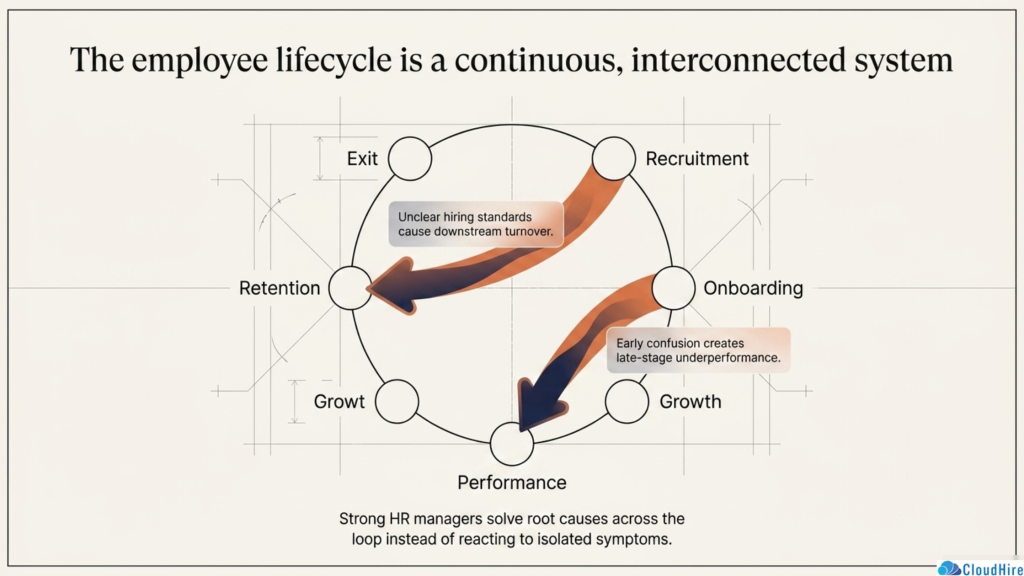
The strongest human resource managers understand that these stages are connected. Problems that appear during performance reviews often begin during onboarding, while poor retention is frequently the result of unclear hiring standards or limited development opportunities. Looking at HR through the entire employee lifecycle makes it easier to solve root causes instead of reacting to symptoms.
Policies Exist Because Trust Eventually Gets Tested
Most companies write policies as insurance. Employees read them as promises.
HR managers understand this gap. Every policy answers an unspoken question: “What happens if something goes wrong?”
This is where what are the responsibilities of hr manager becomes delicate. Too strict and people feel watched. Too vague and people feel unsafe.
Good HR managers write policies that feel predictable, not threatening. They explain reasoning. They make consequences consistent.
Employees do not quote policies. They feel their fairness.
Performance Issues Are Rarely About Performance Alone
When someone underperforms, the easiest response is documentation. The responsible response is investigation.
HR managers ask uncomfortable questions. Was the role clear? Was feedback given early? Did expectations shift quietly? Did management avoid conflict?
This part of the job demands emotional intelligence more than frameworks. HR managers coach managers through difficult conversations without humiliating anyone.
This invisible work defines trust inside organizations.
Conflict Arrives Quietly, Not Loudly
Formal complaints are the final chapter, not the beginning.
HR managers notice conflict through tone changes, sudden silence, repeated “small concerns,” and emotional fatigue. They intervene before people reach breaking points.
This work rarely involves scripts. It involves listening without judgment and acting without drama.
People who wonder what does an hr manager do often overlook this. Conflict prevention does not announce itself. But when absent, everything feels heavier.
Compliance Is a Responsibility, Not an Identity
Yes, HR ensures labor laws are followed. But the way compliance is handled defines culture.
HR managers who rely only on rules create fear-based environments. Those who explain intent create accountability without anxiety.
This balance sits at the center of hr manager responsibilities. Protecting the company should never mean silencing employees.
Common Mistakes Even Experienced HR Managers Make
Experience doesn’t eliminate mistakes. It simply changes which ones become expensive.
Some of the most common challenges include:
- Prioritizing urgent hiring over hiring quality, creating problems that appear months later.
- Waiting until annual reviews to discuss performance instead of providing continuous feedback.
- Writing policies that satisfy legal requirements but confuse employees.
- Measuring HR activity instead of business outcomes, such as focusing on completed training instead of improved performance.
- Treating every employee issue as an isolated event instead of looking for recurring patterns across teams.
- Neglecting manager coaching, even though managers influence employee experience more than HR interacts with employees directly.
The strongest HR managers spend less time reacting to individual problems and more time improving the systems that create them.
Culture Lives in Everyday Decisions, Not Presentations
Culture shows up when promotions are delayed, mistakes happen, or exits occur.
HR managers influence culture through how decisions are explained, not just what decisions are made. Transparency reduces rumors. Silence creates stories.
This responsibility cannot be automated. It requires judgment, timing, and empathy.
Modern HR Extends Beyond Office Walls
Remote work changed everything. Trust no longer forms naturally. Communication gaps widen faster.
HR managers now design connection intentionally. They help managers lead without visibility. They protect inclusion when proximity disappears.
This evolution reshaped what are the responsibilities of hr manager in real time. The job now includes emotional architecture across distance.
Microsoft’s Work Trend Index has repeatedly highlighted that hybrid and remote work increase the need for intentional communication, clearer expectations, and stronger manager support rather than more meetings.
How HR Manager Responsibilities Change as Companies Grow
The responsibilities of an HR manager are not fixed. They evolve alongside the organization.
| Company Stage | Primary HR Focus |
| Startup | Hiring quickly, creating basic policies, onboarding employees, and building company culture from scratch. |
| Scale-up | Improving HR operations, introducing structured performance management, strengthening people operations, and building leadership capability. |
| Enterprise | Driving organizational development, succession planning, global compliance, workforce strategy, and long-term talent planning. |
As organizations grow, HR shifts from solving today’s hiring problems to building systems that continue working years into the future. Early on, success is measured by filling roles. Later, it depends on leadership development, workforce stability, and the ability to scale without losing consistency.
Why This Role Quietly Determines Whether People Stay
Employees leave companies when they feel unseen, unheard, or unfairly treated.
HR managers influence all three.
They do not control every outcome. But they shape systems that decide how people experience work. When HR does its job well, people feel steady. When it fails, everything feels fragile.
Understanding hr manager responsibilities means understanding that organizations are human systems first and operational systems second.
HR KPIs That Show Whether HR Is Actually Working
Strong HR is measurable. While every organization tracks different priorities, these indicators provide a balanced view of workforce health and business impact.
| KPI | Why It Matters |
| Employee retention | Measures whether employees choose to stay and identifies potential culture or leadership issues. |
| Time-to-hire | Shows the efficiency of recruitment and hiring processes. |
| Offer acceptance rate | Reflects employer brand, compensation competitiveness, and candidate experience. |
| Employee engagement | Indicates motivation, commitment, and alignment with company goals. |
| Internal promotion rate | Demonstrates whether leadership pipelines and career development are working. |
| Training completion | Measures participation in learning and development initiatives. |
| Compliance incidents | Highlights risks related to HR compliance and workplace policies. |
| Time-to-productivity | Evaluates the effectiveness of onboarding and manager support. |
In our internal analysis of hiring and onboarding workflows, we consistently found that organizations tracking onboarding progress, manager check-ins, and employee retention together were able to identify performance issues much earlier than those relying only on annual reviews. This aligns with broader industry research showing that onboarding quality and manager effectiveness have a measurable impact on long-term retention and engagement.
A Grounded Closing
HR management is not administrative work with a human layer. It is human work with operational consequences.
The best HR managers protect dignity while enabling growth. They reduce chaos without creating control. They help people do their best work without needing applause.
CloudHire supports modern professionals and companies navigating remote and global hiring with clarity, structure, and transparency. If you are exploring HR roles or building teams where people-first decisions are not just slogans, CloudHire offers a focused place to begin.
The quality of your hiring process influences onboarding, performance, and retention. CloudHire helps HR teams get that first step right.
Book a demo
Frequently Asked Questions:
1. What are the main responsibilities of an HR Manager?
An HR Manager oversees hiring, onboarding, performance, pay, and employee relations for a company. They make sure policies are followed, labor laws are respected, and teams have the people and support they need to work well.
2. Is recruitment part of HR Manager responsibilities?
Yes. HR Managers often own or oversee recruitment: writing job descriptions, posting roles, screening CVs, coordinating interviews, and making offers. In larger companies, they manage recruiters and set hiring standards instead of doing every step themselves.
3. What are HR Manager responsibilities in employee relations?
In employee relations, HR Managers handle conflicts, complaints, and difficult conversations. They guide managers on fair treatment, investigate issues like harassment or misconduct, and work to keep the workplace respectful and safe for everyone.
4. What are HR Manager responsibilities in compliance and HR policies?
They create, update, and enforce HR policies in line with local labor laws and company rules. This includes contracts, leave rules, disciplinary processes, data privacy, and health and safety requirements, and ensuring managers follow them consistently.
5. What skills should an HR Manager have?
A successful HR manager combines technical knowledge with strong interpersonal skills. Communication, decision-making, conflict resolution, coaching, HR compliance, workforce planning, and emotional intelligence are all essential. As organizations become more data-driven, understanding workforce analytics and HR technology is becoming increasingly important.
6. What is the difference between an HR Manager and an HR Generalist?
An HR Generalist supports a wide range of day-to-day HR activities such as recruitment, onboarding, employee records, and policy administration. An HR Manager oversees these functions while also leading strategy, managing people, supporting business leaders, and making decisions that influence organizational performance.
7. How is HR success measured?
HR success is measured through a combination of HR metrics and business outcomes. Common indicators include employee retention, time-to-hire, engagement, internal promotions, training completion, compliance incidents, and workforce productivity. The goal isn’t simply to complete HR tasks but to improve the overall employee experience and business performance.
8. Can HR Managers influence company culture?
Yes. While culture belongs to everyone in an organization, HR managers influence it by shaping hiring standards, onboarding experiences, leadership development, performance expectations, recognition programs, and the way policies are applied consistently across teams.
Hire faster with CloudHire
Search 700M+ profiles, run AI interviews and launch outreach on one platform — free to start, no demo call required.