
Pay-Per-Placement Is a 90’s Pricing Model. Here’s What Replaced It.
On this page
By CloudHire Editorial · 28 October 2026 · 6-minute read
Quick answer: Pay-per-placement recruiting, also called contingent recruiting, charges a fee of typically 18–25% of a hire’s first-year salary when the person starts. Its structure has barely changed in decades: the price follows the salary rather than the work, every hire is billed again, screening is left to you, the agency keeps the data, and nothing is promised by a date. Growing companies are replacing it with flat-fee managed recruiting: one fixed price per open role, verified and AI-interviewed candidates, and a written deadline. Your next hire, de-risked.
Ask a founder why they use a recruiting agency and you’ll usually hear the same answer: “We only pay if it works.” No hire, no fee. It sounds like the safest deal in hiring.
But look at what that deal actually is. A percentage of salary, due on the start date. Another full fee for the next hire. A stack of resumes you still have to screen. No data you keep, and no date anyone commits to. Swap the email for a fax and it could be 1995.
Everything around recruiting has changed since then. Sourcing, screening and first-round interviews can now be done by software in hours. Candidates can be faked. Talent is global. Only the pricing model stayed the same.
What is pay-per-placement recruiting?
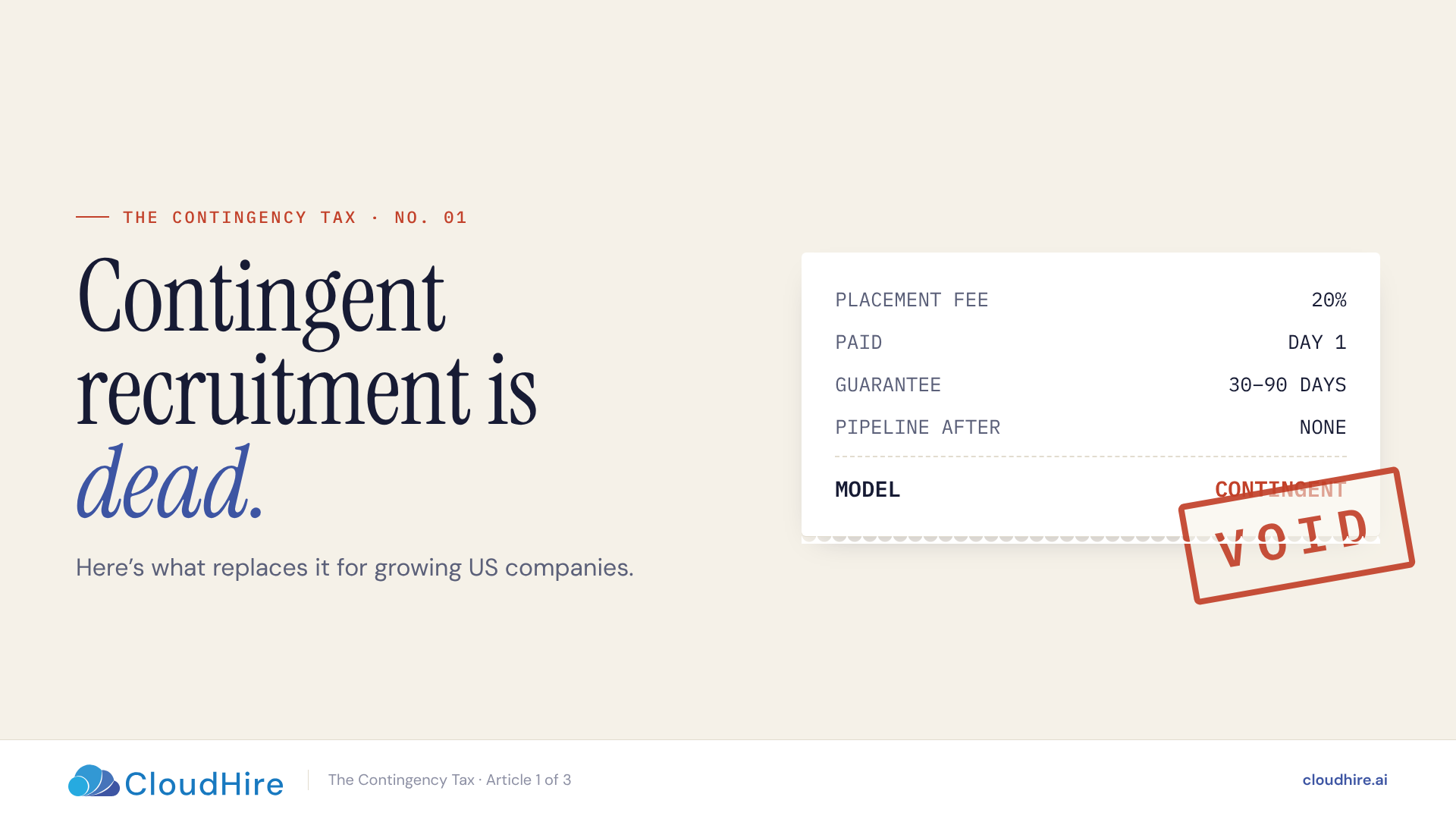
Pay-per-placement recruiting is an arrangement in which a recruiting agency is paid only when a candidate it introduced is hired. The placement fee is a percentage of the hire’s first-year base salary, typically 18–25% for professional roles, and it’s usually due when the person starts. It’s the same thing as contingent or contingency recruiting. On a $100,000 hire, that’s $18,000 to $25,000 for one person.
Why does payment on placement feel safe?
Because the risk looks like it sits with the agency. If nobody gets hired, you owe nothing. For a company without a recruiter, that feels like free insurance.
The catch is that you pay for the insurance in the size of the fee. A percentage-of-salary fee has to cover the searches the agency didn’t fill, for every client. And the safety only covers one thing: whether a hire happens. It says nothing about how fast, how well screened, or what happens to the next role.
Five things about pay-per-placement that haven’t changed
1. The price follows the salary, not the work
Finding a $120,000 account executive isn’t 50% more work than finding an $80,000 one. But under a percentage-of-salary fee, it costs 50% more. The agency’s percentage rises with every raise you build into an offer.
2. Every hire is billed separately
If a search turns up three strong people and you hire two, you pay two placement fees. At a 20% fee on a $100,000 salary, that’s $40,000 for one search. Per-hire fees make a great shortlist more expensive, not less.
3. You get resumes, not interview-ready candidates
Many agencies forward profiles and leave the screening to you. That means your hours (or a founder’s) go into calls with people who were never right for the role. It also means nobody checked whether the person is who they say they are. In a 2025 Gartner survey of 3,000 job candidates, 6% admitted to interview fraud, and Gartner predicts that by 2028 one in four candidate profiles worldwide will be fake.
4. The process is a black box, and the data stays behind
You rarely see how many people were contacted, how they were assessed, or why one profile made the cut. When the search ends, the runners-up and the notes stay in the agency’s database. Your next hire starts from zero, with a new fee.
5. Nothing is promised by a date
Most agreements commit to “best efforts.” There’s no number of candidates, no deadline and no consequence if the shortlist takes six weeks. The agency carries the risk of not getting paid. You carry the risk of an empty seat.
What changed around it?
- Screening got cheap. AI can now source candidates, check them and run a structured first interview against your requirements before a human ever reads a resume.
- Verification became essential. With fake profiles and interview fraud rising, a candidate who hasn’t been verified is a risk, not a shortlist.
- Talent went global. Growing US companies now hire across time zones. A strong remote candidate can sit next to a local one on the same shortlist.
When the expensive part of recruiting becomes fast and repeatable, a fee priced as a slice of salary stops making sense.
What replaced it: flat-fee managed recruiting
Flat-fee managed recruiting is a hiring model in which one partner runs the search for you at a fixed price per open role, combining AI sourcing and screening with a dedicated human recruiter. You pay for the role, not for a share of the salary, and you see the whole process.
| Pay-per-placement (traditional agency) | Flat-fee managed recruiting | |
| How you pay | 18–25% of first-year salary, per hire | One flat fee per open role |
| Second hire from the same search | Another full placement fee | No extra fee |
| What you receive | Resumes to screen | Verified, AI-interviewed, interview-ready candidates |
| Commitment | “Best efforts” | The number of candidates by a date, in writing |
| Your data | Stays with the agency | In your own CloudHire account |
What does a flat-fee pilot look like?
At CloudHire, the first step is a 30-day Managed Recruiting Pilot for one open role. AI does the heavy lifting; a dedicated recruiter does the judgment.
| What the pilot includes | Details |
| Price | $3,000 for a non-technical role, $4,000 for a technical role. One flat fee per open role, not a percentage of salary. |
| Length | 30 days, one open role |
| Guarantee | 5 interview-ready candidates with interviews scheduled within 10 business days of kickoff, or your next 30 days are free. Applies when you review candidates and share decisions on time. |
| Candidates | Sourced with AI, verified through Cloud-ID, and AI-interviewed against your requirements before you see them |
| Extra hires | Hire more than one person from the same search at no extra fee |
| Remote Talent Credit | Every shortlist includes 2 pre-vetted remote candidates from India. Hire one, and your pilot fee becomes a credit toward their first month. |
| After the hire | 60-day replacement and a 90-day warm pipeline while you’re subscribed; the software is $350/month after the pilot |
| Your data | Your own CloudHire account, with every candidate and their scores |
Your next hire, de-risked: the worst case is a free month. The best case is you never pay an agency percentage again.
What CloudHire clients have seen: A New York e-commerce brand had candidate options within 1–2 days and built a five-role team in one week. A New York SaaS company cut its developer team’s average cost by 50% and lifted client engagement 30% with offshore hires. Its CEO: “Some of the hires were so good, I might as well have made them the CEO!”
When does pay-per-placement still make sense?
If you hire one rare specialist a year, have time to screen every resume yourself, and don’t need the pipeline afterwards, paying a placement fee can be reasonable. Retained search still fits executive roles. But most companies with 20 to 120 people aren’t in that position. They’re hiring across sales, support, operations and engineering, several times a year, and paying a full fee each time for a process they can’t see.
Pay-per-placement didn’t get worse. Everything around it got better, and its pricing didn’t move. A fee tied to salary, billed per hire, with no deadline, belongs to a older and slower decade of hiring.
Next step:get a scoped pilot plan for your role. It’s a 30-minute call, and you leave with a hiring plan whether or not you work with us.
Frequently asked questions
What is pay-per-placement recruiting?
It is a recruiting arrangement, also called contingent recruiting, in which an agency is paid only when a candidate it introduced is hired. The fee is typically 18–25% of the hire’s first-year salary, due when the person starts.
How much does a recruiting agency charge per hire?
For professional roles, placement fees typically run 18–25% of first-year base salary. On a $100,000 salary that is $18,000 to $25,000 for one hire, and each additional hire is billed again.
What is the alternative to contingent recruiting?
Flat-fee managed recruiting: one partner runs the search at a fixed price per open role, using AI to source, verify and interview candidates and a dedicated recruiter to manage the role. CloudHire’s pilot is $3,000 for a non-technical role and $4,000 for a technical role.
Is pay-per-placement still worth it?
It can be for one rare specialist hire a year if you have time to screen candidates yourself. For companies hiring several times a year, per-hire fees, unscreened resumes and lost pipelines usually make it the more expensive option.
Sources
Hire faster with CloudHire
Search 700M+ profiles, run AI interviews and launch outreach on one platform — free to start, no demo call required.