
People Management in a Distributed World: What Actually Works
On this page
Hiring the right person is the visible part of building a team. People management is the invisible part that decides whether that hire is still with you, and still doing good work, a year later. This becomes a lot harder once a team is spread across cities, countries, and time zones, because most traditional management habits were built around people sharing a physical room.
This guide looks at what people management actually requires when a team is distributed, using practical structure rather than vague leadership advice.
Why People Management Gets Harder as Teams Go Global
In a single office, a lot of management happens by accident. A manager notices someone seems off during a hallway conversation. A team celebrates a win together in the room right after it happens. Feedback gets delivered in the moment because the opportunity is right there.
None of that happens automatically once a team spans multiple countries. The hallway conversation does not exist. The celebration happens in a chat message someone reads six hours later, if they read it at all. Feedback either gets delayed until a scheduled call or skipped entirely because the moment passed. This is not a communication problem that solves itself with more video calls. It requires management practices that were designed for distance from the start, rather than in-person habits stretched thin across a screen.
The Five Pillars of People Management That Actually Hold Up Across Distance
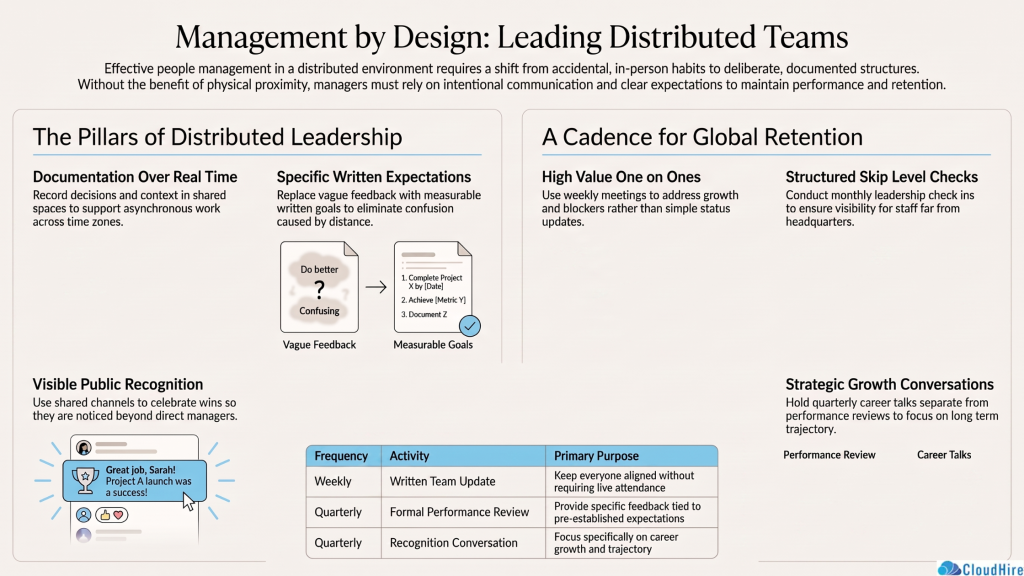
Communication that does not depend on real time. The strongest distributed teams write things down. Decisions, context, and reasoning get documented in a shared place rather than living only in someone’s memory of a call. This is often called asynchronous communication, and it matters because a team member in a different time zone should be able to get full context without waiting for someone else to wake up.
Performance management with clear, written expectations. Vague feedback survives in person because tone and body language fill in the gaps. Across distance, vague feedback is just confusing. Distributed teams that manage performance well tend to write specific, measurable expectations rather than relying on a general sense that “things are going well” or “there have been some concerns.”
Regular, structured check-ins that are not just status updates. A one on one that only covers task status wastes an opportunity. The distributed managers who retain people well use that time to talk about growth, blockers, and how the person is actually doing, not just what shipped this week.
Recognition that is visible beyond the manager. In an office, good work often gets noticed by more than just a direct manager. Distributed teams need to recreate this deliberately, through shared channels where wins get called out publicly, rather than only in a private message that disappears from view.
Career growth paths that are not tied to physical proximity to leadership. One of the quieter risks of distributed teams is that people closest to headquarters, physically or by time zone overlap, tend to get more visibility and more promotion opportunities by default, simply because they are more present. Deliberately correcting for this is part of managing people fairly across a distributed company.
A Practical Cadence for Managing Distributed Teams
Rather than leaving management structure to chance, a lot of well-run distributed teams build a fairly consistent rhythm. Here is a common pattern.
| Frequency | Activity | Purpose |
| Weekly | One on one between manager and direct report | Address blockers, check in on wellbeing, maintain relationship |
| Weekly | Written team update | Keep everyone aligned without requiring live attendance |
| Monthly | Skip-level check-in | Give leadership visibility beyond direct managers, especially for staff far from headquarters |
| Quarterly | Formal performance review | Written, specific feedback tied to clear expectations set in advance |
| Quarterly | Recognition and growth conversation | Separate from performance review, focused specifically on career trajectory |
This is not the only cadence that works, but the underlying principle matters more than the exact schedule. Distributed people management needs structure precisely because it does not happen by accident the way it can in a shared office.
Managing Across Cultural Differences
People management does not look identical everywhere, and assuming your home country’s management style transfers cleanly to every market is a common mistake. Direct, blunt feedback that lands fine in one culture can feel harsh or even disrespectful in another. Some cultures expect a manager to be more directive, while others expect more collaborative decision making even at junior levels. This does not mean abandoning consistent standards across a company. It means being aware that how feedback and expectations are delivered may need to flex, even when the substance stays the same.
The Retention Cost of Weak People Management
It is worth being direct about why this matters financially, not just culturally. Replacing an employee, once recruiting time, onboarding, and lost productivity are counted, typically costs a meaningful multiple of that person’s salary. Weak people management, especially the kind that shows up as vague feedback, invisible recognition, and inconsistent check-ins, is one of the most common and most preventable drivers of early turnover on distributed teams. Companies that invest in structured management practices early tend to see this reflected directly in lower turnover, not just in vague employee satisfaction scores.
Common People Management Mistakes on Distributed Teams
A few patterns show up again and again. Managers sometimes default to over-monitoring, checking in more frequently out of anxiety about not seeing someone work, which tends to erode trust rather than build it. Others under-communicate, assuming that written updates are unnecessary because “we’ll just talk about it in the next call,” which leaves people without context for days. Some companies also promote almost exclusively from within their headquarters office, unintentionally signaling to distributed staff that career growth requires physical proximity, even if nobody ever says that out loud.
Frequently Asked Questions
What is the biggest challenge in managing a distributed team?
The biggest challenge is usually that informal management, the kind that happens naturally in a shared office, does not transfer automatically to distance. Managers have to rebuild communication, feedback, and recognition deliberately rather than relying on it happening by accident.
How often should managers check in with remote or international employees?
A weekly one on one is a common baseline, supported by written team updates and a more structured monthly or quarterly check-in from skip-level leadership to maintain visibility across the whole distributed team.
Does management style need to change across different countries?
The substance of clear expectations and fair treatment should stay consistent, but how feedback is delivered often needs to adapt to cultural norms around directness and hierarchy.
Why does weak people management lead to higher turnover?
Employees who receive vague feedback, little recognition, and inconsistent communication are more likely to disengage and leave, and replacing them typically costs significantly more than the investment it would have taken to manage them well in the first place.
Can people management be effective without any in-person contact?
Yes, though it requires more deliberate structure. Teams that document decisions clearly, hold consistent one on ones, and make recognition visible tend to manage this well even with limited or no in-person contact.
Where CloudHire Fits In
Good people management starts with good hiring decisions, since the wrong fit is much harder to manage well no matter how strong your processes are. CloudHire helps companies build distributed teams with the right people from the start, giving hiring managers better visibility into candidate fit before an offer goes out, which makes everything downstream, including people management, considerably easier. If your team is scaling across countries and wants hiring decisions that set your managers up for success, CloudHire is built for exactly that stage of growth.
Put your job search on autopilot
CloudHire Smart Apply tailors your resume and applies to matching roles for you — so you spend your time interviewing, not scrolling.