
You’re Underestimating the Cost of Employing Staff Abroad
On this page
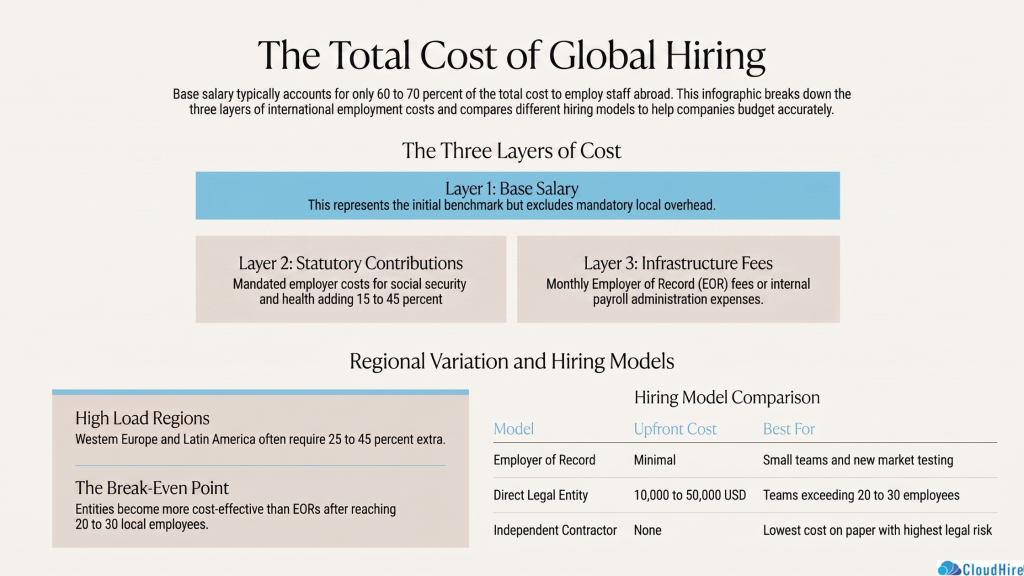
Ask most founders what it costs to hire someone in another country, and they will quote you a salary figure. That number is usually right, and also usually only about 60 to 70 percent of the real answer. The cost of employing staff abroad includes several layers that do not show up until payroll is already running, and getting a realistic total early saves a lot of budget surprises later.
TL;DR: The real cost of employing staff abroad goes well beyond salary. Employers also need to budget for statutory contributions, global payroll, employee benefits, compliance, onboarding, currency fluctuations, and the employment model they choose. The article compares Employer of Record, legal entities, contractors, and PEOs, explains when each makes financial sense, highlights the hidden costs that catch companies off guard, and shows how to build a country-specific budget that reflects the true cost of international hiring.
The Four Layers of Cost You Actually Pay
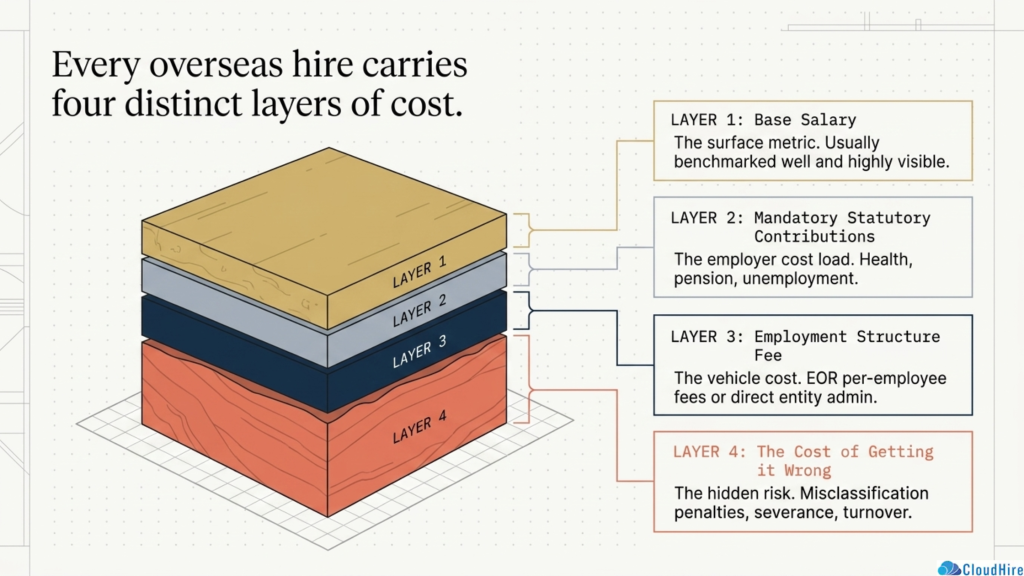
Every overseas hire carries roughly four layers of cost, and most budgeting mistakes happen because only the first one gets counted.
Layer one is base salary: This is the number everyone starts with, and it is usually benchmarked reasonably well since salary data for most roles and countries is easy to find.
Layer two is mandatory statutory contributions: This is where the first real gap appears. Most countries require employer contributions on top of salary for things like social security, health insurance, pension funds, and unemployment insurance. This is often called the employer cost load, and it typically adds somewhere between 15 and 45 percent on top of gross salary depending on the country.
Layer three is your employment structure fee: If you are using an Employer of Record, this is the monthly per-employee fee. If you have a direct entity, this shows up as the ongoing cost of local payroll administration, accounting, and compliance filings, which is a fixed cost rather than a per-employee one, but a real cost regardless.
Layer four is the cost of getting it wrong: This includes things like misclassification penalties, late compliance filings, and the cost of replacing someone who leaves early because onboarding or management was weak. This layer is the hardest to estimate up front, but it is often the most expensive one when it actually hits.
What Is an Employer of Record (EOR)?
An Employer of Record (EOR) is a company that legally employs workers on your behalf in another country. The EOR handles local employment contracts, global payroll, taxes, statutory employee benefits, and workforce compliance, while you manage the employee’s day-to-day work. It allows businesses to hire employees internationally without opening their own legal entity.
What Are Statutory Contributions?
Statutory contributions are mandatory employer payments required under local employment law. They commonly include payroll taxes, pension contributions, social security, unemployment insurance, and healthcare programs. These costs sit on top of an employee’s salary and are often one of the biggest reasons total employment costs vary between countries.
What Is Global Payroll?
Global payroll is the process of paying employees across multiple countries while complying with local tax laws, currencies, reporting requirements, and statutory deductions. An effective international payroll system ensures employees are paid accurately and on time while helping companies remain compliant with local regulations.
A Worked Example: What a 50,000 USD Salary Actually Costs
It helps to see this as real numbers instead of abstract percentages. Say you are hiring someone with a base salary equivalent to 50,000 USD a year.
| Cost layer | Estimated amount | Running total |
| Base salary | 50,000 USD | 50,000 USD |
| Statutory employer contributions (assume 25 percent, a common mid-range figure) | 12,500 USD | 62,500 USD |
| Employer of Record fee (assume 500 USD per month) | 6,000 USD | 68,500 USD |
| Onboarding and management overhead (rough estimate, time cost) | 1,500 to 3,000 USD | 70,000 to 71,500 USD |
The true annual cost in this example lands somewhere around 40 percent higher than the base salary alone. This ratio moves depending on the country. Markets with strong statutory benefits, common across much of Western Europe and Latin America, tend to sit at the higher end of the range. Markets with lighter mandatory benefits structures tend to sit lower.
How Cost Varies by Region
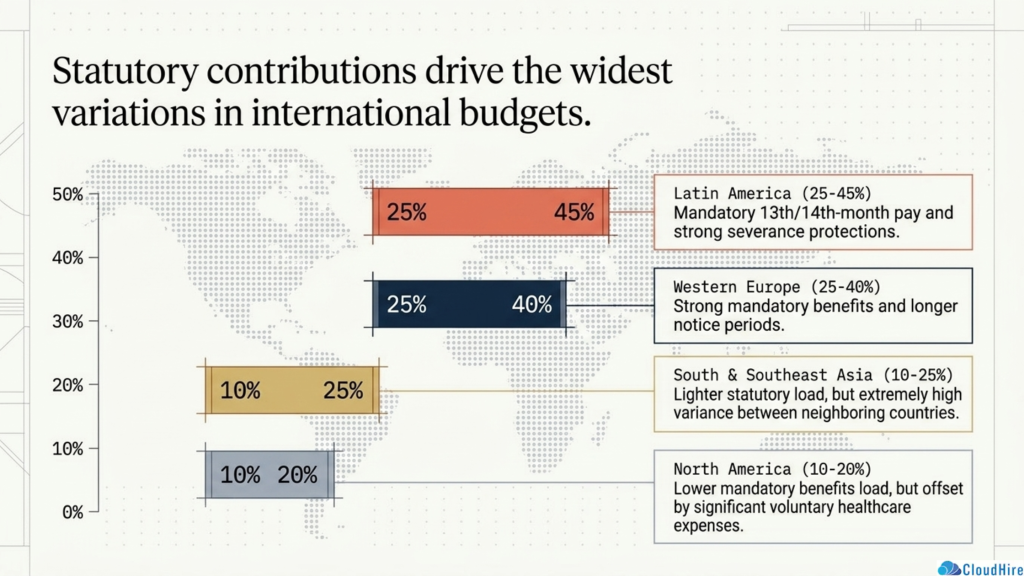
Statutory contribution rates are one of the biggest swing factors in total cost, and they vary widely by region. The table below gives rough, illustrative ranges rather than exact figures, since actual rates depend on specific country and even sometimes state or province level rules.
| Region | Typical statutory employer contribution load | Notable cost factors |
| Western Europe | 25 to 40 percent of salary | Strong mandatory benefits, longer notice periods, higher severance obligations |
| Latin America | 25 to 45 percent of salary | Mandatory thirteenth and sometimes fourteenth month pay, strong severance protections |
| South and Southeast Asia | 10 to 25 percent of salary | Lower statutory load in many markets, but variation is high between countries |
| North America | 10 to 20 percent of salary | Lower mandatory benefits load, but healthcare costs can add significant voluntary benefit expense |
These numbers are meant to set expectations, not replace a proper local calculation for a specific hire. The gap between the lowest and highest end of these ranges is large enough that budgeting a flat percentage across every country is one of the more common ways companies underestimate cost.
Country Examples From Our Internal Analysis
In our internal analysis of international hiring conversations, one of the biggest budgeting mistakes is assuming every country carries similar employer costs. In reality, the cost structure varies significantly depending on statutory obligations and local employment practices.
| Country | Typical Cost Consideration |
| Germany | Higher employer contributions and stronger statutory employee benefits increase total employment costs. |
| Brazil | Mandatory bonus payments and extensive labor protections require larger hiring budgets. |
| India | Lower statutory costs than many Western markets, but compliance requirements still require careful planning. |
| Philippines | Competitive labor costs make hiring attractive, although payroll compliance remains essential. |
| Netherlands | Strong worker protections and employer contributions increase the overall cost of global employment. |
These examples are intended to illustrate how country-specific obligations affect budgeting. Actual costs depend on role, salary, and local regulations.
Comparing the Cost of Hiring Models Directly
The employment model you choose changes the shape of the cost, not just the total.
| Model | Upfront cost | Ongoing cost pattern | Cost at low headcount | Cost at high headcount |
| Direct legal entity | High, often 10,000 to 50,000 USD | Fixed compliance and admin overhead regardless of headcount | Expensive per person | Efficient once spread across many employees |
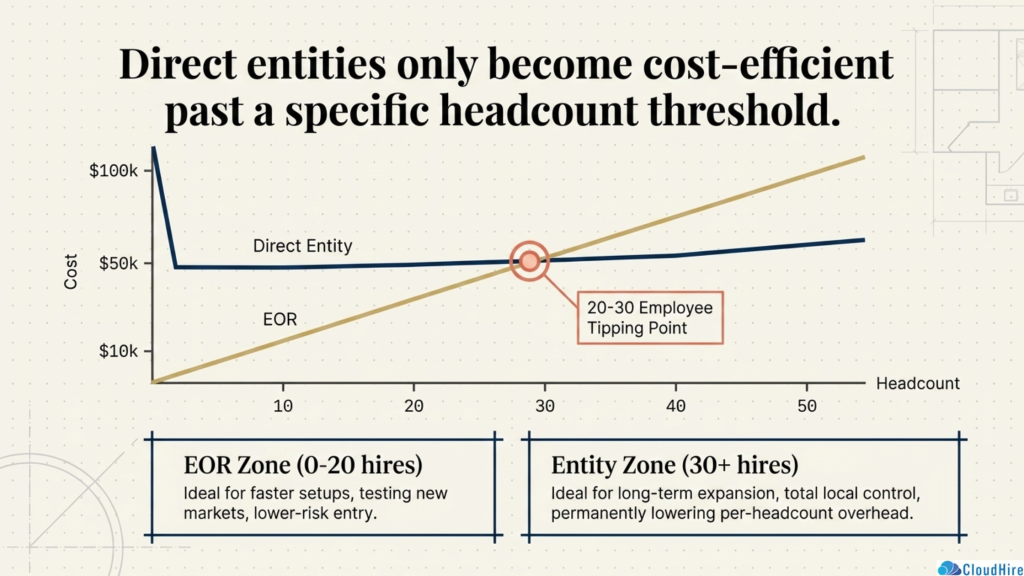
| Employer of Record | Minimal | Per-employee monthly fee | Efficient, since there is no fixed overhead | Fees can exceed the cost of a direct entity past roughly 20 to 30 employees |
| Professional Employer Organization | Requires existing entity | Service fee plus payroll | Moderate | Moderate, scales steadily |
| Independent contractor | None | Contractor rate only | Cheapest on paper | Risk cost grows if the arrangement should legally be employment |
This is why the honest answer to “what does it cost to hire abroad” is almost always “it depends on how many people and for how long,” rather than a single figure.
When Should You Open a Legal Entity Instead of Using an Employer of Record?
Opening your own entity becomes more attractive as your presence in a country grows. While an Employer of Record reduces setup time and simplifies international HR, a direct entity can become more economical for larger teams.
A legal entity generally makes sense when:
- You expect long-term international expansion in a specific country.
- You’re planning to hire more than 20–30 employees locally.
- You want complete control over payroll, benefits, and local operations.
- The ongoing EOR pricing exceeds the cost of maintaining your own entity.
- You’re building a permanent global workforce rather than testing a new market.
For smaller teams or companies entering a country for the first time, an EOR usually provides a faster and lower-risk path to cross-border employment.
Hidden Costs That Rarely Make It Into the First Budget
A few costs consistently get missed in early planning, and they are worth naming directly.
Severance and termination costs are one. In many countries, ending an employment relationship, even for legitimate reasons, requires notice pay, severance calculated by tenure, or both. This is a real cost that only appears when someone leaves, which is exactly why it gets left out of initial budgets.
Mandatory bonus payments are another. A number of countries, particularly across Latin America and parts of Asia, require an additional month or more of salary paid out at specific points in the year, regardless of individual company policy.
Currency risk is a quieter one. If salary is set in your home currency and converted at the time of payment, exchange rate swings can meaningfully change what the employee actually receives, and inconsistent pay can hurt retention even when your company has not changed anything on its end.
Turnover cost is the least visible but often the largest. Replacing someone who leaves within their first year, once you count lost productivity, recruiting cost, and onboarding time again, frequently costs more than a full year of the statutory contribution gap that started this whole conversation.
What Is Employment Misclassification?
Employment misclassification happens when a worker is treated as an independent contractor even though local laws classify them as an employee. This can result in unpaid payroll taxes, penalties, backdated employee benefits, legal disputes, and compliance investigations, making it one of the most expensive mistakes in international hiring.
A Simple Way to Budget More Accurately
Rather than guessing at a flat markup, a more reliable approach is to build a country-specific multiplier. Take the base salary, add the country’s typical statutory contribution range, add your employment structure fee, and add a small buffer, usually 3 to 5 percent, for onboarding and administrative overhead. This gives a number that is close enough to plan against, and it can be refined further once you have run payroll for a country for a full cycle and know the real figures.
Frequently Asked Questions
What is the real cost of employing staff abroad compared to just salary?
Total cost typically runs 30 to 50 percent above base salary once statutory contributions, employment structure fees, and administrative overhead are included, though this varies significantly by country.
Why does the cost of hiring abroad vary so much by country?
Mandatory statutory contributions, required bonus payments, and severance obligations differ widely by country, and these differences are usually the biggest driver of total cost variation.
Is an Employer of Record more expensive than a direct entity?
At low headcount, an EOR is usually cheaper since there is no upfront legal or setup cost. Past roughly 20 to 30 employees in one country, a direct entity often becomes the more cost-efficient option.
What hidden costs do companies most often forget to budget for?
Severance and termination costs, mandatory bonus payments, and the cost of employee turnover are the three most commonly underestimated expenses in overseas hiring.
How can a company estimate cost accurately before hiring in a new country?
Building a country-specific cost multiplier that accounts for base salary, statutory contribution rates, and employment structure fees gives a far more reliable estimate than applying one flat percentage across every country.
Hiring internationally starts with finding the right people. CloudHire helps companies source, evaluate, and hire global talent through one connected hiring platform.
CloudHire Schedule a Demo
Hire faster with CloudHire
Search 700M+ profiles, run AI interviews and launch outreach on one platform — free to start, no demo call required.