
What Is Cloud Online Recruitment & How Does It Actually Work?
On this page
TL;DR Cloud-based recruiting means managing your entire hiring process from finding candidates to screening, interviewing, and hiring using online software instead of old systems installed on office computers. But it’s more than just moving hiring to the cloud. When done properly, it helps teams hire faster, work from anywhere, collaborate in real time, and keep every candidate’s information in one place. When done badly, it’s just the same messy hiring process with a nicer dashboard.
When people ask what cloud online recruitment is, they usually expect a technical definition. Something about servers and SaaS and browser-based dashboards. That definition is accurate but almost entirely useless for understanding whether cloud-based recruiting will actually change how your team hires.
The more useful question is: What does cloud recruiting make possible that wasn’t possible before and why do so many teams still not realize that potential? That’s what this piece is really about.
The Definition: What Cloud-Based Recruiting Actually Means
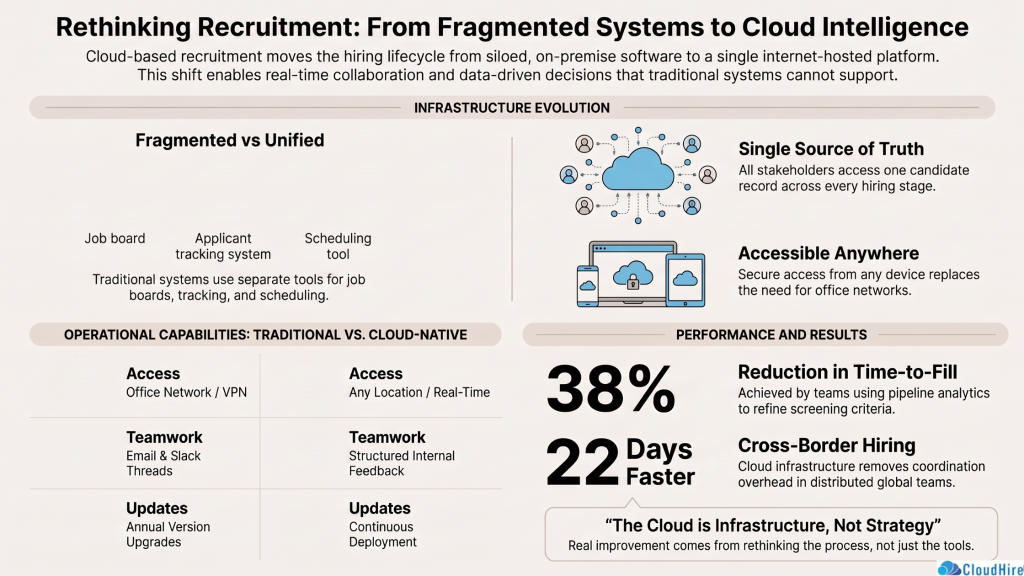
Cloud online recruitment refers to managing the full hiring lifecycle through internet-hosted software rather than on-premise systems. The infrastructure the servers, the storage, the processing power lives in a data center operated by a vendor, not in your office. You access it through a browser or an app. Your data lives in the cloud.
But the definition only becomes meaningful when you understand what it replaces. Before cloud-based hiring tools became mainstream, recruiting operations were fragmented: Job boards were separate from ATS systems, which were separate from scheduling tools, which were separate from offer management. Each system held a piece of the candidate record. Recruiters spent a substantial chunk of their day transferring information between systems that couldn’t talk to each other.
Cloud recruiting platforms consolidate that stack. A single platform can manage job distribution, candidate tracking, interview scheduling, assessment delivery, team collaboration, and reporting with all data in one place, accessible by anyone on the hiring team, from anywhere.
How Cloud Online Recruitment Works: The Pipeline, Step by Step
Understanding the mechanics matters because it reveals where the real gains are and where most teams leave them on the table. Here’s how a modern cloud-based recruiting workflow moves from open role to accepted offer:
1. Job creation & multi-channel distribution
A role is defined inside the platform and pushed simultaneously to job boards, the company careers page, LinkedIn, and niche sites from a single interface, with no duplicate data entry.
2. Centralized application intake
Every applicant, from every source, enters the same pipeline. There’s no inbox overflow, no spreadsheet tracking, no “I thought someone else was handling this” problem.
3. AI-assisted screening & ranking
The platform applies screening logic to surface the most relevant candidates first not auto-reject them, but prioritize them for human review. The recruiter sees a ranked list, not a flood.
4. Collaborative review & interviewing
Hiring managers, panel interviewers, and recruiters see the same candidate record. Feedback is structured and stored not scattered across email threads and Slack messages.
5. Decision, offer, and handoff
Offers are generated, tracked, and accepted within the platform. When the hire is made, the candidate record moves directly into onboarding no data re-entry, no dropped handoffs.
6. Analytics & pipeline reporting
Every stage is measured: source quality, time-per-stage, offer acceptance rate, drop-off points. The data accumulates and improves every subsequent search.
That six-step flow sounds straightforward. The reason it often isn’t is that most platforms execute steps one and two well and then degrade rapidly in quality. Steps three through six where the real hiring decisions happen tend to be where underpowered platforms run out of capability.
Cloud Recruiting vs. Traditional Recruiting: What Actually Changes
| Dimension | Traditional / On-Premise | Cloud-Based Recruiting |
| Access | Office network or VPN required | Any device, any location, real-time |
| Data ownership | Siloed by system, manual exports | Unified candidate record across all stages |
| Team collaboration | Email threads, separate feedback docs | Structured feedback inside the candidate profile |
| Scaling | IT infrastructure investment required | Scales with usage, no hardware dependency |
| Reporting | Manual data pulls, retrospective only | Real-time dashboards, predictive analytics |
| Integration | Complex, expensive custom builds | Native APIs connect to HRIS, calendars, assessments |
| Update cycles | Annual or biannual version upgrades | Continuous deployment, always current |
The table makes cloud recruiting look like an obvious upgrade and in most dimensions, it is. But “cloud-based” is not a quality guarantee. A poorly designed cloud ATS replicates every problem of its on-premise predecessor, just in a browser tab instead of an installed application.
“Moving your hiring to the cloud doesn’t modernize your recruiting. Rethinking how you recruit, then using cloud tools to execute it that’s what changes outcomes.” – Sufiyan, CEO, CloudHire
What Makes a Cloud Recruiting Platform Worth Using?
Because “cloud-based” has become a baseline expectation rather than a differentiator, the more important question for any hiring team is: What separates a cloud recruiting platform that actually improves hiring outcomes from one that just digitizes the status quo?
Intelligent screening that doesn’t black-box the logic
Any platform worth using should surface the best candidates first, but the logic doing that surfacing should be auditable. AI-powered recruiting tools that can’t explain why a candidate was ranked first or eliminated are operationally dangerous. The best platforms make their screening logic transparent so recruiters can calibrate it, not just trust it.
This is an area where platforms vary dramatically. Some apply rigid keyword matching dressed up with a machine learning label. Others like CloudHire.ai build screening around role-specific outcome criteria, letting hiring teams define what good actually looks like for each search and adjusting ranking logic accordingly.
Real-time collaboration without version-control chaos
In distributed hiring teams, which is most hiring teams now, the candidate record needs to be a single source of truth, not a document that exists in five slightly different versions across five people’s email inboxes. Cloud-based ATS platforms with real collaboration built in (not bolted on) give every stakeholder the same view at the same moment, with a clear audit trail of who said what and when.
Integrations that work without an IT project
A cloud recruitment platform that requires a three-month implementation to connect to your HRIS, your calendar, and your LinkedIn account isn’t saving you time; it’s just deferring the pain. Native integrations should be available out of the box, and new ones should require configuration, not custom code.
Analytics that inform future hires, not just current ones
The compounding value of cloud recruiting comes from data. Every search your team runs should make the next search faster and more accurate because the platform is learning which sources produce quality candidates for which roles, which screening questions predict performance, and where in the pipeline you’re losing candidates you wanted to keep. Recruiting analytics done right isn’t just reporting. It’s institutional memory.
Our Insight
Teams that treat their cloud recruiting platform as a data system, not just a workflow tool, see compounding returns over time. In our analysis, organizations that actively used pipeline analytics to refine their screening criteria across consecutive searches reduced their average time-to-fill by 38% within six months, without increasing sourcing budgets. The platform got more efficient because the team got more specific about what they were looking for.
The Specific Advantages for Remote and Distributed Hiring Teams
If your team is hiring across time zones, countries, or simply working from different locations, cloud online recruitment removes friction that traditional systems simply can’t solve. A hiring manager in Singapore can review a candidate profile, leave structured feedback, and flag for a technical interview while the recruiter in London is asleep. When that recruiter wakes up, the pipeline has moved.
This matters more than it might seem. Asynchronous hiring workflows are one of the most underrated advantages of cloud-native recruitment. The fastest companies hiring globally aren’t the ones with the largest recruiting teams; they’re the ones whose hiring processes don’t require everyone to be online at the same time to keep moving.
Our internal Analysis found that organizations with cloud-native hiring infrastructure complete cross-border searches an average of 22 days faster than those relying on regional or locally installed systems. The gap comes almost entirely from coordination overhead, not from sourcing, not from interviewing, but from the time lost waiting for information to move between people and systems.
What Cloud Recruiting Doesn’t Fix on Its Own
It would be convenient if moving to a cloud platform automatically improved hiring quality. It doesn’t. The technology creates the conditions for better hiring; it doesn’t do the hiring.
The most common mistake teams make when adopting cloud-based recruiting software is treating implementation as the finish line. They migrate their job templates, configure their pipeline stages, and start using the new platform exactly the way they used the old one. Same screening criteria, same interview process, same evaluation rubrics. The only thing that changed is where the data lives.
Real improvement comes from using the transition to a cloud platform as an opportunity to examine the underlying process.
- Which of your screening criteria actually predict job performance?
- Where in your pipeline do strong candidates drop out and why?
- What does your offer-acceptance rate tell you about how candidates experience your process?
A cloud recruitment system gives you the data to answer those questions. Acting on the answers is still entirely on you.
Is Cloud-Based Recruiting Right for Every Organization?
Mostly, yes, but with honest caveats. Small teams hiring fewer than 20 roles a year may not see the compounding analytics benefits quickly enough to justify the cost of enterprise platforms. They’re still better served by cloud tools than spreadsheets and email, but they should prioritize simplicity over feature depth.
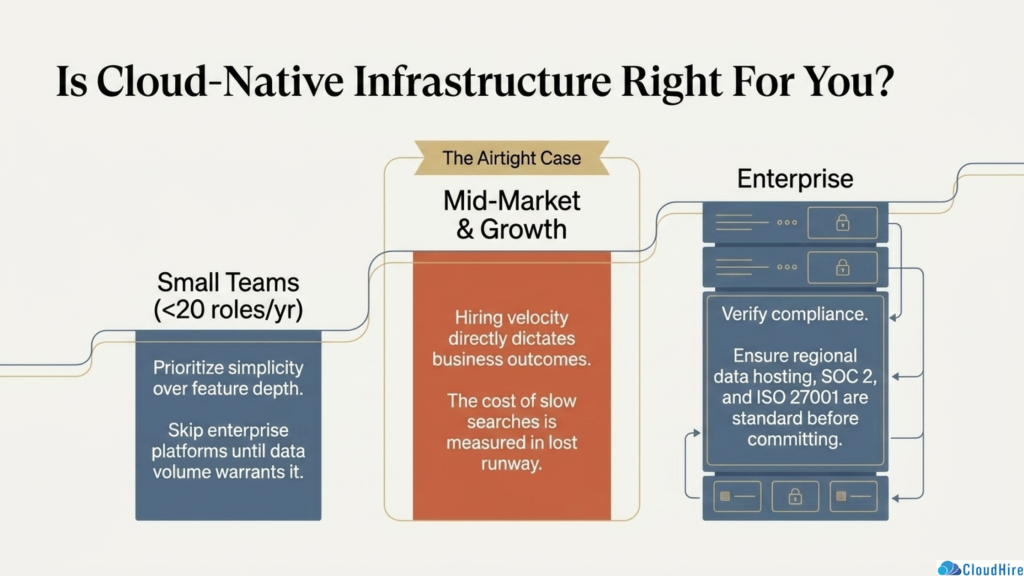
Large organizations with complex compliance requirements, particularly in regulated industries, need to evaluate whether a given cloud platform meets their data residency and security requirements before committing. Most reputable cloud recruiting platforms now offer regional data hosting and SOC 2 or ISO 27001 compliance as standard, but it’s worth verifying rather than assuming.
For growth-stage companies and mid-market teams, the segment where hiring velocity and hiring quality are most directly tied to business outcomes, the case for cloud-native recruiting infrastructure is essentially airtight. The cost of bad hires and slow searches at that stage is measured in runway, not just headcount.
The Future of Cloud Recruiting: Where It’s Heading
The next wave of capability in cloud online recruitment isn’t about adding more features to existing platforms; it’s about tighter integration between hiring data and workforce data. The gap between “hired” and “performing at six months” is currently invisible to most recruiting systems. The platforms closing that gap are building feedback loops between hiring outcomes and screening models, so that the platform gets better at predicting success with every cohort of hires, not just every search.
Predictive hiring models, structured skills assessments scored in real time, and automated pipeline diagnostics that flag when a search is going off track these aren’t speculative features. They’re in production at the best platforms today. The question for hiring teams isn’t whether this capability will become standard. It’s whether they’re on a platform that’s building toward it.
“The best cloud recruiting platforms don’t just manage your pipeline; they learn from it. Each hire should make the next one faster and more accurate.” – Sufiyan, CEO, CloudHire
Final Thought: The Cloud Is Infrastructure, Not Strategy
Cloud online recruitment gives you the infrastructure to hire well at speed, at scale, from anywhere. But infrastructure is only as valuable as the strategy it enables. The teams that get the most out of cloud-based hiring platforms are the ones who use the visibility, the data, and the collaboration those platforms provide to make genuinely better decisions not just faster versions of the same flawed ones.
The question worth asking when evaluating any cloud recruiting platform isn’t “does it have the features we need today?” It’s “does it get meaningfully better the longer we use it?” If the answer is yes, you’ve found infrastructure worth building on.
Frequently Asked Questions
1. Is cloud online recruitment the same as an Applicant Tracking System (ATS)?
Not exactly. An Applicant Tracking System (ATS) is one part of cloud online recruitment. Cloud recruitment platforms often include an ATS but also provide job distribution, interview scheduling, AI-assisted screening, team collaboration, reporting, integrations, and onboarding. In other words, an ATS manages candidates, while cloud recruitment manages the entire hiring process.
2. Is cloud recruitment suitable for small businesses?
Yes, although the type of platform matters. Small businesses typically benefit from simple cloud recruiting tools that centralize hiring and automate repetitive tasks without unnecessary complexity. As hiring volumes grow, they can adopt more advanced features such as AI-powered screening, analytics, and workflow automation.
3. How secure is cloud-based recruitment software?
Most modern cloud recruiting platforms include enterprise-grade security features such as data encryption, role-based access controls, multi-factor authentication (MFA), audit logs, and compliance with standards like SOC 2, ISO 27001, or GDPR, depending on the provider. Before choosing a platform, organizations should verify that it meets their security, privacy, and data residency requirements.
4. Will moving to a cloud recruiting platform automatically improve hiring?
No. A cloud platform improves visibility, collaboration, and access to hiring data, but it doesn’t fix a poor recruitment process. Companies see the biggest improvements when they combine cloud technology with structured interviews, clear evaluation criteria, consistent hiring practices, and ongoing analysis of recruitment metrics.
5. What features should I look for in a cloud recruiting platform?
Look for features that improve hiring decisions, not just administration. A strong cloud recruiting platform should provide AI-assisted candidate screening with transparent ranking logic, collaborative hiring workflows, native integrations with HR and productivity tools, customizable hiring pipelines, real-time analytics, automated interview scheduling, robust security, and reporting that helps improve future hiring outcomes rather than simply tracking current activity.
CloudHire.ai is cloud recruiting built for how hiring actually works.
Not just a browser-based ATS but a platform that learns from every search, surfaces the right candidates faster, and gives distributed hiring teams the real-time visibility they need to close roles without the coordination chaos.
If your current tools aren’t compounding in value, it might be time to see what a genuinely cloud-native platform looks like.
Hire faster with CloudHire
Search 700M+ profiles, run AI interviews and launch outreach on one platform — free to start, no demo call required.