
Employee Benefit Trust: A Risk and Governance Framework
On this page
TL;DR: The companies that get the most value from an Employee Benefit Trust don’t treat it as a tax strategy. They use it as a long-term talent strategy, combining independent governance, transparent ownership, and fair employee rewards to build trust, improve retention, and support sustainable growth.
For many leaders, compensation still means salary, bonuses, and maybe stock options for a few senior people. But as retention gets harder, trust in employers declines, and employees demand fairness, not promises. Companies are quietly turning to a different structure altogether.
That structure is often misunderstood, rarely explained clearly, and incredibly powerful when done right. To understand why it’s gaining attention, you need to understand what is employee benefit trust is beyond legal definitions and tax jargon.
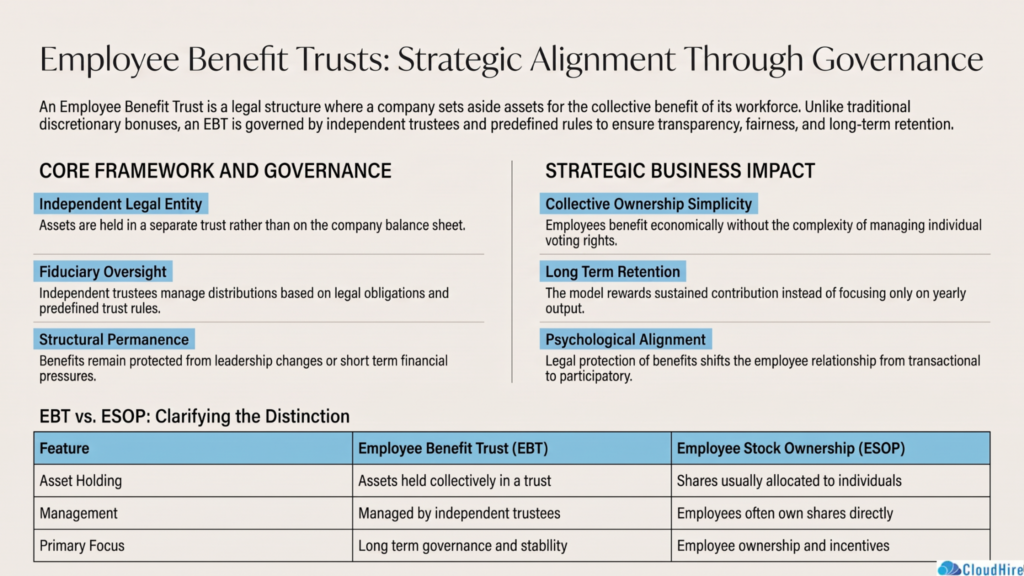
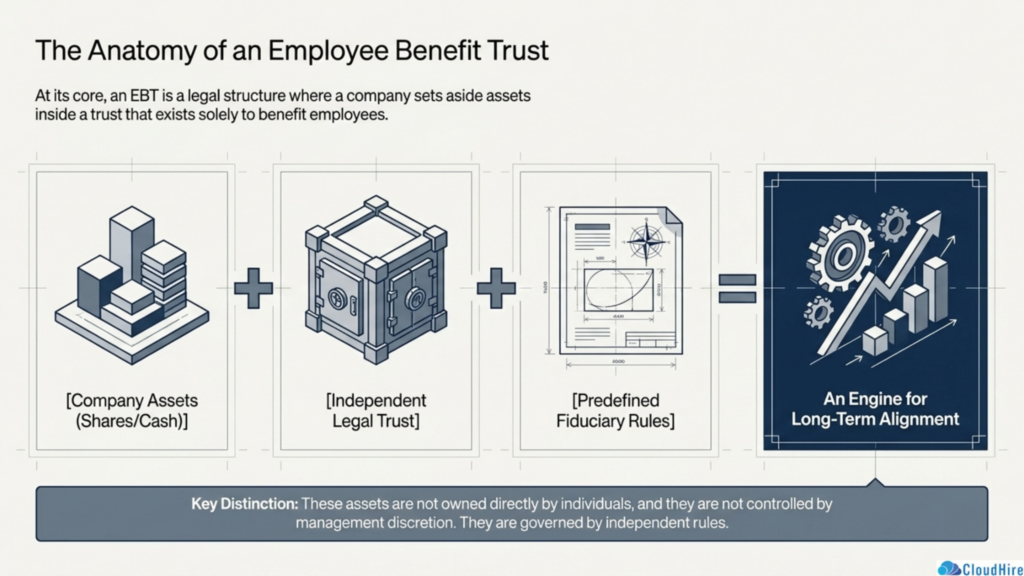
At its core, an employee benefit trust (EBT) is a legal structure where a company sets aside assets, usually shares or cash, inside a trust that exists solely to benefit employees. These assets are not owned directly by individuals and not controlled by management discretion(but governed by predefined trust rules and fiduciary duties.) Instead, they are governed by predefined rules and fiduciary duties designed to protect employee interests over the long term.
This distinction changes everything.
What is EBT in short?
An Employee Benefit Trust (EBT) is a legal trust that holds company assets, usually shares or cash, for the benefit of employees. Instead of management deciding who gets what, independent trustees distribute benefits according to predefined legal rules.
Why Companies Create Employee Benefit Trusts in the First Place
Most organizations don’t struggle because employees lack talent. They struggle because employees don’t feel aligned, valued, or secure enough to invest long-term energy.
Traditional compensation models reward output today. EBTs reward contribution over time.
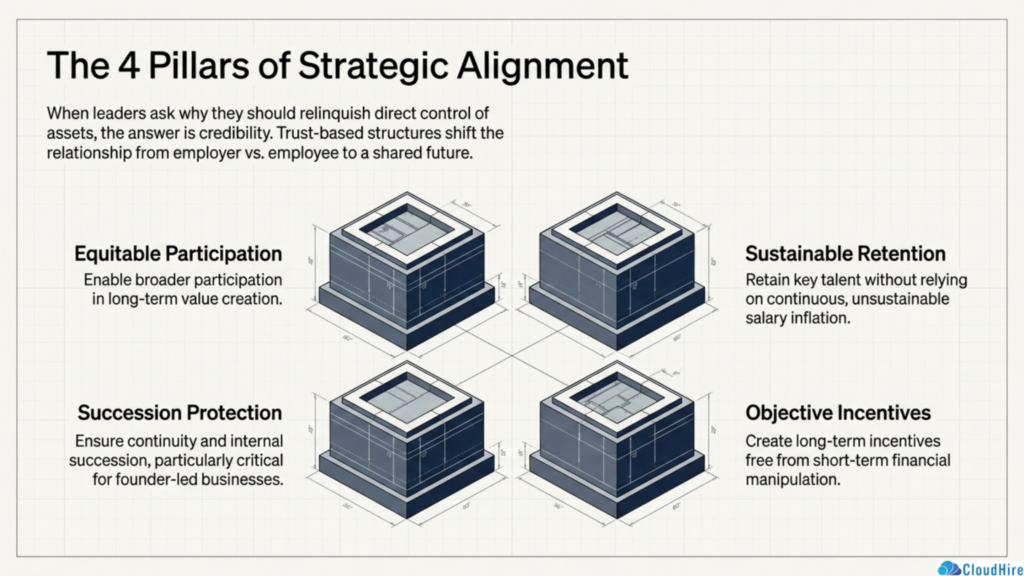
When people ask what is employee benefit trust is, what they’re really asking is why companies would give up control of assets. The answer is alignment. Trust-based benefit structures shift the relationship from “employer vs employee” to “shared future.”
EBTs are often created to:
- Enable broader, more equitable participation in long-term value
- Retain employees without relying on continuous salary inflation
- Support succession planning in founder-led or privately held businesses
- Protect employee benefits from leadership changes
- Create long-term incentives without short-term manipulation
Unlike bonuses or stock grants that can be changed overnight, an EBT is governed by legal obligations. That permanence is what builds credibility.
How an Employee Benefit Trust Actually Works
An EBT is set up as an independent legal entity. Assets are transferred into the trust, and trustees manage them on behalf of employees according to the trust deed.
The key point most people miss: management does not control distribution arbitrarily.
Instead, the trust defines:
- Who qualifies as a beneficiary
- What benefits can be distributed
- Under what conditions distributions happen
- How conflicts of interest are handled
- What happens during exits, acquisitions, or closures
This structure ensures benefits are not subject to favoritism, leadership mood swings, or short-term financial pressure.
This is why employee benefit trust is as much about governance as it is about money.
A Simple Example of How an Employee Benefit Trust Works
Imagine a private company wants to reward employees for helping the business grow over many years. Instead of giving shares directly to every employee, the company transfers some shares into an employee benefit trust.
Independent trustees manage those shares based on the trust rules. As employees become eligible, they may receive bonuses, shares, or other benefits from the trust. The company cannot simply change the rules whenever it wants because the trust is managed separately.
This allows employees to benefit from the company’s long-term success while keeping the ownership structure simple.
Step-by-Step: How an Employee Benefit Trust Is Set Up
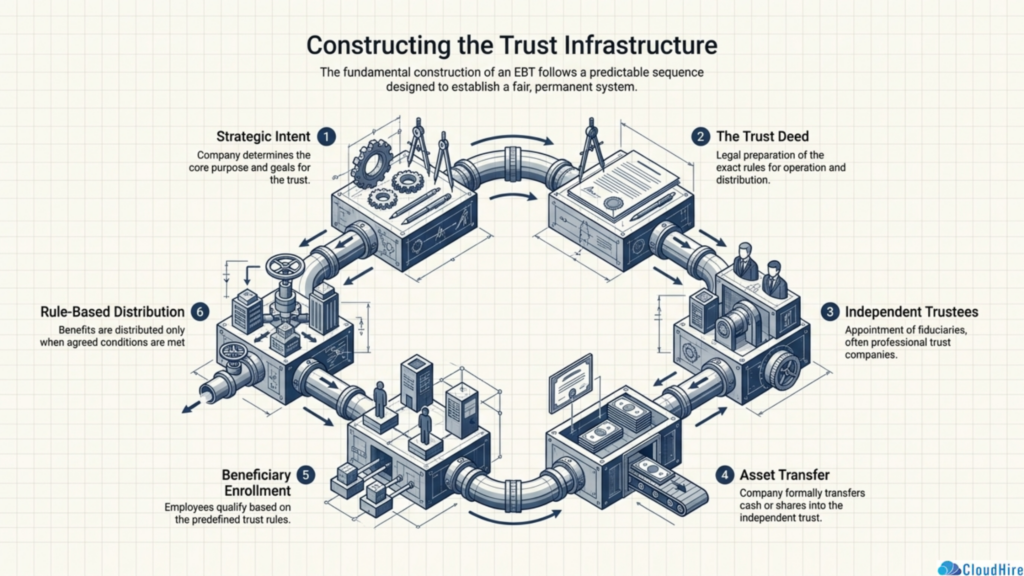
Although the legal process differs by country, most employee benefit trusts follow the same basic steps:
- The company decides why it wants to create the trust.
- A trust deed is prepared with the rules for how it will operate.
- Independent trustees are appointed.
- The company transfers shares or cash into the trust.
- Employees become beneficiaries according to the trust rules.
- Benefits are distributed when the agreed conditions are met.
The goal is to create a fair system that continues to work even as company leadership changes.
Employee Benefit Trust vs ESOP: What’s the Difference?
Although they both help employees benefit from company success, they work differently.
| Employee Benefit Trust (EBT) | ESOP |
| Assets are held in a trust | Employees usually receive shares directly |
| Managed by independent trustees | Employees own their allocated shares |
| Often focuses on long-term governance | Often focuses on employee ownership and incentives |
| Common in private companies | Common in startups and public companies |
The right choice depends on the company’s goals, ownership structure, and long-term plans. We’ve worked with hiring teams long enough to see that compensation discussions are increasingly moving beyond salary and bonuses. Employee benefit trusts are becoming part of that conversation, especially for companies thinking about long-term retention and ownership.
Employee Benefit Trusts vs Traditional Bonus Plans
A traditional bonus rewards employees for short-term performance, usually every year. An employee benefit trust is designed to create long-term value.
With a bonus, the company decides how much to pay each year. With an employee benefit trust, the rules are set in advance and managed by trustees, making the process more consistent and transparent.
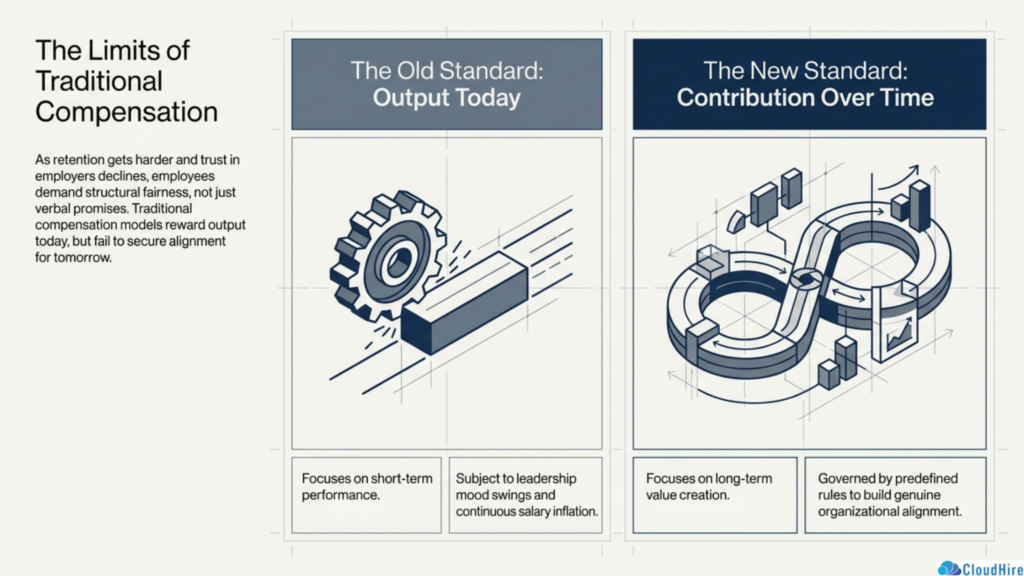
Many companies use both together. Bonuses reward today’s performance, while an employee benefit trust encourages employees to stay invested in the company’s future.
Common Myths About Employee Benefit Trusts
There are many misunderstandings about employee benefit trusts.
Myth: Employees automatically own the company.
Reality: Employees become beneficiaries of the trust, not direct owners of all company assets.
Myth: EBTs only exist to reduce taxes.
Reality: Their main purpose is long-term governance and employee benefits. Tax treatment depends on local laws.
Myth: Only large companies can create one.
Reality: Smaller private businesses can also use employee benefit trusts if they fit their long-term plans.
Myth: Management can change the rules whenever they want.
Reality: Once established, the trust is governed by legal rules and managed by trustees.
Employee Ownership Without Chaos
Many companies like the idea of employee ownership but fear operational complexity. EBT employee benefit trust solves that concern solve that.
Rather than giving shares directly to hundreds or thousands of employees, ownership is held collectively through the trust. Employees benefit economically without having to manage voting rights, paperwork, or individual equity decisions.
This model:
- Keeps cap tables clean
- Prevents fragmented ownership disputes
- Ensures continuity during leadership transitions
- Allows employees to benefit from long-term value creation
In practice, this has become especially attractive for privately held and family-run companies that want succession without selling out.
The Cultural Impact Most Leaders Underestimate
The biggest value of an EBT isn’t financial. It’s psychological.
When employees know part of the company is held specifically for them and protected legally, it changes how they show up. People think longer-term. Collaboration improves. Attrition slows.
This happens because the relationship shifts from transactional to participatory.
Employees stop asking:
“Will this help me survive this year?”
And start asking:
“Will this help us grow sustainably?”
That mindset shift is subtle, but powerful. It’s one of the least discussed benefits when explaining employee benefit trust, yet one of the most impactful.
Where Employee Benefit Trusts Go Wrong
EBTs are not automatically fair or effective. Poor design can create new problems.
Common mistakes include:
- Allocation formulas that reward tenure over contribution
- Trustee bodies lacking independence
- Vague distribution rules that confuse employees
- Treating the trust purely as a tax tool
- Failing to communicate how the trust actually works
When employees don’t understand the structure, trust erodes. When governance lacks transparency, skepticism grows. An EBT only works if people believe it exists for them, not around them.
Who Should Not Use an Employee Benefit Trust?
An employee benefit trust is not the right solution for every business.
It may not be suitable for companies that:
- Change ownership or business strategy frequently.
- Have unstable finances or struggle to fund employee benefits.
- Want complete flexibility over how rewards are distributed.
- Are looking only for short-term employee incentives.
If a company is not ready to commit to long-term employee benefits, a simpler bonus or incentive plan may be a better fit.
The Legal Backbone That Makes EBTs Credible
A key reason employee benefit trusts carry weight is fiduciary duty. Trustees are legally obligated to act in the best interest of beneficiaries the employees, not the company leadership.
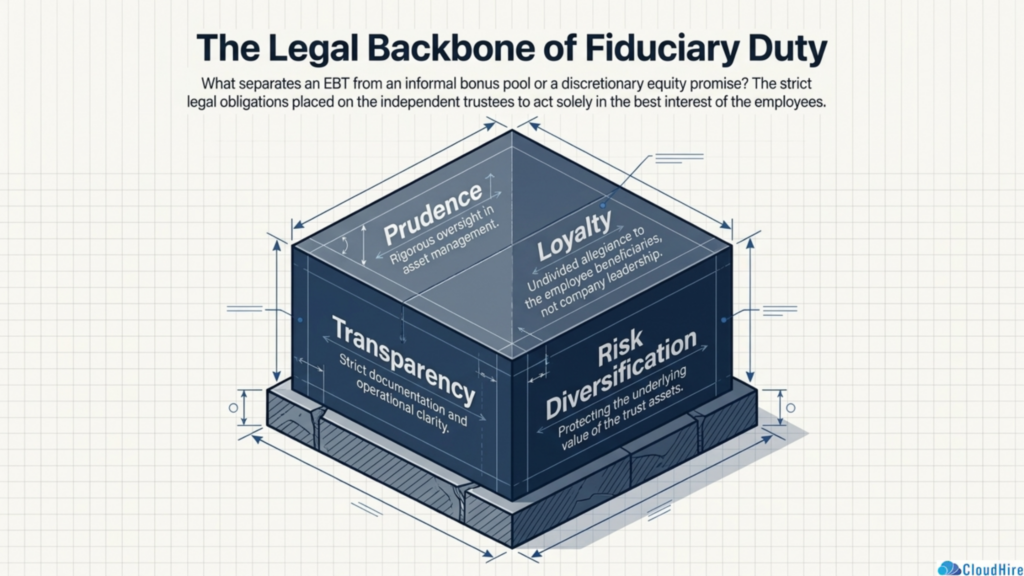
In many jurisdictions, benefit trusts operate under strict frameworks that require:
- Prudence in asset management
- Loyalty to beneficiaries
- Transparency and documentation
- Risk diversification
These obligations protect employees from misuse while giving companies credibility when claiming long-term commitment to their workforce.
This legal backbone is what separates EBTs from informal bonus pools or discretionary equity promises.
Employee Benefit Trusts and Taxation Realities
Discussions around employee benefit trust taxation often create confusion, largely because tax treatment depends on jurisdiction, trust structure, and how benefits are distributed.
While EBTs can offer tax efficiency when structured properly, their primary value is governance, not avoidance. Poorly designed trusts created purely for tax reasons face higher scrutiny and reputational risk. Organizations that prioritize transparency and long-term fairness tend to see stronger outcomes than those focused narrowly on tax optimization.
How Employee Benefit Trust Rules Differ Across Countries
Employee benefit trust rules are not the same everywhere.
Some countries have detailed laws covering how trusts are created, taxed, and managed. Others have different structures or may not use employee benefit trusts at all.
Because of these differences, companies should always take legal and tax advice in the country where the trust will operate instead of assuming the same rules apply everywhere.
Employee Benefit Trusts and Modern Employer Branding
Today’s workforce pays attention to how companies distribute value not just how much they pay.
EBTs signal:
- Long-term thinking instead of quick wins
- Shared success instead of executive-first rewards
- Structural fairness instead of verbal promises
For candidates, especially mid-career professionals, this matters. It suggests stability, ethical governance, and respect for contribution.
That’s why employee benefit trust increasingly shows up in employer branding conversations, even if quietly.
Why Employee Benefit Trusts Matter for Hiring and Employer Branding
Today’s candidates look beyond salary. Many also want to know whether a company shares success with its employees and invests in their future.
An employee benefit trust can help demonstrate that commitment. It shows the company is thinking beyond yearly bonuses and building a long-term relationship with its workforce.
While an employee benefit trust alone won’t attract great talent, it can strengthen employer branding and give candidates more confidence in the company’s long-term vision.
EBTs as Part of Responsible Growth
As expectations around corporate responsibility rise, EBTs are being used as tools for inclusive wealth creation. Instead of concentrating equity upside among founders and investors, value is shared with the people building the company every day.
Some organizations are extending trust benefits across geographies and job levels, ensuring access isn’t limited to senior or high-paying roles. When done right, this builds trust not just internally, but externally with customers, partners, and even regulators.
When an Employee Benefit Trust Makes Sense (And When It Doesn’t)
EBTs are powerful, but they aren’t universal solutions.
They work best for companies that:
- Have stable or growing profitability
- Value long-term employee retention
- Want to avoid short-term incentive volatility
- Are thinking seriously about succession or ownership continuity
They are less effective when companies:
- Change strategy frequently
- Lack financial transparency
- Treat benefits as purely transactional
Understanding what an employee benefit trust is also means knowing whether your organization is culturally ready for it.
The Bigger Picture
At its core, an employee benefit trust is not just a legal structure. It’s a statement.
It says the company believes value should be shared, protected, and governed, not negotiated behind closed doors or distributed unevenly. It says long-term alignment matters more than short-term optics.
That is why what is employee benefit trust keeps showing up in serious conversations about sustainability, fairness, and modern work not as a trend, but as infrastructure.
Frequently Asked Questions
What is the employee benefit trust definition?
An employee benefit trust is a legal trust set up by a company to hold assets (usually shares or cash) for the benefit of employees, ex‑employees and their dependents. It is run by independent trustees who must act in the best interests of those employees, not the company.
Why do companies create an employee benefit trust?
Companies use EBTs to:
- Hold shares or cash to fund bonuses and long‑term incentive plans.
- Support share option schemes, growth shares, or joint share ownership plans.
- Create an internal market for private company shares and help with succession or buyouts.
The goal is to align employees with company performance and manage incentives centrally.
How is an employee benefit trust different from an employee ownership trust?
An employee benefit trust is mainly a vehicle to hold assets and deliver incentives to employees, often selectively. An employee ownership trust typically holds a controlling stake in the business for the benefit of all employees, focusing on long‑term employee ownership of the company itself.
Who are the trustees and how does an employee benefit trust work?
Trustees are often professional trust companies or specialist administrators appointed by the employer. They must:
- Keep the trust independent.
- Manage and invest assets.
- Decide who gets what and when, in line with the trust rules and law.
What are the benefits of an employee benefit trust for employees?
EBTs can:
- Give employees access to company shares and long‑term value growth.
- Provide a structured way to receive bonuses or deferred compensation.
- Protect benefits if the company runs into financial trouble, because assets are held in trust, not on the company’s own balance sheet.
Hire faster with CloudHire
Search 700M+ profiles, run AI interviews and launch outreach on one platform — free to start, no demo call required.