
Why Introverts Feel Invisible in Remote Work and How to Change That
On this page
(Without Becoming Someone Else)
TL;DR: Remote employees become more visible by reducing contribution friction through documentation, asynchronous communication, written follow-ups, following TRACE frameworks and consistent knowledge sharing instead of relying on meetings. Managers can improve recognition by measuring outcomes over activity, creating multiple ways to contribute, and rewarding lasting business impact rather than online presence.
Remote work was supposed to be the great equalizer. No loud conference rooms, interruptions, performative meetings. For introverts, it sounded like a promised land.
Yet many introverted professionals report the opposite: A persistent anxiety that they are invisible, under-recognized, or quietly sidelined in distributed teams.
This is the quiet panic of remote work where contribution is no longer about what you think, but how visibly and legibly you signal that thinking. And this is where the common advice goes wrong. The problem isn’t that introverts need to “break out of their shell.” The problem is that remote systems reward presence signals more than intellectual value.
To understand how to contribute more at remote work, introverts don’t need louder voices. They need a system that makes their thinking visible.
The Quiet Panic of Remote Work
The popular belief is that remote work naturally favors introverts. You can think deeply, work independently, and avoid performative office politics. On paper, this sounds ideal.
In practice, introvert remote work challenges often intensify rather than disappear.
Remote environments reward presence signals: quick Slack replies, early Zoom participation, visible commentary during live discussions. These signals get mistaken for engagement, leadership, and impact.
Consider the highly competent engineer who ships reliable code and spots architectural risks early but rarely interrupts Slack threads or speaks first on Zoom. Their ideas exist, but they surface late or not at all. Meanwhile, louder contributors shape decisions simply by being earlier in the conversation.
This is why many introverts struggle with how to contribute more at remote work. Not because they lack insight, but because their natural thinking rhythm doesn’t match the visibility mechanics of distributed teams.
The Real Problem Isn’t Introversion, It’s Contribution Friction
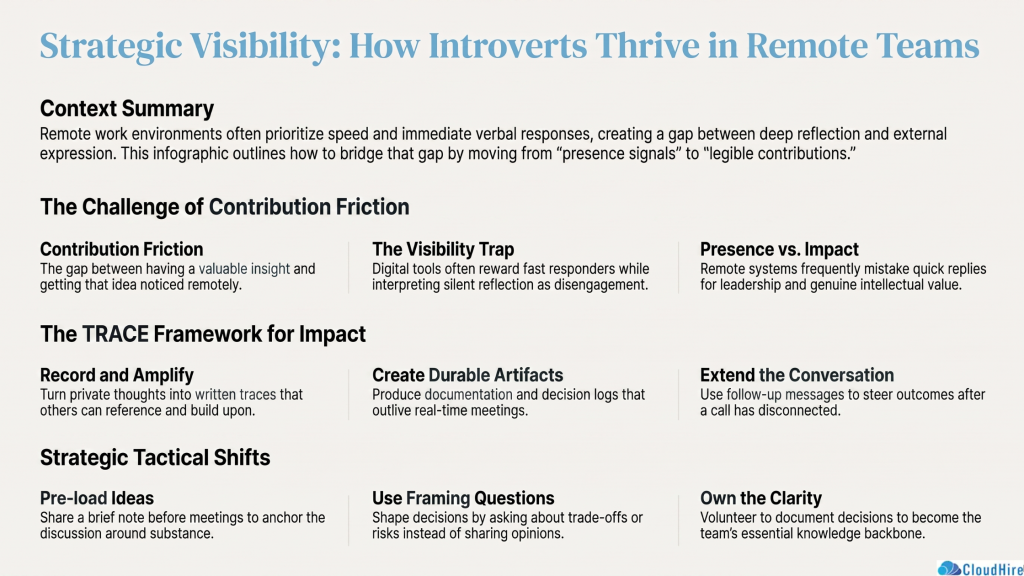
Introversion itself isn’t the blocker. The real issue is the contribution friction, the gap between deep thinking and external expression in remote systems.
In physical offices, contribution often happens through proximity. In remote work, it happens through tools: Slack, Notion, email, and Zoom. These tools favor speed, interruption, and constant availability.
For reflective thinkers, this creates friction. Ideas form slowly, carefully, and often after a conversation ends. By the time clarity arrives, the decision may already be made.
Compare two contributors:
- One speaks confidently in every daily stand-up, even when they’re unsure.
- Another sends a thoughtful post-meeting document outlining risks and alternatives after no one is paying attention.
Both are contributing, only one is rewarded. This is a structural issue in remote work communication, not a personality flaw tied to introversion at work.
Imagine this scenario: “Many introverts recognize the feeling that follows. A meeting ends. The call disconnects. And ten minutes later, the clearer version of the idea finally arrives. It’s sharper, more useful, and addresses the real risk. But now it feels awkward to raise. The moment has passed. So the thought stays private, not because it lacked value, but because the system had no space for delayed clarity.”
Why “Speak Up More” Is Bad Advice for Introverts
“Just speak up more” is the most well-meaning and damaging advice introverts receive at work.
Forcing real-time participation increases cognitive load. Instead of focusing on the quality of ideas, introverts must split attention between processing, timing, and social performance. The result is often a shallower contribution or silence.
Remote work intensifies this problem. Meetings are compressed, interruptions feel more aggressive, and latency creates social awkwardness. Many remote rituals are built on extrovert norms: brainstorming out loud, verbal alignment, and spontaneous reactions.
Research and lived experience consistently show that teams often reward first speakers, not best thinkers. This undermines psychological safety and lowers overall decision quality.
Ironically, telling introverts to speak more often leads to worse outcomes for them and for the team.
Contribution ≠ Talking: Redefining What “Showing Up” Means Remotely
To increase remote work contribution, we need a more precise definition of what contribution actually is.
In knowledge work, contribution typically falls into three categories:
- Idea generation: producing original insights, risks, or alternatives
- Decision shaping: influencing how choices are framed, evaluated, or sequenced
- Execution clarity: translating decisions into clear next steps, documentation, or systems
Introverts often excel in all three, but their contributions remain invisible because they don’t map cleanly to “meeting presence.”
Remote teams frequently conflate contribution with participation. But participation is an activity; contribution is an outcome. A single well-timed framing question can alter a decision more than ten minutes of discussion. A clear decision log can prevent weeks of misalignment.
When contribution is redefined this way, introversion stops being a disadvantage. It becomes an underutilized asset.
The Visibility Trap: Why Introverts Get Overlooked Online
One of the least discussed aspects of remote work communication is its algorithmic nature. Tools like Slack, Notion, and email don’t just transmit information; they rank it implicitly through timestamps, notifications, and thread positioning.
Fast responders rise to the top. Silent thinkers fade into the background.
This creates what can be called the visibility trap. Silence is interpreted not as thoughtfulness, but as disengagement. Even when introverts are deeply involved, their lack of ambient signals makes their contribution hard to detect.
“This misinterpretation often surfaces during performance reviews. Feedback sounds like “we’d like to hear you speak up more” or “you should be more visible.” Rarely does it mention the documents quietly holding projects together or the risks that were flagged early but not loudly. Over time, introverted contributors learn that effort without visibility doesn’t translate into recognition, even when outcomes improve.”
The solution isn’t to be louder, it’s to be legible.
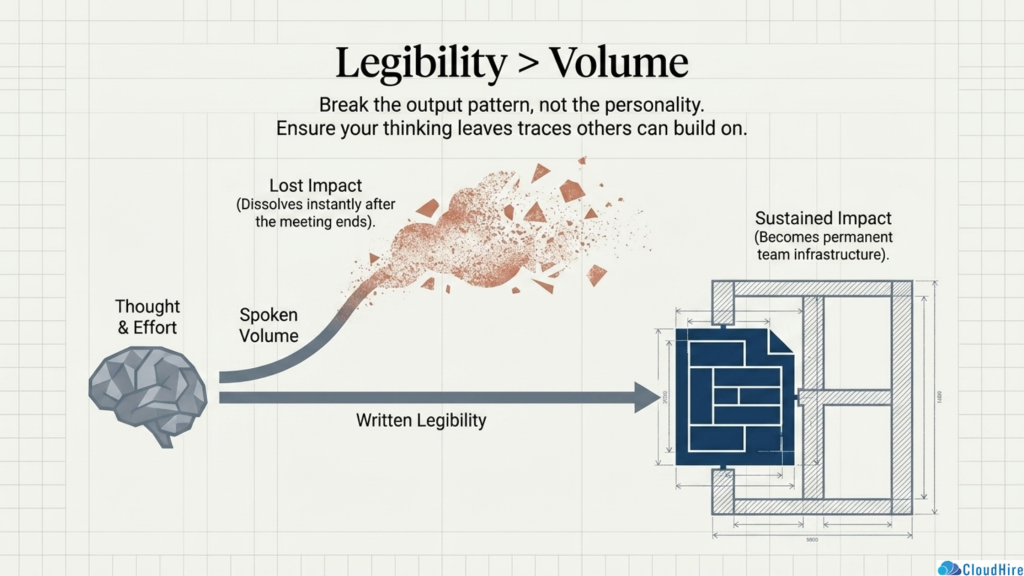
Legibility means ensuring that your thinking leaves traces others can see, reference, and build on. Without these traces, even excellent work risks being forgotten.
Breaking the Introverted Self (Without Breaking Yourself)
The phrase “breaking the introverted self” sounds violent, and it should. Because what usually breaks introverts at work isn’t introversion, but sustained pressure to perform extroversion.
A healthier interpretation is this: break the output pattern, not the personality.
Introverts don’t need to become more energetic. They need to become more intentional about how and when their energy is deployed. This is where energy-aware contribution matters.
Instead of spending limited energy on draining activities (unstructured meetings, spontaneous debates), introverts can redirect effort toward high-leverage outputs that persist over time.
This shift doesn’t require becoming someone else. It requires designing a contribution system that respects cognitive rhythms while still meeting the visibility demands of remote work.
Tactical Shifts: How Introverts Can Contribute More Strategically
This is where abstract reframing turns into practical leverage. The following shifts are not about doing more, but about doing what already comes naturally more visibly and strategically.
- Pre-load ideas before meetings
Sending a short note or document beforehand allows your thinking to shape the discussion before real-time dynamics take over. It also anchors the conversation around substance, not spontaneity. - Write before speaking
For many introverts, clarity emerges through writing. Drafting thoughts before meetings improves confidence and precision, making spoken contributions more impactful when they do happen. - Use follow-up messages as influence tools
Decisions often solidify after meetings. A thoughtful Slack recap or email can steer outcomes long after the call ends, often with more influence than anything said live. - Ask framing questions instead of sharing opinions
Questions like “What trade-off are we optimizing for here?” or “What risk are we assuming if this fails?” shape decisions without requiring assertive self-expression. - Create durable artifacts
Documents, summaries, and decision logs outlive meetings. They turn private thinking into shared infrastructure, increasing long-term impact.
One clear recap can outweigh ten spoken comments. This is how introverts succeed in remote work, not by competing for airtime, but by owning clarity.
The TRACE Framework for Introverted Visibility
Introverts don’t need to become louder. They need a system that helps their ideas travel further.
CloudHire uses the TRACE Framework as a simple way to think about sustainable visibility in remote work.
| Step | What it Means | Example |
| T – Think deliberately | Don’t rush ideas. Organize them before sharing. | Draft key points before meetings. |
| R – Record your thinking | Leave written traces others can revisit. | Create a short design note or project update. |
| A – Amplify asynchronously | Influence discussions outside live meetings. | Share a follow-up in Slack or Notion after the meeting. |
| C – Create durable artifacts | Produce documentation that outlives conversations. | Decision logs, playbooks, retrospectives. |
| E – Extend conversations | Keep important discussions moving after meetings end. | Ask clarifying questions or summarize next steps. |
The goal isn’t to increase how often you speak. It’s to increase how often your thinking shapes decisions.
The Introvert Advantage in Remote Teams (That No One Talks About)
When remote teams function well, they rely heavily on skills introverts often possess in abundance: deep focus, pattern recognition, risk sensing, and long-range thinking.
Introverts are frequently the ones who notice inconsistencies, anticipate downstream consequences, and maintain documentation that keeps teams aligned. These are not flashy contributions, but they are foundational.
In many distributed teams, the “quiet person” eventually becomes the knowledge backbone, the one others rely on for context, history, and judgment. The tragedy is that this value is often recognized late, or only after damage has occurred.
Remote work, done right, should amplify these strengths, not suppress them.
What Managers Get Wrong About Quiet Employees
Managers often mistake silence for disengagement. In physical offices, body language and presence fill in gaps. In remote environments, those cues disappear, and silence becomes suspicious.
This leads to performance evaluations that reward visibility over impact, airtime over outcomes.
Effective remote leadership requires new metrics: quality of artifacts, decision influence, consistency of follow-through, and clarity of communication. When these are prioritized, introverted contributors stop being “quiet employees” and start being recognized as system stabilizers.
In our internal analysis, we found that managers account for around 70% of the variance in employee engagement, making management quality one of the strongest predictors of team performance.
How Managers Can Build Introvert-Friendly Remote Teams
Supporting quieter employees isn’t about encouraging everyone to speak more. It’s about creating multiple ways to contribute.
Managers can make a significant difference by:
- Sharing meeting agendas before discussions.
- Accepting written feedback after meetings.
- Measuring outcomes instead of participation.
- Rotating facilitators so the same voices don’t dominate.
- Recognizing documentation, planning, and decision quality during performance reviews.
- Leaving space for asynchronous discussion before final decisions are made.
The most inclusive remote teams don’t lower expectations. They widen the paths through which people can contribute.
Remote Work Practices That Reward Introverts
The way a team communicates often matters more than the personalities within it.
| Traditional Practice | Introvert-Friendly Alternative |
| Brainstorming live | Collect written ideas before discussion |
| Unstructured meetings | Share agendas in advance |
| Instant decisions | Allow time for written follow-ups |
| Verbal status updates | Maintain shared project dashboards |
| Verbal feedback | Combine conversations with written summaries |
Small changes like these improve participation for everyone, not just introverts.
Mistakes Introverts Make Without Realizing It
Many introverts don’t struggle because they lack good ideas. They struggle because they unintentionally make those ideas difficult to discover.
Some of the most common mistakes include:
- Waiting until an idea feels perfect before sharing it.
- Assuming good work will naturally be noticed.
- Treating meetings as the only place where influence happens.
- Never following up after discussions.
- Avoiding visibility because it feels like self-promotion.
- Documenting work without explaining why it matters.
Influence grows when valuable work is easy to find, not when it stays private.
Career Growth Strategies for Quiet Employees
Career growth in remote work depends less on personality than on consistency.
Employees who quietly produce excellent work often assume that managers will automatically notice. Unfortunately, remote work rarely works that way.
Instead:
- Share monthly accomplishment summaries.
- Volunteer to document important decisions.
- Become the person who simplifies complex problems.
- Write project retrospectives others can learn from.
- Build expertise in a specific area that colleagues naturally associate with your name.
Visibility doesn’t require constant speaking. It requires creating work that people repeatedly return to.
Conclusion: You Don’t Need to Be Louder, You Need to Be Legible
Remote work doesn’t need louder voices. It needs clearer signals.
Introverts don’t need to change who they are to contribute more. They need systems that allow their thinking to travel, persist, and influence.
Contribution is not a personality trait. It’s an architectural outcome.
When thinking becomes legible, durable, and well-timed, impact compounds quietly. And in the long run, that kind of contribution speaks louder than volume ever could.
Frequently Asked Questions
Why do introverts struggle more in remote work?
Remote work often rewards visibility over reflection. Introverts usually generate strong ideas but may need more time to process information before contributing.
Can introverts become leaders in remote teams?
Yes, many effective remote leaders rely on clear writing, thoughtful decision-making, documentation, and consistent follow-through rather than constant verbal communication.
Should introverts force themselves to speak more?
Not necessarily. Speaking at the right moment matters more than speaking more often. Written communication, documentation, and thoughtful follow-ups can create just as much influence.
How can managers recognize quiet employees fairly?
Evaluate outcomes, documentation quality, decision influence, and long-term impact instead of relying only on meeting participation or visible activity.
The best remote teams reward impact, not visibility. CloudHire helps businesses hire and build distributed teams that do the same.
Put your job search on autopilot
CloudHire Smart Apply tailors your resume and applies to matching roles for you — so you spend your time interviewing, not scrolling.