
Why Is It Hard to Find Jobs as a Recent Graduate?
On this page
You did what you were told. Good grades, a degree, maybe an internship or two. And yet the inbox is full of rejections, or worse, silence. If you are asking why entry-level jobs are so hard to find, you are not imagining it. The system you are up against was not built with you in mind.
The real enemy here is not your resume. It is what recruiters call the experience paradox, the strange loop where every entry-level listing asks for two to three years of experience before you can get your first real job. This blog breaks that loop down and shows you how to work around it.
The Experience Paradox, Explained
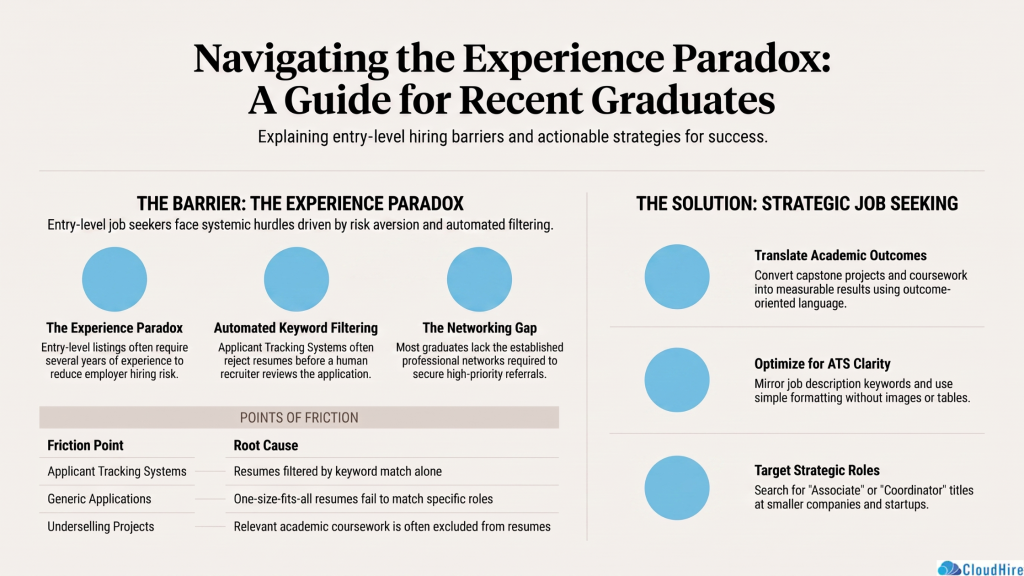
Here is the trap. Companies want proven talent because hiring is expensive and risky for them. So even junior job listings get written with experience requirements meant to filter out risk, not necessarily to filter out you. The problem is, this filtering happens automatically, often before a human even reads your application.
This is not a personal failure. It is a structural issue in how graduate hiring works today, and understanding that is the first step to beating it.
Where Recent Graduates Actually Lose Ground
Most graduates lose time in a few predictable places. Here is where the real friction happens.
| Problem area | What is actually happening |
| Applicant tracking systems (ATS) | Resumes get filtered by keyword match before a human sees them |
| Generic resumes | One resume sent to fifty jobs rarely matches any of them well |
| Underselling coursework and projects | Real, relevant experience gets left off because it “doesn’t count” |
| Networking gap | Most first job search advice ignores that graduates often have small networks |
| Applying only to “graduate programs” | Missing smaller companies that hire without a formal program |
Each of these is fixable. None of them require magically gaining three years of experience overnight.
How to Fight the Experience Paradox
Here is a practical way to counter this, step by step.
- Translate coursework, capstone projects, and part-time work into resume bullet points that use outcome language, not just task language
- Target company size strategically. Smaller companies and growing startups often hire on potential, not just resume history
- Use your college career resources and alumni network before cold applying, since referrals bypass a lot of ATS filtering
- Apply to roles labeled “associate” or “coordinator,” not just ones explicitly marked “entry-level,” since new grad job titles vary widely by company
- Build one visible proof of skill, a portfolio, a small project, or a certification relevant to your target role
This is the heart of good entry-level career strategy. It is not about lowering your standards. It is about being more targeted than a generic job search allows.
Rewriting Your Resume for the ATS Filter
Since resume keyword matching is often the first hurdle, treat your resume like it needs to pass a test before a human ever sees it.
- Mirror the exact language used in the job description for skills and tools
- Avoid image-heavy or overly designed resume templates, since many ATS platforms cannot read them properly
- List measurable outcomes from projects and coursework, even academic ones, using numbers where you can
- Keep formatting simple: standard fonts, clear headers, no tables or text boxes inside the file itself
Small changes here often make a bigger difference than sending out twice as many applications.
The Networking Gap Nobody Warns You About
Most job search advice assumes you already have a professional network. Recent graduates usually do not, and that is not your fault. Building one from zero is possible with a focused approach:
- Reconnect with professors, especially ones who supervised projects or research
- Join alumni groups on LinkedIn tied to your university and department
- Reach out to people one or two roles ahead of where you want to be, not just senior leaders
- Attend smaller, focused events in your field instead of large generic career fairs
This kind of graduate networking strategy builds slowly, but it compounds. Referrals consistently outperform cold applications in most industries.
People Also Ask
Why can’t I get an entry-level job even with a degree?
Many entry-level listings unintentionally screen out fresh graduates through experience requirements written for risk reduction, not accuracy. Tailoring applications to specific roles and using referrals where possible helps counter this.
Do internships actually help you get hired after graduation?
Yes, internships are one of the strongest signals employers look for, since they show applied experience. If you lack one, relevant projects, freelance work, or volunteer roles can partially fill that gap.
Should recent graduates apply to jobs they are not fully qualified for?
Generally yes, especially if you meet most core requirements. Job postings often list ideal, not mandatory, qualifications. Applying selectively to roles where you meet 60 to 70 percent of requirements is a reasonable approach.
How long does it typically take a graduate to find their first job?
It varies widely by field and market conditions, but three to six months of active, targeted searching is common. A longer timeline does not necessarily reflect a weaker candidate profile.
The Real Takeaway
The experience paradox is not a reflection of your worth as a candidate. It is a flaw in how hiring pipelines are built, and once you see it clearly, you can work around it instead of taking every rejection personally. Focus your energy on tailored applications, real proof of skill, and small consistent networking steps, not just volume.
CloudHire’s AI matching looks past rigid experience filters and connects graduates with roles that fit their actual skills and projects, not just years on a resume.
Ready for a fairer shot at your first role? Start your CloudHire profile today.
Put your job search on autopilot
CloudHire Smart Apply tailors your resume and applies to matching roles for you — so you spend your time interviewing, not scrolling.