
How Accurate Are AI Tools at Predicting Good Employee Performance?
On this page
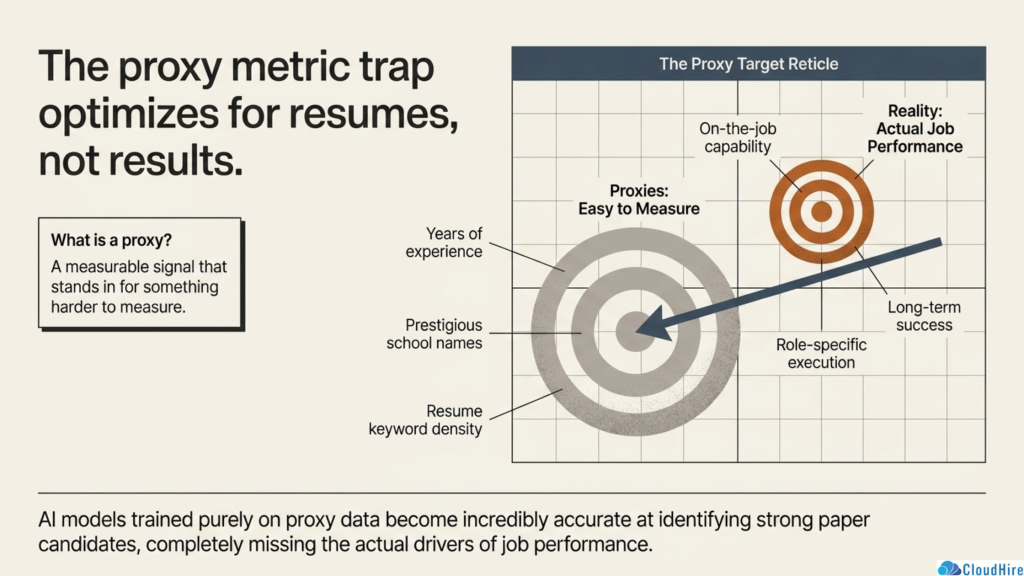
Every hiring tool eventually gets asked the same hard question. Does this actually predict who will be good at the job, or does it just predict who looks good on paper? The honest answer separates trustworthy AI hiring tools from ones quietly repeating an old mistake. The real enemy here is the proxy metric trap, the tendency to optimize for signals that are easy to measure, like resume keywords or test scores, instead of signals that actually connect to on the job performance.
This blog looks honestly at AI predictive hiring accuracy, what it can and cannot reasonably promise, and how to evaluate any tool’s claims with a critical eye.
The Proxy Metric Trap, Explained
A proxy metric is something measurable that stands in for something harder to measure directly. Years of experience is a proxy for skill. A prestigious school name is a proxy for capability. Resume keyword density is a proxy for relevant expertise. None of these are useless, but none of them are the actual thing you care about, which is how well someone will perform in your specific role.
AI models trained primarily on these proxies can become very good at predicting who looks like a strong candidate on paper, without necessarily predicting who will actually perform well once hired. This distinction matters enormously and gets glossed over in a lot of vendor marketing.
What “Accuracy” Actually Means in Hiring Predictions
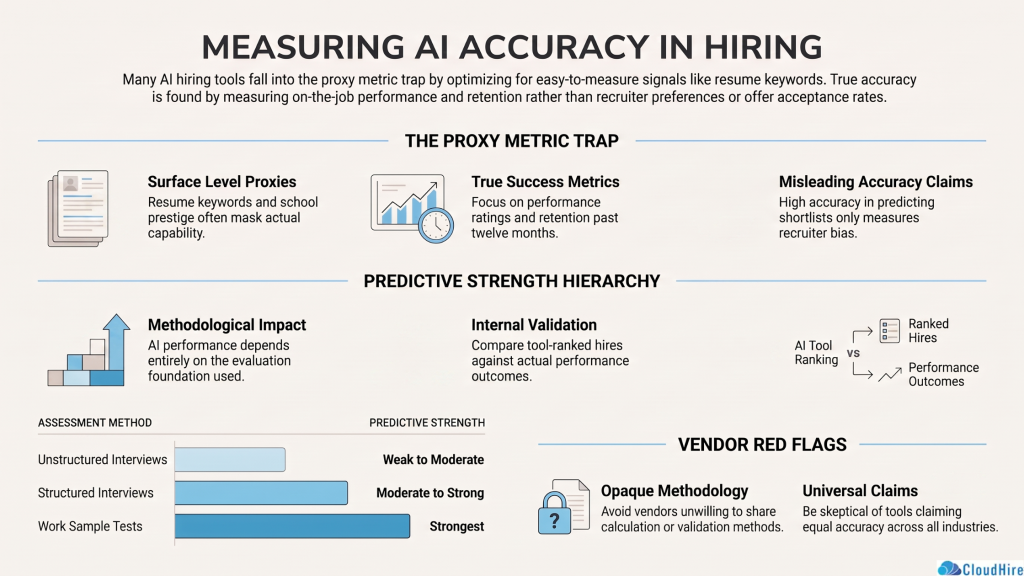
“Our AI is 90 percent accurate” sounds impressive until you ask the follow up question: accurate at predicting what, exactly? Common but very different claims include:
- Predicting who will be shortlisted by a human recruiter (a proxy for recruiter preference, not job performance)
- Predicting who will accept an offer if extended one
- Predicting performance ratings after six or twelve months on the job
- Predicting retention, meaning who stays in the role past a year
Only the third and fourth claims genuinely measure quality of hire prediction. The first two are useful operationally but say little about whether the tool identifies people who will actually succeed in the role.
Structured vs Unstructured Predictors
Decades of hiring research, well before AI entered the picture, established a rough hierarchy of how well different assessment methods predict job performance. This context is useful when evaluating any AI tool’s claims.
| Assessment method | General predictive strength |
| Unstructured interviews (casual conversation, gut feel) | Weak to moderate |
| Resume screening alone | Weak to moderate |
| Structured interviews with consistent questions and scoring | Moderate to strong |
| Work sample tests or job simulations | Strong |
| Combination of structured interviews and work samples | Strongest |
AI tools that simply automate resume screening or unstructured evaluation inherit the same weaknesses those methods always had. AI tools built around structured criteria and job-relevant signals tend to perform better, not because the AI is magic, but because it is built on a stronger evaluation foundation to begin with.
How to Actually Validate an AI Tool’s Predictions
Rather than trusting a vendor’s accuracy claim at face value, run your own internal validation using hiring outcome tracking.
- Select a sample of recent hires made using the tool’s recommendations
- Track their performance ratings, manager feedback, and retention at the six and twelve month marks
- Compare outcomes for candidates the tool ranked highly against those it ranked lower but your team hired anyway
- Look for meaningful gaps between the two groups, not just a general sense that hiring “feels” better
This kind of internal check takes patience, often six months to a year of data, but it is the only reliable way to know if a tool’s predictions hold up in your specific context, not just in a vendor’s case study from a different industry.
Red Flags in an Overconfident AI Vendor
Some vendor claims deserve healthy skepticism. Watch for:
- Precise sounding accuracy numbers with no explanation of what they measure or how they were calculated
- No willingness to share validation methodology or allow independent review
- Claims of universal accuracy across all industries and role types, which is rarely realistic given how different job performance drivers can be
- Pressure to adopt without a pilot or trial period to test real outcomes first
A tool built on evidence based hiring principles should welcome scrutiny, not deflect it. This is also where CloudHire’s approach differs, since our matching criteria are built to be reviewed and validated against your own hiring outcomes, not treated as a black box you have to trust blindly.
Building a Feedback Loop Between Predictions and Actual Performance
The most reliable AI hiring tools improve over time because they are designed to learn from real outcomes, not just initial screening data. A good predictive validity feedback loop includes:
- Regularly feeding performance review data back into the evaluation criteria
- Adjusting weightings when certain predictors turn out to correlate poorly with actual performance in your context
- Involving hiring managers in reviewing whether top AI-ranked hires are actually excelling, not just getting hired
Without this loop, even a well-built tool can quietly drift out of alignment with what your company actually needs over time.
Setting Realistic Expectations Internally
No tool, AI or otherwise, predicts job performance with certainty. Manage internal expectations by framing AI recommendations as a strong starting signal, not a final verdict. Combining tool recommendations with structured interviews and, where relevant, work sample assessments consistently produces better outcomes than relying on any single method alone.
People Also Ask
How accurate are AI hiring tools at predicting job performance?
Accuracy varies significantly by tool design and what exactly is being measured. Tools built on structured, job-relevant criteria tend to outperform those relying mainly on resume keyword matching or informal interview impressions.
Can AI predict which candidates will be good employees?
AI can meaningfully improve prediction when combined with structured evaluation methods and validated against real performance data, but it should not be treated as a guaranteed or infallible predictor on its own.
How do I know if our AI hiring tool’s accuracy claims are real?
Ask the vendor exactly what outcome their accuracy figure measures, request validation methodology, and ideally run your own internal comparison between tool-ranked hires and actual performance over six to twelve months.
Should we combine AI screening with structured interviews?
Yes, this combination generally produces stronger predictive results than either method alone, since structured interviews and work samples remain some of the strongest known predictors of job performance.
The Real Takeaway
The proxy metric trap is easy to fall into because proxies are simple to measure and performance is not. The tools worth trusting are the ones built around job-relevant, validated criteria and willing to be checked against your own real hiring outcomes, not just a polished accuracy claim from a sales deck.
Want a matching approach built to be validated, not just trusted? See how CloudHire’s criteria connect to real hiring outcomes.
Hire faster with CloudHire
Search 700M+ profiles, run AI interviews and launch outreach on one platform — free to start, no demo call required.