
ATS vs CRM: Which One Does Your Hiring Team Actually Need?
On this page
Every recruiter gets asked this eventually, usually after someone in leadership says “we need to buy a system.” Then comes the panic Googling, the vendor demos, and the eternal question: do we need an ATS, a CRM, or both?
Here’s the plain-English version of what each one actually does, and more importantly, which one solves your problem right now.
The One-Line Version
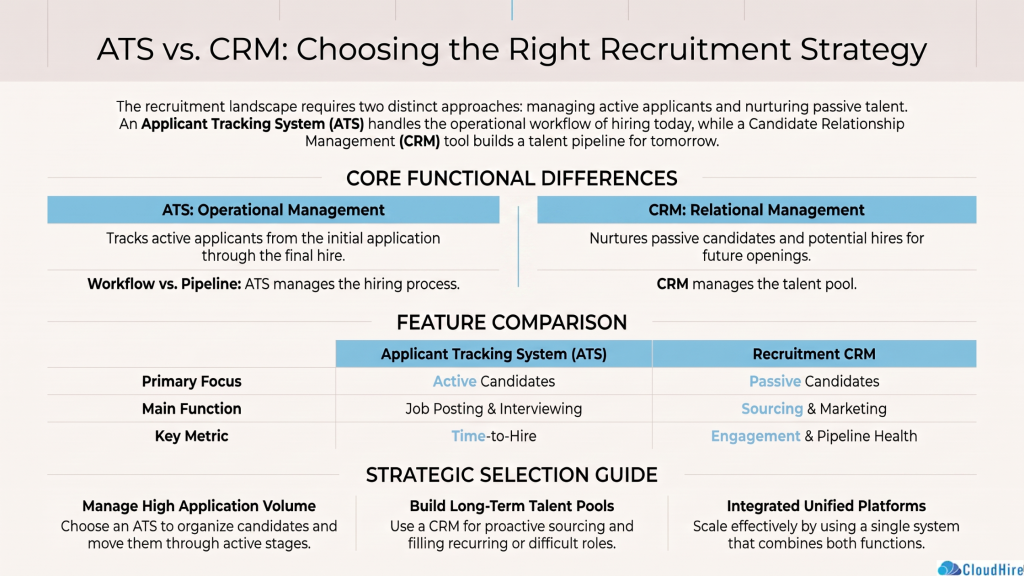
ATS – Manages Active Applicants
Tracks everyone who applied to a job you posted from “applied” to “hired.” It’s workflow management for open roles.
CRM – Manages Potential Candidates
Stores and nurtures people you want to hire someday, even if there’s no open role yet. It’s relationship management for your talent pipeline.
That’s really it. One is about people who raised their hands. The other is about people you haven’t talked to yet or people you liked but couldn’t place last time.
What Is an Applicant Tracking System (ATS)?
An Applicant Tracking System (ATS) is recruitment software that helps hiring teams manage active candidates after they apply for a role. It organizes applications, moves candidates through each hiring workflow, stores interview feedback, generates offer letters, and provides hiring analytics that make the recruitment process easier to manage.
What Is a Recruitment CRM?
A Recruitment CRM (Candidate Relationship Management) helps companies build relationships with passive candidates before they apply for a job. Instead of managing applications, it focuses on candidate sourcing, candidate engagement, recruitment marketing, and maintaining a long-term talent pipeline so recruiters already know who to contact when new roles open.
Let’s Make It Even More Concrete
Picture a recruiter at a mid-size company. They post a role for a product designer. 200 applications come in. They screen, shortlist, interview, reject, and eventually hire. Every step of that process that’s what an applicant tracking system handles. Stages, statuses, interview notes, offer letters, all of it.
Now that the same recruiter is at a conference and meets someone impressive who isn’t job-hunting right now. Or they remember a candidate from six months ago who was great but the timing wasn’t right. They want to stay in touch, send the occasional message, and have that person ready when the next role opens. That relationship lives in a candidate relationship management tool, a recruitment CRM.
One is operational and another is relational.
So When Does Each One Actually Matter?
You need an ATS if…
Applications are coming in and you have no organised way to track or move them forward
You need a CRM if…
You’re doing proactive sourcing, building talent pools, or hiring for hard-to-fill roles repeatedly
You need both if…
You’re scaling fast, hiring across multiple teams, and playing both inbound and outbound talent games
Most early-stage companies start with just an ATS and bolt on CRM capabilities later. The problem is that they wait too long; by the time they need a talent pipeline, they have nothing to pull from.
Which One Does Your Hiring Team Actually Need?
The easiest way to decide is to work backwards from your biggest hiring challenge.
| If your situation is… | You probably need… |
| You’re hiring today and struggling to organize applications | ATS |
| You regularly lose great candidates because there isn’t an open role | Recruitment CRM |
| You’re hiring for difficult or recurring positions | ATS + CRM |
| You’re growing quickly across multiple teams or locations | An integrated ATS + CRM platform |
A simple rule works surprisingly well. If your biggest problem starts after someone clicks “Apply,” focus on your Applicant Tracking System. If the problem starts before someone even knows your company is hiring, invest in Candidate Relationship Management. Once both challenges exist at the same time, managing them inside one platform usually becomes the better long-term decision.
The Features That Actually Differ
- Job posting and distribution – ATS does this, CRM doesn’t. CRM doesn’t care about posted jobs, only people.
- Pipeline stages – ATS tracks applied → screened → interviewed → offered → hired. CRM tracks aware → engaged → interested → ready to hire.
- Automated outreach – Both can do it, but for very different reasons. ATS sends “thanks for applying.” CRM sends “here’s why you’d love working here.”
- Candidate database/talent pool – CRM’s whole job. ATS typically only stores people who applied to something.
- Reporting on time-to-hire – ATS. CRM reports on engagement and pipeline health instead.
ATS vs CRM: Side-by-Side Comparison
| Feature | Applicant Tracking System (ATS) | Recruitment CRM |
| Primary purpose | Manage active candidates | Build relationships with passive candidates |
| Job posting | Yes | No |
| Application tracking | Yes | No |
| Interview management | Yes | No |
| Offer management | Yes | No |
| Talent pools | Limited | Yes |
| Candidate nurturing | Limited | Yes |
| Email campaigns | Basic | Advanced |
| Candidate sourcing | Limited | Yes |
| Recruitment marketing | No | Yes |
| Hiring analytics | Strong | Engagement-focused |
| Best for | Filling open roles | Building future hiring pipelines |
The Part Most Vendors Won’t Tell You
A lot of companies buy an ATS, use 30% of it, and then wonder why their passive candidate sourcing isn’t working. The answer is they’re using a process tool for a relationship problem.
And the reverse happens too, teams buy a CRM to feel organised, but they still don’t have a clean way to actually move candidates through an active hiring process. So things fall through the cracks at the exact moment it matters most.
The honest answer is that the line between ATS and CRM is blurring. The best modern recruitment platforms are handling both a system that can manage an active pipeline and a long-term talent pool without jumping between tools.
ATS + CRM vs an All-in-One Hiring Platform
Many organizations eventually end up with both an ATS and a CRM. The problem isn’t owning both tools; it’s managing two disconnected systems that store different versions of the same candidate information.
| Separate ATS + CRM | Integrated Hiring Platform |
| Candidate data lives in multiple systems | One shared candidate record |
| Manual imports and exports | Information updates automatically |
| Duplicate profiles | Single source of truth |
| Different reporting dashboards | Unified hiring analytics |
| Recruiters switch between tools | One continuous hiring workflow |
An integrated platform doesn’t replace good recruiting. It removes the administrative work that gets in the way of it.
How We Handle This at Cloudhire
At CloudHire, we built the platform around this exact problem. Most of our customers come to us having used a standalone ATS that couldn’t help them build a pipeline or a CRM with no proper hiring workflow automation built in.
We give you both in one place. Active applicants move through structured stages. Passive candidates sit in talent pools with automated touchpoints keeping them warm. And because it’s all connected, when a new role opens, you’re not starting from zero; you’re pulling from people you already know.
That’s not a feature checklist thing. It’s just a saner way to hire.
Common Mistakes Companies Make When Choosing an ATS or CRM
The biggest hiring problems usually aren’t caused by buying the wrong software. They’re caused by expecting software to fix broken recruiting processes.
Some of the most common mistakes include:
- Buying a Recruitment CRM before building a structured hiring process inside an Applicant Tracking System.
- Treating an ATS as a long-term talent pipeline instead of actively nurturing candidates.
- Keeping passive candidates in spreadsheets where relationships quickly become outdated.
- Purchasing enterprise talent acquisition software with features the team never uses.
- Measuring software success by the number of features instead of hiring outcomes like time-to-hire, quality-of-hire, and candidate experience.
Technology works best when it supports a clear hiring strategy rather than replacing one.
One Question to Help You Decide Right Now
Ask yourself: Is your biggest problem that applications are a mess to manage, or that you don’t have anyone to hire when you need them?
The first is an ATS problem. The second is a CRM problem. If the answer is both, which it usually is past a certain hiring volume, you need a platform that doesn’t make you choose.
ATS vs CRM vs HRIS: What’s the Difference?
Many buyers also compare ATS and CRM with an HRIS, but they solve different problems.
| System | Primary Purpose |
| Applicant Tracking System (ATS) | Manage applications, interviews, and hiring decisions for open roles. |
| Recruitment CRM | Build relationships with future candidates and maintain long-term talent pools. |
| HRIS | Manage employee records, payroll, benefits, attendance, and HR administration after someone is hired. |
Choosing between an ATS and a CRM is only the first decision. Building a hiring process that works across both is the bigger one. CloudHire is designed to support that process from start to finish.
Book a demo
Frequently Asked Questions
Does CloudHire work as both an ATS and a recruitment CRM?
Yes, and that’s kind of the whole point. At CloudHire, we didn’t want teams juggling two systems with no connection between them. Active applicants, passive candidates, and talent pools all live in the same platform. When a role opens, you can pull from your existing pipeline instead of starting a new search from scratch every time.
Can I use a CRM instead of an ATS?
Technically, yes, people do it. But you’ll feel the gaps quickly. A CRM isn’t built to handle inbound applications at volume, manage interview stages, or produce time-to-hire reporting. It’s like using a notebook as a project manager. Works until it really doesn’t. Use the right tool for the active process and bolt on CRM for the long game.
What’s the difference between a talent pool and a candidate database?
A candidate database is a passive storage of names and CVs sitting somewhere. A talent pool is actively maintained: segmented by role type, seniority, or skill set, with some form of ongoing engagement so candidates actually remember who you are when you eventually reach out. One is a filing cabinet. The other is a warm bench you can pull from.
Is an ATS worth it for small companies that only hire a few people a year?
If you’re hiring fewer than 10 people a year, a lightweight ATS is still worth it, not for the complexity, but for the paper trail. When hiring decisions get questioned (and they do), having documented stages, interview notes, and rejection reasons is what protects you. The right ATS at this size is simple and cheap, not enterprise software. Don’t over-buy.
Why do so many companies end up with both an ATS and a CRM that don’t talk to each other?
Because they bought them at different times, for different problems, from different vendors. The ATS came first when there were applications to manage. The CRM came later when someone said, “We need to build a proactive sourcing strategy.” Now there are two systems, two datasets, and a recruiter manually copying information between them. This is extremely common and extremely fixable; it just requires choosing integrated tools from the start rather than duct-taping them together later.
Hire faster with CloudHire
Search 700M+ profiles, run AI interviews and launch outreach on one platform — free to start, no demo call required.