
Coca-Cola’s International HRM Strategy: What It Got Right and What Any HR Team Can Actually Use
On this page
TL;DR: The global dominance of The Coca-Cola Company (TCCC) is not merely a triumph of marketing or supply chain logistics; it is fundamentally a testament to its sophisticated International Human Resource Management (IHRM) strategy. With operations in more than 200 countries and 70% of its volume originating outside the United States, TCCC’s ability to synchronize global integration with local responsiveness relies heavily on its human capital architecture. An analysis of TCCC’s strategic practices reveals that its success stems from a “strategy-as-practice” approach, where HR initiatives are embedded in everyday tasks across all organizational levels, rather than being confined to executive suites. For modern HR teams, the actionable lessons lie in balancing rigorous global standards with hyper-localized talent management, leveraging digital transformation for employee resilience, and aligning human capital with broader corporate sustainability goals.
Coca-Cola comes up constantly in international HR case studies, and usually for good reason. Few companies have operated across as many countries, for as long, while keeping a recognizable brand and a functioning global workforce intact. The company operates in more than 200 countries, which is more countries than there are member states in the United Nations, and it has done this largely through a franchise bottling model rather than owning every operation directly. That structure alone creates an unusual HR challenge, since Coca-Cola has to maintain consistency across a business it does not fully control operationally in most markets.
This post looks at what actually held that together on the HR side, and what is genuinely usable for a company that is nowhere near Coca-Cola’s size.
The Structural Challenge Coca-Cola’s HR Function Had to Solve
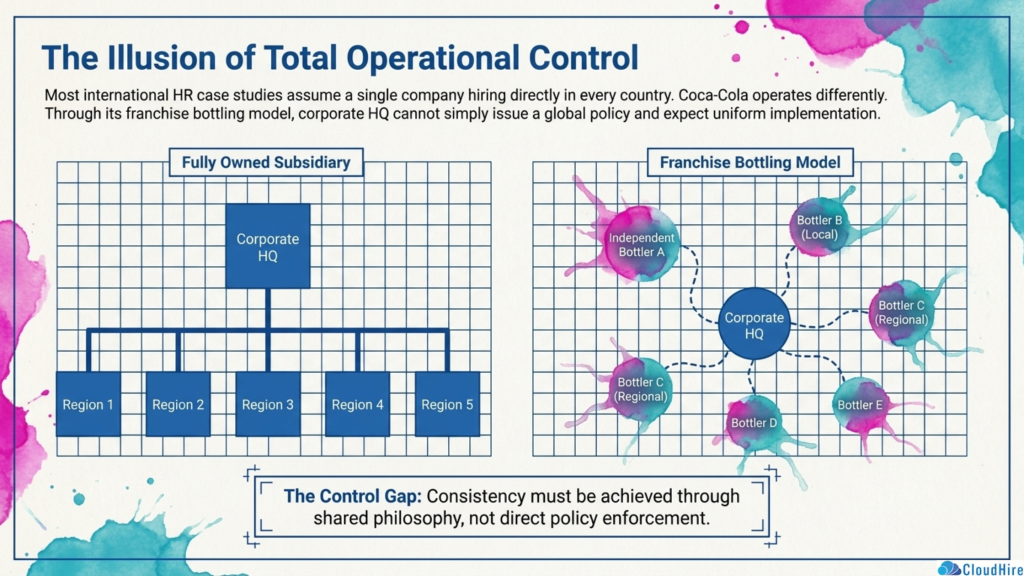
Most international HR strategy case studies involve a single company hiring directly in each country. Coca-Cola’s situation is more complicated, because in most markets, the actual bottling and distribution is run by independent or partially owned bottling partners, not by the Coca-Cola Company itself. This means Coca-Cola’s corporate HR function cannot simply issue a global policy and expect uniform implementation the way a fully owned subsidiary structure would allow.
The way this gets managed, based on how the company’s own HR approach has been described in business and academic case studies, is by separating what stays centralized from what gets localized. Corporate HR sets a common philosophy, rather than a single rigid policy, and local operations, including bottling partners, build their specific practices around that philosophy. This is sometimes summarized as the company’s broader approach to global operations, often described as thinking globally while acting locally, applied to HR just as much as to marketing and product formulation.
What Coca-Cola Centralizes and What It Leaves Local
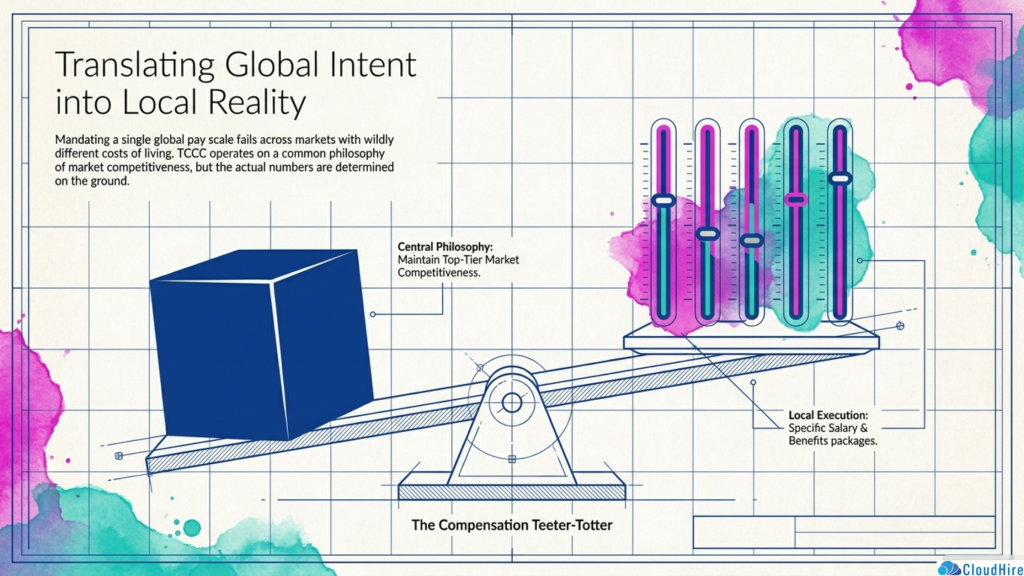
A useful way to understand this is through compensation, since it illustrates the pattern clearly. Rather than mandating a single global pay scale, which would make no sense across markets with wildly different costs of living and labor markets, the company has operated on the basis of a common compensation philosophy, generally aiming for total pay packages that are competitive with strong employers in each local market. The philosophy is centralized. The actual salary numbers are set locally.
Staffing follows a similar pattern. Wherever possible, local operations are staffed predominantly with local talent rather than relying heavily on expatriates sent from headquarters. This is not just a cost decision. Local hires generally understand the local market, culture, and regulatory environment far better than someone parachuted in from outside, which matters enormously for a consumer brand that depends on local relevance.
Where the company has invested more centrally is in developing a group of internationally minded managers who move across markets over the course of their careers, building both a shared understanding of the company’s global priorities and the kind of cross-market fluency that is hard to develop by staying in one country. This is a deliberate long-term investment in leadership pipeline, not a short-term staffing fix.
Strategy-as-Practice: Embedding HR in Daily Operations
Coca-Cola’s HR strategy exemplifies the concept of “strategy-as-practice” (SaP), where strategic actions are realized through the everyday tasks of participants at all levels. This decentralized approach allows for greater agility and involvement, ensuring that HR initiatives are not just top-down mandates but are organically integrated into the daily workflow of employees worldwide. Our recent studies highlight that when HR and line managers share views on strategic integration, organizations achieve higher levels of operational coherence and employee alignment.
For any HR team, the lesson is clear. “Strategy must be operationalized at the grassroots level.” This involves empowering local managers to adapt global HR frameworks to their immediate operational realities. By focusing on the process rather than just the outcome, Coca-Cola fosters a culture where every employee contributes to the strategic vision, enhancing overall organizational performance. This method contrasts with traditional hierarchical models, offering a more resilient structure capable of adapting to rapid market changes.
The Lesson Underneath the Case Study
Strip away the scale, and the core lesson is something almost any growing company can apply. Do not try to run identical HR policy in every country. Decide what actually needs to be consistent, usually philosophy, values, and standards of fairness, and let the implementation of those principles flex to fit local law, culture, and market conditions. Companies that get this backwards, either forcing identical policy everywhere or letting every market operate with no shared standards at all, tend to run into either compliance friction or a fragmented culture, sometimes both.
The other lesson worth pulling out is the deliberate investment in local staffing and local leadership development. It is tempting, especially early in a company’s international growth, to lean heavily on people from headquarters to run new markets, since they already understand the company. The tradeoff is that this slows down building genuine local market understanding and can create a two-tier culture where headquarters staff are seen as the “real” leadership and local hires are seen as support. Prioritizing local talent for local leadership, even when it takes longer to build than sending someone from headquarters, tends to produce a stronger long-term result.
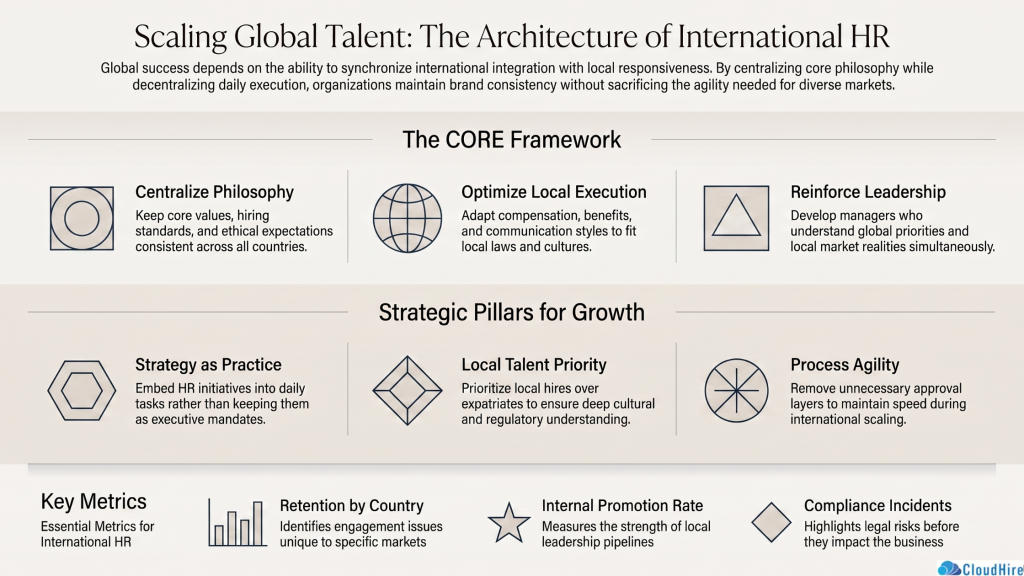
The CORE Framework: A Practical Model for International HR
The biggest lesson from Coca-Cola’s approach isn’t that everything should be standardized. It’s knowing what deserves consistency and what needs flexibility. Growing companies can apply the same principle through a simple framework.
| Principle | What It Means |
| C – Centralize philosophy | Keep your company values, hiring standards, leadership expectations, and ethics consistent across every country. |
| O – Optimize local execution | Adapt compensation, benefits, communication styles, and HR practices to local laws, cultures, and market expectations. |
| R – Reinforce leadership | Develop leaders who understand both the company’s global priorities and the realities of their local markets. |
| E – Evaluate consistently | Measure performance using the same principles everywhere while allowing teams to achieve results in ways that fit their market. |
Companies expanding internationally often fail because they choose one extreme. Either every office follows identical policies regardless of local realities, or every country creates its own approach with little connection to the wider business. The strongest international organizations maintain consistent principles while giving local teams enough flexibility to succeed in their own markets.
How We’ve Applied a Similar Approach at CloudHire
We are obviously a much smaller company than Coca-Cola, but the same tension shows up as soon as any company starts hiring across borders, and we have run into it directly while building out our own team. The instinct early on is to try to standardize everything, the same interview process, the same benefits language, the same management style, regardless of where someone is based. What we found is that this works fine for the parts that should genuinely stay consistent, like how we evaluate candidates or the standards we hold managers to, but it creates real friction when applied to things that should flex locally, like how feedback gets delivered or what benefits actually matter to someone in a given market.
The shift that helped was the same one described above. Get clear on which parts of our people practices are genuinely non-negotiable, and give real flexibility everywhere else, rather than either forcing uniformity or letting every hire be a one-off decision with no shared standard behind it. It is a simple idea, but it takes actually going through the friction of getting it wrong once or twice to actually believe it.
What Smaller Companies Should Not Copy
Coca-Cola’s HR strategy has taken decades to build, backed by resources that few organizations possess. Copying the entire system is neither realistic nor necessary.
Instead, smaller companies should avoid three common mistakes.
Don’t build unnecessary approval layers simply because large enterprises have them. Multiple levels of approval often slow hiring and decision-making without improving quality.
Don’t imitate enterprise HR processes before you’ve reached enterprise scale. Complex competency frameworks, dozens of management layers, and extensive policy manuals often create bureaucracy instead of better people management.
Most importantly, don’t over-standardize too early. A startup hiring across three countries doesn’t need identical benefits, communication styles, or management practices everywhere. What should remain consistent are hiring standards, company values, and expectations around performance and fairness. Everything else should adapt to local realities.
The goal isn’t to become Coca-Cola. It’s to borrow the principles that created consistency while keeping the agility that smaller companies naturally possess.
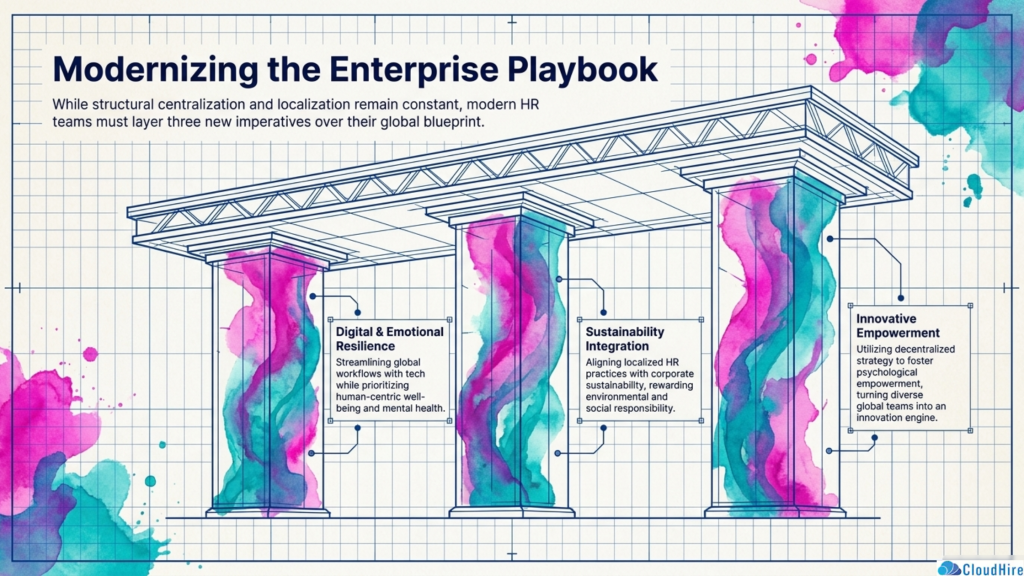
Actionable Insights for Modern HR Teams
Based on Coca-Cola’s demonstrated successes, several best practices emerge for HR teams operating in a global context:
- Embrace Glocalization in HR Policies: Develop core global HR principles but allow significant flexibility for local adaptation. This ensures compliance with local labor laws and cultural expectations while maintaining brand consistency.
- Decentralize Strategic Execution: Adopt a “strategy-as-practice” mindset by involving employees at all levels in strategic initiatives. This enhances buy-in and ensures that HR strategies are practical and relevant to daily operations.
- Invest in Digital and Emotional Resilience: Utilize digital tools to streamline HR processes but prioritize human-centric approaches that support employee well-being and mental health, especially in post-pandemic environments.
- Integrate Sustainability into HR Metrics: Align HR practices with corporate sustainability goals by recognizing and rewarding behaviors that contribute to environmental and social responsibility.
- Foster Innovation through Empowerment: Create HR systems that encourage psychological empowerment and innovative work behavior, turning the global workforce into a source of continuous innovation.
International HR KPIs Every Global Team Should Track
Building an international HR strategy is only half the job. The other half is measuring whether it actually works across different markets.
| KPI | Why It Matters |
| Retention by country | Identifies cultural, leadership, or engagement issues unique to specific markets. |
| Internal promotion rate | Measures whether leadership pipelines are developing locally instead of relying on headquarters. |
| Time-to-hire | Shows how efficiently talent is being attracted and hired across regions. |
| Offer acceptance rate | Reflects employer brand strength, compensation competitiveness, and candidate experience. |
| Compliance incidents | Highlights legal or regulatory risks before they become larger business problems. |
| Employee engagement | Indicates whether employees feel connected to both local teams and the broader organization despite geographic differences. |
Frequently Asked Questions
What is Coca-Cola’s international HR strategy known for?
It is often studied for balancing centralized HR philosophy, particularly around compensation principles and leadership development, with highly localized execution across the many countries and bottling partners it operates through.
Does Coca-Cola use expatriates or local staff in its international operations?
The company has generally prioritized staffing local operations with local talent where possible, using international assignments more selectively to build cross-market leadership experience rather than as the default staffing approach.
What can a smaller company actually learn from Coca-Cola’s HR approach?
The most transferable lesson is separating what should be centralized, values, philosophy, and fairness standards, from what should be localized, the specific implementation of those standards in each market.
Why does a franchise or bottling model make international HRM harder?
Because the parent company does not fully control operations in every market, which means HR consistency has to be achieved through shared philosophy and standards rather than direct policy enforcement everywhere.
Is centralizing HR policy globally ever the better approach?
For very early-stage international operations with few employees, some centralization can be simpler to manage. As headcount and country count grow, most companies find that some degree of localization becomes necessary to stay compliant and culturally relevant.
Where We Fit In
If you are trying to build an international HR approach that actually holds together the way Coca-Cola’s has over decades, the hiring layer is where that consistency either starts or breaks down. CloudHire helps growing companies bring the same candidates through a consistent, fair evaluation process everywhere, while still giving room for local hiring practices to flex where they need to. If your team is figuring out how to scale HR practices across new markets, it is worth building that hiring foundation with CloudHire before the policy debates even start.
Every global HR strategy eventually depends on the quality and consistency of its hiring process. That’s where CloudHire fits in.
Hire faster with CloudHire
Search 700M+ profiles, run AI interviews and launch outreach on one platform — free to start, no demo call required.