
Hiring Overseas Employees: Guide For Companies Doing It the Right Way
On this page
You have found a great candidate. The only problem is they live in a country where your company has no legal presence. This is the exact moment when a lot of hiring plans quietly stall, not because the candidate is not right, but because nobody on the team is fully sure what happens next.
Hiring overseas employees is not as complicated as it feels the first time you try it, but it does involve a few decisions that are easy to get wrong if you have never done it before. This guide walks through what actually needs to happen, in plain terms, so you can make the hire without guessing.
Let’s Clear Up a Few Myths First
Before getting into the process, it helps to separate what people assume about overseas hiring from what is actually true. Here is a quick comparison.
| What people assume | What is actually true |
| You need a company entity in every country you hire in | You can hire through an Employer of Record without setting up your own entity |
| Paying someone as a contractor is always simpler and safer | Contractor status has strict legal tests, and getting it wrong leads to misclassification penalties |
| Overseas employees are not entitled to benefits unless you choose to offer them | Most countries have mandatory statutory benefits that are not optional |
| Hiring overseas always takes months | Using an EOR, a single hire can often be completed in one to three weeks |
| Time zone differences make overseas teams hard to manage | With the right async communication habits, time zone gaps are manageable, not disqualifying |
Why Companies Hire Overseas in the First Place
The honest answer is usually a combination of cost and access. Salaries for the same role can vary significantly across countries, which lets companies stretch their hiring budget further. But cost is rarely the whole story anymore. Many companies are hiring overseas because the specific skill set they need, whether that is a particular engineering specialty or a language capability, is easier to find in another country than in their own.
There is also a resilience angle worth mentioning. A support team spread across three time zones can offer close to round the clock coverage without anyone working a night shift, which is a genuine operational advantage rather than just a cost play.
The Three Legal Routes to Hiring Someone Abroad
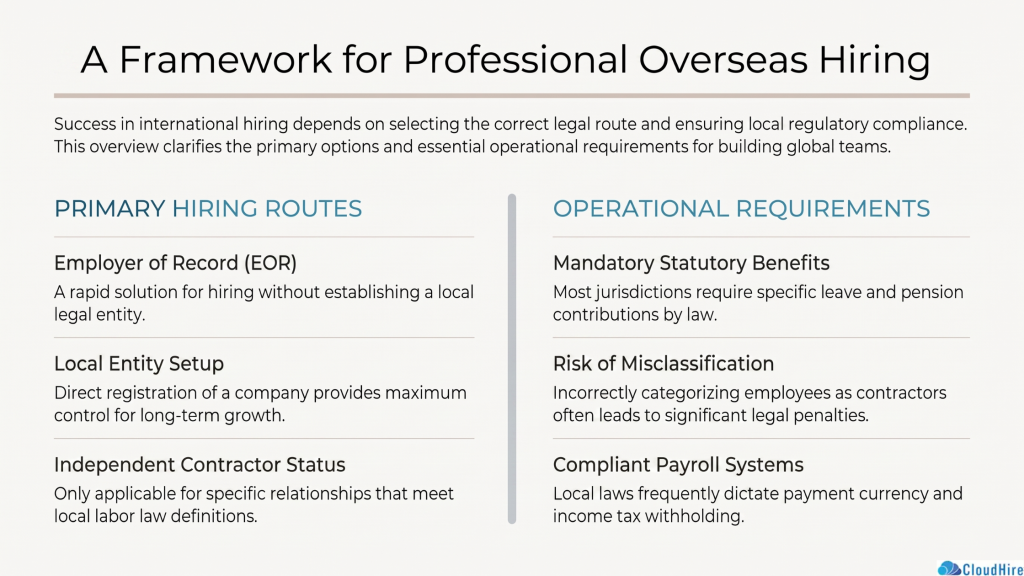
There are really only three ways to legally bring someone onto your team when they live in another country.
Route one: set up your own entity. This is the most involved option. You register a legal company in the employee’s country, which then becomes the employer on paper. It gives you full control but takes real time, usually months, and involves legal and accounting costs that only make sense once you plan to hire a meaningful number of people there.
Route two: use an Employer of Record. An EOR already has a registered entity in the target country and legally employs the person for you. You manage their work day to day, and the EOR handles the employment contract, payroll, tax withholding, and statutory benefits. This is by far the fastest route and has become the standard way companies test new markets or make one-off hires.
Route three: engage them as an independent contractor. This works, but only when the actual working relationship supports it. If the person works exclusively for you, follows a fixed schedule you set, and the relationship runs indefinitely, most countries’ labor authorities will consider that an employment relationship regardless of what the contract says. Treating a de facto employee as a contractor is the single most common overseas hiring mistake, and it can result in retroactive taxes, benefits, and penalties.
What You Actually Need Before Making an Offer
Here is a practical checklist worth going through before an offer letter goes out to someone overseas.
- Confirm the person’s legal right to work from their current location
- Decide which hiring route you are using, direct entity, EOR, or contractor, and confirm it matches the actual working relationship
- Check the country’s mandatory notice period and severance rules, since these apply even to new hires from day one in many jurisdictions
- Confirm statutory benefits, such as paid leave, national holidays, and pension or retirement contributions
- Set up a payroll method that pays the person in a currency and cadence that meets local legal norms
- Draft an employment contract or agreement that meets local requirements, not a copy of your home country’s standard template
Skipping any of these does not always cause an immediate problem, but it tends to surface later, often at the worst possible time, such as when the employee leaves the company or files a complaint.
Work Permits, Visas, and the Question People Usually Forget to Ask
If you are hiring someone who is a citizen and resident of the country they will work from, work permit questions typically do not apply, since they already have the right to work there. Where this gets more complicated is when someone wants to work for you from a country they are not a citizen of, for example a digital nomad situation. In those cases, the relevant question is not about your company sponsoring a visa in the traditional sense, but whether the individual has independent legal status to live and work in that country. Many countries now offer digital nomad visas specifically for this situation, but the responsibility for holding valid status generally sits with the individual, not the employer, though this varies by country and is worth confirming with local counsel for anything beyond a short-term arrangement.
Paying Overseas Employees Without Creating a Mess
Payroll is where a lot of the operational complexity of overseas hiring actually lives. A few things worth setting up correctly from the start:
| Consideration | Why it matters |
| Currency of payment | Some countries require or strongly prefer payment in local currency to comply with labor law |
| Tax withholding | The local employer, whether that is you or an EOR, is usually responsible for withholding income tax at source |
| Payment cadence | Monthly pay is standard in many countries, but some require more frequent pay cycles |
| Benefits contributions | Pension, health insurance, and social security contributions are often mandatory and calculated as a percentage of salary |
| Currency fluctuation | If salary is set in your home currency and converted at payment time, employees can see real pay swings from exchange rate movement |
Getting payroll wrong is rarely a dramatic, one-time failure. It is usually a slow accumulation of small compliance gaps that eventually surface during a tax audit or when an employee asks a benefits question nobody can answer.
Onboarding an Overseas Employee So They Actually Feel Part of the Team
Legal and payroll setup gets a lot of attention because it carries compliance risk, but the human side of onboarding an overseas hire matters just as much for retention. A new employee who joins a distributed team and spends their first month feeling disconnected from the rest of the company is a lot more likely to leave within the year.
A few habits that make a real difference include assigning a buddy from a different location rather than only from headquarters, scheduling live overlap time in the employee’s first two weeks even if it means someone else adjusts their hours temporarily, and documenting company knowledge in writing so a new hire in a different time zone is not stuck waiting hours for an answer to a basic question.
Frequently Asked Questions
Is it legal to hire someone who lives in another country?
Yes, as long as it is done through a proper legal route, either a direct entity, an Employer of Record, or a genuine independent contractor arrangement that matches the real working relationship.
How do you pay overseas employees?
Most commonly through payroll run by a direct entity or an Employer of Record, in the employee’s local currency, with tax withholding and statutory benefits contributions handled at the source.
What documents do you need to hire overseas staff?
Typically an employment contract that meets local legal requirements, tax registration documents where applicable, and proof of the employee’s right to work in their location. An EOR usually handles most of this documentation on your behalf.
Can you hire overseas employees without opening a local company?
Yes, This is the main reason Employer of Record services exist, and it is the fastest legal way to hire someone in a country where you have no entity.
What is the biggest risk in hiring overseas employees?
Misclassifying someone as a contractor when the real relationship functions as employment. This is the single most common and most costly mistake companies make when hiring overseas.
CloudHire
Finding the right remote candidate overseas is only half the job. CloudHire’s platform is built to help you manage the rest of it, from sourcing and screening candidates in new markets to keeping the hiring process organized as your team grows across countries.
If your next great hire happens to live somewhere your company does not yet have a legal presence, CloudHire can help you move on that hire without the process stalling out in the details.
Hire faster with CloudHire
Search 700M+ profiles, run AI interviews and launch outreach on one platform — free to start, no demo call required.