
Remote Staffing: The Surprising Strategy That’s Redefining Work (And Why You Should Care)
On this page
TL;DR: The biggest advantage of remote staffing isn’t saving money. It’s giving businesses access to talent they would never find locally. Companies that treat it as a business strategy, not a temporary trend, gain a lasting competitive edge.
Remote staffing isn’t just a pandemic hangover. Today it’s a strategic advantage that helps organizations compete for talent, build resilient operations, and unlock productivity that traditional hiring models often struggle to deliver. Many organizations exploring this model initially engage a remote staffing agency to design compliant, scalable hiring frameworks across regions.
If your company is still asking “Should we use remote staffing?” this guide will give you the hard facts, real benefits, and practical insights you need.
What Is Remote Staffing (And Why It’s More Than Remote Work)
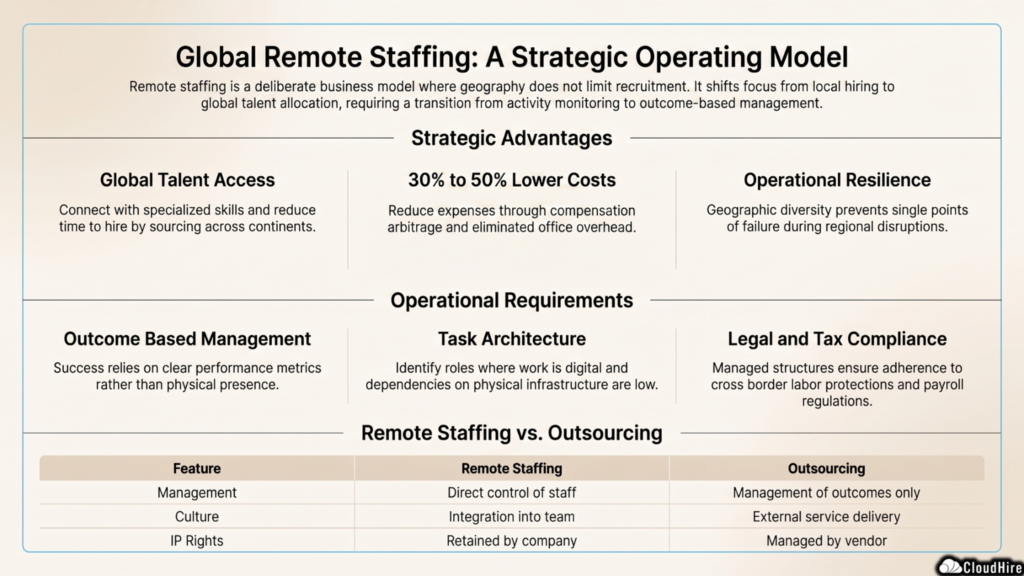
Remote staffing is the strategic sourcing and engagement of professionals who work outside traditional office settings, often across cities, countries, or continents. Unlike before, “remote work,” which might be an employee choosing to work from home occasionally, remote staffing is a deliberate business model where geography no longer limits recruitment, execution, or team composition. This is why remote staffing companies have emerged as strategic partners, helping businesses operationalize distributed workforce models rather than just filling vacancies.
This shift isn’t just theoretical, it’s reshaping how organizations hire and scale. For example, companies expanding beyond domestic talent pools experience higher satisfaction, better work-life balance, and increased productivity among workers who value flexibility and autonomy.
Remote staffing doesn’t merely let people telecommute. It lets teams tap the best people anywhere in the world, driving value across almost every dimension of how work gets done.
Which Roles Actually Work Best for Remote Staffing (And Which Don’t)
Not every role translates equally well to remote staffing. Organizations that succeed don’t “go remote” universally they map roles based on work type, interdependence, and output measurability. Many firms work with staffing agencies for remote jobs to break roles into remote-compatible components before hiring begins.
Remote staffing works best when:
• Work is digital, knowledge-based, or output-driven
• Tasks can be documented and transferred clearly
• Performance can be measured through outcomes
• Dependencies on physical infrastructure are low
Examples of strong remote roles include software engineering, design, data analytics, marketing operations, finance analysis, customer support, recruiting, and many research-based functions.
Roles that are harder, though not impossible, include those requiring physical equipment, high-security environments, or constant real-time coordination (e.g., lab technicians, facilities operations, certain hardware engineering roles).
The key isn’t job titles. It’s task architecture. Breaking roles into remote-compatible and location-dependent components often reveals hybrid solutions rather than all-or-nothing decisions.
Why Remote Staffing Is a Smart Talent Strategy
One of the biggest advantages of remote staffing is access and speed.
Before remote models became mainstream, employers often limited hiring to people who could physically relocate or commute to a workplace. Today, that barrier is gone. Accessing a global talent pool means:
- Easier access to rare and specialized skills
- Smaller time-to-hire windows when urgency matters
- More flexibility in scaling teams up or down based on demand
We found that firms using remote recruitment and interviewing tools often reduce time-to-hire and improve candidate engagement compared to traditional pipelines.
That matters in markets where demand for top talent outstrips supply. When you can hire across geographies, your talent pool grows not by 10% or 20%, but exponentially. Skilled professionals in one country can contribute meaningfully to teams on another, often without relocation hassles. To manage this scale efficiently, some businesses evaluate the best staffing agencies for remote jobs to accelerate sourcing in specialized skill categories.
The Cost Reality: Remote Staffing vs Traditional Hiring
Remote staffing is often discussed as a talent strategy, but it is also a financial model.
| Section | Cost Factor | Description |
| Cost Reality | Model Perspective | Remote staffing is not just a talent strategy—it is a financial operating model. |
| Cost Advantages | Reduced Office Overhead | Savings from less physical office space, utilities, and on-site infrastructure. |
| Lower Relocation Expenses | Eliminates or reduces employee relocation, travel, and mobility costs. | |
| Compensation Arbitrage | Ability to hire in lower-cost markets without sacrificing quality. | |
| Specialized Talent Access | Access to global specialists without local salary inflation. | |
| Hidden / Operational Costs | Compliance Management | Managing legal, tax, and labor regulations across multiple regions. |
| Collaboration & Security Tools | Investment in remote work platforms, cybersecurity, and communication tools. | |
| Process & Documentation Time | Time required to design workflows, SOPs, and reporting systems. | |
| Payroll & Classification Risks | Risks related to tax errors, payroll compliance, and contractor misclassification. |
Companies that approach remote staffing as “cheap labor” usually fail. Those that treat it as efficient global talent allocation gain both cost discipline and capability expansion. A staffing agency for remote jobs can also help model total workforce cost across regions, factoring compliance, payroll, and infrastructure tradeoffs.
Remote Staffing Helps Productivity If You Do It Right
There’s a long-standing myth that people working remotely are less productive than on-site workers. But data says otherwise.
Many studies, including our internal analysis shows that when remote roles are structured around clear outcomes, not “hours in a chair,” productivity rises. Remote workers often report fewer distractions and deeper focus, especially in knowledge-intensive roles where independent work matters most. According to workplace adoption statistics, a substantial share of workers report higher productivity and satisfaction when given flexible work options.
However, this doesn’t happen automatically. Productivity gains tend to show up when:
- Expectations are outcome-focused
- Roles are well documented and measurable
- Teams communicate clearly, especially asynchronously
- Tools and workflows support remote collaboration
In other words, it’s not remote staffing itself that boosts productivity, it’s how it’s managed. Structured onboarding frameworks often provided by a remote jobs staffing agency can help teams reach performance benchmarks faster.
Remote Staffing Supercharges Talent Diversity and Inclusion
Another powerful benefit of remote staffing is the ability to build teams that reflect a broader range of experiences and identities.
By hiring beyond local labor markets across regions, cultural contexts, and educational backgrounds, organizations naturally increase cognitive diversity: the variety of perspectives people bring to solving problems. Diversity isn’t just a feel-good goal; research consistently links diverse teams to better decision-making and innovation.
Remote staffing also reduces some structural barriers in workplaces. Workers with caregiving responsibilities, disability accommodations, or location constraints often find onsite jobs difficult to manage. Remote roles let these talents contribute meaningfully while balancing life demands.
This means remote staffing isn’t only about flexibility it’s about unlocking hidden human capital that traditional hiring may overlook.
Hybrid and Async-First Models: The New Norm
As organizations scale remote staffing, new models are emerging that blend the best of both remote and onsite work.
One popular approach is the async-first model. Instead of forcing real-time collaboration, this structure prioritizes documentation, clear deadlines, and autonomy, enabling teams spread across time zones to work seamlessly without constant coordination meetings.
Companies using async-first staffing models report lower burnout and higher retention over time because work becomes less about location and more about execution and results.
Another trend is hybrid staffing ecosystems that use AI or workflow platforms to assign tasks based on skills, availability, and context, not geography. This reduces delays and balances workloads across time zones, making distributed teams feel like a single, coordinated unit rather than isolated subgroups.
Remote Staffing and Organizational Resilience
Modern research doesn’t just shout about talent and productivity, it also ties remote staffing to resilience.
We saw that distributed work is one of the key factors helping companies bounce back faster from disruptions like supply-chain shocks, regional outages, and economic volatility.
When work is spread across multiple jurisdictions and time zones, there’s no single point of failure. If one region faces a crisis (weather, power outage, regulatory change), teams elsewhere can keep operations running. This geographic diversity acts like an insurance policy for business continuity. Companies adopting global remote staffing solutions often cite resilience as a primary driver, not just cost efficiency.
That’s why institutions looking toward future uncertainties increasingly view remote staffing not as a perk, but as a core resilience strategy.
Legal, Compliance, and Risk Considerations
One of the biggest misconceptions about remote staffing is that location independence removes regulatory obligations. It doesn’t.
- Cross-border remote staffing introduces:
- Worker classification rules (employee vs contractor)
- Payroll tax and social security requirements
- Labor protections and termination laws
- Data security and privacy compliance
- Intellectual property ownership clarity
Organizations manage this through employer-of-record models, local entities, or compliant contractor structures. The key is not avoiding complexity, but structuring remote staffing deliberately so risk doesn’t surface later through audits or disputes. Many rely on remote staffing agencies with cross-border legal expertise to reduce classification and tax exposure.
Remote staffing maturity includes legal architecture, not just hiring speed.
Building Strong Remote Teams That Thrive
Remote staffing works best when it’s intentional, not reactive. Here’s how teams can make it successful:
1. Get Clear on Roles and Outcomes
Ambiguity kills remote productivity faster than poor technology. Clear job descriptions, measurable KPIs (key performance indicators), and agreed goals help remote staff know what success looks like.
2. Invest in Communication Tools
Good tools like shared documentation systems, async messaging platforms, and transparent project boards are essential. But tools alone aren’t enough. Teams must agree on communication norms, too.
3. Build Psychological Safety
Remote workers can feel isolated if they’re not fully integrated into the culture. Intentional onboarding, virtual social time, and recognition rituals help people feel connected, not alone.
4. Use Data to Inform Decisions
Tracking process metrics (e.g., task completion rates, response times, team sentiment) helps leaders spot issues early. Teams that measure and adjust performance regularly get better outcomes.
5. Leadership and Management Shifts Required
Remote staffing doesn’t fail because of distance. It fails because management styles don’t adapt.
Traditional management relies on visibility and proximity. Remote staffing requires:
• Outcome-based performance management
• Documentation-first communication
• Trust-driven accountability
• Reduced meeting dependency
• Clear decision ownership
Managers must shift from monitoring activity to enabling execution. Teams that make this transition see higher autonomy, faster decision cycles, and lower burnout.
Remote staffing is as much a leadership transformation as a hiring model. These practical steps help bridge the gap between theory and real remote staffing success.
Challenges and How to Overcome Them
No model is perfect. Remote staffing brings challenges, but they are solvable with intention.
Time Zone Coordination
Working across zones can mean scheduling headaches. The solution isn’t forcing synchronous meetings, it’s prioritizing async collaboration and finding overlapping windows only when needed, rather than as a default.
Culture and Belonging
With limited in-person interaction, organic bonding can lag. Leaders who invest in regular check-ins, mentorship programs, and inclusive rituals see better cohesion.
Managerial Shifts Required
Remote teams don’t respond to command-and-control. They thrive under trust-based, outcome-oriented leadership, a shift that requires coaching and deliberate practice.
Recognizing and planning for these challenges helps companies succeed long-term.
The Bigger Picture: Economic and Social Impact
Remote staffing isn’t just changing workplaces, it’s influencing economies.
On the individual level, professionals in regions with limited local opportunities can compete for global roles without relocating, often earning higher compensation than local markets would allow. This contributes to geographic equity and talent redistribution.
On the community level, remote work can bolster secondary cities and rural regions through increased spending on broadband, co-working spaces, and services, a trend economists call “distributed agglomeration benefits.”
Policies like the OECD’s updated tax conventions and immigration innovations (like digital nomad visas) are already adapting to these realities, smoothing cross-border work and reducing friction.
At the same time, research warns that remote models must be executed with care to avoid replication of historical biases in AI hiring tools, meaning human oversight and ethical design remain crucial.
Conclusion: Remote Staffing Isn’t Optional, It’s Strategic
The idea that remote work is temporary or situational is outdated. Today, remote staffing is one of the most consequential shifts in how organizations work, hire, and innovate.
Companies that embrace it thoughtfully, balancing global reach with strong culture, clear expectations, and inclusive practices, find talent faster, build more resilient systems, and unlock productivity advantages that simply weren’t possible in the old, location-bound world.
Remote staffing isn’t a trend. It’s a distinct capability one that requires strategy, empathy, and disciplined execution.
Frequently Asked Questions
1. How to Transition to Remote Staffing (Without Disrupting Operations)
Moving toward remote staffing doesn’t require a full overhaul. Successful organizations phase it in.
Step 1: Identify remote-compatible roles
Step 2: Pilot with a small team or function
Step 3: Define communication and documentation standards
Step 4: Equip managers with remote leadership training
Step 5: Measure performance, engagement, and delivery outcomes
Gradual adoption allows systems, culture, and workflows to adjust without productivity shocks.
2. How is remote staffing different from outsourcing?
Remote staffing: You hire employees directly (your payroll, your IP rights, your culture). Outsourcing: Third‑party vendor supplies workers (you manage outcomes, not people). Remote staff = extension of your team; outsourcing = service delivery.
3. What are the top benefits of remote staffing?
- Cost savings: 30–50% lower than US/EU salaries (talent from LATAM, India, Eastern Europe).
- 24/7 coverage: Time zones create overlap.
- Scale speed: Hire specialists fast without office expansion.
- Retention edge: Full benefits build loyalty vs gig contractors.
Hiring isn’t limited by location. Neither should your talent strategy.
See how CloudHire helps you build high-performing remote teams, faster.
CloudHire
Hire faster with CloudHire
Search 700M+ profiles, run AI interviews and launch outreach on one platform — free to start, no demo call required.