
How Do You Build a Remote Team From Scratch? A Complete Guide
On this page
Companies that treat remote hiring as a complete operating system rather than a recruitment task build teams that are easier to scale, more productive, and better prepared for long-term growth.
Building a successful remote team starts long before the first hire. It begins with deciding which roles can work remotely, where to hire, and how your team will collaborate across time zones. Once the strategy is clear, companies need a reliable way to source qualified talent while staying compliant with local employment laws, payroll requirements, and tax regulations. Strong onboarding, secure access to company systems, and clear documentation help new hires become productive faster, while consistent communication and outcome-based performance metrics keep distributed teams aligned.
What This Guide Covers
- Phase 1: Defining your remote team strategy before you hire
- Phase 2: Sourcing global talent the right way
- Phase 3: Navigating compliance and entity questions
- Phase 4: Setting up payroll and benefits across countries
- Phase 5: Onboarding and early team structure
- Phase 6: Building culture and retention in a distributed team
- Phase 7: Security Is Part of Hiring
Phase 1: Defining Your Remote Team Strategy Before You Hire
Before sourcing a single candidate, get clear on the fundamentals of your remote team structure.
- Which roles genuinely benefit from being remote versus which require in-person collaboration
- Whether you are building a fully distributed team, a hub-and-spoke model with regional clusters, or a hybrid structure
- Your target hiring regions, based on talent availability, cost structure, and time zone overlap needs
- Core working hours or overlap windows required for team collaboration
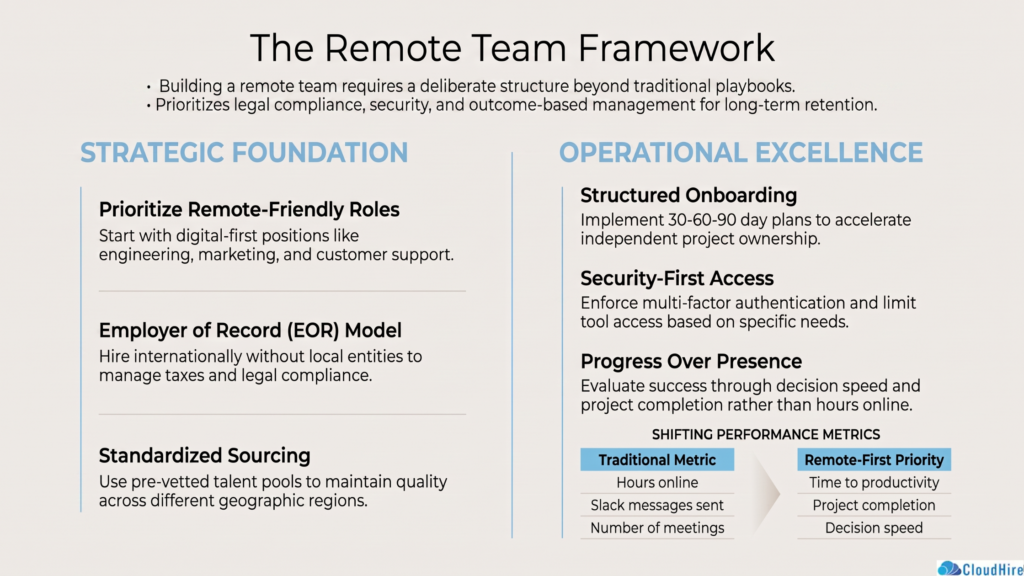
Not every role is equally suited to remote work. Some jobs rely mainly on digital collaboration, while others depend on being physically present. If you’re building your first remote team, start with roles that already work well online before expanding into more location-dependent positions.
| Role | Why it works well remotely |
| Software Engineering | Most work happens online and collaboration tools are already part of daily work. |
| Customer Support | Calls, chat, and email can be handled from almost anywhere with the right systems. |
| Marketing | Content, paid ads, SEO, social media, and email marketing are already digital-first. |
| Sales | Inside sales and account management are commonly done through video calls and CRM tools. |
| Design | Designers collaborate using cloud-based tools and project management platforms. |
| HR & Recruiting | Interviews, onboarding, and hiring can all be managed remotely with modern software. |
| Finance & Accounting | Reporting, payroll, budgeting, and financial planning can usually be done securely online. |
Some roles are harder to make fully remote because they rely on physical locations or equipment.
- Warehouse and logistics staff need to be on-site.
- Manufacturing roles require factory access.
- Field sales often involve travelling to customer locations.
- Healthcare roles usually require face-to-face patient care.
Starting with remote-friendly positions helps companies build processes before expanding remote hiring into more complex functions.
Phase 2: Sourcing Global Talent the Right Way
Once your strategy is clear, sourcing becomes the next major building block. Effective global talent sourcing typically combines a few approaches:
- Working from pre-vetted, pre-screened talent pools rather than starting from zero for every role
- Targeting specific regions strategically based on your defined hiring strategy, not opportunistically
- Building a consistent screening process across every hire, so quality standards remain stable across countries
CloudHire’s sourcing tools are built specifically for this stage, connecting you with pre-vetted global talent matched to your specific role requirements, which significantly shortens the sourcing timeline compared to posting listings and waiting for applications individually in each target country.
How Much Does It Cost to Build a Remote Team?
Many companies assume remote hiring is automatically cheaper than hiring locally. In reality, you’re simply spending money in different places.
Common costs include:
| Cost Area | What it usually covers |
| Recruitment | Job boards, recruiters, sourcing platforms, assessments |
| Equipment | Laptop, monitor, accessories, shipping |
| Payroll | Salary processing, taxes, international payments |
| Benefits | Health insurance, leave, statutory contributions |
| Software | Slack, Zoom, Google Workspace, project management tools |
| Compliance | Contracts, labor laws, Employer of Record (EOR) services |
| Training | Onboarding, documentation, learning platforms |
The exact cost depends on the country, role, and hiring model. Companies that hire internationally often spend less on office space but invest more in compliance, onboarding, and collaboration tools. Planning these costs early prevents unexpected delays later.
Phase 3: Navigating Compliance and Entity Questions
This is where most companies hit their first major decision point, and often their first major delay. Hiring internationally raises immediate international employment compliance questions: do you need a legal entity in each country, or is there a faster path?
For most companies, especially those hiring a small number of employees in a new country, setting up a local entity is slow, expensive, and unnecessary. An Employer of Record (EOR) structure allows you to legally employ someone in another country without establishing your own entity there, since the EOR serves as the legal employer on your behalf while you retain full day-to-day management of the employee’s work.
Phase 4: Setting Up Payroll and Benefits Across Countries
Once you hire internationally, payroll becomes more than simply sending someone a salary every month. Every country has different tax rules, mandatory benefits, reporting requirements, and payment methods.
Imagine hiring a software engineer in Brazil. Instead of manually researching local tax rules, calculating deductions, processing payments in Brazilian Real, and filing government reports yourself, the payroll system handles those requirements automatically. The employee receives their salary correctly, required taxes are deducted, statutory benefits are included where necessary, and compliance reports are generated for local authorities.
The same process looks different in every country, which is why international payroll quickly becomes difficult without the right systems.
Some of the biggest differences include:
| Payroll Element | Why it changes by country |
| Tax withholding | Every country has different tax rates and reporting rules. |
| Statutory benefits | Leave, pensions, healthcare, and social contributions vary. |
| Currency | Employees are usually paid in their local currency. |
| Compliance reporting | Governments require different forms and deadlines. |
CloudHire combines payroll with its Employer of Record service, so companies don’t have to coordinate multiple providers or manually move employee information between different systems.
Best Tools for Managing Remote Teams
Building a remote team isn’t only about hiring people. It’s also about giving them the tools to work together smoothly.
Some of the most widely used tools include:
| Tool | Best For |
| Slack | Daily communication |
| Zoom | Meetings and interviews |
| Google Workspace | Email, documents, spreadsheets, calendars |
| Notion | Documentation and knowledge sharing |
| ClickUp | Project management |
| Loom | Recording quick video updates |
| GitHub | Software development collaboration |
| Linear | Engineering project tracking |
| Miro | Brainstorming and whiteboarding |
The exact tools matter less than consistency. Everyone should know where conversations happen, where documents live, and how work moves from one stage to the next.
Phase 5: Onboarding and Early Team Structure
Hiring someone is only the beginning. Good onboarding determines how quickly new employees become productive and how connected they feel to the team.
A simple 30-60-90 day plan gives every new hire clear expectations.
| Time | Goal |
| First 30 Days | Meet the team, learn systems, complete training, understand company processes. |
| Next 30 Days | Start owning projects, contribute independently, ask questions regularly. |
| By 90 Days | Manage work confidently, collaborate across teams, and begin improving existing processes. |
Good onboarding also includes:
- Equipment delivered before the first day.
- Accounts and software ready to use.
- Regular check-ins with the manager.
- One teammate assigned as a buddy for everyday questions.
Clear onboarding reduces confusion, improves confidence, and helps remote employees feel part of the company much faster.
Phase 6: Building Culture and Retention in a Distributed Team
Culture does not happen automatically in a remote team the way it might in a shared office. It requires deliberate structure:
- Regular, predictable communication rhythms, so team members always know when and how to connect
- Intentional social touchpoints, virtual or in-person, for team members who want them
- Clear career growth paths and visibility, since remote employees can be easily overlooked without deliberate effort
- Occasional in-person gatherings, where feasible, to strengthen relationships that purely virtual interaction cannot fully replace
Distributed team retention improves significantly when these elements are built in from the start, rather than addressed only after turnover becomes a visible problem.
Common Pitfalls When Building Remote Teams From Scratch
- Hiring reactively, role by role, without a defined regional or structural strategy
- Underestimating compliance complexity and assuming standard contracts work across all countries
- Treating payroll as an afterthought instead of an integrated part of the hiring process
- Neglecting onboarding structure, leaving new hires to figure things out on their own
- Assuming culture will develop naturally without deliberate investment in distributed team connection
Phase 7: Security Is Part of Hiring, Not an IT Problem
Most companies think about security after they make the hire.
That is backwards.
The biggest security risk in a remote company isn’t a hacker. It’s a new employee with the wrong access.
The moment someone joins your team, they gain access to emails, documents, customer data, code, financial records, and internal conversations. If access isn’t controlled from day one, a simple mistake can expose information that took years to build.
Every remote hiring process should include a security checklist before an employee logs in for the first time.
- Give access only to the tools they actually need, not every tool the team uses.
- Require multi-factor authentication (MFA) for every company account.
- Use a password manager instead of asking employees to remember dozens of passwords.
- Manage company devices remotely so lost or stolen laptops can be locked or wiped.
- Use a VPN when employees need to access internal systems over public or unsecured networks.
- Remove access immediately when someone changes roles or leaves the company.
One mistake many growing companies make is giving every employee the same permissions because “it’s easier.” It is easier, until someone accidentally deletes data, downloads confidential files, or shares sensitive information with the wrong person.
The fastest way to lose control of a remote team isn’t hiring the wrong person. It’s giving the right person access to everything.
As your team grows across countries and time zones, security becomes harder to fix later. Building good access habits from your first remote hire is far easier than untangling years of unnecessary permissions.
How Do You Measure Whether a Remote Team Is Actually Working?
Once a remote team starts growing, measuring performance becomes harder. Many companies fall into the trap of tracking what’s easy to see instead of what actually drives results.
| Instead of Measuring… | Measure This Instead | Why It Matters |
| Hours online | Time-to-productivity | Shows how quickly new hires become independent contributors. |
| Slack messages sent | Project or task completion | Work delivered matters more than conversations about work. |
| Number of meetings | Decision speed | Fewer meetings with faster decisions usually indicate healthier workflows. |
| Daily activity | Employee retention | High turnover often points to problems in hiring, onboarding, or management. |
| Attendance | Engagement | Engaged employees understand priorities and take ownership without constant direction. |
| Onboarding checklist completed | Onboarding success | The real goal is whether employees can work confidently without asking the same questions repeatedly. |
The exact metrics will vary by team. Engineering teams may look at delivery velocity, customer support teams may track resolution times, and sales teams might measure pipeline progression. Whatever you choose, focus on metrics that reflect business outcomes rather than visible activity.
One metric deserves special attention: time-to-productivity. If new hires need several months before they can work independently, the problem usually isn’t the employee. It’s often a sign that your onboarding, documentation, or internal processes need improvement.
The easiest work to measure is rarely the most valuable. The best remote companies measure progress, not presence.
A Quick-Reference Build Checklist
| Stage | Key actions |
| Strategy | Define roles, structure, target regions, and core hours |
| Sourcing | Use pre-vetted talent pools, consistent screening criteria |
| Compliance | Decide between entity setup or EOR, confirm country-specific requirements |
| Payroll | Set up integrated, compliant payroll and benefits per country |
| Onboarding | Prepare equipment, schedule, and a written 30-60-90 day plan |
| Culture | Build communication rhythms, growth visibility, and connection touchpoints |
Frequently Asked Questions
Do I need to set up a legal entity to hire remote employees internationally?
Not necessarily. An Employer of Record structure allows you to legally employ international team members without establishing your own entity in each country, which is significantly faster for most companies, especially when hiring a small number of employees per country.
How many remote employees should I hire first?
Start with 1–3 remote employees so you can test your hiring process, communication rhythm, and delivery system without losing control. This small number helps you see what breaks early, before the team gets bigger. Once the process feels smooth, scale slowly.
Should remote employees get company laptops?
Yes, if they are handling company work, data, or internal tools. A company laptop makes security, software setup, and IT support much easier. It also keeps work life more consistent, especially when your team is spread across places.
Should remote workers have fixed hours?
Give core working hours instead of strict all-day rules. That way people still have flexibility, but everyone overlaps for meetings, updates, and urgent decisions. It also prevents the team from drifting into random schedules that hurt coordination.
Can I hire contractors instead?
Yes, but only when the work is short-term, project-based, or truly independent. Contractors are useful for speed and flexibility, but they are not ideal for core roles that need long-term ownership. If the work is ongoing, full-time hiring usually fits better.
What’s the difference between EOR and contractor?
An EOR is the legal employer, so they handle payroll, taxes, and local compliance for you. A contractor is self-employed and works independently, usually on their own schedule. The difference matters because the wrong setup can create legal and tax problems.
Remote team vs distributed team?
A remote team usually works outside one office but often stays in one country or time zone. A distributed team is spread across regions, countries, or continents. Distributed teams need stronger documentation, async communication, and clearer overlap windows.
What’s the biggest compliance mistake?
The biggest mistake is treating a contractor like an employee. If you control their hours, tools, and daily work like staff, the classification can become risky. That can lead to fines, back pay, and tax issues later.
Bringing It All Together
Building a remote team from scratch works best as a connected system, strategy, sourcing, compliance, payroll, onboarding, and culture, rather than a series of disconnected decisions made under time pressure. Getting the structure right early saves significant time and cost as the team scales.
How CloudHire Helps
The CloudHire Remote Team Pyramid
Building a successful remote team works best when every layer supports the one above it.
Culture
Onboarding
Payroll
Compliance
Sourcing
Strategy
Many companies focus only on hiring people. In reality, hiring is only one layer. Without clear strategy, compliant hiring, reliable payroll, structured onboarding, and a healthy culture, remote teams become difficult to scale. The strongest remote companies build each layer in order, creating a foundation that supports long-term growth.
Ready to build your remote team the structured way? See how CloudHire supports sourcing and payroll in one place.
Hire faster with CloudHire
Search 700M+ profiles, run AI interviews and launch outreach on one platform — free to start, no demo call required.