
What Is the Fastest Way to Hire Globally? 5 Ways to Compress Global Hiring Time

On this page
Quick answer: With the right setup, a company can go from identifying a candidate to having them legally employed and paid in another country within 7 days. Traditional global hiring, by contrast, often takes 6 to 12 weeks once you factor in entity setup, contract drafting, and payroll onboarding. This guide breaks down exactly how that 7-day timeline works and five specific ways to compress global hiring time.
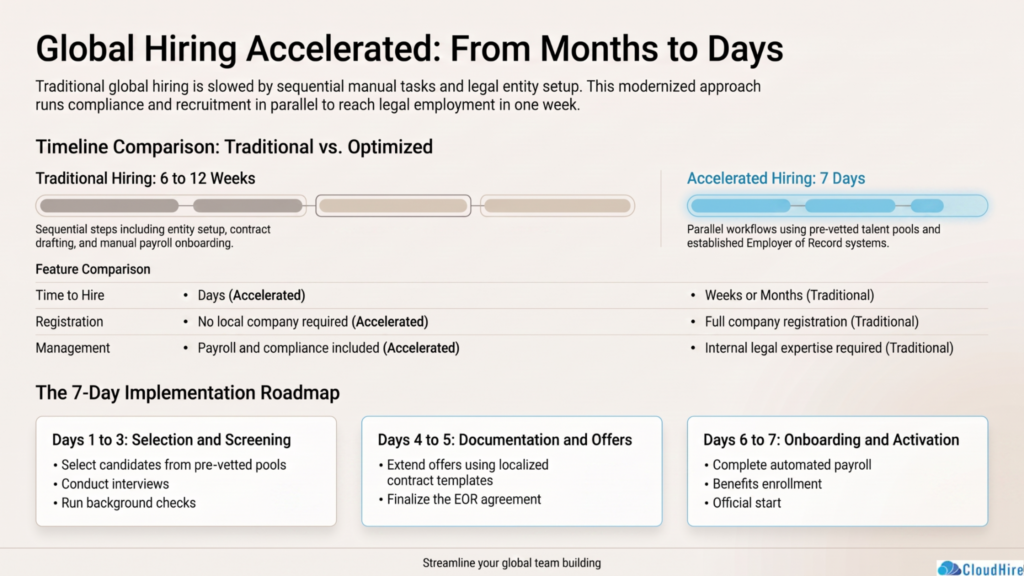
The 7-Day Benchmark: What “Fast” Actually Means in Global Hiring
Speed in global hiring is not about skipping steps. It is about removing the steps that were never necessary in the first place, mainly entity setup and disconnected, sequential processes that could run in parallel instead. A 7-day SLA is achievable when compliance, contracts, and payroll setup are pre-built and running alongside candidate evaluation, rather than starting only after an offer is accepted.
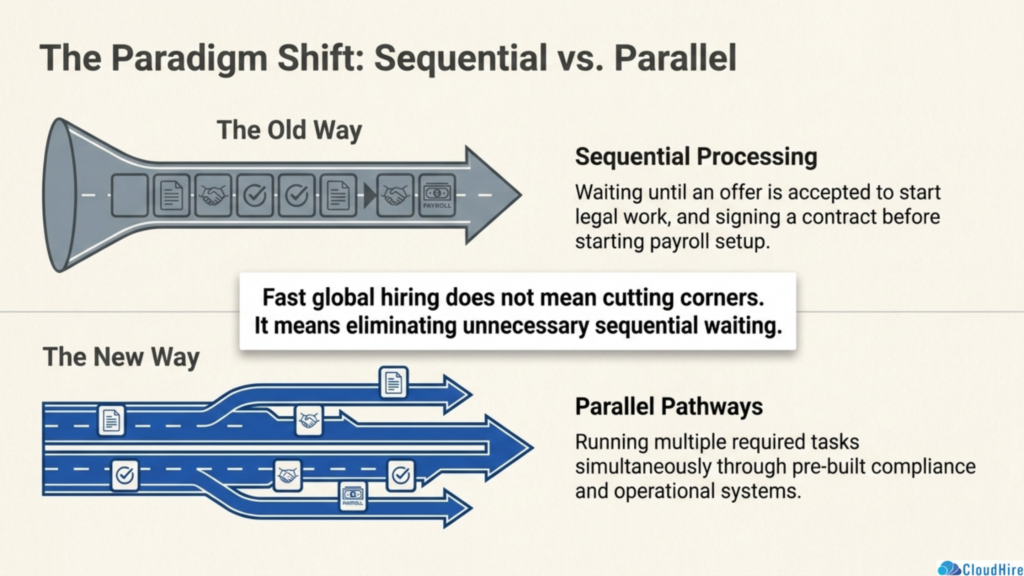
Where Time Actually Gets Lost in Global Hiring
| Stage | Traditional timeline | Compressed timeline |
| Entity setup or legal review | 4 to 8 weeks (if setting up a local entity) | 0 days (skipped via EOR) |
| Candidate sourcing and screening | 1 to 3 weeks | 2 to 3 days |
| Contract drafting per country | 1 to 2 weeks | Same day (pre-built templates) |
| Background and reference checks | 3 to 7 days | 1 to 2 days (parallel processing) |
| Payroll and benefits setup | 1 to 3 weeks | 1 to 2 days (pre-integrated system) |
The traditional path fails mainly because each stage waits for the previous one to finish. Compressing the timeline means restructuring the process so several of these stages happen simultaneously instead.
5 Ways to Compress Global Hiring Time
1. Use Pre-Vetted Talent Pools Instead of Cold Sourcing
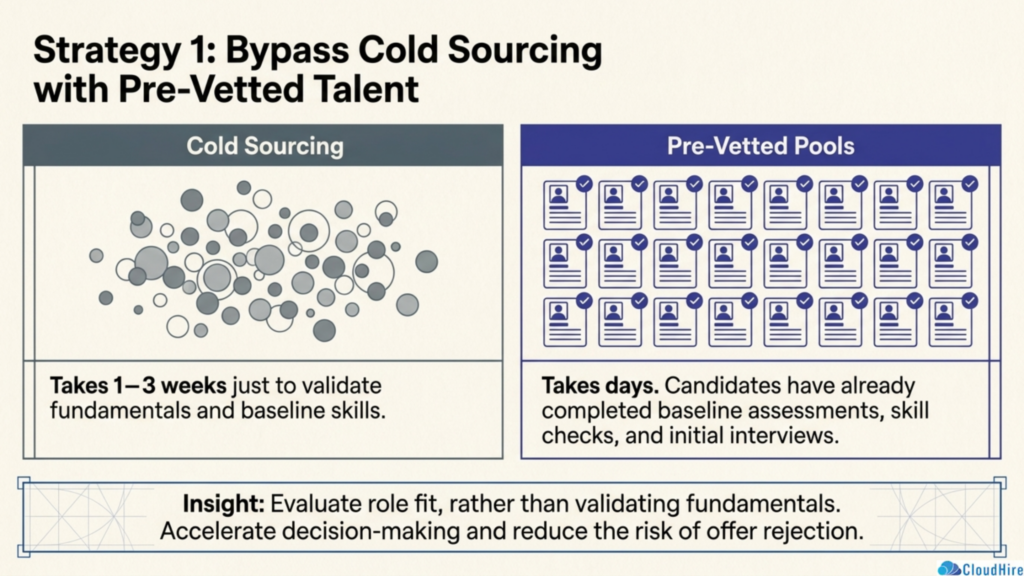
Cold sourcing, posting a role and waiting for applications to trickle in, is one of the biggest time sinks in global talent acquisition. Working from a pre-screened, pre-vetted talent pool cuts sourcing and initial screening from weeks down to days, since much of the qualification work has already happened before a specific role opens.
2. Run Compliance and Interviews in Parallel, Not in Sequence
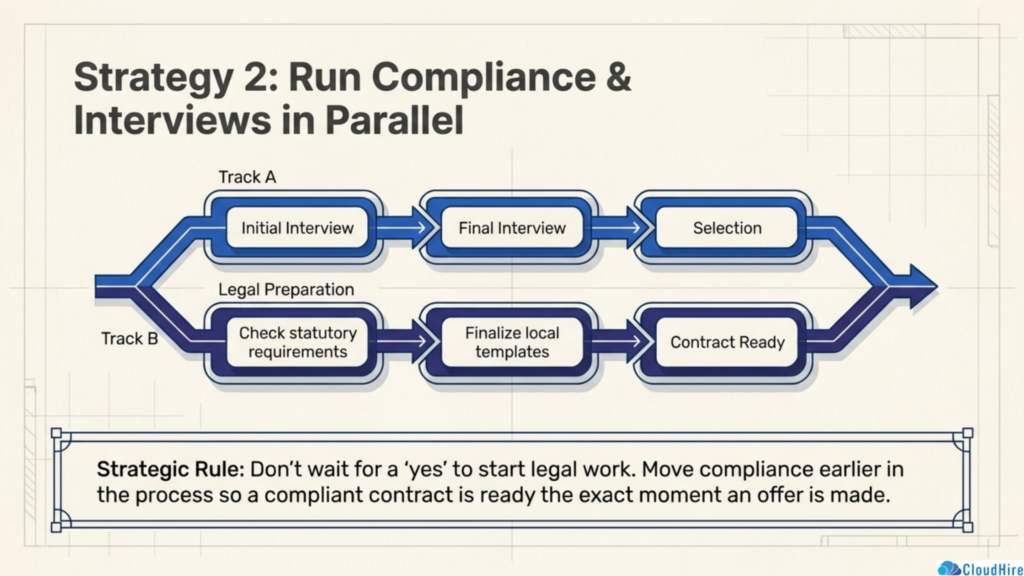
Most companies wait until an offer is accepted before starting compliance and entity questions in a new country. This sequential approach adds weeks by default. Running local compliance review and interview stages in parallel, so legal groundwork is already prepared by the time an offer goes out, removes this bottleneck entirely.
3. Use Standardized Contracts Through an Employer of Record
Drafting a country-specific employment contract from scratch, or worse, setting up a legal entity in a new country, is the single biggest source of delay in traditional global hiring. An Employer of Record (EOR) model uses pre-built, locally compliant contract templates for dozens of countries, turning a multi-week legal process into a same-day task.
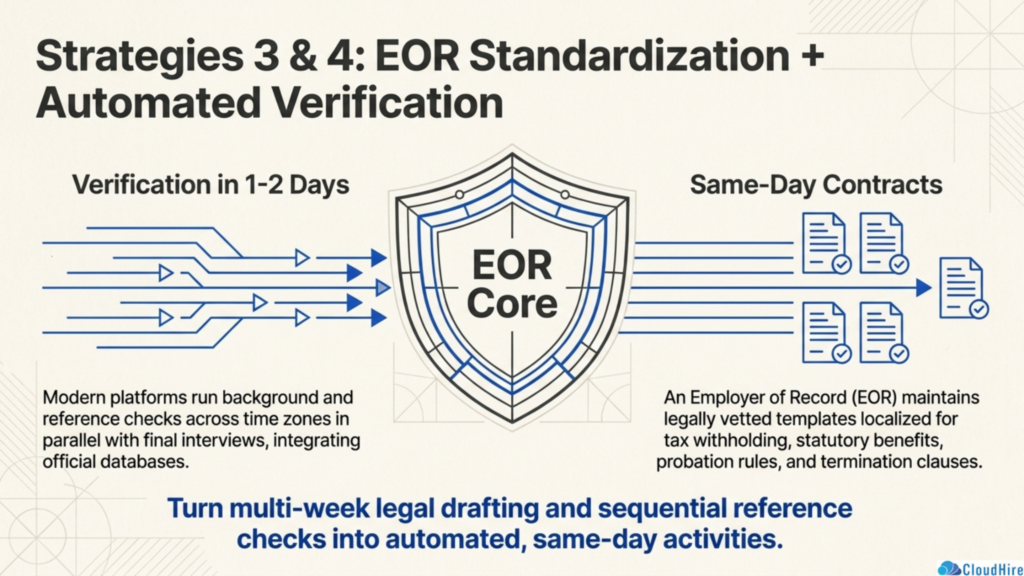
4. Automate Reference and Background Checks
Manual reference checks, scheduled around time zones and busy former managers, routinely add three to seven days to a hiring timeline. Automated, parallel-processed background and reference verification systems can complete this stage in one to two days without sacrificing thoroughness.
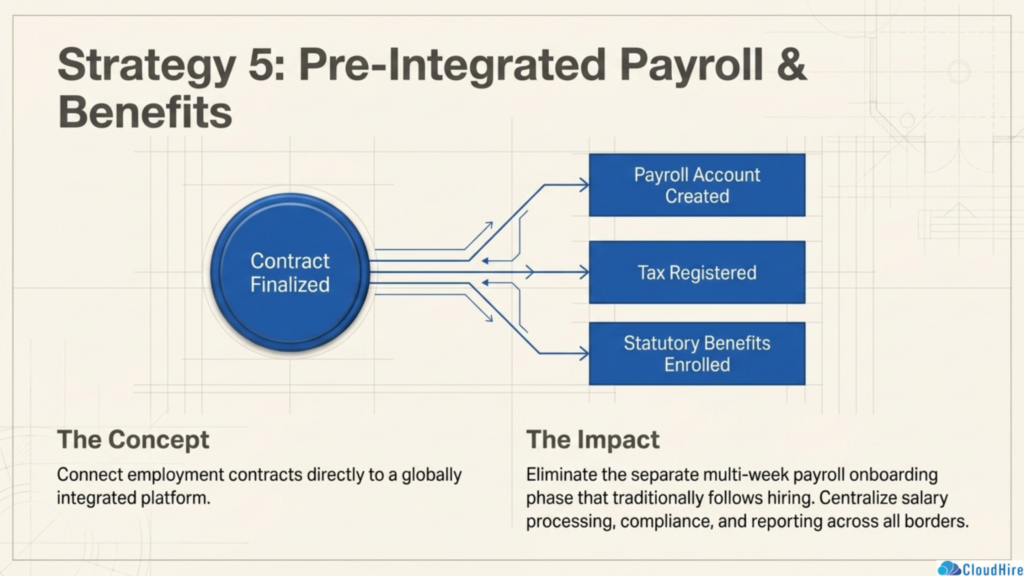
5. Pre-Integrate Payroll and Benefits Onboarding
Setting up payroll compliant with local tax law, benefits, and statutory requirements is traditionally one of the slowest stages, often taking weeks per country. A pre-integrated global payroll system connected directly to the employment contract can complete this setup in one to two days once the contract is finalized, rather than as a separate multi-week process afterward.
The Hidden Cost of Slow Global Hiring
Companies often think slow hiring only delays recruitment. In reality, it delays the business.
An open engineering role can push product launches back by weeks. A vacant sales position means fewer conversations with prospects and slower revenue growth. Existing employees take on additional work, increasing the risk of burnout, while top candidates continue interviewing elsewhere.
Hiring speed isn’t just an HR metric. It’s a business metric.
The cost of a vacant role usually grows faster than the cost of filling it.
Sample 7-Day Global Hiring Timeline
| Day | Activity |
| Day 1 | Candidate identified from pre-vetted pool, initial interview scheduled |
| Day 2 to 3 | Interviews completed, reference checks run in parallel |
| Day 4 | Offer extended using standardized, country-compliant contract template |
| Day 5 | Offer accepted, EOR employment agreement finalized |
| Day 6 | Payroll and benefits setup completed through pre-integrated system |
| Day 7 | New hire fully onboarded, legally employed, and ready to start |
EOR vs Setting Up Your Own Legal Entity
| Employer of Record (EOR) | Local Legal Entity |
| Hire in days | Often takes weeks or months |
| No local company registration | Company registration required |
| Payroll managed for you | Build your own payroll process |
| Local compliance included | Internal legal expertise required |
| Ideal for testing new markets | Better suited for long-term operations at scale |
A useful rule of thumb: if you’re hiring a handful of employees in a new country, an EOR is usually the faster and simpler option. Opening your own entity often makes more sense once hiring reaches a scale where maintaining local infrastructure becomes financially worthwhile.
Which Countries Are Fastest for Global Hiring?
Not every country offers the same hiring experience. Labor laws, payroll systems, and employment regulations vary considerably.
Countries such as India, Canada, the United Kingdom, and the Philippines often allow relatively straightforward onboarding through an Employer of Record. Others may require additional documentation, local filings, or longer notice periods before employment can begin.
The fastest companies don’t assume every country follows the same process. They plan around local requirements before opening a role.
When Hiring Faster Isn’t the Right Decision
Not every position should be filled in seven days.
Executive hires often involve multiple stakeholders and long-term strategic decisions. Regulated industries may require extensive compliance reviews or security checks. Highly specialized technical roles sometimes need longer evaluation periods to reduce hiring risk.
Moving quickly should never mean reducing hiring quality.
The goal isn’t to hire as fast as possible. It’s to remove unnecessary waiting while keeping every necessary decision intact.
Candidate Experience
Faster Hiring Creates a Better Candidate Experience. Candidates notice delays just as much as employers do.
Long periods without updates create uncertainty and increase the chances that strong candidates accept competing offers. Clear timelines, faster feedback, and fewer administrative delays make the hiring process feel more professional while improving offer acceptance rates.
Candidates rarely reject fast hiring. They reject unclear hiring.
What Can Slow This Down
A few factors genuinely extend even a well-optimized process, and it is worth knowing them upfront:
- Countries with unusually complex or slow-moving regulatory requirements for new employment contracts
- Candidates requiring additional negotiation time before accepting an offer
- Roles requiring specialized skills not present in an existing pre-vetted pool, requiring fresh sourcing
None of these eliminate the value of a compressed process, but they are realistic exceptions worth planning around rather than ignoring.
Frequently Asked Questions
Is a 7-day global hire realistic for every country?
Mostly yes, though a small number of countries with unusually complex labor regulations may require slightly longer compliance review.
Does compressing the timeline reduce compliance quality?
No, when done through a proper EOR structure, compliance is built into the pre-existing contract templates and payroll systems, not skipped.
What is the biggest single factor in speeding up global hiring?
Removing entity setup entirely through an EOR model consistently has the largest impact on total timeline, since it removes the slowest traditional stage altogether.
What Is an Employer of Record (EOR)?
Most companies don’t need to open a legal entity every time they hire in a new country. An Employer of Record (EOR) is a third-party organization that legally employs workers on your behalf while you manage their day-to-day work. The EOR handles employment contracts, payroll, tax withholding, statutory benefits, and local labor law compliance, making it possible to hire internationally without months of legal setup.
What Is Global Payroll?
Global payroll is the process of paying employees across multiple countries while complying with each country’s tax laws, statutory benefits, reporting requirements, and employment regulations. Instead of managing separate payroll providers in every country, many companies use integrated global payroll platforms that centralize salary processing, compliance, and reporting.
What Is Cross-Border Hiring?
Cross-border hiring means employing people who live and work in countries where your company does not necessarily have a legal entity. Companies typically achieve this through an Employer of Record, local subsidiaries, or contractor arrangements, depending on the country’s regulations and the nature of the role.
How CloudHire Helps
CloudHire is built around exactly this compressed model, combining pre-vetted global talent, EOR-backed contracts, and integrated payroll into a single connected process, so a 7-day hire is a realistic standard, not an exceptional case.
Check out our easy Recruiter Guide to CloudHire Platform
Ready to hire globally in days, not months? Talk to CloudHire about your next global hire

Hire faster with CloudHire
Search 700M+ profiles, run AI interviews and launch outreach on one platform — free to start, no demo call required.