
For Candidates: Why the Hiring Game Changed in 2026 (And How to Win It)
On this page
TL;DR: The job search in 2026 is not broken because candidates are unqualified. It’s broken because hiring changed faster than most people realised. AI now screens resumes before humans do, ghosting is usually a process failure instead of personal rejection, and the candidates who move fastest are the ones who communicate clear, measurable impact instead of generic experience. This blog explains how modern hiring actually works, why most old job search advice fails now, and how CloudHire is building a candidate experience designed around transparency, skills, and real communication.
The job search in 2026 is not just competitive, it is structurally different. AI screens you before a human does. Silence is the new rejection. And the old resume advice is genuinely useless now. Here’s what actually works.
The Hiring Game Changed & Most Candidates Haven’t Caught Up Yet.
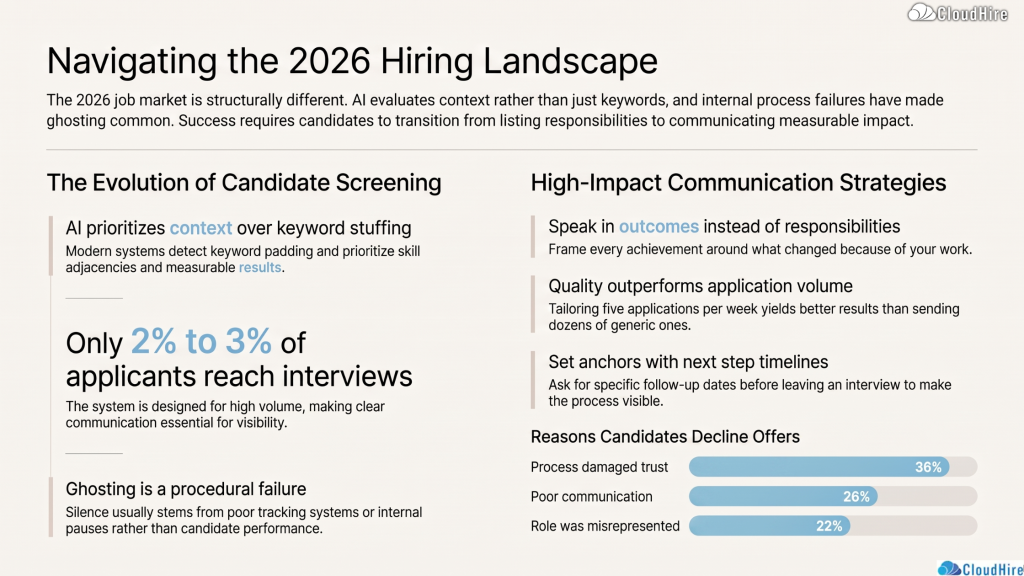
Here is something most hiring content will not tell you. The job search is statistically designed to be demoralising. The average job seeker now submits between 32 and 200 applications before landing a single offer. Only 2–3% of applicants ever reach the interview stage. And 78% of job seekers say the job search negatively affects their mental health.
That is not a personal failure. That is a broken system and most candidates are trying to navigate it with outdated advice written for a world that no longer exists.
At CloudHire, we sit inside this market every day. We see what hiring teams actually look for, what makes a candidate move through a pipeline versus disappear from it, and why the same person gets ignored at one company and fast-tracked at another. The difference is almost never the resume. It is almost always how clearly a candidate’s value is communicated to both AI systems and the humans behind them.
This is what we know. And it is what we want every candidate we work with to understand.
What “For Candidates” Actually Means in 2026
The phrase “for candidates” has become meaningless in most hiring content. It gets slapped on top of generic interview tips and resume templates that have not changed since 2015. So let’s be specific about what candidates actually face right now. These numbers describe a system where candidates do a significant amount of work tailoring applications, preparing for interviews, completing assessments and still receive nothing back. Not a rejection. Not a timeline. Just silence.
The good news: companies that treat candidates well are getting dramatically better results. 76% of candidates say a positive hiring experience influenced their decision to accept an offer. 66% of workers say they feel burned out by the job search. The candidate who feels informed and respected moves faster and converts higher. The system is broken, but the fix, when companies choose to apply it, works.
How AI Screening Actually Works (And Why It’s Not What You Think)
The most damaging myth in the current job market is that AI screening is just aggressive keyword matching and that the solution is to stuff your resume with terms from the job description.
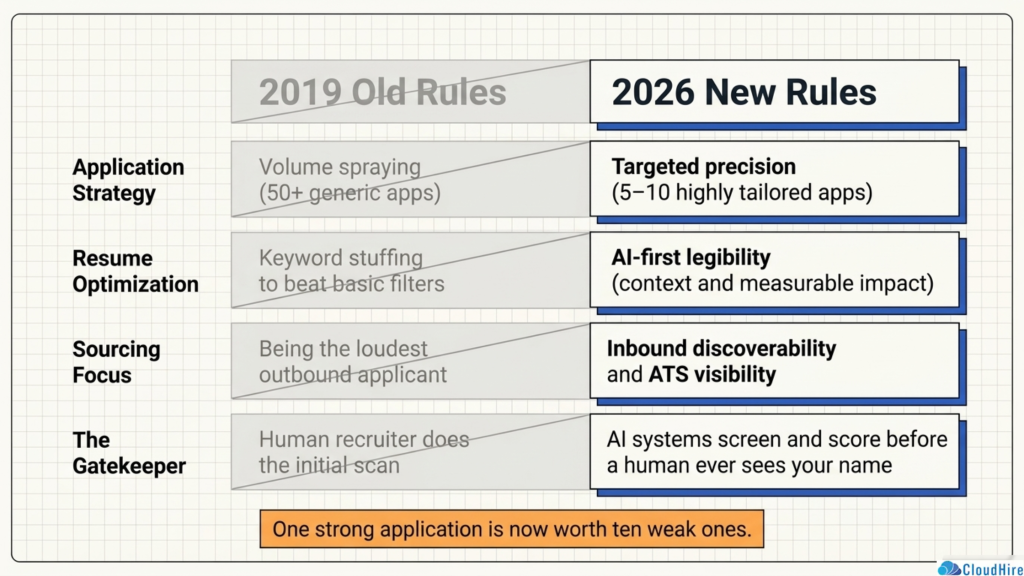
That was true in 2019 and it’s not true now. Modern AI screening tools, the ones used by companies at scale in 2026, do something much closer to reading. They evaluate context, consistency, measurable impact, and inferred skill adjacencies. An AI tool reviewing your resume can now determine that a Python developer who has worked with pandas likely understands SQL queries. It can flag a “10 years of experience” claim that isn’t reflected in the timeline of roles listed. It can also identify candidates that a keyword search would have completely missed, people with non-linear careers who have the right underlying skills.
Common mistake: Keyword stuffing now actively hurts you
AI models trained on millions of resumes have learned to recognise keyword padding. A resume that repeats “strategic thinking” and “cross-functional collaboration” without a single concrete result is now a signal of low quality, not a signal of strong candidacy. Worse, it wastes the context window that modern AI uses to assess you.
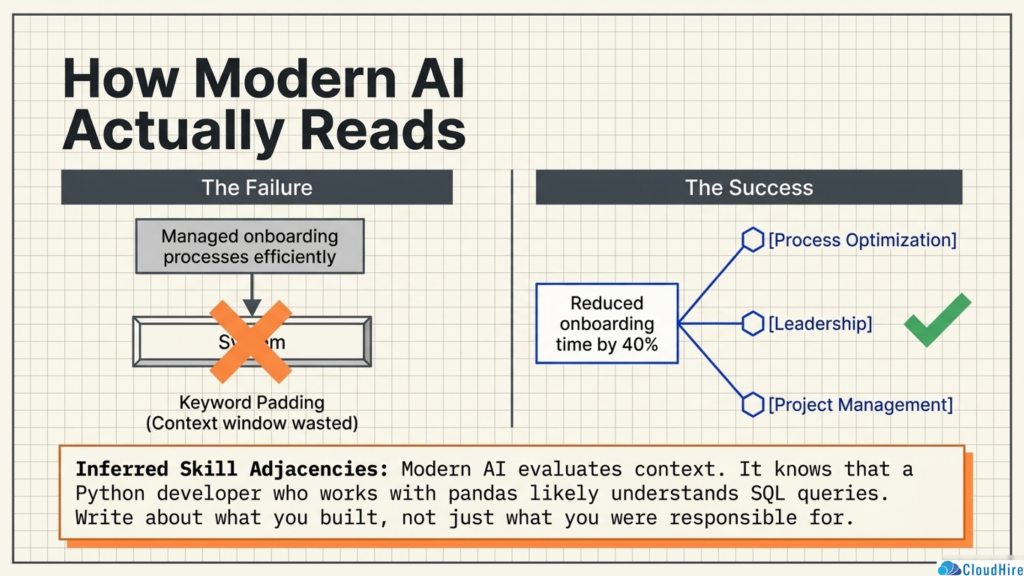
What works instead: write about what you actually built, changed, or improved with numbers where you have them. “Reduced onboarding time by 40%” is ten times more useful to an AI screening model than “managed onboarding processes efficiently.”
The candidates who pass AI screening are not the most keyword-optimised. They are the most clearly written.
Why You’re Getting Ghosted (And It’s Usually Not About You)
Ghosting after an interview is one of the most common and most misread experiences in job hunting today. Candidates almost always interpret silence as rejection or as a sign that they performed poorly. In most cases, it is neither.
61% of job seekers report being ghosted after completing at least one interview in 2026.
This is a process failure, not a performance signal.
From our internal research at CloudHire, the most common reasons candidates get ghosted after interviews are:
1. The hiring team has no structured follow-up workflow
Many companies, especially fast-growing ones, run interviews on instinct. There is no system that triggers a follow-up email when a candidate reaches a decision point. The recruiter means to reach out and simply does not.
2. The role paused internally without anyone telling the candidate
Budget freezes, internal restructuring, and hiring priority shifts happen constantly. When a role pauses, most teams drop communication entirely rather than explaining the delay a practice that is bad for employer brand and terrible for candidates.
3. The candidate is in a “hold” position
You are the strong backup candidate while the team pushes an offer to their first choice. They intend to come back to you. They almost never communicate this clearly.
4. Poor ATS hygiene on the employer side
Candidate records sitting in an ATS with no assigned next step do not generate automatic follow-ups. The candidate record goes stale. No one sent the rejection because no one checked the queue.
“The company is not ghosting you because you failed. In most cases, they are ghosting you because their process has no mechanism to do otherwise.” – Avira, HR, CloudHire
The practical response to all of this: ask for a concrete next-step timeline before you leave every single interview. “What does the timeline look like from here?” is the most underused sentence in job hunting. It sets an anchor. It makes the ghosting visible if it happens. And it signals that you are organised and interested, both of which are positive signals.
What Actually Makes a Candidate Move Fast Through a Pipeline
After working with hundreds of hiring processes at CloudHire, there are patterns that are remarkably consistent across industries and company sizes. The candidates who move fastest are not always the most experienced or the most credentialed. They share a different set of qualities.
What We See at CloudHire
They speak in outcomes, not responsibilities.
Every bullet point on their resume and every interview answer is framed around what changed because of their work, not just what they were responsible for doing.
They research before they ask.
They have done enough research on the company to ask questions that go beyond what’s on the website. This matters more than most candidates realise, as it signals low management overhead to hiring teams.
They are specific about what they want.
Candidates who say “I’m open to anything” are harder to place and harder to excite a hiring team about. Specificity about role type, stage of company, and type of problem signals self-awareness. That is extremely attractive to hiring managers.
They follow up once, clearly, and then stop.
A brief, direct follow-up email within 24 hours of an interview is professional. A second follow-up, a week later, asking for a status update, is also fine. Everything after that becomes noise.
Industry data from LinkedIn’s 2025 Future of Recruiting report confirms that teams using AI-assisted hiring recover roughly 20% of recruiter time per week. That time gets reinvested in the candidate conversations that machines cannot handle, assessing cultural fit, negotiating the offer, and selling the role. The human interaction that remains is higher-stakes than it has ever been. Every conversation with a recruiter or hiring manager matters more, not less, in an AI-screened world.
How to Get Recruiters to Reach Out to You Instead
The strongest candidates do not spend all of their time applying for jobs. They make it easier for recruiters to find them first.
Recruiters search thousands of profiles every day using Applicant Tracking Systems (ATS), LinkedIn Recruiter, internal talent databases, and AI-powered sourcing tools. Your goal is to become discoverable before a role is even advertised.
A few small changes can make a significant difference:
- Build your LinkedIn profile around measurable achievements instead of generic responsibilities.
- Make your portfolio public and easy to access through your profile or resume.
- Keep your ATS resume updated with the skills and technologies you actively use rather than every keyword you can think of.
- Include examples of projects, certifications, and business outcomes that demonstrate your transferable skills.
- Stay active within your industry by sharing insights, commenting on discussions, and expanding your professional networking instead of only applying for jobs.
- Be specific about the kinds of roles you want. Recruiters can match candidates more accurately when career goals are clear.
One pattern we’ve consistently observed at CloudHire is that candidates who communicate their impact clearly receive more recruiter outreach than candidates with longer resumes. Visibility is rarely about being the loudest applicant. It comes from making your experience easy to understand.
The Offer Acceptance Problem Nobody Talks About
Here is a data point that rarely gets discussed from the candidate’s perspective: the proportion of candidates accepting job offers dropped from 74% in 2023 to 51% in 2025.
That is an enormous shift. Nearly half of all candidates who receive offers are now saying no.
Why? The most common reasons are not salary. They are:
- The process itself damaged trust. 36% of candidates declined offers after a negative interview experience. If a company treated you poorly during hiring, you reasonably assume they will treat you poorly while employed.
- The role was misrepresented. 22% report that the actual role was significantly different from the job posting. When candidates discover this at the offer stage, they walk.
- Poor communication created doubt. 26% of candidates rejected offers due to unclear job expectations or poor communication throughout the process.
Understanding this as a candidate is important: you have more leverage than the hiring process makes you feel. Companies that run poor hiring processes are losing candidates at the offer stage at record rates. Your decision to walk away from a misaligned process is a rational, data-backed choice, not a failure of nerve.
How to Evaluate a Job Offer Beyond Salary
Salary matters, but it rarely determines whether you’ll enjoy the role six months later.
Before accepting any offer, evaluate the entire opportunity.
| Question | Why It Matters |
| Does the role match the original job description? | Unexpected changes often signal larger communication problems. |
| How does the manager support employee growth? | Good managers have a bigger impact on career development than salary alone. |
| Is there a clear learning path? | Strong career growth comes from continuous learning, not just promotions. |
| How is performance measured? | Clear expectations reduce uncertainty and improve long-term success. |
| What flexibility does the company offer? | Hybrid work, remote jobs, and flexible schedules affect daily quality of life. |
| How transparent was the hiring process? | A respectful candidate experience usually reflects the company’s culture after hiring. |
An offer should answer as many questions as it creates. If you’re uncertain about responsibilities, growth opportunities, or expectations before you join, those questions rarely disappear after you start.
Key Insight: An offer is just a data point, definitely not a finish line
The best candidates evaluate offers the same way companies evaluate candidates, methodically. Pay attention to how the company communicated during the process. Note whether the role description matched what you actually heard in interviews. Ask directly about the things that matter to you, like team structure, growth path, and how performance is reviewed. The answers to those questions matter more than the headline salary number in most cases.
How CloudHire Works For Candidates
Most job platforms were built for companies, not candidates. The candidate is the product matched, surfaced, and delivered. We built CloudHire differently because we saw what that model produces: candidates who feel invisible, processes that reward the wrong signals, and hiring decisions made on noise rather than signal.
Here is what we do differently for candidates:
1. We match on demonstrated skills, not just job titles
Our AI doesn’t look at your job title and match it to an open role title. It looks at what you have actually built and done and surfaces you to roles where that work is relevant, even if the title is different.
2. We tell you why you were matched
No black box. When CloudHire surfaces you for a role, we tell you specifically which parts of your background we matched so you can decide whether it’s genuinely right for you before investing time in the process.
3. We enforce communication standards with the companies we work with
Every company on CloudHire commits to candidate communication timelines. Ghosting is not a feature of our process for any candidate, at any stage. If a company cannot hold to that standard, they do not use CloudHire.
4. We give candidates market intelligence, not just job listings
We tell candidates what similar roles are paying, what companies in their target space are hiring for, and where the real gaps in the market are. The job search should feel informed, not like a guessing game.
Frequently Asked Questions
How do I get past AI resume screening in 2026?
Write in plain language and focus on measurable results. Modern AI screening reads context, not keywords. Each bullet point should answer: “What changed because of what I did?” Include specific numbers where you have them. Remove filler phrases and passive language, which are actively penalised by modern screening models.
What do I do if I’m being ghosted after an interview?
Send one brief, direct follow-up within 24 hours of the interview. If you have not heard back by the timeline they gave you, send one more message asking for a status update. After that, move on mentally, but keep the application open in your tracker. Roles reopen, circumstances change, and the candidate who follows up professionally is far more likely to be remembered.
Should I use AI to write my resume and cover letters?
Use AI as a starting point, not a final product. AI-generated applications without any personal voice are identifiable to experienced recruiters and hiring managers. Use AI to structure your thoughts, check for gaps, and suggest language, then rewrite it in your own voice with your own specifics. The goal is clarity, not polish.
How many applications should I send per week?
Fewer, better-targeted applications consistently outperform volume spraying. From what we see at CloudHire, candidates who send 5–10 highly tailored applications per week move through pipelines faster than those sending 50 generic ones. Hiring teams notice the difference immediately. One strong application is worth ten weak ones.
How is CloudHire different from other job platforms for candidates?
CloudHire matches candidates based on demonstrated skills and career trajectory, not just job title matches. We also require the companies we work with to maintain candidate communication standards, which means no ghosting at any stage. Candidates on CloudHire know where they stand.
You shouldn’t have to guess where you stand in a process.
At CloudHire, we built a hiring experience for candidates who are serious about their next move and tired of being treated like a number. Skills-based matching. Real communication. Market intelligence you can actually use. Join the candidates who are navigating the 2026 job market with a clear view, not a blind one.
Explore CloudHire for Candidates
The Bigger Picture
The 2026 job market rewards one thing above everything else: Clarity.
Clarity about who you are, what you have built, what you want, and how you communicate all of it. The candidates who struggle are not the least skilled; they are the least legible. They are doing good work, but describing it in ways that neither AI systems nor human hiring teams can parse quickly.
This is fixable. It does not require a personal rebrand or a new set of credentials. It requires a fundamentally different way of thinking about what “for candidates” means in a world where your first audience is a machine and your second audience is a human who reads your AI score before reading your name.
The job search will get harder before it gets easier. The companies building real infrastructure for candidate experience and the candidates building real clarity around their own value are the ones who will move through this market cleanly. Everyone else will keep refreshing their inbox, wondering why no one is responding.
We’d rather work with the ones who move cleanly.
Finding the right job isn’t just about applying to more roles. CloudHire helps you build a stronger profile, improve your visibility to recruiters, and connect with opportunities that match your skills and career goals.
Creat your Cloud ID →
Put your job search on autopilot
CloudHire Smart Apply tailors your resume and applies to matching roles for you — so you spend your time interviewing, not scrolling.