
Is It OK to Cold Email a Recruiter? Yes When It’s Done Thoughtfully (4+ Templates)
On this page
TL;DR: Cold emailing recruiters isn’t as unprofessional as generic emails are. The best cold emails are short, personalized, sent to the right recruiter, and clearly explain why you’re a good fit. Strong subject lines, relevant experience, and thoughtful follow-ups matter far more than sending hundreds of emails. With CloudHire, you can combine proactive outreach with AI-powered job applications, and every recruiter reply, from interview requests to follow-ups, is routed into one place, so you never miss an opportunity or have to manage multiple inboxes.
There is a very specific moment in a job search that most people don’t talk about.
You’ve already applied. You’ve updated your resume. You’ve done what you were “supposed” to do. Still, days pass. Sometimes weeks. And then you find yourself staring at a recruiter’s profile, wondering if sending an email would help or quietly hurt your chances.
That hesitation doesn’t come from laziness. It comes from uncertainty. No one wants to seem intrusive. No one wants to be remembered for the wrong reason.
So the real question isn’t whether is it ok to cold email a recruiter. It’s whether you can do it in a way that feels respectful, informed, and genuinely useful to both sides.
The answer is yes. But only when it’s done thoughtfully.

What Cold Emailing a Recruiter Actually Means?
Cold emailing is often misunderstood as a bold or aggressive move. In reality, it’s simply initiating a professional conversation without a prior relationship.
At its core, cold email meaning is simple: In hiring, this happens more often than people realize. Recruiters speak to candidates they’ve never met every single day. The difference between a welcome email and an ignored one is not familiarity, it’s always relevance.
A thoughtful cold email to recruiter doesn’t say, “Please give me a job.”
It says, “I’ve taken time to understand what you hire for, and I believe my experience connects meaningfully to it.”
That distinction matters.
Hiring today is fluid. Roles evolve. Teams change direction. Many opportunities exist long before they ever reach a public job board. Cold emailing allows candidates to enter the moving system without waiting for permission.
Why Cold Emails Work When Job Applications Often Don’t
If job applications always worked as expected, cold emailing wouldn’t exist.
The reality is that most hiring systems are designed for scale, not nuance. Applicant tracking systems prioritise structure and keywords. They rarely capture the context of why your experience matters here, now, for this team.
Cold emails restore that missing context.
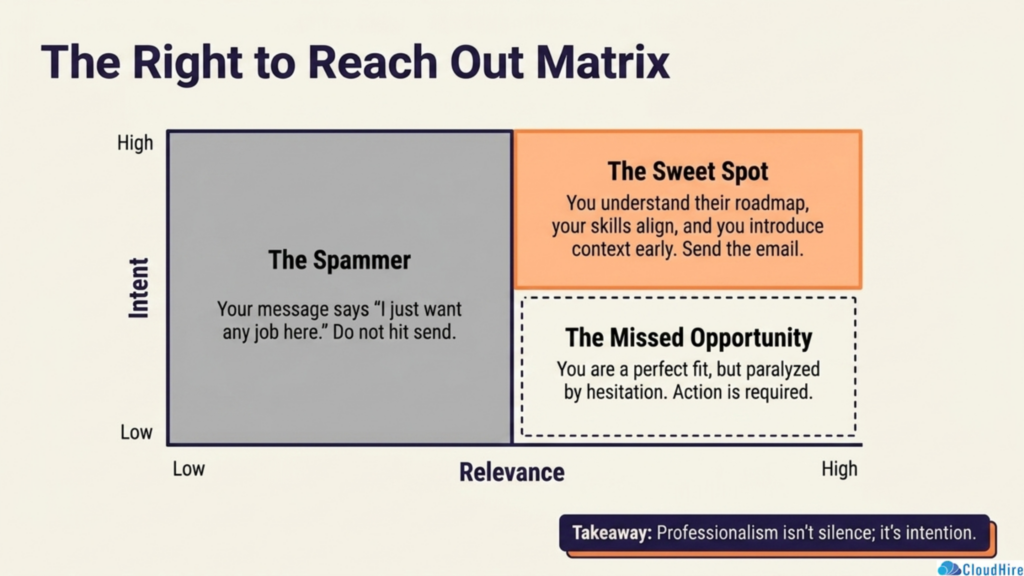
They allow you to explain alignment in your own words, rather than hoping software infers it correctly. For recruiters, this can be valuable. A short, well-reasoned email can surface a candidate they wouldn’t have discovered through filters alone.
This is why many recruiters say the same thing privately: some of their best hires started as conversations, not applications.
Is It Unprofessional or Annoying to Cold Email a Recruiter?
This concern stops many capable candidates from reaching out, and it deserves a clear answer.
Cold applying is not unprofessional.
Being careless is.
Recruiters are not annoyed by emails from people they don’t know. They are frustrated by messages that show no effort, emails that are generic, rushed, or clearly sent to dozens of companies at once.
On the other hand, a message that demonstrates awareness of the company, the role, and the recruiter’s responsibility often feels welcome, even when the timing isn’t right.
Professionalism isn’t about silence. It’s about intention.

When Cold Emailing a Recruiter Makes Sense
People often ask is it ok to cold email a recruiter without considering timing. Cold emailing works best when there is a real reason behind it.
Maybe you noticed a role that closely matches your background, but your experience doesn’t fit neatly into the job description. Maybe the company is scaling a team you’ve worked in before. Or maybe there isn’t an open role at all, but the work they’re doing aligns strongly with what you already know how to do.
In these situations, waiting passively often leads nowhere. Cold emailing becomes a way to introduce context early, before opportunities become crowded.
What doesn’t work is emailing simply because you want any job. Recruiters can sense that immediately. Effective cold emailing for job searches is specific, not hopeful.
Should You Cold Email Before or After Applying?
There isn’t one right answer. It depends on the situation.
If a role has already been posted, it’s usually best to apply first and then send a short email introducing yourself. That way, the recruiter can immediately find your application in their system.
If there isn’t an open position but you’re genuinely interested in the company, reaching out before applying is completely reasonable. Your email becomes a professional introduction rather than a follow-up.
If someone has referred you, mention the referral in your first email. It gives the recruiter immediate context and helps your message stand out.
The important thing isn’t whether you email before or after applying. It’s making sure your message adds context instead of repeating what’s already in your application.
How to Identify the Right Recruiter Before You Reach Out
This is where many cold emails quietly fail.
Not every recruiter hires for every role. Large companies often divide recruitment by function, seniority, or region. When your email reaches the wrong person, it doesn’t matter how well written it is; it simply doesn’t land.
Identifying the right recruiter takes a little research, but it pays off.
Start by looking at recent job postings from the company. Recruiter names often appear on listings, even if applications go through an ATS. That name usually belongs to the person managing the role.
LinkedIn is another reliable signal. Search for the company name alongside titles like “Recruiter,” “Talent Partner,” or “Talent Acquisition.” Then look at what they post. Recruiters frequently share roles they’re actively hiring for. Their activity tells you what they own.
Company career pages, hiring events, webinars, and even announcement posts about new team members can also reveal who handles which roles. These moments create a natural context for outreach.
The goal isn’t to be perfect. It’s to be relevant.
When your email reaches someone who actually understands your function, it feels intentional rather than random, and that changes how it’s received.
How to Write a Cold Email That Feels Human and Gets Read
People searching for how to cold email for a job often focus too much on structure and not enough on intent. A strong cold email doesn’t try to impress. It tries to connect.
It starts by explaining why you’re reaching out to this recruiter, not just why you want the role. That context matters more than credentials in the opening lines.
From there, the message should briefly explain alignment. Not everything you’ve done just overlaps with what they hire for. This shows judgment. Recruiters notice when candidates can prioritise relevance over volume.
The tone should remain calm and grounded. Confidence comes from clarity, not urgency. Ending the email with a gentle invitation to connect, rather than a demand for time, keeps the exchange professional and low-pressure. It’s closer to a professional introduction than a mail for jobs.

Below is a sample cold email for job outreach that reflects that balance.
Cold Email Example 1:
Hi [Name],
I saw your post about growing the product analytics team at [Company]. I’ve spent the last four years working in product-led environments where analytics directly supports experimentation and roadmap decisions, which is why your role stood out to me.
In my current role, I partner closely with product managers to turn user behaviour into actionable insights, particularly around funnel optimisation and feature adoption. That overlap felt relevant to what your team is building.
If it’s useful, I’d be happy to share more context or have a brief conversation to explore fit. Either way, thank you for sharing your hiring insights publicly.
Best,
[Your Name]
Cold Email Example 2:
Hi [Name],
I’ve been following [Company]’s product evolution, particularly how the design team supports scale without losing usability. While I haven’t seen an open design role recently, your team’s direction aligns closely with the kind of problems I work on.
I currently design complex B2B interfaces, often collaborating with engineering during early problem definition rather than late-stage execution. Given your product roadmap, I thought it made sense to introduce myself ahead of any future needs.
No expectation of immediate action, just wanted to reach out thoughtfully rather than wait for a listing.
Best regards,
[Your Name]
A cold email’s job is not to secure an offer. It’s to open a door.
What Subject Lines Actually Get Opened
What Subject Lines Actually Get Opened?
Your subject line decides whether your email gets opened or ignored. It doesn’t need to be clever. In fact, simple, specific subject lines usually perform better because recruiters immediately understand why you’re reaching out.
Good subject lines include enough information to give context without trying to sell yourself.
Examples:
| Good Subject Lines |
| Senior Product Designer | Referral from Alex |
| Backend Engineer | Experience with Kubernetes |
| Interested in Data Analyst Opportunities |
| Marketing Manager | 5 Years in B2B SaaS |
| Application for Customer Success Manager |
| Following Up on Product Manager Application |
Avoid subject lines like:
- Urgent!!!
- Please Read My Resume
- Looking for Any Job
- Job Request
- Need Opportunity
These don’t tell recruiters what the email is about and often look like mass-sent messages. A clear, professional subject line gives recruiters enough context to decide whether your email is relevant before they even open it.
Following Up Without Creating Discomfort
Silence is common in hiring. It rarely means rejection.
Recruiters manage shifting priorities, and emails are often missed unintentionally. A short, respectful follow-up after a few days is acceptable. It should reference the original message and restate interest without frustration or pressure.
Follow-up Email Example 1:
Hi [Name],
I wanted to briefly follow up on the message I shared last week regarding my experience in [specific skill or role area]. I know timing can be unpredictable, so I wanted to check back in case this aligns with anything you’re currently planning.
If now isn’t the right moment, I completely understand. I appreciate you taking a look whenever it fits.
Best,
[Your Name]
Follow-up Email Example 2:
Hi [Name],
I wanted to share one additional update since my last note. I’ve recently completed a project focused on [specific outcome or metric], which closely mirrors the kind of work your team has hired for in the past.
Sharing this in case it’s useful for current or future planning. If the timing isn’t right, no problem at all.
Thank you,
[Your Name]
If there’s still no response, it’s best to stop. Professional restraint protects your reputation and leaves space for future interactions. Hiring is rarely a one-time encounter.
Common Mistakes That Undermine Cold Emails
Most cold emails fail for subtle reasons.
Messages that are clearly templated feel impersonal. Emails that focus entirely on what the candidate wants ignore the recruiter’s reality. Overly long messages demand attention that hasn’t yet been earned.
Another common issue is speed. Spelling errors, vague wording, or unclear intent quietly signal carelessness. In hiring, these details matter.
The solution is rarely to send more emails. It’s to send fewer, better ones.
When You Should Not Cold Email a Recruiter
Cold emailing isn’t the right solution in every situation.
It’s usually better not to reach out if you’re sending the same generic message to dozens of companies, asking for “any job,” or following up repeatedly after receiving no response.
You should also avoid contacting recruiters who clearly don’t hire for your role or sending emails that don’t explain why you’re interested in that specific company.
Cold emails work because they’re thoughtful and relevant. Once they become repetitive or impersonal, they lose the very thing that makes them effective.
Cold Emailing as a Long-Term Career Strategy
When people repeatedly ask is it ok to cold email a recruiter, it’s often because they see it as a one-off risk.
Some emails lead to conversations immediately. Others resurface months later, when timing aligns. Recruiters remember candidates who communicate clearly, even when there’s no immediate opening.
Over time, cold emailing becomes less about asking and more about staying visible in a meaningful way. It complements applications rather than replacing them.
Cold Email vs LinkedIn Message: Which Works Better?
Both can work, but they serve different purposes.

| Method | Best For |
| Cold Email | Detailed introductions, attaching a resume, following up after applying |
| LinkedIn Message | Short introductions, networking, reconnecting after events |
| Referral | Warm introductions through mutual connections |
Email gives you more space to explain why you’re reaching out and lets recruiters keep your message alongside your application.
LinkedIn messages are better for starting quick conversations, but many recruiters receive hundreds every week.
If you already know the recruiter’s work email, a thoughtful email is often the stronger option.
Final Thought
So, is it ok to cold email a recruiter?
Yes, cold emailing a recruiter is not about bypassing systems or demanding attention. It’s about participating thoughtfully in how hiring actually works today.
When done with care, research, and respect, it stops feeling risky. It becomes a quiet, professional way to advocate for yourself without noise, without pressure, and without shortcuts.
And often, that’s exactly what opens the right conversation.
CloudHire helps candidates strengthen email outreach. From AI-powered resume optimization to personalized recruiter outreach and interview preparation, it helps ensure the opportunity you’ve created with your email doesn’t stop after the first click.
Hire faster with CloudHire
Search 700M+ profiles, run AI interviews and launch outreach on one platform — free to start, no demo call required.