Most interview guides online repeat the same recycled lines: “be confident,” “highlight your strengths,” “research the company.”
But ask anyone who’s gone through interviews in the last year, and they’ll tell you the hiring landscape has changed. Interviewers expect sharper thinking, clearer storytelling, and deeper self-awareness than ever before.
This is the guide people wish existed before walking into an interview. Not fluffy advice. Not high-level theory. Just best answers to interview questions that are usable, proven, modern answers that work in the real world.
If you’ve ever walked out of an interview thinking,
“I know I could’ve answered that better,”
This is the guide you save and keep coming back to when preparing best answers to interview questions that truly land.
The Modern Interview: What’s Really Being Tested Now
Across thousands of interview patterns in the last two years, a clear shift has emerged:
Interviews today evaluate clarity, velocity of thinking, and pattern recognition.
Hiring managers care less about memorized responses and more about:
- Your ability to break problems down
- Your understanding of your own behavior
- Your ability to communicate decisions
- Your alignment with the company’s direction
Perfect answers aren’t about being impressive; they’re about being useful, predictable, and easy to understand.
This is why the best answers to interview questions today don’t sound impressive but they sound clear, structured, and grounded.
This guide breaks down the most commonly asked questions with answer structures that actually match what interviewers look for now. Not outdated scripts, but best answers to interview questions shaped for modern hiring.
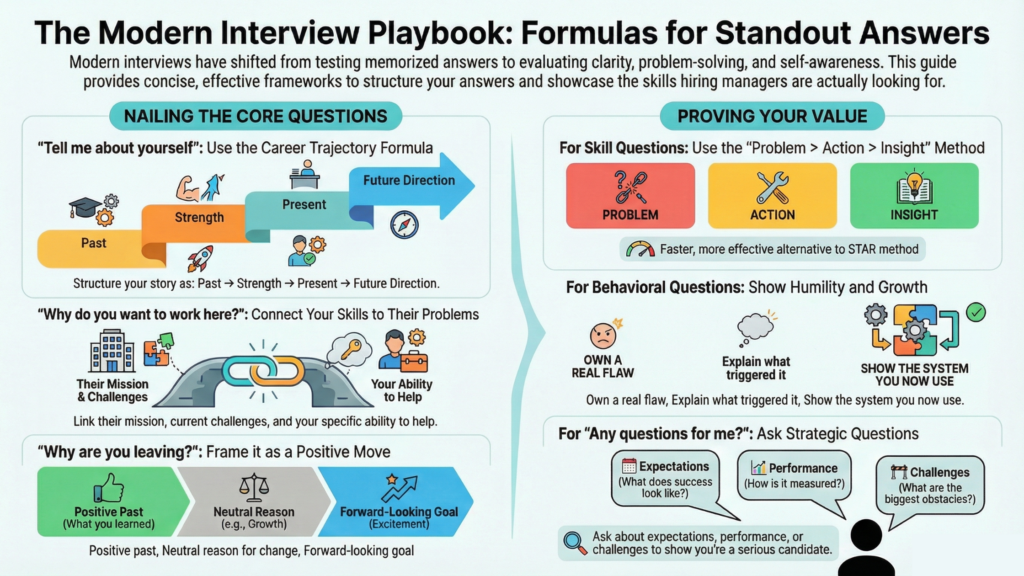
“Tell me about yourself” The 30-Second Career Story
The mistake most people make: giving a biography.
What works today: a trajectory.
Think of your answer like a movie trailer, not the entire film. This is one of the most important moments where interviewers decide whether you can deliver the best answers to interview questions with clarity.
A structure that consistently performs well is:
Past → Strength → Present → Direction
Example:
“I started my career in customer operations, where I realized I had a strength for solving messy problems under pressure. That led me into process improvement roles, and recently I’ve been focused on building scalable systems for growing teams. Today I’m looking for a place where I can apply that focus to a larger product or customer-facing environment.”
Why this works: It gives the interviewer exactly what they need to understand your arc and momentum. Which is the foundation of best answers to interview questions across roles.
“What makes you unique?” The Differentiator That Actually Lands
Many candidates treat this question like a personality essay.
Interviewers don’t want random trivia; they want a repeatable skill backed by evidence.
Use this formula:
Unique strength → Proof → Why it matters for them
Example:
“One thing that sets me apart is that I can take incomplete inputs and still produce a clear direction. At my last job, our roadmap changed weekly, but I built a system that allowed my team to deliver ahead of schedule without burning out. [Roles like this] need someone who can create clarity quickly, so that’s where my uniqueness fits in.”
This answer is specific, practical, and interviewers love it. Hallmarks of the best answers to interview questions.
“Why do you want to work here?” The New Standard
Most candidates over-explain their admiration for the company.
The interviewer really wants to know:
How well did you study our problems?
Modern best answers to interview questions here connect 3 things:
- Their mission
- Their current challenges
- Your ability to improve something specific
Here’s how to answer Why do you want to work here in a way that hits all three:
“I’m drawn to companies that are building for long-term impact, and your focus on simplifying user workflows stood out to me. I noticed you’re doubling down on automation and improving reliability, and that’s exactly the environment I work best in solving operational complexity. What excites me is the chance to help accelerate that roadmap.”
This shows alignment without sounding generic.
“Why are you leaving your current job?” The High-Risk Question
This question ‘why are you leaving your current job interview answer’ is not about your past.
It’s about whether you bring drama.
A safe, modern, interviewer-friendly structure:
- Something positive
- Something neutral
- Something forward-looking
Example:
“I’ve learned a lot in my current role, especially how to build cross-functional systems from scratch. The next phase of the company is shifting toward maintenance, and I’m ready for a more growth-oriented environment again. I’m looking for a place that challenges me in new ways.”
No negativity. No blame. Clean and mature.
The Secret to Answering Skill Questions: Use “Problem > Action > Insight”
Traditional STAR answers are too long. The most effective and best answers to interview questions today is this faster version:
Problem → What you did → What you learned
This structure works for almost all job interview questions without dragging.
Example:
Q: “Tell me about a time you fixed a broken process.”
Problem: “Our onboarding time doubled because the workflow wasn’t tracked.”
Action: “I mapped the entire pipeline, removed three unnecessary approvals, and automated reminders.”
Insight: “I realized that 80% of delays happen where responsibility overlaps, so now I always clarify ownership first.”
This is short, sharp, and deeply effective.
How to Answer Behavioral Questions That Catch People Off Guard
Interviewers increasingly test self-awareness with questions like:
- “Tell me about a piece of feedback that changed you.”
- “Describe a time you misjudged something.”
- “What’s a habit you’re trying to fix?”
The winning answers combine humility with control:
Own a flaw → Show what triggered it → Show a system you now use
Example:
“I used to take on too much because I didn’t want to slow down projects. It backfired when I missed a detail that affected a deadline. Since then, I have used a personal rule that if something takes longer than 20 minutes, someone else should know about it. This small habit keeps me aligned with my team.”
Interviewers love candidates who know their failure modes.
If You’re a Fresher or Early Career: What Interviewers Actually Look For
Entry-level candidates often worry they don’t have enough experience. But hiring managers for an entry-level position look for something entirely different:
- Your curiosity
- Your pace of learning
- How do you think about mistakes
- Whether you can follow a structured process
If you need to prepare for interview questions for an entry level position, use this shape:
“Here’s how I approach learning → example → why it works”
Example for sales interview questions and answers for freshers:
“I know early sales roles are about consistency, not shortcuts. In my internship, I kept a log of every objection I received and every framing that worked. After two weeks, I could predict patterns. That’s how I learn quickly: repetition, reflection, and creating small playbooks.”
This makes you look coachable and self-directed.
The Question No One Prepares For: “Do you have any questions for me?”
Interviewers use this moment to measure:
- Your seriousness
- Your ability to think
- Your grasp of the problems they’re solving
Don’t ask shallow questions, make sure to choose questions to ask interviewer that reveal your strategic thinking.
Examples:
- “What would someone need to do in the first 90 days to exceed your expectations?”
- “When you imagine someone thriving in this role, what are they doing differently from an average performer?”
- “Which initiatives keep getting pushed back but shouldn’t be?”
These questions show you’re already imagining the role from the inside.
The Questions You Must Prepare For Even If They Aren’t Asked
Here are four topics that appear across nearly all questions asked in interview with answers you should mentally prepare:
- A problem you solved
Answer from Cloudhire’s Team: “At my last role, we noticed candidates were dropping off after the first interview, but no one had clear data on why. Instead of guessing, I personally followed up with a few candidates who declined to continue. The feedback was uncomfortable but clear: timelines were unclear, and communication felt cold. I rewrote the interview email templates, added a simple ‘what to expect’ step-by-step note, and set a 48-hour follow-up rule. Drop-offs reduced noticeably within a month, and hiring managers stopped escalating delays.”
Why this works: it shows initiative, discomfort tolerance, and ownership, not heroics.
- A conflict you handled maturely
Answer from Cloudhire’s Team: “I once disagreed with a hiring manager who wanted to reject a candidate purely based on pedigree. Instead of pushing back emotionally, I asked if we could run a short paid task as a tie-breaker. The manager agreed reluctantly. The candidate performed better than expected and was hired. Six months later, that same manager asked me to design tasks for all similar roles. I didn’t ‘win’ the argument, I reframed it into an experiment.”
Why this works: no drama, no ego, just calm problem-solving.
- A project that taught you something unexpected
Answer from CloudHire’s Team: “I led a content initiative that I was confident would perform well because competitors were doing something similar. It flopped. What surprised me wasn’t the failure, but why our audience didn’t want depth; they wanted clarity. After reviewing comments and behavior, I shifted the format to simpler, question-based content. That version started ranking and driving engagement. It taught me to stop copying strategy and start listening harder.”
Why this works: shows learning, humility, and correction, not perfection.)
- A moment where you showed ownership without being asked
Answer from CloudHire’s Team: “During a busy period, I noticed onboarding docs were outdated, but fixing them wasn’t part of my role. New hires kept asking the same questions. I updated the doc quietly, added screenshots, and shared it with the team lead, saying, ‘Use this if helpful.’ It became the default onboarding resource later. I didn’t ask for credit, I just removed friction.”
Why this works: ownership without announcing it.
Highly recommend that if you build one story for each, you’ll be able to answer almost any curveball.
The Meta-Skill: How to Sound Sharp Without Sounding Rehearsed
Most candidates over-practice. The real trick is to prepare in structures, not scripts.
Structure gives you:
- Clarity
- Confidence
- Adaptability
When the interviewer asks something unusual, you’re not stuck. That’s the real secret behind best answers to interview questions that feel human, not robotic.
A great warm-up trick before an interview:
Pick any random object on your desk, a pen, a wallet, a cup, and practice explaining why it’s useful in three different ways:
- Emotional
- Functional
- Strategic
If you can do that with a pen, you can do it with your experience.
Conclusion: Interviews Reward People Who Think Clearly
If you build a small library of:
- 3 stories
- 3 strengths
- 3 lessons
- 3 questions of your own
You’ll outperform 95% of candidates who rely on memorizing templates. The best answers to interview questions aren’t memorized. They are structured, human, honest, and aligned with the company’s problems.
And if you’re exploring your next remote opportunity or want to understand what high-quality global hiring looks like today, you can browse roles on CloudHire we connect candidates with vetted, long-term remote jobs while helping companies hire stronger distributed teams.
Your career deserves the right fit. Start with clarity, structure, and preparation.
Frequently Asked Questions
1. How to answer “do you have any questions for us?” (best questions)
Always ask 2-3 thoughtful ones:
- “What does success look like in the first 90 days?”
- “How does this team measure impact?”
- “What’s the biggest challenge the team faces right now?”
2. What are the best answers to “tell me about yourself”?
Keep it 1-2 minutes: past role/project, current skills, why this job.
Best answer: “I’ve spent the last [X years] as a [role] at [company], where I [key achievement with numbers]. I specialize in [2-3 skills from JD]. I’m excited about this role because [specific company/role fit].”
3. What is the best answer to “why should we hire you”?
Focus on results + fit, not traits.
Best answer: “You should hire me because I’ve delivered [specific result, e.g., ‘grew revenue 25%’] using [skills they need]. I understand your [challenge from research] and know how to [solution that matches your experience].”