Many job seekers assume their resume gets ignored because of skills or experience gaps. Often, the real issue hides in a small technical detail. Recruiters use systems that filter applications long before a human sees them. When your resume misses the structure these systems expect, important details stay unnoticed. You might be a strong fit on paper, yet your application never reaches the hiring team.
You deserve clarity in this process. You deserve a resume that works for both humans and technology. A resume that feels natural to read and still supports an optimal resume structure for modern hiring tools. When you understand how these systems read your document, you remove barriers that stop your job search.
Take a moment. Let’s build a resume that speaks clearly.
Understanding of Applicant Tracking Systems
Many people think an AI applicant tracking system acts like a strict judge. In truth, these tools simply scan documents for structure, keywords, and clarity. They help recruiters sort applications because volume stays high each week.
An applicant tracking system for recruiters reads your resume by looking at headers, skills, job titles, dates, and keywords. When these sections stay clear, the system records your information accurately. When formatting block content or when keywords stay hidden inside graphics or tables, the system captures only fragments. This leads to missing matches and weak visibility.
Understanding this flow helps you create an ATS optimized resume that respects both the system and the recruiter who later reads it.
“Most resumes don’t fail because of weak experience. They fail because small friction in how information is structured stops systems from reading them clearly.”
– Sufiyan, CEO, CloudHire
A Resume That Reads Cleanly Without Confusing Structure
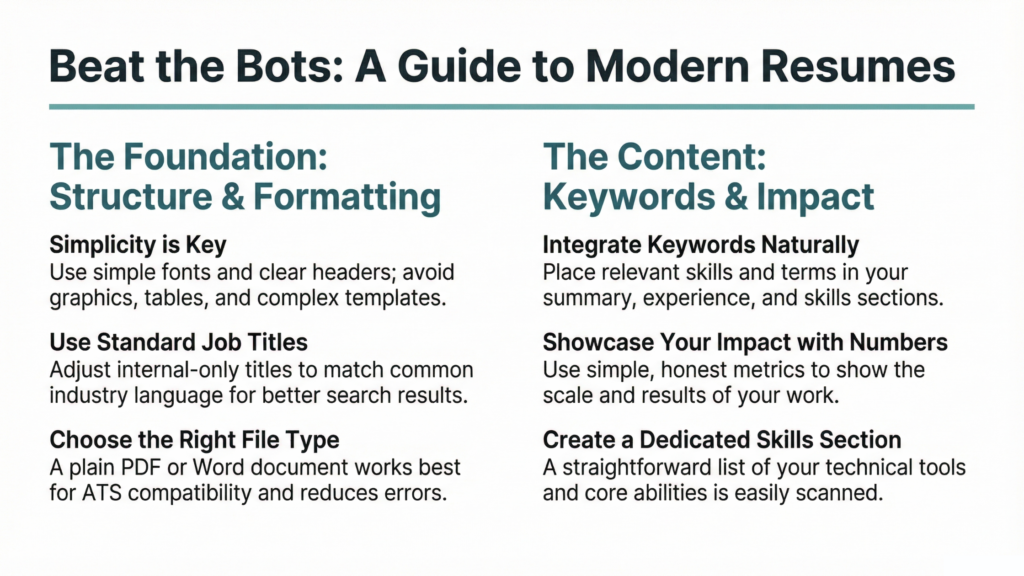
You do not need fancy templates. You do not need graphics or charts. You need a structure that stays simple and friendly for scanning.
You can focus on:
- Clear section headers
- Simple fonts
- Straightforward alignment
- Bold keywords
- Full words instead of shortened forms
This type of structure works well for an ATS resume optimization tips approach because every word stays readable. Recruiters also prefer this style because it removes distractions and gives them a clear path through your experience.
The best resume format for applicant tracking system stays clean and direct. When your layout respects the way systems read documents, your content appears exactly as you intended.
Keywords That Match How Recruiters Search
Recruiters search inside their system the same way you search online. They type in skill keywords, job titles, tools, and experience levels. Your resume needs the right language so it matches these searches without feeling forced.
For effective resume optimization, Focus on natural phrasing. You do not need to stack terms repeatedly. You only need the right phrases in the right places.
- Your professional summary can hold your main skills.
- Your experience section can hold outcome-based tasks.
- Your skills section can list tools and methods with clarity.
This gives you strength when systems compare your resume to applicant tracking system keywords. When you write in your own voice and still include terms that match industry language, you build a stronger presence.
You do not need keyword stuffing. You need smart placement. That is how you optimize resume for ATS without losing your tone.
The Type of Content That Helps Your Resume Stand Out
A calm resume stands out when it removes noise. You can focus on your actual work instead of trying to impress with heavy language. Recruiters read many documents each day. They notice clarity more than anything.
You can explain:
- What you improved
- What you launched
- What you supported
- What you managed
- What you solved
This creates a useful pattern for both humans and an AI resume optimizer because your impact stays visible through action words and outcomes. When your tasks feel grounded and real, your resume becomes memorable without forcing drama.
You want each role to show intention. A few well-written lines speak louder than long paragraphs with no direction.
Clean Job Titles That Match Industry Language
When your job title stays unclear or uncommon, systems struggle to match it to the right role. Recruiters also search titles directly in the system.
If your company used an internal title that does not match the market, you can adjust it in a safe and transparent way. For example:
- Business Associate (Client Support)
- Engineer I (Backend Development)
- Assistant Manager (Content Strategy)
This keeps honesty intact while helping systems find you for relevant searches. It helps your resume connect with search engine optimization resume ranking patterns because your terminology matches how people look for candidates.
A Skills Section That Feels Useful, Not Decorative
A strong skills section supports the rest of your resume. It helps systems recognize patterns and connects well with resume optimizer tools. Many people list random skills without context. You want your list to reflect the work you actually do.
For example:
- Project planning
- Reporting and documentation
- Cross-team alignment
- Troubleshooting
- Technical tools
This becomes a central block that systems use to match you to the job. A simple list delivers strong visibility when recruiters run searches inside their system.
Numbers That Highlight Your Impact Without Exaggeration
Recruiters appreciate numbers because they show scale. When you add simple metrics, even small ones, your resume becomes actionable.
You can write:
- Improved response time by a small percentage
- Handled a specific number of customers
- Completed tasks within set timelines
- Supported teams across regions
- Increased accuracy in reporting
You do not need large, dramatic results. You only need truth. These details help your resume earn trust and support the scanning process as well.
Writing That Lets Your Strengths Breathe
A resume does not need heavy adjectives or long descriptions. It needs space. When you allow each section to breathe, the reader can understand your growth. This approach shapes a calm and confident document.
You can use short lines that explain each task clearly. You can separate achievements naturally. This helps both humans and systems absorb your message.
When your writing stays steady and honest, your resume holds presence. When your tone stays simple, your value shows stronger.
A Summary That Guides the Recruiter Gently
Your summary is the soft start to your resume. It should not overwhelm. It should guide. You can use this area to introduce your main strengths, your current focus, and the skills you bring forward.
This part creates early alignment with optimal resume structure. It also helps systems match your profile to job descriptions early in the scan.
Think of it as your quiet first impression. Calm. Clear. Focused.
Documents That Help Your Resume Perform Better
Your resume does not work alone. Some tools and formats enhance your visibility.
- A plain PDF or Word file works best for ATS systems.
- Consistent job dates support cleaner scanning.
- Straightforward bullet points increase readability.
- A skills list in text helps the system capture all keywords.
These steps support your ATS optimized resume and reduce processing errors that hide important information from recruiters.
A Steady Approach to Writing Experience
Experience sections carry the weight of your resume. You want each role to show movement and growth. You can describe what changed during your time there and how your actions supported the team.
Instead of long stories, you can create calm and clear explanations of your tasks. This format matches how systems read resumes through scanning blocks of text. It also makes it easier for recruiters to understand your strengths quickly.
This approach stays true to ATS resume optimization tips while remaining human and gentle.
Final Thoughts for a Resume That Reaches the Right People
Your resume becomes stronger when it stays honest, clear, readable, and easy for technology to process. Resume optimization is not about chasing trends, complicated templates, or heavy descriptions. You need structure, intention, and steady language.
When you respect how systems read documents and how humans read stories, you create a resume that meets both with ease. You remove barriers that keep your experience unseen. You invite more callbacks by presenting who you are in a direct and confident way.
Calm writing leads to strong resumes. Clear structure leads to better recruiter matches. Your next opportunity may come from a document that finally reflects your real work.
Take your time. Shape it with care. Let your voice stay present.
If you’d like help putting this into action, Cloudhire can AI-optimize your resume and simplify the steps from applying to interviewing, keeping everything in one place so you can focus on your next move – Get in touch with us
Frequently Asked Questions
What are common resume optimization mistakes?
- Using a PDF with scanned images (unreadable by ATS).
- Keyword stuffing (looks fake to humans).
- Generic objective (“hardworking professional”).
- Missing metrics/numbers in achievements.
- Wrong file name (“resume.pdf” vs “John-Smith-Marketing-Manager.pdf”.)
What is resume optimization?
Resume optimization is tailoring your resume to pass applicant tracking systems (ATS) and grab recruiter’s attention. It means using job-specific keywords, clear formatting, and focused achievements so both machines and humans notice you quickly.
How long should an optimized resume be?
One page for most people (under 10 years of experience.) Two pages max for senior roles or extensive achievements. Recruiters spend 7-10 seconds scanning, so keep the best info above the fold and ruthlessly cut anything not relevant to the job.