You’ve seen those headlines everywhere: “Immediate hire remote jobs”! “Start tomorrow!” They grab attention but often hide chaotic hiring practices that waste everyone’s time. What if the real path to fastest hiring remote jobs comes from understanding hidden systems? Not by rushing, but by intentional navigation.
Why “Urgently Hiring” Signals Often Backfire
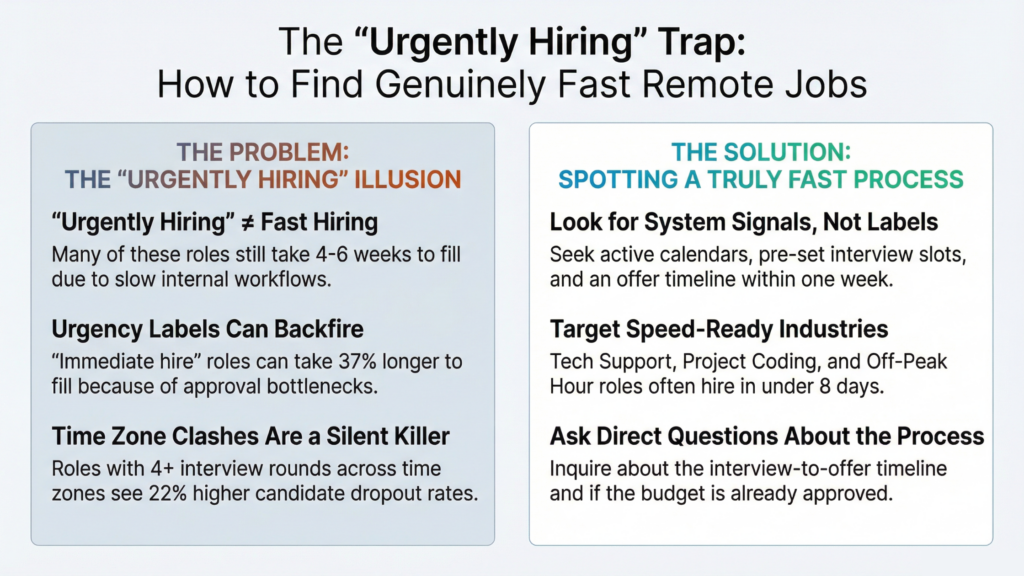
Many companies post “remote jobs urgently hiring” yet still take 4-6 weeks to screen candidates. The disconnect often lies in inefficient structures. The issue is not just candidate speed; it is the internal workflow. When a job is labelled “immediate hire jobs remote,” candidates assume speed. But when the process uses legacy hiring workflows, delays multiply.
For example, a study in a tech firm found roles labelled “immediate hire” actually took 37 % longer to fill than standard listings because of approval bottlenecks. The fastest hiring remote jobs don’t rely on hype; they rely on ready-to-go budgets, delegated decision-making and proactive scheduling.
Thus, if you’re chasing fastest hiring remote jobs, look for signals such as an active calendar, interview slots already set, and an offer timeline that fits within a week.
Time Zones: The Silent Killer of Quick Hiring
One major barrier to remote hiring speed is remote hiring time zone challenges scheduling interviews. When your candidate lives in Mumbai and your hiring manager is in New York, aligning calendars becomes a hidden drag. Surveys show that roles with four or more interview rounds see up to 22 % higher dropout rates when time zones clash. Companies that land fastest hiring remote jobs have figured this out. They:
- Cluster interviews within a 48-hour window
- Use automated scheduling tools that detect time zones and offer slots accordingly
- Offer asynchronous alternatives such as recorded interviews, so the candidate submits answers and the team reviews when convenient
When you pursue remote jobs immediate hire, ask: How many interview rounds? Can I self-schedule across time zones? That first response tells you more than the “urgently hiring remote jobs” label.
Three Fields Where True Speed Happens
Based on remote hiring data for 100K+ roles, three areas tend to deliver fastest hiring remote jobs in under a week:
1. Tech Support & Customer Success
Average hire time: 5-8 days
Why: Skill tests are standard, the role description is clear, and candidate’s scope is defined.
Keyword: “remote jobs immediate hire” appears often here.
2. Short-Term Project Coders (Bug-fix, MVP builds)
Average hire time: 72 hours
Why: Portfolio > resumes; paid trial tasks replace screenings.
Listings often say “immediate hire remote jobs.”
3. Off-Peak Hour Roles (global customer coverage)
Average hire time: ~6 days
Why: Shift-based scheduling helps focus the pool and speed approvals. Employers search “remote jobs urgently hiring” to fill these positions quickly.
If you want fastest hiring remote jobs, these fields often move. Other roles may still deliver speed, but the system elements above must be present.
The Tools, Cutting, and Screening Delays
When companies aim for the fastest hiring remote jobs, they invest in streamlined workflow tools:
- AI parsing and skill tagging to handle initial screening
- Integrated candidate scheduling + calendar sync across time zones, Incruiter
- Automated offer/contract generation so the offer follows the final interview quickly
When you look for immediate hire jobs remote, pay attention to the language: “Offer within 48 hours after final interview”, “Self-schedule interview slot today”. These clues tell you the system is built for speed.
People Optimization: The Forgotten Lever
Speed isn’t only tech. It is alignment across three threads:
- Budget – Roles already approved and ready to be filled (no waiting for CFO sign-offs)
- Team leads – Empowered to decide fast without layers of approvals
- Candidates – Options to self-schedule, clear timeline ahead of time
Studies show that when candidates see a live status (“Your file is being reviewed by 2 interviewers”), follow-up emails drop by 75 %. Calm speed happens when anxiety drops. Systems that support fastest hiring remote jobs create transparency, not confusion.
Should You Chase “Urgently Hiring” Labels?
Short answer: Sometimes, but with questions.
When you see “remote job immediate hire”, ask:
- What is the interview-to-offer timeline? (If >10 days, speed will suffer)
- Can I schedule all rounds via one calendar link? (Avoid back-and-forth)
- Was this role budget approved already? (New approvals drag out process)
Your target is the fastest hiring remote jobs, not just promoted ones. Picking roles where the system supports speed matters more than the label.
Avoiding the Common Pitfalls
Some companies offer remote hiring urgent roles, but stall because they keep saying “need to check availability”. Or they add interview rounds without reducing decision layers. This creates confusion for candidates and costs for companies.
As an applicant, you can spot delays by:
- Ungiven timeline (e.g., “We’ll be in touch soon”)
- Multiple interviewers arranged ad hoc instead of being scheduled ahead
- No transparency on next steps
If you’re looking for immediate hire remote jobs, focus on clarity of flow and decision time. A streamlined process signals genuine speed.
How to Position Yourself for These Roles
If your goal is to land roles labelled “remote jobs urgently hiring”, match your profile to speed-ready roles:
- Highlight clear, current skills
- Choose roles with defined outcomes over vague roles
- Offer quick availability
- Update your LinkedIn or profile with “Available for immediate remote hire” (if true)
- In your interview, ask: “What is your fastest hire workflow?” and “What is the budget status?”
Doing this aligns you with companies offering fastest hiring remote jobs and reduces wasted waiting.
Filter the Market Effectively
Not all roles are truly fast. Use these filters:
- Keyword check: “immediate hire remote jobs”, “urgent start remote”
- Minimum rounds: One or two rounds only
- Time zone friendly: Offer time slots within 72 hours
- Clear contract path: Offer mark is less than a week after the last discussion
When you apply to roles with these signs, your chances of landing one of the fastest hiring remote jobs increase significantly.
Retention Matters Too
Speed is important, but so is fit. Fast hiring doesn’t mean you skip culture fit or onboarding. When companies rush without structure, turnover increases.
Build onboarding check-ins, provide probation-period reviews, and schedule early feedback. This keeps the remote job promise alive and reduces regrets.
Final Thoughts
As a job seeker, you gain by focusing on clarity, timelines, and process. As a recruiter, you gain by fixing the unseen friction. Only then does “remote jobs immediate hire” translate into real hires, not just hype.
When you apply, ask the right questions. When you hire, build the right systems. That is how the rapid hiring promise actually works. – Want to take the first step towards fast hiring? We’re here to help.
Seeking the fastest hiring remote jobs isn’t about chasing labels. It’s about reading signals, knowing what structure supports speed, and aligning yourself accordingly. A company ready to hire quickly has a clear budget, efficient tools, transparent scheduling, and candidate-friendly workflows.
Frequently Asked Questions (FAQs)
What are the benefits of immediate remote hiring?
Faster onboarding, less competition, and quicker contribution to team goals. It supports candidates who want to start right away and companies that need results sooner.
How can companies improve inefficient remote candidate screening?
Swap manual resume review for skill-based tagging, integrate scheduling tools that handle time zones, and provide clear timelines to candidates to keep momentum.
How do time zone differences affect remote hiring?
When interviewers and candidates live across wide zones, scheduling becomes slower and drop-out rates rise. Tools that offer self-scheduling across time zones reduce that lag significantly.
What strategies improve remote employee retention?
Provide a structured onboarding path, frequent check-ins in the first 90 days, clear performance expectations and schedule remote social connection opportunities to reduce isolation.