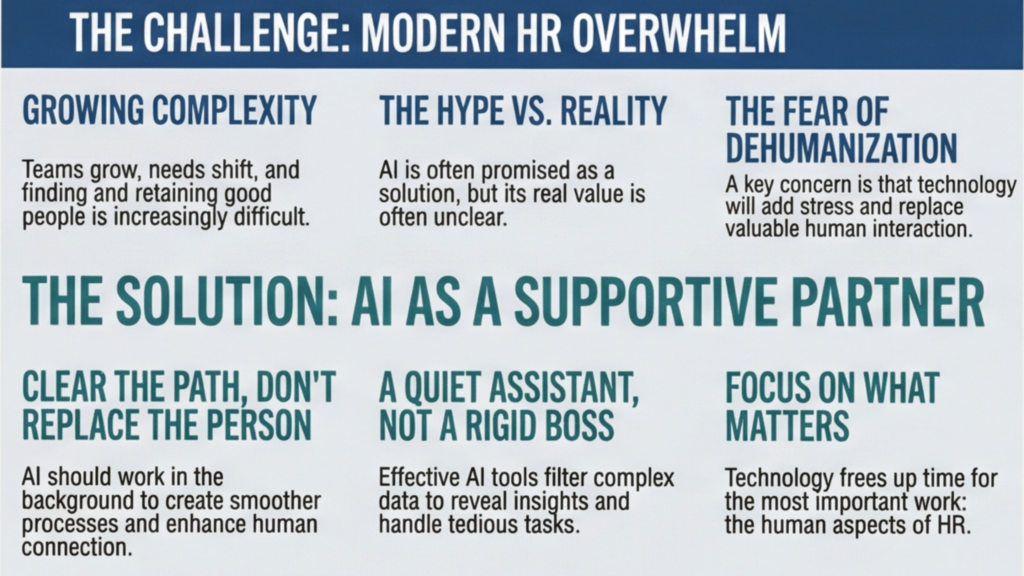
Feeling overwhelmed by HR demands is common. Teams grow. Needs shift. Finding good people feels harder than ever, and keeping them happy and productive adds layers of complexity.
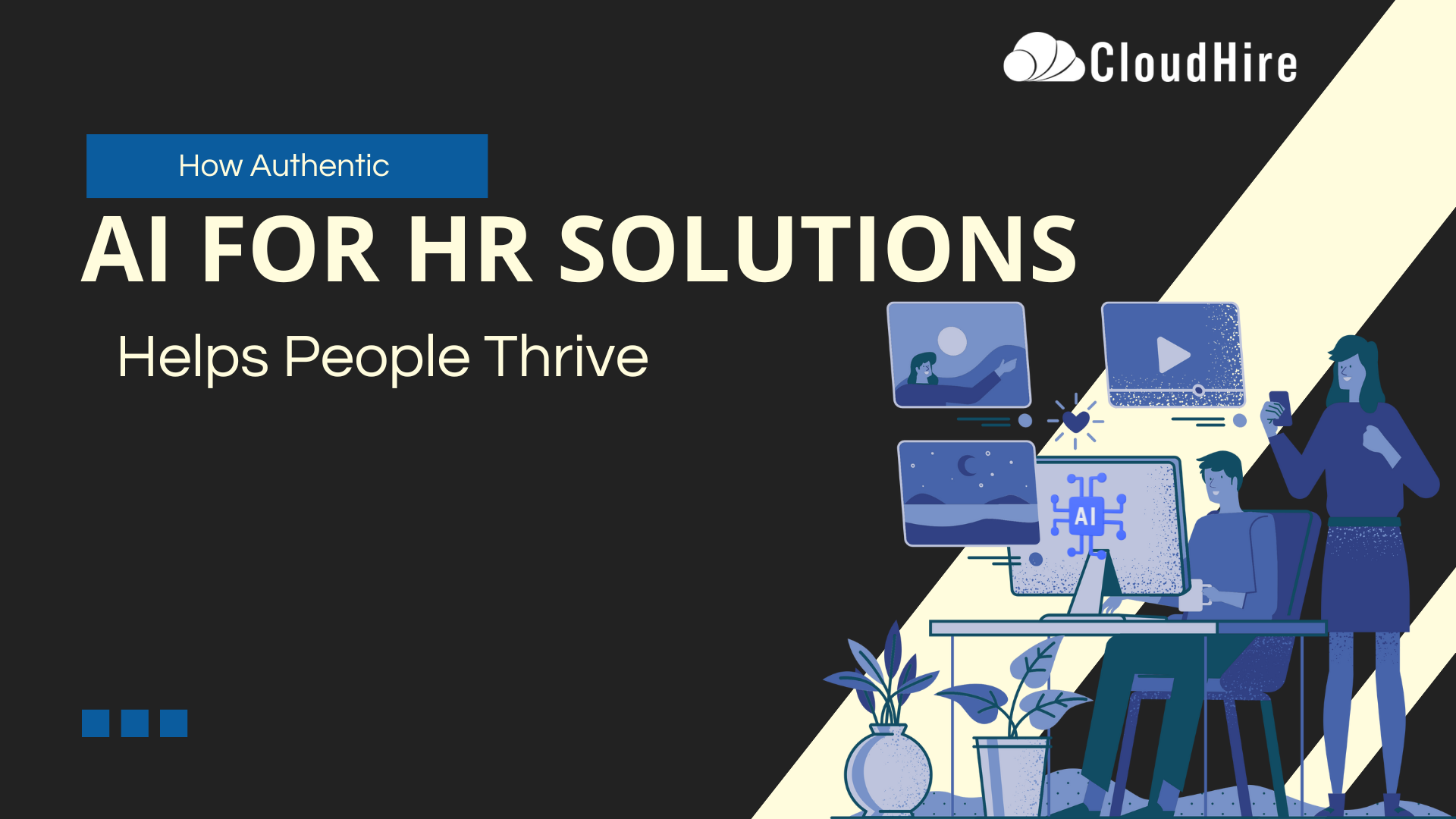
Maybe you’ve heard about AI for HR solutions promising efficiency and smarter decisions. But let’s move past the hype. What does real value look like? How can technology genuinely help people, the ones you hire and the ones doing the hiring, without adding stress? We’ll look at ways AI tools work quietly in the background to create smoother processes and more human-focused outcomes. This is less about replacing interaction and more about enhancing it. Think of it like clearing a path through a forest, making it easier to reach the destination together.
1. Understanding What Matters: AI Beyond the Buzzwords
The term “AI for HR solutions” covers many possibilities. The essence isn’t just automation for speed, but doing things better. Let’s focus on practical impacts:
- Do we find better people more fairly? Reducing hidden biases.
- Do our teams feel more supported and engaged? Understanding needs beneath the surface.
- Can we plan our workforce not just for next quarter, but sustainably? Seeing long-term needs.
- Does the technology free up our time for the human aspects of HR? Removing tedious tasks.
Effective AI isn’t a crystal ball making predictions. It’s a set of tools that handle complex data patterns, revealing insights we might miss. They function more like reliable filters and calm partners than rigid bosses. Think of a helpful assistant quietly organizing your desk so you can focus on the person across from you.
2. Understanding How Fairness and Transparency Reduce User Anxiety in Recruitment Tools
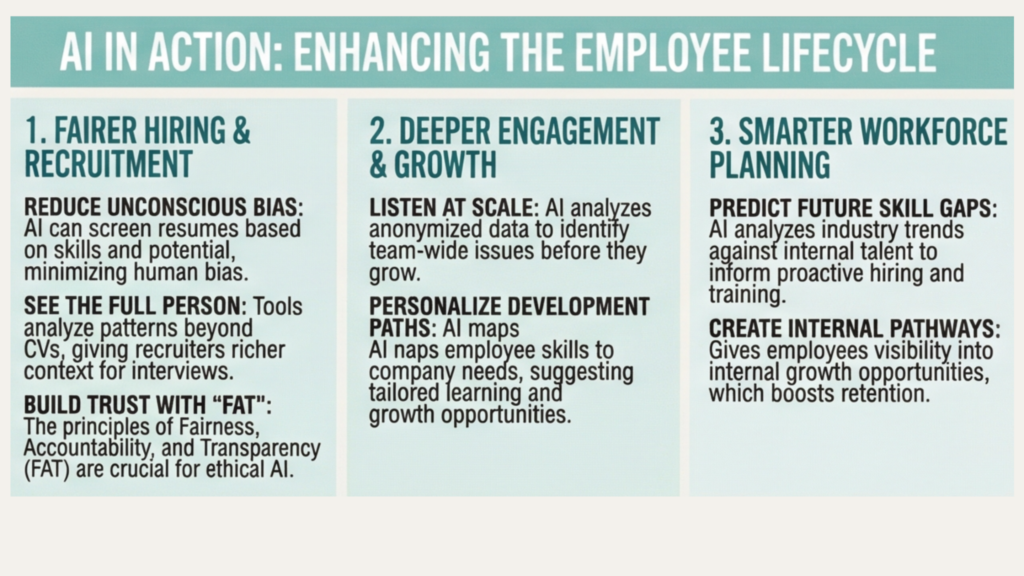
This is often the first touchpoint people experience with HR technology. Done right, it sets a positive, professional tone. Think of AI tools for talent acquisition as helpful guides, not gatekeepers. Good tools focus on potential and fit, not just keyword matching.
Reducing Hiring Bias: How AI Helps Create Fairer Starting Points
The fear of AI perpetuating bias is legitimate. However, thoughtfully designed AI recruitment screening can actively reduce unconscious human bias that creeps into resume reviews. The key? Transparency, or understanding how the tool works and what it values. Concepts like “FAT” – Fairness, Accountability, Transparency – are crucial. Some sophisticated systems even highlight their logic, helping recruiters see why a candidate is surfaced, moving beyond the “black box” concern. This isn’t just technology; it’s about building bias free hiring foundations for the crucial first impression candidates have of your company. When implemented ethically, these tools help recruiters see a broader, more diverse talent pool based on relevant skills and potential.
Seeing the Full Person: How AI Enhances the Human Element in Hiring
Beyond filtering, advanced AI talent acquisition tools like CloudHire analyze patterns beyond CVs. Perhaps a candidate consistently demonstrates problem-solving skills in open-ended assessments. Maybe their project work signals adaptability. This analysis provides recruiters with richer context, shifting the conversation from checking boxes to understanding potential contributions. The best tools augment the recruiter’s intuition, providing deeper insights to facilitate more meaningful human conversations during interviews. This approach fundamentally supports how to improve hiring process by making the selection phase more informed and human-centered.
Understanding how fairness and transparency reduce user anxiety in recruitment tools
3. Beyond the Hire: How AI Supports Lasting Employee Engagement and Growth
Finding great people is one challenge. Helping them flourish is another. This is where artificial intelligence for human resources tools moves into fostering connection and development. Real employee engagement isn’t just ping-pong tables; it’s about feeling valued, understood, and having growth paths.
Listening Well: Understanding Team Dynamics with Data
Subtle signals often emerge before formal feedback. Perhaps anonymous pulse survey responses cluster around workload concerns in a specific department. Maybe communication tool usage patterns suggest collaboration hurdles. Some HR software platforms analyze these patterns anonymously, identifying trends without invading privacy. This allows proactive interventions, perhaps retraining a manager on delegation, or improving cross-team communication channels before disengagement sets in. It’s about listening at scale to address real issues, fostering a more supportive environment where people feel heard, and directly impacting employee engagement.
Building Individual Pathways: How AI Personalizes Development
Imagine understanding each employee’s skills and aspirations clearly and suggesting tailored learning paths. AI for HR solutions can map individual skills profiles against company needs and internal opportunities. For instance, an employee strong in analysis but looking for leadership might be guided towards relevant project management courses available internally. Contextualized systems can recommend specific training based not only on their current role but inferred potential paths mapped against their skills and preferences. This moves beyond generic training catalogues to personalized growth journeys, showing employees a tangible investment in their future within the company. It leverages people optimization by aligning individual aspirations with organizational needs.
Looking Ahead Smartly: Workforce Planning for Stability and Opportunity
Effective workforce planning HR means more than headcount projections. It involves predicting future skill needs, identifying potential talent gaps, and planning for succession internally. Sophisticated workforce planning HR tools analyze skills trends across the industry, compare them to internal talent pools, and forecast gaps. This informs proactive hiring and robust internal development programs. Knowing future needs allows creating internal pathways, giving employees visibility into growth opportunities within the company, a crucial factor for retention in HR automation.
4. Bringing It Together Smoothly: Building Sustainable Change with AI
Adding complexity rarely helps. Implementing AI for HR solutions should simplify and clarify, not create new burdens. Success requires thoughtful integration.
Starting Where It Hurts: Choosing the Right Focus First
Think about the greatest points of friction or pain within your HR processes:
- Is it the endless hours spent sifting resumes?
- High early-stage turnover?
- Low engagement in development programs?
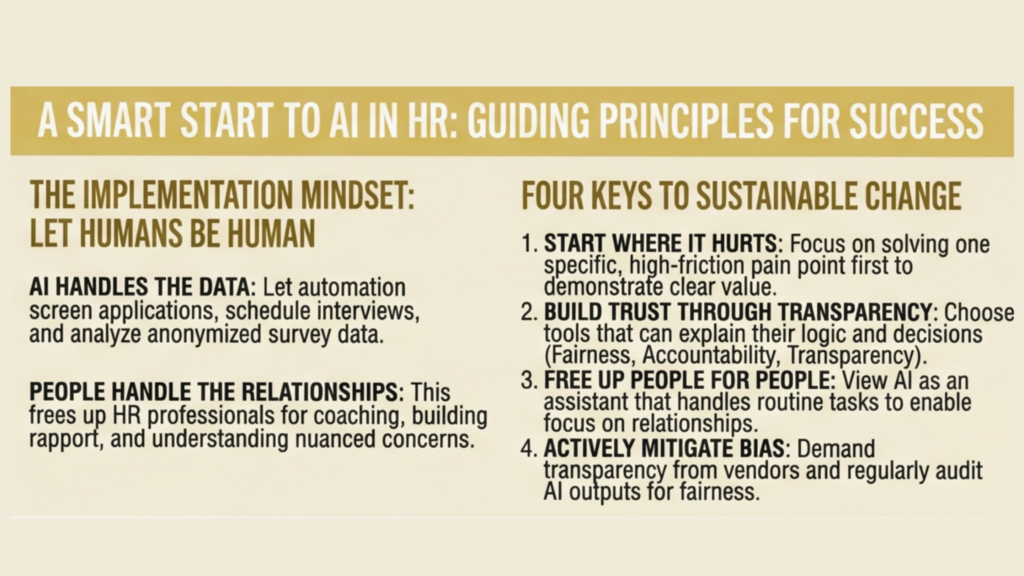
Pilot AI solutions targeting these specific areas. Focusing on solvable pain points provides tangible value and builds internal confidence. Trying to overhaul everything simultaneously often leads to overwhelm and resistance. Addressing one clear challenge effectively demonstrates value and builds momentum for wider adoption. Keep the focus narrow initially; solve a real problem quietly and well.
Making Sense Together: Explaining How AI Works Builds Trust
People understandably feel wary about decisions influenced by technology they don’t understand. Choose HR software and AI in talent acquisition tools that offer some level of explainability. Can the system explain why it recommended a particular candidate or flagged a risk? Transparency around criteria and logic (“Fairness, Accountability, Transparency” – FAT) builds crucial trust with both HR teams and employees. Avoid tools operating as opaque systems. Look for vendors who prioritize explainability features. Trust comes from understanding, not from blind faith in complex algorithms.
If this way of thinking about AI in hiring resonates, it’s the same philosophy that guides how we at CloudHire build our tools – Talk to us?
Letting Humans Be Human: AI Handles Data, People Handle Relationships
The most successful implementation mindset views AI as an assistant.
Let HR automation tools handle repetitive tasks:
- Screening initial applications
- Scheduling interviews
- Analyzing anonymized engagement survey data
- Generating standard reports on skills gaps
This frees up your HR professionals for the irreplaceably human tasks:
- Building rapport in interviews
- Understanding nuanced employee concerns
- Coaching managers
- Designing thoughtful development programs
- Fostering genuine connection
Ensuring Fairness in Focus: Consciously Reducing
Admit the limitations. AI learns from data, and historical HR data often reflects past biases. Actively work to mitigate this. Demand transparency from vendors about their bias testing and mitigation strategies. Use diverse data sets for training. Regularly audit AI outputs for potential bias. Ethical implementation is an ongoing commitment, not a one-time setup check. Striving for bias free hiring and equitable talent management is a continuous journey where technology needs careful human oversight and ethical boundaries.
The Steady Path Forward: Authentic Value in AI for People
Integrating valuable AI for HR solutions is a thoughtful process, not a frantic rush to buy software. It requires selecting tools that align with core principles:
- Solving Specific Problems: Start with real pain points.
- Building Trust: Choose transparency and explainability (FAT-CAT)
- Freeing People: Let automation handle routine tasks so HR can focus on relationships.
- Actively Mitigating Bias: Commit to ethical oversight and regular audits.
This measured approach unlocks the genuine potential of AI tools for talent acquisition and employee management. It transforms the noise of modern HR challenges into calmer, more purposeful work. Better decisions, deeper engagement, and more sustainable planning become possible.
The promise of AI talent acquisition tools and broader artificial intelligence for human resources isn’t about cold efficiency replacing human warmth. It’s about harnessing data’s quiet potential to reduce friction, highlight important patterns, and create more space for the meaningful human conversations and thoughtful leadership that build truly thriving workplaces. That’s how AI for HR solutions truly earns its place not as a loud disruptor, but as a steady, supportive partner in building a better workplace.
If you’re exploring how AI can quietly support fairer hiring, clearer decisions, and more human HR practices, that’s exactly the space we think about every day at Cloudhire. Our tools are built to reduce friction, not add noise, helping HR teams focus on people while technology handles the patterns in the background.
If you’re curious, you’re always welcome to start a conversation with us.
Frequently Asked Questions:
1. What are AI for HR solutions, and how do they actually help HR teams?
AI for HR solutions are tools designed to support hiring, engagement, and workforce planning by analysing large amounts of data that humans can’t realistically process alone. Their real value is not speed for its own sake, but clarity. When used thoughtfully, they reduce repetitive work, surface meaningful patterns, and give HR teams more time to focus on people rather than processes.
2. Can AI for HR solutions really reduce hiring bias?
Yes, but only when fairness and transparency are built into the system. Ethical AI recruitment tools are designed to reduce unconscious human bias by focusing on skills, patterns, and potential rather than surface-level signals. Transparency is key. When recruiters understand why a candidate is recommended, AI becomes a fairness tool rather than a black box.
3. How does AI improve the candidate experience during hiring?
AI improves the candidate experience by making processes clearer, faster, and more consistent. Thoughtfully designed tools help ensure candidates are evaluated on relevant criteria, receive timely communication, and experience fewer arbitrary delays. When AI is transparent and fair, it reduces anxiety rather than increasing it.