Virtual pipelines, video-first selling, AI-supported prospecting, and global hiring have reshaped how Sales teams work. In this new landscape, remote sales jobs aren’t just an option; they have become a strategic career path.
But are they better than traditional office sales roles?
Which one accelerates your income, stability, and long-term growth?
And which environment makes you a stronger salesperson?
This guide brings insights from our internal team to help you choose a path that truly works for your mind, goals, and strengths.
The Rise of Remote Sales Jobs: Data, Not Hype
The shift toward remote sales jobs didn’t happen by accident. Several powerful trends collided:
1. Workflow Digitization
Over 80% of B2B decision-makers now prefer digital-first interactions. That means fewer call-heavy, office-dependent workflows and more virtual meetings, async deal updates, and CRM-driven operations.
Sales roles that once required being physically present inside sales, software demos, and client onboarding now operate entirely online. This enabled categories like remote inside sales jobs and even niche fields like remote funeral sales jobs to flourish.
2. Global Talent Competition
Remote hiring allows companies to source talent from anywhere. Senior roles like remote software sales jobs or remote sales representative jobs now attract worldwide applicants. This raises the bar on skills but also opens doors to professionals far outside traditional tech hubs.
3. Productivity Advantages
Studies from Stanford show remote sellers gain the equivalent of two extra working weeks per year due to:
- No commuting
- Fewer office distractions
- Greater control over energy rhythms
- The ability to design their own work environment
Professionals in high ticket sales jobs remote roles benefit the most from this, because deeper focus = higher close rates.
Why Office Sales Still Matter: The Human Factor
While the world is shifting to remote, traditional office sales environments still offer unique advantages that can’t be replicated through a screen.
1. High-Density Learning
Sales is an apprenticeship-driven profession.
Sitting near top performers exposes you to:
- objection patterns
- tone and energy shifts
- live negotiation dynamics
- micro-behaviors that improve persuasion
This environment speeds up growth in early careers, including those transitioning into tech sales jobs remote roles later.
2. Serendipitous Networking
In-office sellers often receive:
- faster promotions
- more leadership visibility
- stronger peer mentorship
Office interactions accelerate promotions, especially in competitive sales fields like tech, SaaS, or medical device sales.
3. Emotional Contagion
Research from the University of British Columbia shows that team-based, high-energy environments boost optimism and performance hormones crucial in high-volume sales floors.
Remote setups don’t naturally provide this psychological lift.
Which Environment Wins? A Framework Based on Your Strengths
Instead of asking “Which is better?”, ask:
Which aligns with how I work best?
Below is a decision model based on skill dynamics, psychology, and workflow fit.
1. Geography & Lifestyle Flexibility
Remote wins overwhelmingly.
If you live outside major cities, jobs like sales remote jobs or part time remote sales jobs give you access to roles previously limited to expensive metros.
If you’re caregiving, studying, or need flexibility, remote is a game-changer.
2. Communication Style
- Strong writer? Self-starter? Introvert who excels in async?
You will thrive in remote sales job environments. - Charismatic? Thrive in in-person persuasion? Feed off team energy?
Office selling gives you an edge.
Remote selling relies heavily on:
- crisp emails
- structured CRM notes
- written proposals
- clear demo narratives
Office selling leans on:
- voice persuasion
- live collaboration
- real-time coaching
3. Skill Specialization
Economic models show remote work increases “skill polarization”: roles requiring advanced skills grow fastest.
Examples:
- remote tech sales jobs – high earning potential but requires technical comprehension
- remote inside sales jobs – requires CRM mastery
- remote sales rep jobs – strong follow-up, self-management
- funeral sales specialist remote jobs – niche expertise, compliance understanding
Meanwhile, office environments are ideal for developing:
- soft-skill persuasion
- energy-based selling
- negotiation intuition
4. Income Trajectory
Remote offers:
Higher base salaries due to global competition.
Office often offers:
Faster promotions due to managerial visibility.
If you want long-term career elevation (leadership, enterprise roles), office may provide clearer pathways.
If you want work–life leverage and skill arbitrage across multiple markets, remote may be superior.
Futureproofing: How to Stay Relevant in Both Worlds
Sales as a profession is becoming more data-driven, analytical, and distributed. To stay competitive, whether in-office or remote, focus on these:
1. Master Digital Sales Tools
Top performers today know:
- CRM deep usage
- AI-enhanced prospecting
- call intelligence tools
- automated outreach
- virtual demo frameworks
This skill set is particularly valued in remote sales jobs, remote sales representative jobs, and remote tech sales jobs.
2. Build a “Proof Pack” Portfolio
Instead of relying on a resume, collect:
- pipeline screenshots (sanitized)
- before/after deal metrics
- short explanations of your closing process
- templates you built
- scripts you wrote
Employers in best remote sales jobs categories love proof over promises.
3. Specialize in a Niche
Broad sales skills are valuable, but niche expertise is what protects you from outsourcing or automation.
Examples:
- compliance-heavy niches
- medical/biotech inside sales
- enterprise SaaS
- cybersecurity sales
- data infrastructure
Generalists struggle more in remote hiring pools; specialists stand out.
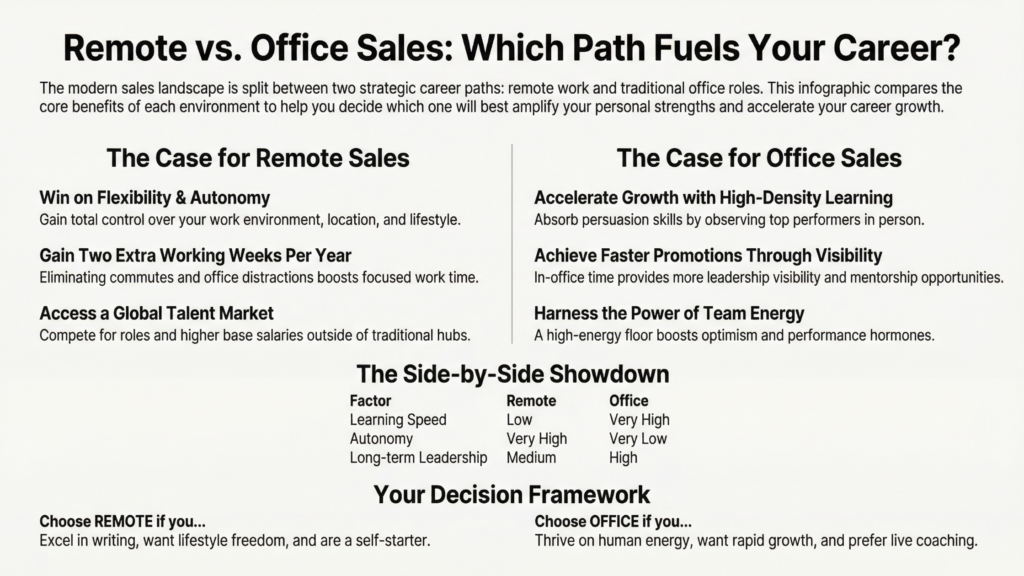
Remote Sales Jobs vs Office Sales: The Side-by-Side Comparison
| Factor | Remote | Office |
| Flexibility | Very High | Very Low |
| Income range | High | High |
| Learning speed | Low | Very High |
| Autonomy | Very High | Very Low |
| Team energy | Low | Very High |
| Talent competition | Very High | Medium |
| Long-term leadership | Medium | High |
So… Which Path Should You Choose?
Choose remote sales jobs if you:
- Excel in writing and follow-through
- Want lifestyle freedom
- Prefer controlled environments
- Aim to specialize in digital-first sales
Choose office sales if you:
- Thrive on human energy
- Want rapid early-career growth
- Prefer collaborative, real-time coaching
- Excel at spontaneous persuasion
Both paths lead to strong careers if you align your strengths with the environment.
Final Takeaway
It isn’t remote vs office.
It’s choosing environments that amplify your strengths.
Remote gives you autonomy, flexibility, and global access.
The office gives you energy, mentorship, and acceleration.
Whichever direction you choose, build modern skills, document your wins, and grow into the version of yourself that the market and your future self will reward.
Your next chapter in sales can be the strongest one yet. Start shaping it today.
Ready to explore sales roles that match how you work best? CloudHire helps sales professionals explore remote and global roles aligned with modern sales workflows. – To talk to us? Click The Link
Frequently Asked Questions:
1. What are the key differences in skills required for remote sales jobs versus office-based roles?
Remote sales jobs need stronger self-management, digital communication, and tool skills, while office-based roles lean more on in-person presence and support from the team.
2. How has the rise of remote sales jobs impacted urban and rural employment opportunities?
Remote sales jobs opened more opportunities for people in smaller towns and rural areas, while also letting some city workers move out of expensive urban centers. At the same time, access still depends on internet quality and company policies, and some employers are cutting back on remote roles, which can hit rural job seekers harder.
3. Do remote sales representative jobs demand higher qualifications than traditional sales roles?
Usually, formal qualifications are similar, but remote sales representative jobs expect stronger tech comfort and proof that you can work independently. What often changes for remote roles is the list of extras: CRM tools, online meeting platforms, home office setup, reliable internet, and sometimes experience working in remote teams.