Most people hear about remote writing jobs as if they are simple: turn on your laptop, type a few sentences, send a proposal, wait for a reply. The reality feels different for anyone who has tried it.
The space is crowded. Expectations shift. The work looks light from the outside but demands clarity, calm thinking, and the ability to shape ideas in a way that brings value to someone else.
What makes it worth exploring is that writing remains one of the few remote careers where your voice, your habits, and your understanding of an audience can build income that grows with time, not against it. Whether you choose creative writing jobs remote, remote technical writing jobs, remote freelance writing jobs, or even niche paths like remote grant writing jobs or medical writing jobs remote, the foundation stays the same: skill and consistency.
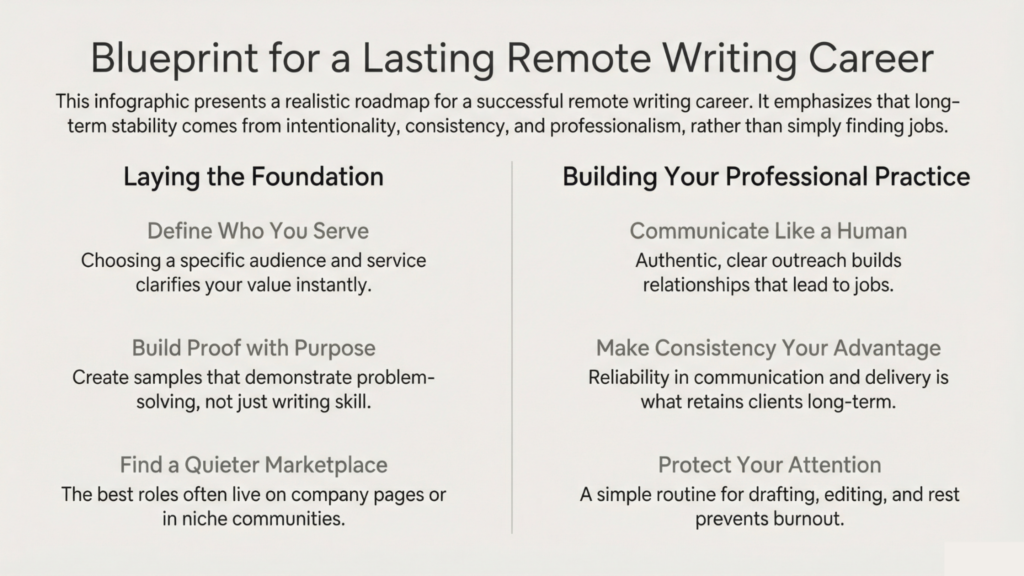
To understand this field without the usual noise, you need a picture that matches how working writers move, not the glamorous beach version, not the gloomy low-rate version. Something closer to the truth: a path with connected steps, steady progress that feels slow at first, and an environment where small improvements compound into long-term opportunity.
1. Start With Who You Serve
Remote writing grows best when you choose who you write for before anything else.
Most people skip this because it feels restricting. They want freedom, so they try to write for everyone. Even jumping between technical writing jobs remote, curriculum writing jobs remote, sports writing jobs remote, and more.
The result is not freedom, it’s confusion.
Readers sense when a writer tries to speak to too many types of people at once. Clients sense it too.
Writing becomes clearer the moment you choose the kind of work you want to be known for. Some writers lean toward newsletters. Some toward long-form articles. Some toward product messaging. Some enjoy highly structured fields like scientific writing jobs remote or grant writing jobs remote. The choice matters less than the commitment.
When you know what you want to offer, you start to understand the reader you’re responsible for. That responsibility shapes your tone, your research, and the way you frame information.
2. Build Proof With Intention
Once your focus settles, you need proof, but not loud proof.
Most job seekers collect dozens of samples that feel empty because they lack context. A strong writing sample always feels anchored to a purpose.
- If you create a mock article, explain the question it solves.
- If you craft a newsletter, think about why someone opens it.
- If you write a product blurb, understand what emotion it guides.
When you share samples built with intention, clients don’t just see “writing.” They see thinking, clarity, and problem-solving.
That alone sets you apart in the world of remote writing jobs, especially if you’re targeting entry level writing jobs remote or remote writing jobs no experience.
3. Search Where Good Opportunities Actually Live
Large job boards work, but they drain energy fast. The best roles often surface in quieter places where hiring managers speak without filters.
Look for opportunities in:
- A company’s own career page
- Industry-specific Slack or Facebook communities
- Smaller agencies looking for stable help
- Founder posts on LinkedIn
- Newsletters that curate writing roles
When you approach the search intentionally, the field stops looking like a noisy marketplace and becomes a series of clear doors you can knock on one by one. This applies whether you’re seeking content writing jobs remote, remote creative writing jobs, remote writing jobs entry level or highly specific options like envelope writing jobs remote.
4. Reach Out Like a Human
Most people send robotic outreach messages. Hiring managers can smell templates instantly.
A grounded message needs only three things:
- A short note showing that you understand their brand
- A sample they can read in under a minute
- An invitation to test your work
No theatrics. No dramatic claims. Clients want clarity, not charm.
Good writing builds trust, but a grounded voice builds relationships, and relationships bring jobs. Whether freelance writing jobs remote, part-time work, or long-term contracts.
5. Price With Honesty, Not Perfection
Pricing overwhelms new writers because they think it must be perfect from day one.
It doesn’t. It only needs to be honest.
Look at:
- The time a task takes you
- The complexity of the subject
- The value the company receives
Over time, you will see patterns: which pieces drain you, which flow naturally, which require more research.
These patterns shape the rates that feel true to you.
Clients appreciate transparency more than drama. Tell them what they will receive and when. Clarity reduces friction. Clarity also earns raises. Even in competitive areas like remote grant writing jobs or technical writing jobs remote.
6. Consistency Is Your Hidden Advantage
Consistency is not about forcing yourself into creativity. It’s the quiet rhythm that shows in your delivery.
When a writer:
- Sends drafts on time
- Communicates clearly
- Edits with intention
- Follows a simple workflow
…clients stay.
Writing is creative, but reliability is what turns a one-time project into long-term work. This is true whether you’re doing remote content writing jobs, remote creative writing jobs, remote technical writing jobs, or any specialty in between.
A simple internal process, how you gather info, organize thoughts, and polish drafts, brings calm to both you and your clients.
7. Notice What Others Miss
Writers who grow stable careers share a skill: they notice small things.
It could be:
- The rhythm of a brand’s voice
- Gaps in a company’s content library
- Reader habits that reveal deeper needs
When you point out helpful improvements without being pushy, you become more than a writer. You become someone who strengthens the brand.
Small observations build long-term trust.
8. Protect Your Attention With Routine
Writing demands presence. A distracted mind produces vague work. When attention slips, quality follows. Drafts arrive later than promised. Edits feel rushed. Small inconsistencies creep in, and clients notice, even if they don’t name it directly. Over time, trust erodes not because the writing is bad, but because it feels uneven.
Create a simple routine:
- Time for reading
- Time for drafting
- Time for editing
- Time for rest
A steady routine protects not just your focus, but your reputation. Clear thinking shows up as cleaner drafts, faster revisions, and fewer back-and-forth emails. That reliability is often what separates writers who keep clients from those who constantly search for new ones.
9. Consider Stability With Contracts
At some point, you may value stability more than piecemeal projects. A contract can offer:
- Consistent income
- Fewer client searches
- Deeper familiarity with one brand
- A chance to refine a voice over time
When you move into contract work, clarity matters even more. Both sides must know outputs, timelines, and success measures. With that in place, the work feels like a partnership, not service.
This is often how writers transition from scattered, remote freelance writing jobs to more secure roles, even in specialized areas like sports writing jobs remote or technical writing jobs remote.
10. Build Slowly, But Build Intentionally
The remote writing path rewards the kind of patience where you show up, not the kind where you wait for luck.
If you commit to:
- Building proof
- Communicating like a human
- Delivering consistently
- Thinking clearly
…the field opens in ways that feel natural. You stop chasing opportunities and start choosing the ones that fit you.
Remote writing jobs promise flexibility, but what they truly offer is growth in skill, confidence, and your ability to shape messages in a crowded world. Whether you start with entry level writing jobs remote or aim for advanced roles, progress compounds with time.
Approached with honesty and awareness, this field becomes a place where people build careers at their own pace, with their own voice, and with a sense of stability that few remote paths offer.
Frequently Asked Questions:
Can I make $1000 a month freelance writing?
Yes, many freelance writers make $1000 a month or more, especially with consistent clients and basic rates of $0.05–$0.10 per word or $20–$50 per hour. Beginners often start at 10–20 hours a week on small gigs like blog posts or emails, while experienced writers hit this easily with 2–4 steady clients.
How much do remote writers make?
Remote writers earn $30,000–$80,000 a year on average, depending on niche, experience, and full-time vs freelance. Entry-level remote roles pay $15–$25/hour or $40k–$55k salary; specialists in tech, finance, or copywriting often make $60k–$100k+ with bonuses or retainers.
What writing jobs are commonly remote?
Common remote writing jobs include content writer, copywriter, blog writer, social media writer, email marketer, technical writer, SEO writer, and grant writer. These roles work well remotely because they rely on clear briefs, research, and digital delivery rather than in-person collaboration.
What writing jobs are commonly not remote?
Writing jobs often not remote include newspaper reporter, magazine editor, academic textbook writer, scriptwriter for live TV/theater, legal drafting, and medical transcription. These need on-site access to sources, teams, events, or sensitive documents that don’t travel well digitally.