Many people search for data analyst jobs remotely because the field feels open and exciting. Companies talk about data growth and the need for people who can understand patterns. Courses, bootcamps, and tutorials make it seem easy to enter. But when applicants actually begin applying to remote data analyst jobs, they face confusion. The requirements feel unclear. The skills feel scattered. The job titles look similar but behave differently.
This guide shares what hiring teams notice and also tells you how to build proof of skill without guessing. CloudHire works with many companies that hire data professionals, and the insights here come from real patterns in hiring.
Understanding Why Data Analyst Jobs Attract So Many Applicants
People from many backgrounds feel drawn to this field. Some studied mathematics. Some worked in customer support. Some studied economics. Some worked in finance. They all want stable work that uses problem-solving.
The result is a crowded space with wide variation. A candidate with strong SQL knowledge competes with someone who knows spreadsheets only. A candidate with strong business sense competes with someone who can write perfect Python code. Hiring managers look for balance, not just technical skill, but also business sense. This balance is where most applicants fall short.
This variation creates confusion, especially for people applying to data analyst remote jobs entry level or data analyst jobs junior remote.
The Real Nature Of Data Analyst Work
Many articles describe the job in broad terms. They say analysts clean data, build dashboards, and generate insights. While true, this description does not explain daily work.
Daily work often includes:
- Checking data reliability
- Asking teams clear questions
- Studying patterns in a calm, structured way
- Cleaning datasets that look messy
- Writing explanations that others can follow
- Sharing findings with people who do not work with data
The job rewards steady thinking and clarity. Tools matter, but judgment matters more.
Different Types Of Data Analyst Jobs And How They Work
Many applicants treat all analyst roles the same. In reality, companies hire analysts for very different reasons. Knowing these differences helps you target your applications more effectively, especially for data analyst 1 jobs remote, entry level data analyst jobs remote, and healthcare data analyst jobs remote.
Below are the types you will see most often.
1. Product Data Analysts
These analysts support product teams. Their work focuses on user behaviour and product flow.
They track:
- User actions
- Drop points
- Feature usage
- Experiment results
They help the product team make decisions about improvement.
2. Marketing Analysts
These analysts support marketing teams. Their work focuses on campaigns, traffic, and conversions.
They track:
- Campaign performance
- Cost efficiency
- Customer segments
- Channel quality
They help the marketing team spend money wisely.
3. Operations Analysts
These analysts help companies run smoothly. They measure performance across departments.
They track:
- Supply issues
- Delays
- Cost patterns
- Process gaps
They help teams fix slow or inefficient areas.
4. Finance Analysts With Data Skills
These roles mix financial planning with data work.
They track:
- Revenue trends
- Expenses
- Forecasting
- Budget decisions
They help leaders understand company health.
5. Healthcare Data Analysts (Highly Growing Remote Sector)
These roles work with patient outcomes, medical operations, and healthcare quality metrics.
They track:
- Treatment patterns
- Operational delays
- Patient satisfaction metrics
- Clinical processes
Demand for healthcare data analyst jobs remote continues to rise, especially in the U.S.
The Skills That Truly Matter For Data Analyst Jobs Remote
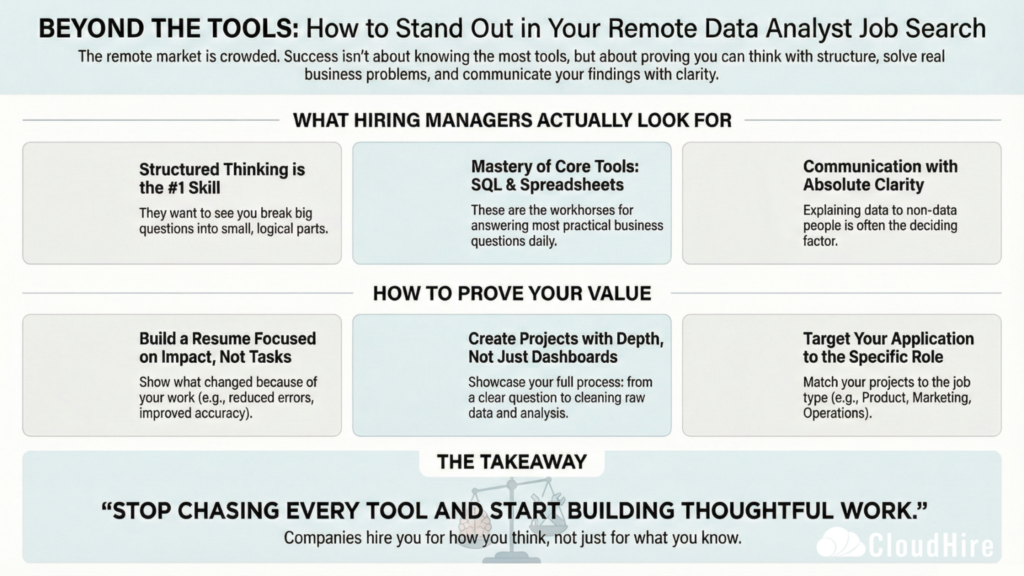
Many job descriptions show long lists of tools. This confuses people. Hiring managers care more about whether you can think clearly with data. Tools only help you express that thinking.
Skills that matter most:
Structured Thinking
Strong analysts break big questions into small parts. They avoid noise and focus on what matters. This is the #1 skill in all remote data analyst job interviews.
SQL For Real Work
Good SQL helps you answer most practical questions. You need comfort with joins, groups, filters, and date handling. You also need awareness of data quality problems.
Confidence In Spreadsheets
Spreadsheets remain central for quick checks, reports, and last-minute requests. They help teams across departments. Many hiring managers trust spreadsheet knowledge as a sign of readiness.
Simple Statistics
You do not need heavy mathematics. You need comfort with averages, distributions, variance, and simple testing. These help you check whether a pattern is real.
Communication With Clarity
Analysts often speak to people who do not understand numbers deeply. Clear writing is often the deciding factor for remote data analyst jobs entry level candidates.
What A Strong Data Analyst Profile Looks Like
A good profile does not overwhelm. It shows skill, judgement, and real examples. A hiring manager should understand your value without guessing.
A strong profile includes:
One page resume
Short, clean, and focused. It should show impact:
- Improved accuracy
- Reduced errors
- Automated steps
- Found issues early
Instead of listing tasks, show what changed because of your work. Impact > tasks
Projects With Depth
Many candidates create simple dashboards. These do not impress managers. They want projects that show steps:
- Clear question
- Raw dataset
- Cleaning choices
- Analysis steps
- Validation
- Final explanation
Three strong projects can outperform twenty generic ones.
Readable Portfolio
Your portfolio should feel easy to explore. It should show:
- Organized folders
- Clean code
- Short notes
- Attractive charts
- A simple flow
The goal is trust. This directly helps in software for data analyst remote jobs like Tableau, Power BI, or SQL analyst work.
Active GitHub Or Notebook Library
Managers look for consistent activity. They check whether you experiment, learn, and work with calm detail.
How Companies Actually Hire Data Analysts
Hiring follows a pattern. Knowing this pattern prepares you better than any random practice.
First Stage: Communication Check
This is a simple conversation. They check:
- Clarity
- Confidence
- How you explain your past work
They want people who stay calm with incomplete information.
Second Stage: SQL Or Logic Task
This stage checks your ability to think before writing code. Good candidates write short, clear queries.
Third Stage: Case Study
The most important stage. You receive a dataset with issues. They look for how you:
- Clean data
- Build structure
- Test ideas
- Present results
This stage reveals thought process more than technical range.
Final Stage: Team Fit
Companies check whether your communication style matches their work rhythm. They also check your patience, curiosity, and interest.
How To Apply Smartly And Not Exhaust Yourself
People often send 200+ applications. Real progress happens when you target roles intentionally, especially for data analyst jobs remote entry level where competition is high.
Steps that help:
1. Match Your Projects To The Role
Product roles need behaviour analysis
Marketing roles need channel data
Operations roles – efficiency forecasting
Healthcare needs quality metrics
Choose your best aligned project and highlight it.
2. Write A Short Note
Short note increases trust:
“I included a case study that matches your data problems. I focused on clear cleaning steps, simple explanations, and practical insights.”
3. Update Your Profile Often
Fresh activity signals that you care about the field.
4. Use Smart Automation Tools
Tools like Cloudhire help you apply more intentionally by matching your profile to the right roles, highlighting relevant projects, and keeping applications consistent. This saves time, reduces burnout, and lets you focus on quality instead of volume.
Mistakes That Hold Many Candidates Back
These mistakes appear in most rejected applications.
1. Surface-level Projects: Dashboards without questions and explanations do not prove analytical thinking.
2. Copying Tutorials: Managers recognize tutorial-based work quickly.
3. Explaining Too Little: Many applicants present numbers without context. This confuses teams.
4. Ignoring Business Sense: The best analysts understand how the company earns, spends, and grows.
5. Fear of Messy Data: Many candidates avoid raw datasets. This hurts their readiness.
Practical Ways To Build Experience Without A Job
You can build experience through simple, structured work.
Ideas:
- Work with public datasets that include missing values
- Analyse real issues from open data portals
- Create monthly reports for practice
- Build dashboards for a small business
- Track weekly patterns in sports, weather, or local datasets
- Write short case studies that explain your thinking
Each practice builds judgment and clarity.
Why Data Analyst Jobs Remain A Strong Path
These jobs stay valuable because companies depend on a clear understanding of their numbers. They need people who ask questions, check accuracy, and explain results. Analysts who practice steady thinking grow quickly. They move into product analytics, business analytics, data science, Revenue analyst, analytics engineer, or operations analytics, depending on preference.
Whether you want stability, growth, or flexibility, the field supports all paths.
Final Thoughts
The truth is simple: you don’t need to become a perfect analyst to get hired. You just need to show how you think. If your projects reflect real questions, if your explanations feel honest, and if your profile shows steady progress, teams will notice. This field becomes easier once you stop chasing every tool and start building thoughtful work. Data roles reward clarity, patience, and curiosity, qualities anyone can build with consistent practice.
The next step is simply continuing to build work that reflects how teams actually make decisions. CloudHire focuses on that hiring-side perspective, especially for remote roles.
Frequently Asked Questions
1. What is the work of a data analyst?
A data analyst takes raw data, cleans it, studies it, and turns it into clear insights for the business. They answer questions like “what is happening,” “why did it happen,” and “where can we improve,” usually through reports, dashboards, and charts.
2. Are data analyst jobs entry level?
Many data analyst jobs are open to entry‑level candidates, but they still expect basics like Excel or spreadsheets, simple SQL, and comfort with charts and reports. Titles to look for include “Junior Data Analyst,” “Data Analyst I,” “Business Analyst – Entry Level,” and “Reporting Analyst.”
3. How to get a data analyst job as a fresher or with no experience?
As a fresher, focus on three things: core tools, a tiny portfolio, targeted applications, and basic networking.
- Learn spreadsheets, SQL, and one BI tool like Power BI or Tableau.
- Build 3–4 small projects using public datasets, with a clear question, simple analysis, and one clean dashboard or report.
- Add these to GitHub or a simple site and apply to internships, junior analyst, and trainee roles that mention “graduates welcome” or “no experience required.”
- Connect with analysts on LinkedIn, ask short, genuine questions, and let people know you’re exploring analyst roles. It opens doors faster than applying alone.
4. Who is a data analyst & what is their job description?
A data analyst is a professional who collects, organizes, and analyzes data to help teams make better decisions. A typical job description includes tasks like collecting data from systems, cleaning and checking its quality, analyzing trends, building dashboards and reports, tracking KPIs, and explaining findings to non‑technical stakeholders in simple words.