Why I Must Hire You? How Top Candidates Close Interviews (Downloadable Cheet sheet)
When an interviewer asks some version of “why i must hire you” they are not testing your confidence. They are testing your clarity. They want to know two things in ten seconds: can you do the role, and will you make the team better? If your answer is fuzzy, long, or generic, the interviewer will mentally move on. This guide is the exact, practical playbook for answering that question so hiring teams remember you for the right reasons.
One simple truth that changes answers immediately
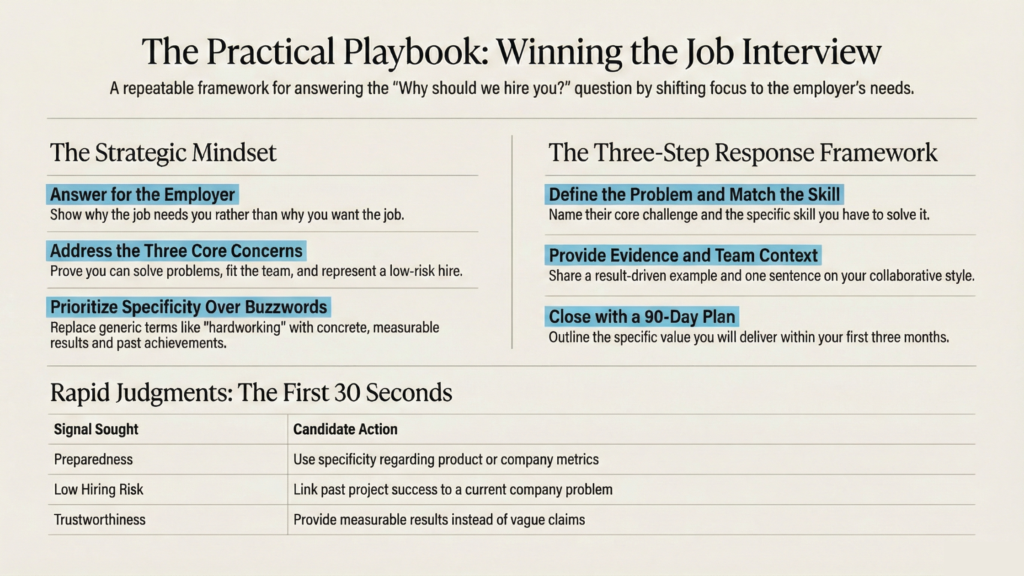
Most people answer for themselves. The best candidates answer from the employer. If you want to change the outcome of the interview, stop telling them why you want the job and start showing why the job needs you. That small shift changes everything about your content, tone, and confidence.
Download – ONE-PAGE CHEAT SHEET_ “WHY I MUST HIRE YOU”
What Employers Are Really Asking, in Plain Language
When someone asks, “Why should we hire you?” they want to know:
- What problem will you solve on day one?
- How will you fit into their team and culture?
- How low-risk are you to hire?
Your answer should speak to those three points quickly and with evidence.
The Practical Framework: Five Steps to Build Any Answer
Use this on every interview. It is short, repeatable, and adaptable.
- Name the core problem they have. Show you understand the role.
- Say the one skill or experience you have that matches that problem.
- Give a specific example with a result. Be ready with numbers or clear outcomes.
- Add one short sentence about how you work with others.
- Close by saying what you will do in your first 30 to 90 days.
This framework works for junior roles, mid roles, and executives. It keeps you focused, credible, and memorable.
Real Interview Mistakes and Exactly How to Fix Each One
Below are common mistakes with an example of what candidates often say, why it fails, and how to fix it with a real alternative.
Mistake 1: Giving a generic answer
Common line: “I’m hardworking, passionate, and a team player.”
Why it fails: Those words describe thousands of applicants. They do not show you how can solve the company’s specific problem.
Fix: Replace this list with a result story. Example: “In my last role, I led a two-month initiative to reduce onboarding time by 30 percent by building a simple checklist and coaching plan. That reduced churn and saved support time. I can bring that same process focus to improve your new customer activation.”
Mistake 2: Talking about yourself without linking to them
Common line: “I’ve worked on several marketing campaigns, and I loved it.”
Why it fails: Interviewers need to know how your work helped the business they care about.
Fix: Add the link. Example: “I led three campaigns that increased qualified leads by 45 percent in six months. If your goal is to convert more trial users, I would apply those same testing methods to improve your activation flow.”
Mistake 3: Using buzzwords as substitutes for evidence
Common line: “I’m a growth hacker and results-driven.”
Why it fails: Buzzwords are meaningless without proof.
Fix: Replace with a concrete example and metric. Example: “I grew organic signups by 60 percent year over year by restructuring referral flows and measuring cohort retention weekly.”
Mistake 4: Overstating or exaggerating
Common line: “I single-handedly turned the company around.”
Why it fails: Overclaiming is easy to probe and destroys trust.
Fix: Be clear about your role and impact. Example: “I led the product analytics effort that flagged a retention issue. Working with three engineers and our CSMs we designed an intervention that improved 30-day retention by 12 percent.”
Mistake 5: Forgetting to prepare your first 90-day plan
Common line: “I will figure it out.”
Why it fails: It sounds unfocused. Interviewers want to see planning ability.
Fix: Offer a short plan. Example: “In the first 30 days I would map stakeholder goals and data sources, in 60 days I would run one quick experiment, and in 90 days I would roll out the highest ROI change.”
Download – ONE-PAGE CHEAT SHEET_ “WHY I MUST HIRE YOU”
Hidden Hiring Manager Trick: What They Are Listening for and Why It Matters
Hiring managers often make a rapid judgment in the first 30 seconds. They are listening for specific signals that show you can be onboarded quickly. The quick signals are:
- Specificity rather than vagueness.
- Connection to the role inside the company.
- Evidence of measurable results.
- A working style that matches the team.
- Confidence without arrogance.
Those bullets are short, but each needs explanation. Specificity proves you are prepared. If you name the company’s product area or reference a public metric they care about, you show you did your homework. Connection to the role proves relevance. If you show that your last project solved a problem the company currently has, you reduce the perceived hiring risk. Measurable results make your claims verifiable and therefore trustworthy. Matching working style, such as “I work well in async teams” or “I prefer short weekly demos,” shows that you will fit day to day. Confidence without arrogance means you deliver value and can receive feedback. If you address these five elements in a short answer, you pass the interviewer’s mental checklist.
Practical Examples Tailored to Job Levels
Use these templates and adapt the content to your real experience. Do not memorize words; memorize structure and facts.
Junior candidate
“I am eager to learn and have spent the last year running UX tests on a volunteer app that increased engagement by 20 percent. I can bring that hands-on testing habit to your product and quickly run low-cost experiments to improve onboarding.”
Mid-level candidate
“In my current role, I built the analytics that spotlighted the drop-off in our trial funnel, and led a cross-functional experiment that raised conversion by 18 percent in two months. For your team, I would map the key funnel metrics in week one and run a quick experiment to show early lift.”
Senior candidate
“I have led three product teams through replatforms and improved time-to-market by standardizing release practices. I would bring the same roadmap discipline and cross-functional alignment to decrease your engineering cycle time and increase release predictability.”
Career switcher
“Although my background is in animation and creative storytelling, I transitioned to content strategy and drove a campaign that increased demo requests by 25 percent. My design background helps me translate user behavior into clearer product narratives, which I can apply to improve your product messaging.”
Quick Scripts to Answer Similar Interview Questions Naturally
Most candidates don’t realize these are all versions of the same question.
Interviewers intentionally rephrase “Why should we hire you?” in different ways to test two things:
- whether you stay consistent under pressure, and
- whether you understand the employer’s real priorities rather than talking about yourself.
To avoid getting flustered by wording changes, use one simple structure every time: state the employer’s problem → give a quick measurable example → explain how you’ll create similar value in the first 30–90 days.
Below are quick, natural scripts you can use for each variation, so you can answer calmly and with clarity:
- Why can I hire you
“I understand you need faster activation of new users. I improved activation flow at my last company and reduced drop-off by 25 percent through targeted micro-copy and a guided tour. I will prioritize a similar quick win here.” - Why will I hire you
“Because I deliver measurable improvements quickly. For example, I increased retention in my last role by introducing a simple onboarding checklist tracked against cohorts.” - Why must we hire you
“You hire me because I lower execution risk. I have led the exact cross-functional initiatives you described, and I can start by mapping stakeholders and KPIs in week one.” - Why should we hire you
“I offer the combination of product rigor and storytelling. I can quantify problems and communicate solutions to different teams, so decisions move faster.” - How to answer why should we hire you
“Start by naming one problem, give a concrete past example, explain how you work, then close with a 30-90 day value statement.” - Why should the employer hire you
“Because I reduce ramp time. I show early wins and document decisions so outcomes are predictable.” - Why should hire u
“Because I turn ambiguity into clear steps and measurable outcomes.” - Why should you hire me
“You should hire me because I solve the immediate problem you described and bring a complementary skill set.” - Why should we hire you answers
“Pick one or two answers that show measurable impact and align them with the job’s top priorities.” - Why should we hire you sample answer
“See the mid-level candidate example above, tailored to specific KPIs for the role.” - Why should we employ you answer
“Employ me because I will make your team more predictable and faster at delivering customer value.” - What makes you a good fit for this position
“My experience maps directly to the role’s top responsibility, and my working style fits your team’s rhythm.” - Why do you want this job
“I want this job because it combines impact on customers with the chance to improve your core funnel. I have direct experience improving similar metrics, and I enjoy the cross-functional work.” - Why we should pick you
“Pick me because I will deliver measurable results and help the team execute with less friction.”
Each of these lines should be followed by a 1 to 2-sentence example during the interview.
Download – ONE-PAGE CHEAT SHEET_ “WHY I MUST HIRE YOU”
How to Practice So You Sound Natural and Not Rehearsed
Practice your structure out loud. Ask a friend to push for details. Record yourself and time the answer. Keep three evidence stories ready, and swap the stories depending on the role. The goal is not to recite, it is to be able to deliver relevant evidence under pressure.
Closing: The Honest Truth About Winning Interviews
Great answers do not come from trickery. They come from preparation, clarity, and a willingness to show how you help. When you answer “why i must hire you” remember to speak to the employer’s problem, support your claim with real examples, show how you work with others, and explain the early value you will deliver. That combination changes interviews from guessing games into reasonable conversations about fit.
If you are actively interviewing, CloudHire lists remote and on-site roles where clear, evidence-based answers matter. Use the checklist and the example templates here to refine your responses and apply with confidence.
Frequently Asked Questions
What is the “Why should we hire you?” question really testing?
It is testing if you can see their needs and confidently explain how you solve them—not if you have a generic brag list. Interviewers want to know you understand the role, the company, and can tie your skills to their gaps without sounding rehearsed or arrogant.
How do you research the company before answering?
Spend 15 minutes on their recent LinkedIn posts, earnings call, or job description pain points. Note 1–2 specific challenges (e.g., “scaling customer support” or “new product launch”). Then map your experience to those. This makes your answer feel custom, not canned.
What is a winning structure for your answer?
Formula that lands offers:
- Restate their need (“You’re looking to reduce churn by 20%”).
- Your proof (“In my last role, I built a retention system that cut churn 25% for 5K users”).
- Why you specifically (“I thrive in fast-growth teams like yours”).
Keep it 45–60 seconds. Practice aloud 3x.
What do you say if you’re entry-level or switching careers?
“I’m newer to [Field], but I learn fast and deliver. I built [Project] that [Result], and volunteered on [Side Gig] where I [Outcome]. I’d bring fresh energy to your team and grow into a top contributor fast.”
How do you avoid common mistakes?
- No self-praise dump (“I’m hardworking and reliable”).
- No company flattery (“I love your mission”).
- No vague claims (“I’m a team player”).
Always quantify (numbers, outcomes) and tie to their problem. Practice with a friend to sound natural.