Higher education is changing quickly… meaningful work for teachers who want impact without full-time academic commitments.
Universities want flexibility, students want diverse instructors, and institutions now rely on online learning more than ever. This shift has opened a career path that many educators never imagined possible. Remote adjunct professor jobs have become a space filled with opportunity, mobility, and meaningful work for teachers who want impact without full-time academic commitments.
A strong adjunct career today requires more than subject knowledge. It demands presence, communication skills, student-centric thinking, and the ability to manage digital classrooms responsibly. When you understand what institutions look for, you immediately stand out in a market that continues to grow every year.
Below is a complete and practical guide to understanding this field, along with examples, insights, and real preparation techniques.
What Institutions Actually Look For In Remote Adjunct Faculty
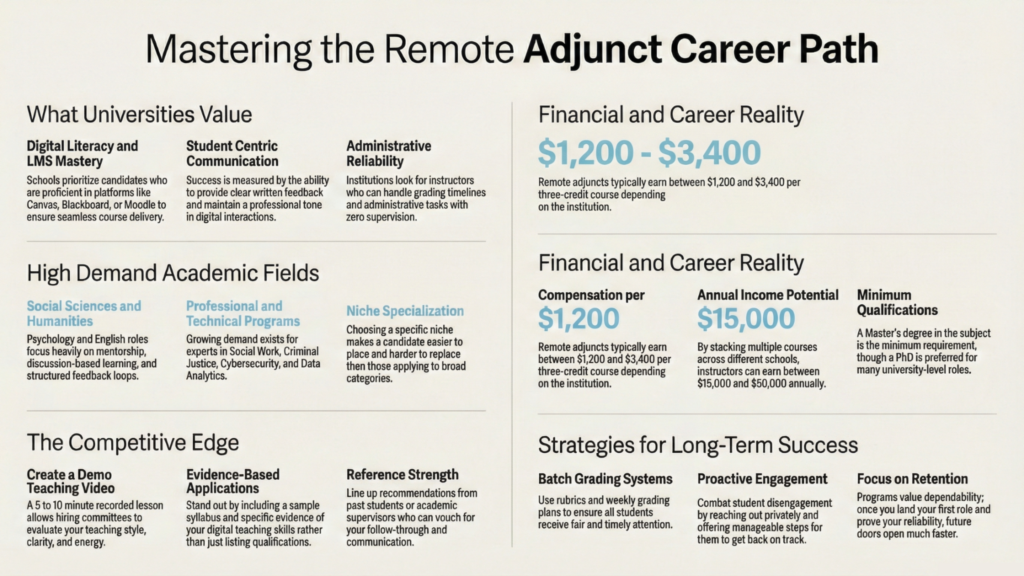
Universities evaluate remote instructors through several lenses. They want instructors who can teach clearly, communicate well in online settings, and handle administrative responsibilities with consistency. The role is part teaching, part student support, and part course management.
Typically, selection committees look for
- Strong subject knowledge
- Familiarity with learning management systems
- Ability to assess students fairly
- Clarity in written feedback
- Professional tone in communication
- Adaptability to different course designs
You do not need to follow a single academic path to succeed. What you need is expertise, reliability, and the ability to engage students through structured digital learning.
Understanding The Range Of Remote Adjunct Fields
The opportunities available today extend far beyond standard academic subjects. Many faculty roles related to social sciences, humanities, technology, and professional programs now operate fully online.
Here are some of the fields where demand has grown significantly.
English and Communication
Roles like adjunct english professor jobs remote typically involve writing instruction, reading analysis, feedback loops, and student developmental support. These roles fit instructors who enjoy mentoring through structured feedback.
Psychology
Universities hiring for adjunct psychology professor jobs remote often seek professionals with real-world experience in counseling, mental health, or research methods. Online psychology courses focus heavily on discussion-based learning and case analysis.
Social Work
Programs offering adjunct social work professor jobs remote want practitioners who understand community practice, policy, and field education. These roles often include reviewing student reflections and evaluating real-world assignments.
Criminal Justice
Institutions offering criminal justice adjunct professor jobs remote look for professionals familiar with law enforcement, legal systems, or criminology. Instructors often guide students through scenario-based learning.
General Online Teaching
Many universities simply list opportunities such as online adjunct professor jobs remote, which cover a broad mix of programs across undergraduate and graduate levels.
Sample Situations You May Face In Remote Adjunct Interviews
Institutions assess how you handle digital teaching environments. Here are some realistic scenarios and strong responses.
Scenario: Handling a disengaged online student
Sample response:
I reach out privately to understand the reason behind the disengagement, then offer small, manageable steps. Sometimes it takes clear guidance, sometimes it takes flexibility. I also adjust discussion formats to make participation easier for students who need structured prompts.
Scenario: Managing grading timelines with multiple course sections
Sample response:
I follow a weekly grading plan. I review assignments in batches, use rubrics to stay consistent, and maintain a simple tracking sheet. This keeps feedback timely and ensures each student receives fair and equal attention.
Scenario: Facilitating meaningful discussion in a remote classroom
Sample response:
I design questions that encourage critical thinking and guide students to connect theory with real experiences. I also jump into discussions early, so the class sees examples of thoughtful engagement.
What Makes Adjunct Remote Teaching Unique Today
Adjunct teaching offers a different rhythm compared to full-time faculty life. The role provides flexibility, real teaching impact, and opportunities across institutions.
- Many educators appreciate
- Freedom to manage schedules
- A chance to teach across multiple universities
- Close interaction with motivated adult learners
- Reduced administrative load
- Expansion of professional identity beyond one campus
Roles such as adjunct professor jobs remote allow educators to bring their expertise into classrooms without the long-term commitments of tenure-track positions.
How To Make Your Adjunct Teaching Application Stand Out
Online adjunct roles can be competitive, so your profile must reflect clarity and professionalism.
Focus on
- A short teaching statement of 250–400 words
- Evidence of digital teaching skills
- This can include a short recorded lecture (5–10 minutes), screenshots of discussion prompts you’ve written, sample written feedback on assignments, or brief descriptions of how you’ve used tools like Canvas, Blackboard, or Moodle to manage grading and student communication.
- Sample syllabus or writing sample
- Experience with tools such as Canvas, Blackboard, or Moodle
- A clean resume highlighting online instruction
- Communication style that shows commitment to students
These elements help you rise above candidates who simply list qualifications without showing how they teach.
Additional Fields That Continue To Grow
Many part-time opportunities are expanding steadily, creating space for educators who want a flexible academic career.
- Part-time adjunct professor jobs remote suit professionals who want to teach while working in industry
- Social work adjunct professor jobs remote help institutions scale programs without overloading resident faculty
- Adjunct remote professor jobs give educators a chance to contribute to universities across locations
- Adjunct professor remote jobs allow experts to teach niche subjects that local campuses may not offer
These categories show how broad and dynamic the adjunct landscape has become.
How To Know If Remote Adjunct Work Fits Your Strengths
Remote teaching aligns well with educators who value independence, structure, and student-focused communication. It works especially well for instructors who enjoy designing clear learning paths.
Ask yourself
- Do I enjoy giving written feedback
- Can I manage deadlines without supervision
- Am I comfortable working with adults from varied backgrounds
- Do I communicate clearly in writing
- Can I adjust my methods depending on student needs
If your answers lean toward yes, remote adjunct work can be a very rewarding path.
Pay Expectations and Negotiation in Remote Adjunct Roles
Compensation for remote adjunct professor jobs is typically structured on a per-course basis, and rates vary widely by institution, discipline, and course level. Most universities publish a fixed pay range, especially for standardized online programs. In these cases, there is often limited room for negotiation.
That said, some flexibility may exist. Instructors with prior online teaching experience, hard-to-fill subject expertise, or a strong track record with the institution may be able to negotiate higher pay over time, additional course assignments, or priority scheduling in future terms. Negotiation tends to be informal and incremental rather than transactional.
For new adjuncts, the practical strategy is to focus first on securing the role, delivering consistent results, and building institutional trust. Pay growth usually follows reliability, not initial bargaining.
Understanding Contract Terms and Renewal Risk
Remote adjunct contracts are almost always term-based. Most appointments last one semester or one course cycle, with renewal dependent on enrollment, departmental needs, and performance. This structure gives institutions flexibility but creates uncertainty for instructors.
Before accepting a role, review the contract carefully. Pay attention to course cancellation clauses, grading and response-time expectations, intellectual property language, and non-compete or exclusivity terms. These clauses vary significantly across institutions and can affect your workload and future opportunities.
Because renewals are not guaranteed, many experienced adjuncts diversify across multiple institutions. This reduces reliance on any single contract and creates income stability over time.
The Role of Unions and Faculty Associations
In some regions and institutions, adjunct faculty are represented by unions or faculty associations. These groups may negotiate pay scales, workload limits, evaluation standards, and reappointment processes on behalf of instructors.
Union coverage varies widely. Some remote adjunct roles fall under collective bargaining agreements, while others do not. If a position is unionized, pay and terms are typically standardized and less negotiable, but more predictable.
Understanding whether a role is covered by a union can help you set expectations around compensation, workload, and long-term stability. Institutions usually disclose this during onboarding or in contract documentation.
Easy Tips to land and Keep Remote Adjunct Roles
Landing and keeping remote adjunct roles takes more than just strong credentials, it’s about proving you can teach effectively online and be reliable over time.
Start with a demo teaching video. Write a short script, practice delivery, and record a clear 5–10 minute sample lesson. Upload it to YouTube so hiring committees can quickly see your teaching style, clarity, and energy in a remote setting.
Line up strong references, especially from past students, academic supervisors, or colleagues who can speak to your communication skills and follow-through.
Choose a clear niche instead of applying broadly. Specializing in areas like cybersecurity, data analytics, or ESL makes you easier to place and harder to replace.
Once hired, focus on retention. Grade consistently, respond on time, and check in with students regularly. Remote programs value dependability.
That first role matters once you’ve taught remotely, doors open much faster.
Bringing It All Together
Online instruction has evolved into a full ecosystem of opportunity. Whether you want to teach writing, psychology, criminology, social work, or general education, there are roles in every corner of higher learning. Understanding how universities evaluate remote faculty, building strong teaching samples, and showing commitment to student success will place you ahead of many applicants competing for similar roles.
CloudHire connects professionals with global opportunities across multiple industries. If you are exploring flexible work, you can browse open roles on CloudHire and discover positions that fit your expertise and schedule.
Frequently Asked Questions
What is a remote adjunct professor job?
A remote adjunct professor job is part‑time online teaching where you lead college courses entirely virtually, usually on platforms like Canvas or Blackboard. You grade, hold office hours via Zoom, and design content, no classroom or commute required.
What qualifications do you need for an adjunct professor job?
Minimum: Master’s degree in the subject (PhD preferred). Key: 3+ years teaching experience, ideally online. Tech comfort (Zoom, LMS) is non‑negotiable. Some fields, like nursing or languages, have extra certs. No PhD? Target community colleges or niche programs.
How much do remote adjunct professors earn?
Per course: $1,200–$3,400 (3 credits, 8–16 weeks). Annual (3–4 courses): $15K–$50K. Top states: NY ($116K), TX ($111K), OH ($92K). Online often pays slightly more than in‑person due to platform demands.
What’s the application process like?
- CV: Teaching history first, publications second.
- Demo: 10–15 min recorded lecture (huge edge).
- Training: 3 weeks paid onboarding for new hires (e.g., SNHU).
- Interview: Teach a sample class via Zoom.
Tailor to the course: show you can engage 30 students online.
What are the downsides of remote adjunct work?
Pay: Per‑course, no benefits.
Competition: 100+ apps per opening.
Instability: Semester‑to‑semester renewals.
Pro: Full flexibility, stack multiple schools for $50K+.