Most resumes are rejected before anyone reads past the first few lines. Not because candidates lack skill, but because the opening gives no reason to continue. This is where resume headline examples matter more than most people realize.
A resume headline is not a slogan. It is not a job title copied from LinkedIn. It is a short, focused statement that helps a hiring manager quickly answer one question: Is this person worth my attention right now?
This article is written from real hiring behavior, recruiter feedback, and patterns seen across ATS systems, not from recycled templates. If you are serious about improving interviews, this is meant to be saved and reused, not skimmed once and forgotten.
Why Resume Headlines Fail Even When Candidates Are Qualified
Many headlines sound fine, but do nothing.
“Experienced professional with strong skills”
“Results-driven team player”
“Motivated individual seeking growth”
These phrases appear everywhere. They add no signal. Hiring managers see them hundreds of times a week. Over time, the brain learns to skip them.
A strong headline does something different. It reduces thinking. It tells the reader what you do, how you do it, and why it matters, all in one breath.
The best headlines work because they are specific, calm, and honest. They do not try to impress. They try to clarify.
What Recruiters Actually Look for in the First Six Seconds
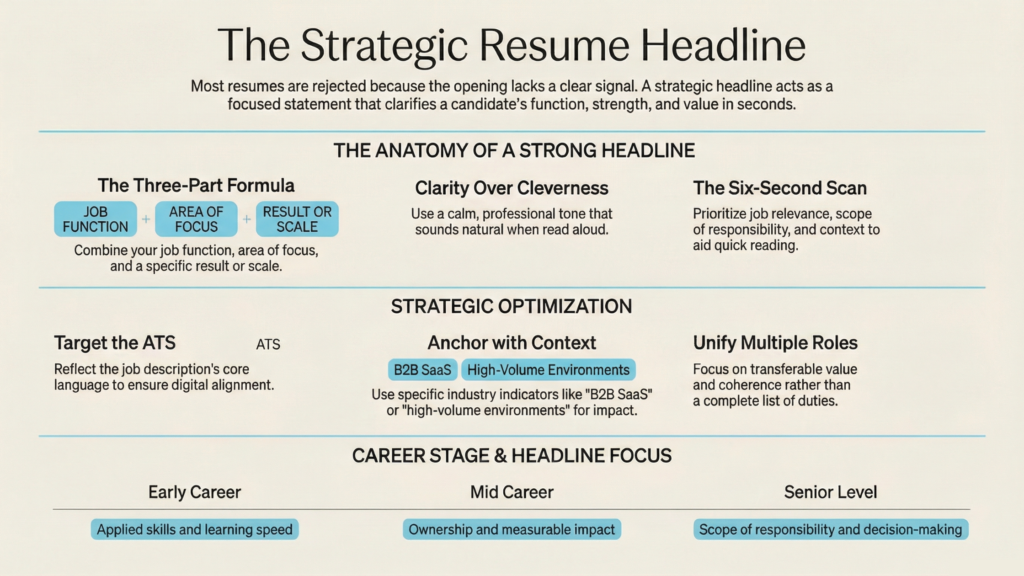
Recruiters do not read resumes the way candidates imagine. Eye-tracking studies show a predictable pattern:
• Job relevance first
• Scope of responsibility
• Industry or context
• Proof of outcome
A good headline supports this scan. It aligns with the role being hired, not the person’s entire career history. This is why copying one headline across applications quietly lowers success rates.
The Anatomy of a Headline That Works
A strong headline usually contains three elements. Not always all three, but at least two.
• Your function or role
• Your area of strength or focus
• A result, scale, or context
For example, compare these two:
“Marketing Manager with 7 years experience” vs “Marketing Manager driving inbound growth for B2B SaaS teams”
The second one anchors attention. It tells a story without noise.
This pattern appears again and again in effective resume headline example formats used by candidates who consistently get callbacks.
Choosing the Right Tone Before Choosing Words
Tone matters more than creativity.
A headline should sound like a calm introduction, not an ad. Avoid excitement. Avoid urgency. Avoid self-praise.
The safest test is simple. Read your headline out loud. If it sounds uncomfortable to say in a professional meeting, it will feel uncomfortable to read. Clarity beats cleverness every time.
How Resume Headlines Change Based on Career Stage
The headline for a recent graduate should not follow the same logic as one for a senior hire.
Early-career candidates benefit from skill direction and learning speed.
Mid-career candidates benefit from ownership and impact.
Senior candidates benefit from scope and decision-making.
This difference is often missing from generic headline in resume examples, which is why they feel flat.
Resume Headline Examples for Different Real-World Situations
Below are CloudHire’s examples built from actual hiring patterns, not theory. Use them as structure, not copy-paste text.
1. When you are early in your career
Focus on skills applied, not years.
“Entry-level data analyst with strong SQL and reporting foundations”
“Junior content strategist supporting SEO-driven growth projects”
These headlines reassure the reader without pretending to be senior.
2. When you are changing roles or industries
Clarity matters more than ambition.
“Operations analyst transitioning from finance into supply chain roles”
“Customer support specialist moving into product operations”
This approach reduces confusion and increases trust.
3. Example of headline on resume for experienced professionals
Experience alone is not a differentiator. Direction is.
“Finance manager leading month-end close for multi-entity teams”
“HR business partner supporting high-growth technology teams”
These headlines frame responsibility clearly.
4. Handling Multiple Roles Without Confusing the Reader
Many professionals worry about diverse backgrounds. The mistake is trying to include everything.
A headline should unify, not list.
This is where resume headline examples for multiple jobs work best when they focus on transferable value.
“Operations and project specialist improving process efficiency across teams”
“Marketing and analytics professional bridging content and performance data”
The goal is coherence, not completeness.
5. Customer-Facing Roles Need a Different Emphasis
For service roles, outcomes matter more than tools.
Strong resume headline examples for customer service focus on experience scale and problem handling.
“Customer support lead managing high-volume ticket environments”
“Customer service specialist resolving complex billing and account issues”
These headlines show reliability, not friendliness alone.
Avoiding Ats Mistakes That Silently Block Your Resume
Applicant Tracking Systems do not “read” headlines the way humans do. They scan for alignment.
This means your headline should reflect the role title and core language used in the job description, without copying it word for word.
This is why example of headline for resume content should be adjusted slightly for each application.
One version rarely fits all.
Common Headline Patterns That Hurt More Than Help
Even well-meaning headlines can work against you.
Avoid these patterns:
• Overloaded headlines with too many claims
• Buzzwords without context
• Titles that do not exist in the real job market
• Vague leadership claims with no scope
If a headline raises questions instead of answering them, it slows the reader down. Slowness reduces callbacks.
How to Test Whether Your Headline Is Doing Its Job
Before finalizing, ask three questions:
• Does this clearly match the role I am applying for
• Would a stranger understand what I do from this alone
• Does it sound like something a real person would say
If the answer to any is no, simplify.
The strongest resume headline examples are often the shortest ones that still feel complete.
Why One Great Headline Outperforms Ten Average Resumes
Recruiters often shortlist based on comfort, not perfection. A clear headline creates that comfort.
It tells them where to place you mentally. It reduces uncertainty. It makes the rest of the resume easier to trust.
That is why a well-written example of headline on resume can quietly outperform stronger resumes with weaker openings.
A Practical Way to Write Your Own Headline
Instead of starting with words, start with answers.
Write down:
• The role you are applying for
• The problem that role exists to solve
• How do you help solve it
Turn that into one sentence. Remove extra words. Read it out loud.
That sentence is your headline.
Final Thoughts
A resume headline is not decoration. It is positioning.
The right headline respects the reader’s time. It offers clarity without effort. It invites the next line to be read.
If you are actively applying or planning your next move, revisit your headline first. Small changes here often create the biggest shifts in response.
The best resumes are not written once. They are refined over time.
CloudHire offers AI-powered resume optimization, using machine learning to tailor headlines, keywords, and formatting to job descriptions and ATS signals.
Frequently Asked Questions
What is a resume headline?
A resume headline is a 1-line tag under your name that grabs attention before they read further. It is your “elevator pitch” packed with job title, key skills, and impact, think LinkedIn headline but sharper for ATS and recruiters scanning 7 seconds.
Why do resume headlines actually matter?
They boost ATS match by 40% (keywords) and get you 30% more recruiter emails. Generic resumes drown; headlines scream “right person.” Tailor per job, pull 2–3 words from the JD.
Common resume headline mistakes to avoid?
- Vague: “Hardworking Professional” → trash.
- Too long: 2+ lines = skipped.
- No numbers: “Experienced Manager” vs “Managed 50-Person Team.”
- Not tailored: Same headline for marketing + engineering jobs.
Test: Does it pass ATS + hook humans?
Resume headline vs summary: When to use each?
Headline: 1 line, top priority (ATS + scan).
Summary: 3–4 lines under headline (deep dive for humans).
Use both. Headline gets interview; summary seals it.