Most people think interview answers fail because they are weak. They fail because they sound replaceable.
When an interviewer asks why are u interested in this job, they are listening for something very specific. They want to hear a reason that could not be copied and pasted into another interview five minutes later.
The strongest answers usually sound calm. Almost conversational. They feel like a thought someone has carried for a while, not something assembled the night before.
Let’s look at what that actually sounds like.
What the Interviewer Is Actually Trying to Understand
When someone asks why are you interested in this job, they are not asking for flattery. They are not asking you to repeat the job description.
They are trying to understand three quiet things.
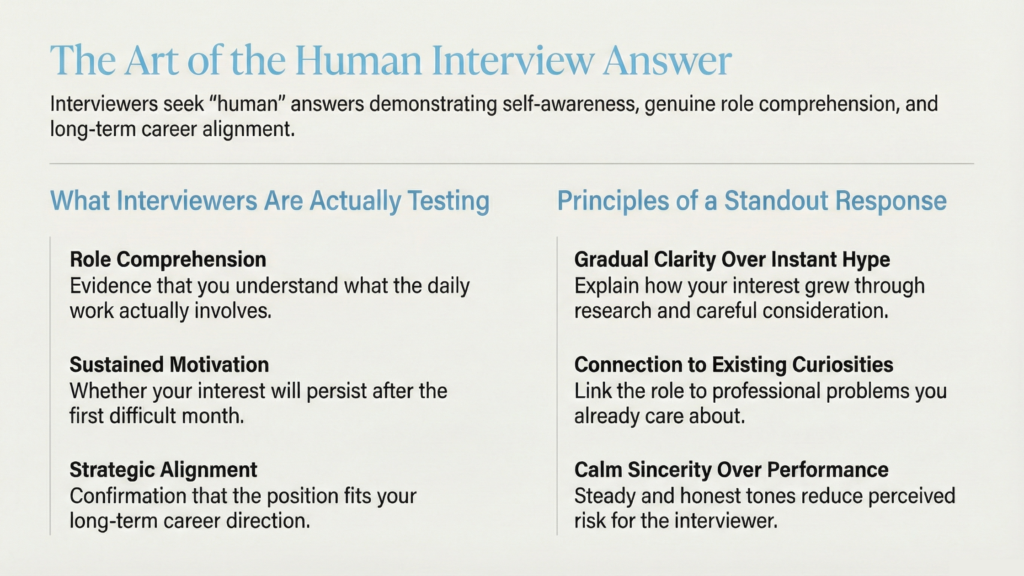
First, whether you understand what the job actually involves.
Second, whether your reasons will still matter after the first hard month.
Third, whether this role fits your direction or is just another stop.
Most weak answers fail because they only address one of these.
Honesty Works Better Than Enthusiasm
Interviewers are trained to sense emotional mismatch. Overenthusiasm for the wrong reasons raises quiet concerns.
Honest answers feel steady. They reduce risk.
A calm answer often outperforms a passionate one because it signals self-awareness.
This is especially true when answering why are you interested in this position in mid or senior level roles.
Example 1: When Interest Grew Slowly, Not Instantly
Many candidates believe they must sound excited from day one. That is not true. Some of the best answers come from gradual clarity.
Why are u interested in this job
“I did not apply immediately when I first saw this role. I saved it and came back to it a few times. Each time, I noticed the same thing. The work here focuses on long-term improvement rather than quick fixes, and that matters to me. In my last role, the projects I enjoyed most were the ones where I could slow down, understand the system, and make it better over time. This job feels aligned with that way of working.”
Why this works – It sounds honest. It shows discernment. It tells the interviewer this was a considered choice, not a rushed one.
Example 2: When the Role Solves a Problem You Already Care About
Strong answers often connect the job to an existing frustration or curiosity.
Why am I interested in this job
“In my current role, I often see good ideas lose momentum because there is no clear ownership. What stood out to me about this position is that it owns outcomes, not just tasks. I am interested in this job because it allows someone to take responsibility from start to finish, and that is the part of my work I have always found most meaningful.”
Why this works – It shows self-awareness. It shows the candidate understands the pain points of similar roles.
Example 3: When the Job Feels Like a Natural Continuation, Not a Jump
Not every career move needs to sound dramatic.
Why are you interested in this position
“This role feels like a continuation of the work I am already doing, but with more focus. In my current position, I touch many areas but rarely get to go deep. What drew me to this position is the chance to concentrate on fewer priorities and do them well. That shift matters to me at this stage of my career.”
Why this works – It feels mature. It signals stability. Interviewers trust this tone.
Example 4: When People, Not Brand Names, Create Interest
Many candidates mention company reputation. Few explain why it matters to them.
Why are u interested in this job
“I spoke with two people who work here before applying. What stayed with me was how they described decision-making. They both mentioned being trusted to make calls without constant escalation. That kind of environment brings out my best work. That is why I was interested in this job, even before looking at the full description.”
Why this works – It feels grounded in reality. It shows effort without sounding performative.
Example 5: When the Interest Comes From Contrast With a Previous Role
Contrast creates clarity.
Why are you interested in this job answer sample
“In my last role, speed was always prioritized over quality. I learned a lot there, but I also learned what I do not want long-term. This job stood out because it values accuracy and thoughtful execution. I am interested in this role because it aligns better with how I want to work and the standards I hold for myself.”
Why this works – It is reflective, not negative. Interviewers respect candidates who learn from experience.
Example 6: When You Are Changing Direction Carefully
Career shifts need reassurance, not hype.
Why am I interested in this position
“My interest in this position comes from working closely with this function for the past year. I was not originally hired for it, but I found myself drawn to the work. Over time, I realized I was more engaged during those projects than in my core responsibilities. This role gives me the chance to make that interest intentional rather than incidental.”
Why this works – It explains the shift logically. It lowers perceived risk.
Example 7: When the Job Matches How You Think, Not Just What You Do
Sometimes interest is cognitive, not technical.
Why are u interested in this job
“What attracted me to this role is how problems are framed. The way this team approaches challenges, by asking why before how, matches how I naturally think. I have worked in environments where execution came first, and I noticed the difference in outcomes. That alignment is why this job matters to me.”
Why this works – It shows depth. It speaks to mindset, not just skills.
Example 8: When Stability Itself Is the Honest Answer
Not everyone is chasing rapid change. And that is okay.
Sample answer why are you interested in this job
“At this point in my career, I am looking for a role where I can stay long enough to see the impact of my work. This position offers that continuity. I am interested in this job because it allows me to build, refine, and improve over time rather than constantly reset.”
Why this works – It sounds realistic. Hiring managers value retention.
Example 9: When the Answer Is Quiet but Strong
Some answers do not try to impress. They simply make sense.
Why are u interested in this job
“I am interested in this job because it fits the way I work best. The responsibilities are clear, the expectations are defined, and the work requires consistency more than constant urgency. That environment allows me to produce my best results.”
Why this works – It feels confident without noise.
A Thoughtful Why Are You Interested in This Job Answer Sample for Uncertain Roles
“I am interested in this role because it sits at the intersection of work I already enjoy and areas I want to understand better. I may not have done everything listed yet, but I have worked closely with similar responsibilities and found that I enjoy the problem-solving aspect. This role gives me a chance to deepen that work in a focused way.”
This answer works because it sets realistic expectations.
Common Mistakes That Quietly Hurt Strong Candidates
Even experienced candidates fall into these traps.
• Talking only about the company, not the role
• Talking only about yourself, not the work
• Sounding rehearsed instead of reflective
• Overusing motivational language without substance
Avoiding these makes your answer feel human.
Closing Thoughts
The question why are u interested in this job sounds simple, yet it reveals more than most interviewers admit. It shows how you choose work, how you think about growth, and whether the role fits your way of working. Strong answers are rarely clever. They are clear, personal, and honest. They come from knowing what kind of work keeps you steady, not just busy.
When your answer reflects real alignment, interviews shift. The conversation feels calmer. You stop trying to impress and start explaining. That is usually when interviewers start listening more closely.
Finding roles where that kind of alignment exists matters just as much as preparing the answer itself. CloudHire focuses on connecting professionals with remote and flexible job opportunities where skills and intent matter more than surface-level filtering. Book a call with us
Frequently Asked Questions
1. What does “why are you interested in this job?” really mean?
It means: “Do you understand this role and company, and can you show that you are a good long-term fit?”
Hiring managers want to see that you read the job description, know what the team does, and have a clear reason for choosing this job over others.
2. How do you answer “why are you interested in this job?” in one or two lines?
Use this pattern:
“I’m interested in this job because it focuses on [key tasks you like], and I’ve done similar work in [project/experience]. I also like that your company [specific thing about product, culture, or mission], which matches how I like to work.”
3. What should I mention when explaining why I’m interested in a job?
Mention three things:
- What you like about the role (tasks, tech, type of work).
- What you like about the company (product, values, market, culture).
- How your skills and goals match both (experience, tools, achievements).