

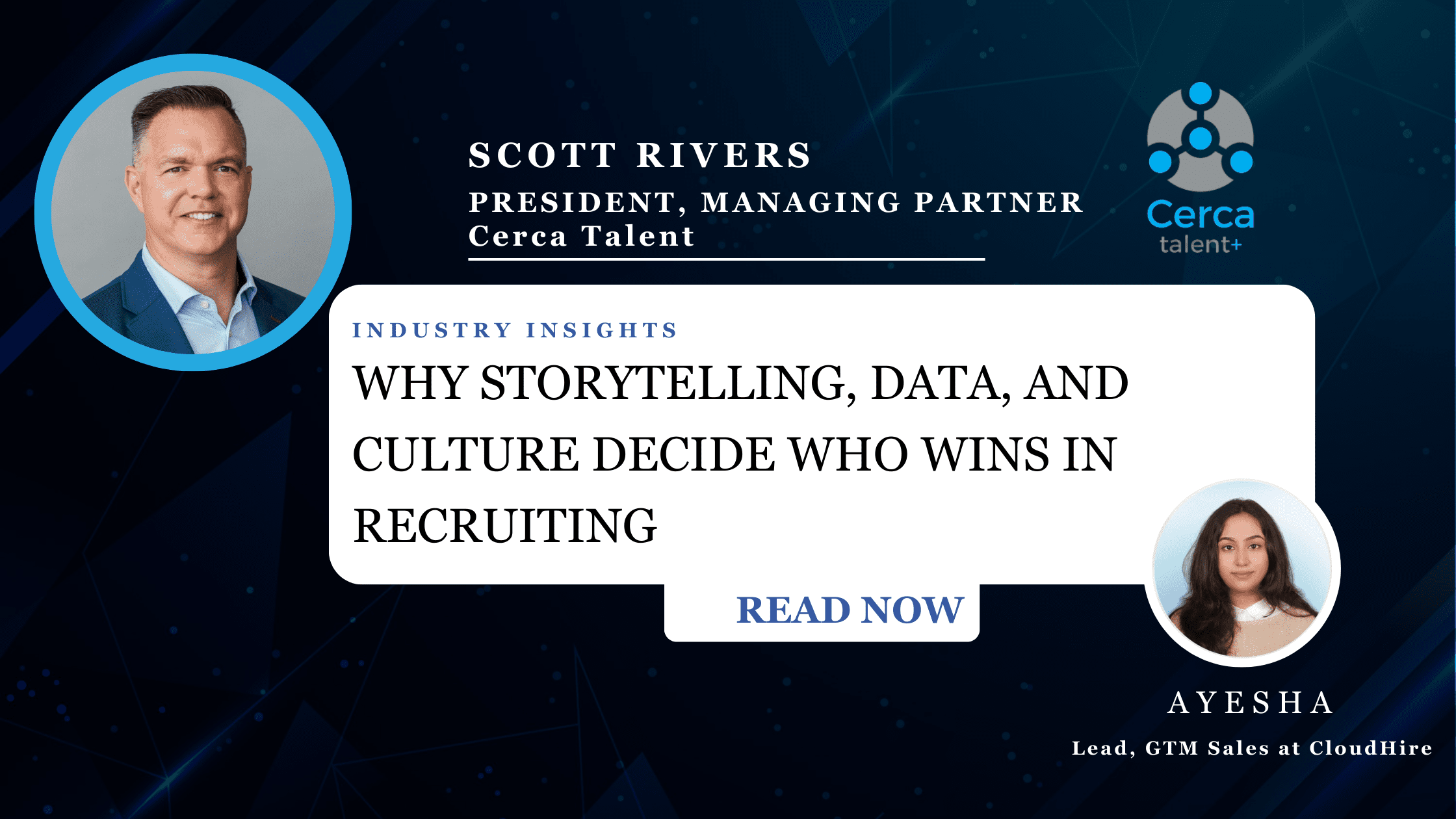
There are leaders who talk about excellence, and then there are leaders who spend decades quietly building it. In a recent remote interview, Scott Rivers, President, Managing Partner of Cerca Talent, revealed how twenty-five years in recruiting, ten years inside global life sciences giants, and a relentless obsession with understanding people have shaped one of the most trusted niche recruiting firms in the United States.
This interview unpacks each of those truths through his voice, his philosophies, and his experience.
A Journey That Began Inside Bayer and Johnson & Johnson
Scott Rivers began his career not in recruiting but inside the very industries he would later serve. His decade-long stint in diagnostics and life sciences shaped how he thinks about talent today. After assembling high-performing teams and collaborating with recruiters, something shifted for him. He saw a space where deep domain knowledge was missing. He knew he could bring a higher level of professionalism, context, and respect for the craft.
That realization became his first recruiting firm. Twenty years later, he has built and sold companies, led RPO for one of the world’s largest life sciences organizations, and ultimately returned to what drives him most. Being a specialized partner who helps companies grow with the right people rather than a high-volume provider who simply fills roles.
Today, Cerca Talent operates across ten U.S. states and two countries with a model grounded in precision, messaging, and long-term market presence.
Where Growing Companies Fail Most in Hiring
Scott sees the same patterns repeat themselves inside fast-growing companies. Almost every failure begins with poor messaging.
According to him, “the first touchpoint candidates receive decides whether a company will even be considered.”
Many organizations still underestimate it, sending vague job descriptions or unclear positioning that do nothing to stand out. His team spends significant time understanding a client’s culture, leadership perspective, goals, and competitive edge. Only then do they begin recruiting.
Without that foundation, companies end up attracting the wrong candidates or only those actively job hunting. Scott explains that “the best talent rarely looks for roles publicly.” They respond to clarity, relevance, and a compelling story.
But messaging is just one leak. Follow-up processes, candidate nurturing, consistent communication, and data accuracy all create opportunities for failure. A recruiting process spans interviews, preparation, feedback, offers, resignations, and onboarding. A gap in any one of those steps can cause top candidates to walk away.
Why Internal Teams Struggle To Scale Hiring
Most companies do have internal recruiters. What they lack is the ability to do high-volume, multi-state, multi-role hiring all at once. The scale breaks down. Too many parallel conversations, too little data accuracy, too little context on the market.
Cerca Talent fills that gap by owning both the volume and the relational depth. Scott’s team often knows candidates personally. They know who consistently outperforms quota, who rises through promotions, and who only presents well in interviews without being exceptional in the role.
This long-term familiarity gives them an advantage that internal teams cannot replicate quickly.
The Relationship Philosophy That Keeps Top Talent Engaged
One of the most memorable moments from this interview is Scott’s story of sending a candidate to another agency. He was not working the role. He would earn nothing from that referral. But he still did it.
For him, recruiting is about service. “When you treat people well, even when there is no transaction involved, it all comes back,” he emphasized. Candidates remember who helped them. They refer others. They return later when the timing aligns. And companies notice.
This philosophy runs through the entire firm. Every recruiter, salesperson, and coordinator follows structured touch plans. Contacts are not just names in a system. They are people the team stays connected with year after year. Over time, this creates an unusual outcome. Clients start approaching them instead of the other way around.
Why Some Companies Keep Hiring The Wrong People
Scott believes that many companies simply do not know their market deeply enough. They move too quickly or rely on impressive resumes instead of performance proof.
“Interview charm is not the same as consistent excellence,” he notes. Without long-term market visibility, it is almost impossible to distinguish the two.
His team has spent years tracking the careers of people in their niche. They know who delivers results annually, who earns internal trust, and who receives offers without applying. That level of insight is what prevents mismatches and churn.
The Hidden Machinery Behind Their Recruiting System
At the heart of their system is data. Clean, updated, and actionable data. Scott has built processes inside their ATS where every candidate and company is tracked with purpose. Touch plans are built into the system. Sequencing tools connect with APIs that maintain data quality.
But he is very intentional about simplicity. Earlier, they used nearly a dozen tools. He realized that while he personally enjoys technology, most of the team found it overwhelming. Too many tools slow people down. Today they operate with a much leaner stack where every tool either supports sequencing, tracking, or communication.
The real lift still comes from people. But the systems ensure that nothing falls through the cracks.
Why First-Party Data Will Decide Who Survives
An industry-wide concern Scott highlighted is that many recruiting teams rely entirely on platforms like LinkedIn Recruiter. They treat it as their database. This creates vulnerability.
“If they limit access or raise costs, companies lose their entire talent pipeline overnight.”
Companies that maintain their own rich databases will be the ones who stay resilient. The problem is that most organizations never update or mine their own data effectively. They keep searching externally while their best talent pools sit unused.
Leading A High-Performing Team Begins With Culture
Scott’s approach to culture is simple. “Take care of people. Treat them the way you want to be treated.” Build trust and support. His teams grow because the environment feels stable, fair, and grounded in long-term relationships.
It is the same philosophy he applies externally with candidates and clients. The consistency is what makes the brand recognizable in niche markets.
The Art of Storytelling in Recruiting
“Storytelling is not a marketing buzzword,” – Scott Rivers, President, Managing Partner at Cerca Talent.
It is a tool that shapes how candidates make decisions. People want truth, context, and a narrative that helps them understand why a company might be the right fit.
His team never sends vague requests to talk. They share context, achievements, reasons the opportunity might matter, and how a role aligns with the candidate’s goals. The goal is not persuasion. It is clarity. In a world overflowing with notifications, clarity is what stands out.
AI in Recruiting: Useful, But Not Ready To Replace People
Despite being tech-forward, Scott believes AI is still far from replacing recruiters.
“People who understand Boolean can still outperform most AI search tools today,” he explains.
He embraces AI for structured tasks like converting job descriptions or ensuring workflow consistency. But he is cautious about adopting expensive tools that are not yet mature.
For him, AI will eventually enhance recruiting. It will not replace the relationship-based nature of the work. Conversations about career changes, fears, motivations, and long-term growth cannot be automated meaningfully today.
Final Reflections
This interview is not just an inside look into Cerca Talent. It is a close view of how one leader has built an entire career on staying connected to people, understanding markets deeply, and focusing on clarity over complexity.
Scott’s insights offer something rare in recruiting. Honesty about what really works and what does not.
CloudHire appreciates leaders like Scott who continue shaping the future of recruiting through authenticity, long-term relationships, and a clear understanding of the human experience behind every hire.
Subscribe to the Scaling Remote newsletter for exclusive interviews, tactics, and insights on building high-performing distributed teams.


