Let’s be honest about why companies started using AI in recruitment.
It wasn’t to hire better people. It was to survive volume, speed, and pressure.
Too many applications. Not enough recruiters. Hiring managers are demanding faster results. Leadership is pushing for efficiency gains.
AI promised relief. And in some ways, it delivered: faster resume screening, automated candidate outreach, and scheduling without the back-and-forth.
But it also created new problems.
Missed high-potential candidates whose resumes didn’t match keyword patterns. Over-filtered talent pools that excluded people who could do the job but didn’t describe themselves the “right” way. Shallow signals masked as efficiency candidates moving through pipelines without anyone really knowing if they can do the work.
AI didn’t fix hiring. It exposed how broken it already was.
What Is AI Job Recruitment (Really)?
AI job recruitment is the use of artificial intelligence to support decision-making across the hiring lifecycle.
But let’s be clear about what that actually means, beyond the buzzwords. AI job recruitment goes beyond resume parsing, chatbots, or automated emails.
AI job recruitment, done right, is decision augmentation. It’s using machine learning, natural language processing, and data analysis to give hiring teams better information, not to replace their judgment, but to inform it.
There are different levels of AI involvement:
AI-powered recruiting tools use AI for specific tasks: resume screening, candidate sourcing, and interview scheduling. The recruiter still drives the process.
AI-led hiring systems use AI to make recommendations about who should advance, who to interview, and who to hire. Humans can override, but the default is to follow the algorithm.
Human-in-the-loop hiring models combine AI and human judgment intentionally. AI handles data-heavy tasks and pattern recognition. Humans handle context, nuance, and final decisions.
The difference matters because it determines where things break.
Why Traditional Recruitment Breaks at Scale
Before we talk about what AI does, we need to understand why traditional recruitment struggles.
The problems are structural:
Resume ≠ capability. A resume tells you where someone worked and what their job title was. It doesn’t tell you what they can actually do or how well they did it.
Keyword matching ≠ skill assessment. Screening for buzzwords finds people who know how to write resumes, not people who can perform the job.
Interview ≠ performance prediction. Interviews measure how well someone presents themselves under pressure. That’s useful information, but it’s not the same as predicting job performance.
Speed ≠ quality. Moving candidates through a pipeline quickly doesn’t mean you’re making better decisions. It means you’re making decisions faster.
Here’s the insight: AI didn’t create these problems. It simply made them impossible to ignore.
When you automate a broken process, you get broken results at scale.
Where AI Actually Adds Value in Job Recruitment
So, where does AI help?
Smarter Candidate Discovery (Not Just More Applicants)
Traditional sourcing relies on job boards, referrals, and LinkedIn searches. You find people who are actively looking or who fit obvious patterns.
AI expands this by identifying candidates based on demonstrated skills rather than job titles or current employers. It can surface people from non-traditional backgrounds who have the capability but wouldn’t pass a keyword screen.
This works when the AI is trained on skill signals, not just resume patterns. Otherwise, you’re just getting more volume.
Skill-Based Screening Over Resume Pedigree
The shift from “where did they work” to “what can they do” is where AI makes the biggest impact.
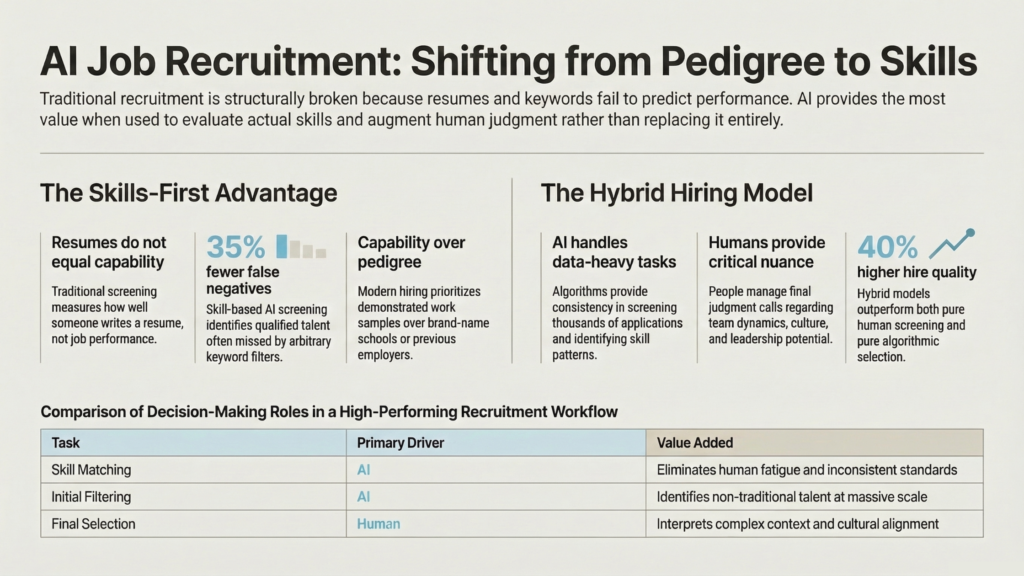
CloudHire’s internal analysis shows that skill-based screening powered by AI reduces false negatives by 35%, meaning fewer qualified candidates get filtered out in early stages because their resume didn’t match arbitrary criteria.
Instead of ranking candidates by brand-name companies or prestigious schools, AI can evaluate them based on demonstrated capabilities: coding challenges, work samples, and skills assessments.
Consistency in Early-Stage Decisions
Human recruiters are inconsistent. One person’s “strong maybe” is another’s “easy yes.” Standards drift. Fatigue sets in.
AI provides consistency. It applies the same criteria to every candidate, every time. That doesn’t eliminate judgment; it reduces randomness.
This is especially useful in high-volume hiring where different recruiters are screening different parts of the same candidate pool.
Faster Shortlisting Without Sacrificing Signal
AI can process thousands of applications and identify the top candidates based on relevant criteria in minutes instead of days.
The key: “relevant criteria” has to actually predict performance. If your AI is just matching keywords faster, you haven’t gained anything except speed.
Better Candidate Experience at Scale
AI enables personalized communication at volume. Candidates get timely updates, clear next steps, and answers to common questions without waiting for a human to respond.
This matters for employer brand. Ghosting candidates or leaving them in limbo for weeks damages your reputation. AI can’t replace human connection, but it can prevent the worst experiences.
The Hidden Risks of AI Job Recruitment
AI solves some problems and creates others. The risks are real.
Algorithmic bias baked into historical data: If your AI is trained on past hiring decisions, it will replicate past biases. If you historically hired more men for technical roles, the AI will learn that pattern and recommend more men.
Over-automation killing nuance: Some hiring decisions require context that AI can’t capture. Cultural fit, team dynamics, leadership potential, these aren’t reducible to data points.
False confidence in “AI recommendations”: When a system tells you this candidate is an 85% match, that number feels scientific. But it’s only as good as the criteria it’s measuring. Bad criteria produce precise-looking but meaningless scores.
Legal and compliance exposure: AI hiring tools face increasing regulatory scrutiny. Companies can be held liable for discriminatory outcomes even if the bias was algorithmic, not intentional.
Teams outsourcing thinking to tools: The biggest risk is treating AI as a black box. If recruiters stop thinking critically because “the AI said so,” decision quality collapses.
Key insight: AI doesn’t eliminate bias. It amplifies whatever process you already have.
AI Job Recruitment vs Human Hiring: A False Choice
The debate shouldn’t be AI versus humans. That’s the wrong framing.
The real question is: who decides what, and when?
AI should handle data-heavy tasks where consistency matters: parsing applications, matching skills to requirements, identifying patterns across thousands of candidates, and flagging inconsistencies or gaps.
Humans should handle judgment calls where context matters: defining what the role actually needs, interpreting signals in light of team dynamics and company direction, making final hiring decisions, and assessing cultural and values alignment.
CloudHire’s internal analysis shows that hybrid models where AI handles screening and humans make final decisions produce 40% better quality-of-hire scores compared to either pure human screening or pure algorithmic selection.
The best outcomes come when each does what it’s good at.
What High-Performing Companies Do Differently With AI
Some companies use AI in recruitment and see amazing results. Others use the same tools and see marginal gains or outright failures.
The difference isn’t the technology. It’s how they deploy it.
AI for filtering, not final decisions: Top performers use AI to narrow the field and surface candidates worth interviewing. They don’t use AI to make the hire/no-hire call.
Skills-first hiring models: They redesign their hiring process around capability verification, then use AI to assess and match skills at scale.
Continuous model feedback loops: They track whether AI recommendations lead to good hires, then adjust the model based on outcomes. Most companies set up AI once and never revisit whether it’s working.
Structured assessments over intuition: They use AI to enforce consistent evaluation criteria, reducing the role of gut feel in early-stage screening.
Clear accountability for outcomes: Someone owns hiring quality, not just hiring speed. AI is measured by whether it improves decision quality, not just whether it processes applications faster.
How CloudHire Powers AI Job Recruitment That Actually Works
Most AI recruiting tools bolt artificial intelligence onto existing broken processes. CloudHire takes a different approach.
AI-driven skill assessment, not resume guessing: Instead of parsing resumes for keywords, CloudHire uses AI to evaluate demonstrated skills through assessments, work samples, and verified capabilities.
Structured talent matching, not keyword ranking: The system matches candidates to roles based on proven ability to do the work, not surface-level resume optimization.
Global, compliant hiring infrastructure: CloudHire handles the complexity of international hiring, data privacy, and regulatory compliance issues that become more complicated when AI is involved.
Human + AI collaboration by design: The platform is built around the principle that AI generates insights and humans make decisions. No black box algorithms making choices without human oversight.
Visibility from screening to performance: Companies can track whether candidates surfaced by AI actually succeed in their roles, creating a feedback loop that improves the system over time.
CloudHire isn’t “AI on top of hiring.” It’s AI embedded into how hiring should work.
When AI Job Recruitment Makes the Biggest Impact
AI recruitment isn’t equally valuable in every situation. It works best when:
High-volume hiring without quality loss: Companies that need to hire hundreds or thousands of people can’t manually review every application. AI makes quality screening possible at scale.
Global or remote talent sourcing: When your talent pool spans continents and time zones, AI handles coordination and initial evaluation across diverse candidate pools.
Skill-critical roles: Positions where specific technical capabilities matter more than pedigree benefit from AI-powered skill assessment.
Fast-scaling teams: Startups and growth companies that need to hire quickly but can’t afford bad hires use AI to maintain standards while moving fast.
Companies moving away from pedigree-based hiring: Organizations committed to skills-first hiring use AI to evaluate capability rather than proxies like education and previous employers.
The Future of AI Job Recruitment
Where is this heading?
Outcome-based hiring: AI will increasingly focus on predicting performance, not just matching keywords. The question shifts from “Does this resume look good?” to “Will this person succeed in this role?”
Skills graphs over resumes: Instead of a chronological work history, candidates will have skill profiles that show what they can do, verified through assessments and past work.
Continuous talent marketplaces: Rather than episodic hiring events, companies will maintain ongoing relationships with talent pools, with AI helping match people to roles as needs evolve.
AI as infrastructure, not a tool: The best companies won’t “use AI for recruiting.” They’ll have recruiting systems where AI is embedded throughout, invisible but essential.
Final Thought: AI Won’t Fix Hiring But It Will Expose It
AI doesn’t hire better people by default. It forces companies to confront how they define “good.”
If you’re using AI to screen resumes faster, you haven’t improved hiring; you’ve just automated the problem that resumes don’t predict performance.
But if you redesign your hiring system around better signals, skills, demonstrated capability, structured assessment, and use AI to make that scalable, you win.
The companies that understand this are pulling ahead. The ones that just add AI tools to broken processes are falling behind while feeling like they’re innovating.
AI won’t fix your hiring. But it will expose what’s broken.
What you do with that exposure is up to you.
FAQ
What is AI job recruitment?
AI job recruitment is the use of artificial intelligence to support hiring decisions across sourcing, screening, assessment, and selection. It includes resume parsing, candidate matching, automated outreach, skill assessment, and interview scheduling. The goal is to augment human decision-making with data and pattern recognition, not to replace recruiters entirely.
How is AI used in recruitment today?
AI is primarily used for resume screening (parsing applications and ranking candidates), candidate sourcing (finding people who match job requirements), chatbots for candidate engagement, interview scheduling automation, and increasingly for skill-based assessment. CloudHire’s internal analysis shows the most effective implementations use AI for early-stage filtering while keeping humans involved in final decisions.
Does AI replace recruiters?
No. AI handles repetitive, data-heavy tasks like screening thousands of applications or matching skills to job requirements. But recruiters are still needed for relationship building, understanding nuanced role requirements, interpreting context, and making final judgment calls. The best outcomes come from human-AI collaboration, not replacement.
What are the risks of AI in hiring?
The main risks are algorithmic bias (AI replicating historical discrimination patterns), over-automation that removes necessary human judgment, false confidence in AI scores that aren’t actually predictive, legal and compliance exposure, and teams outsourcing critical thinking to tools. AI amplifies whatever process you have; if your hiring process is biased, AI will scale that bias.
How can companies use AI ethically in recruitment?
Start by auditing your AI systems for bias and tracking outcomes by demographic groups. Keep humans in the decision loop, especially for final hiring calls. Be transparent with candidates about how AI is used. Continuously validate that AI recommendations lead to good hires. Focus AI on skills and demonstrated capability rather than proxies like education or previous employers. And never treat AI recommendations as final, they’re inputs to human judgment, not replacements for it.