

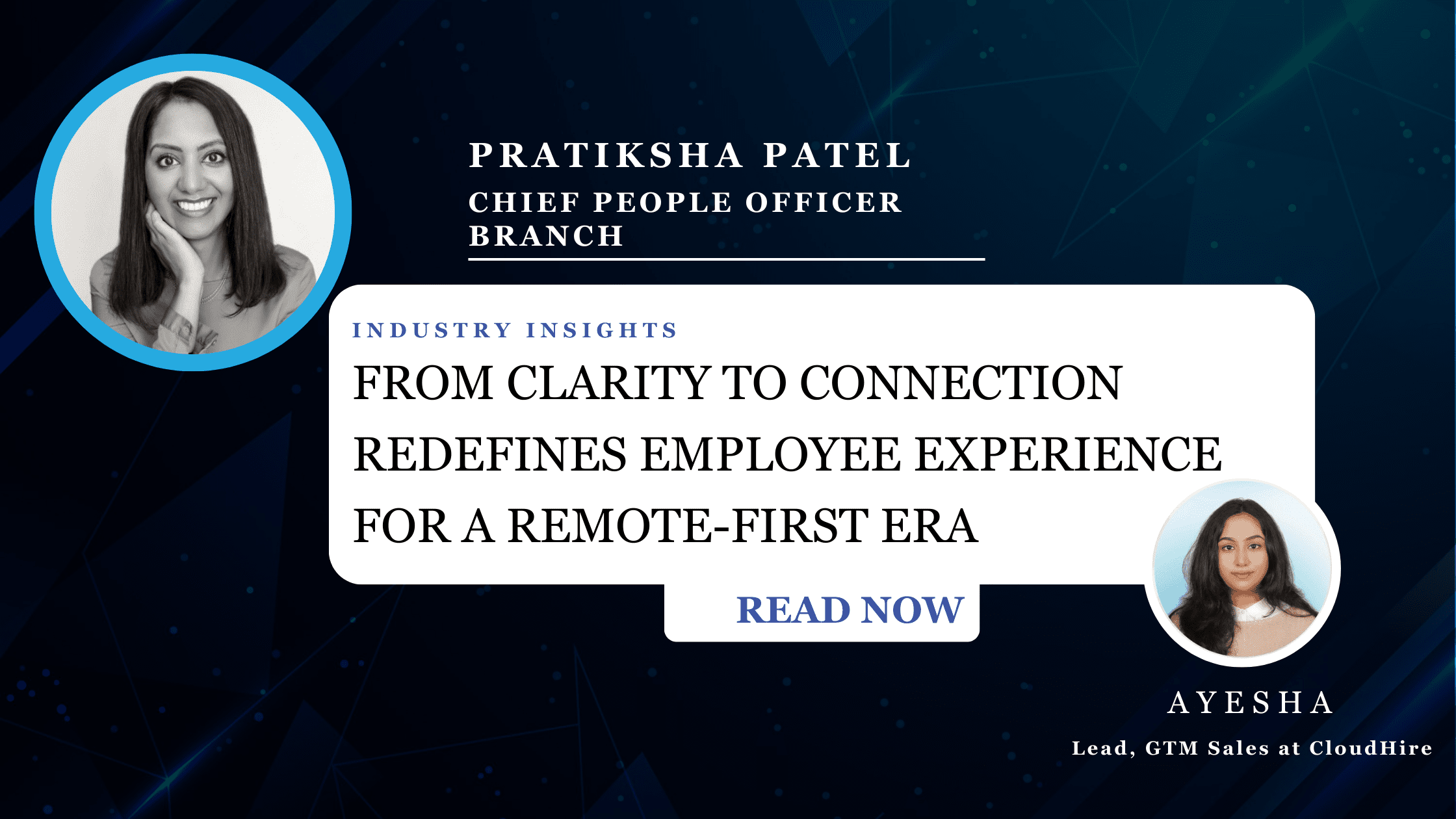
A conversation with Pratiksha Patel, Chief People Officer at Branch.
In the fast-evolving landscape of work, “employee experience” is not a soft HR concept; it’s a measurable driver of retention, productivity, and business growth. Few leaders understand this better than Pratiksha Patel, a seasoned executive with more than 25 years of experience spanning HR, talent, professional development, and even general executive responsibilities.
Pratiksha’s career has taken her across industries and company life stages, building a “large toolbox” of strategies she can adapt to unique business needs. Today, as a leader at Branch, she is at the forefront of designing systems and cultural practices that not only retain top talent, her team boasts a 94% retention rate among high performers but also ensure that every employee’s journey is built on trust, clarity, and meaningful work.
“Employee experience is the outcome of the inputs we design as an organization, and those outcomes show up in what employees think, feel, or do as a result.”
Reframing the Performance Conversation
Traditional HR processes around performance management often carry a stigma. “Progressive discipline” and “performance improvement plans” can feel punitive, breeding fear rather than motivation. Pratiksha and her team decided to reimagine this entirely, introducing a new framework called Path to Performance.
The idea is simple but transformative: provide high clarity on what’s not working, an equally clear picture of the desired state, defined support to get there, and transparency about the implications, positive or negative, of the outcome.
“We’re highly transparent about this structure. Employees know what it is; it’s not in a black box. Even our templates are written with empathy and clarity, not just the baseline required legalese,” she explains.
This shift has turned a compliance-driven process into a human-centered performance pathway, aligning expectations while preserving dignity.
Pay Transparency as a Trust Builder
One of the most distinctive practices at Branch is their same role, same pay policy, meaning every person in the same job, and in the same geographic bucket, earns the same base salary.
While market-driven pay benchmarking is common, this degree of internal equity is rare. And it demands discipline. Pratiksha’s team conducts meticulous reviews of job architecture, ensuring roles are mapped correctly to market data and adjusting when real-world responsibilities change.
The result? Fewer pay disputes, higher trust, and a sense of fairness across the organization.
“When employees ask ‘prove it,’ we open the hood. We share the data, the assumptions, and the job definitions. And if the mapping is no longer correct, even if it was before, we fix it.”
Using Data to Elevate Experience
Pratiksha believes that data is only valuable when it’s contextualized and that performance measures should be tailored to each function.
For some teams, like claims or member support, success is defined by operational KPIs such as volume handled, close rates, or customer wait times. For recruiting, it’s meeting agreed start dates. For leadership, it’s retention trends and internal mobility metrics.
But she cautions against over-reliance on employee engagement surveys alone:
“Self-reported perception is important, but it’s just one factor. You need multiple data sources, quantitative and qualitative, and a willingness to listen.”
The Discipline of Timing in Hiring
Hiring too early or too late can be costly, especially in smaller companies where resources are precious.
Rather than filling all budgeted headcount at the start of the year, Pratiksha’s team partners with leaders to hire when the work truly requires it. They work backwards from operational needs, factoring in training time, and using business data to predict when a role should be operational.
This precision has saved resources and avoided both overstaffing and burnout. “It’s about stewardship of resources,” she says. “We want hiring managers and hiring partners marching to the same, well-informed goal.”
Culture as the Retention Engine
A 94% retention rate for top talent doesn’t happen by accident. For Pratiksha, it comes down to three core principles:
- Productive Transparency – Going beyond average levels of information-sharing to build trust.
- Meaningful Work – Ensuring employees know their remit and have work that engages them from day one.
- Human-First Connections – Building strong social bonds through open-door policies and genuine relationship-building.
These principles, supported by structures like semi-annual feedback cycles, create what she calls “stickiness” in the employee experience.
The Future of Employee Experience with AI
When asked about AI, Pratiksha is a pragmatic practician. She sees its potential in boosting HR productivity and enabling consistent outcomes, while stressing that humans must still define the goals and design the experience.
“AI has been great for summarizing from the get-go. It can assist with in-depth or nuanced reasoning, but only if robustly trained and reviewed. In a human-centric industry like ours, the experience still needs to be shaped and owned by people.”
She likens AI’s rise to past waves of workplace transformation, the internet in the ’90s, the data boom of the 2000s, and sees it as part of the ongoing search for the best leverage point for innovation and value creation.
Actionable Takeaways for People Leaders
From Pratiksha’s playbook, leaders can:
- Reframe negative processes to be clarity-driven and human-centered.
- Build trust with transparency, especially around pay.
- Use data in context, combining quantitative and qualitative insights.
- Time hiring with business needs to optimize resources.
- Embed culture into structures so it scales with growth.
- Design for remote from the start, not as an afterthought.
- Leverage AI carefully, with humans steering the design.
Conclusion: Scaling Trust, Retention, and Impact
Pratiksha Patel’s approach to employee experience blends rigor with humanity, anchoring processes in clarity and data while ensuring they serve people first.
It’s a philosophy that resonates strongly with the mission of Scaling Remote and platforms like CloudHire, which connect companies with top talent while championing transparent, equitable, and engaging work cultures.
Her work is a reminder that in a competitive talent market, the organizations that will win aren’t just the ones that hire the fastest; they’re the ones that design experiences worth staying for.
Want more conversations with leaders shaping the future of work?
Subscribe to Scaling Remote Newsletter for insights, strategies, and stories from the people changing how we work.


