Most teams want to deliver a great hiring experience. Very few know how to measure candidate experience in a way that is meaningful, honest, and useful. That gap creates all the frustration candidates talk about: unclear next steps, inconsistent messaging, slow feedback, confusing interviews, and processes that feel designed for the company but not for the human applying.
But measuring candidate experience is not complicated. It becomes easier once you understand what candidates actually pay attention to and what those signals reveal about your recruitment process. When measured well, it becomes one of the strongest levers for improving quality of hire, offer acceptance, and long-term employer reputation.
This guide breaks down everything you need to understand about what candidate experience is, how to measure it, how to improve it, and how to turn the data into action without adding extra work to your hiring team.
Why Candidate Experience Has Become a Leadership-Level Priority
People now evaluate a company by the way it treats them during hiring. Even one poor interaction can change how they speak about the brand. The question why is candidate experience important has evolved. It is no longer about being polite. It is about protecting trust, reducing drop-offs, and signaling the culture behind the scenes.
A positive candidate experience builds confidence that the company communicates clearly, respects time, and makes thoughtful decisions. A negative one does the opposite. And in competitive talent markets, those impressions directly influence conversions.
What Candidates Really Judge (But Don’t Always Say Out Loud)
Here are the hidden checkpoints candidates use when they decide whether the process feels good:
- Responsiveness. Slow is a response. They interpret delays as lack of clarity or low interest.
- Predictability. If the next steps are vague, they assume internal misalignment.
- Preparation. Interviewers who arrive rushed or distracted reflect a weak hiring culture.
- Respect. They notice how assessments are introduced, how rejections are delivered, and whether communication feels human.
- Fairness. Consistency, inclusivity, and transparency matter, especially when assessing dei candidate experience, where fairness is heavily scrutinized.
These signals are powerful because they reveal the maturity of your hiring process. And they become measurable if you track them the right way.
The Most Reliable Ways to Measure Candidate Experience
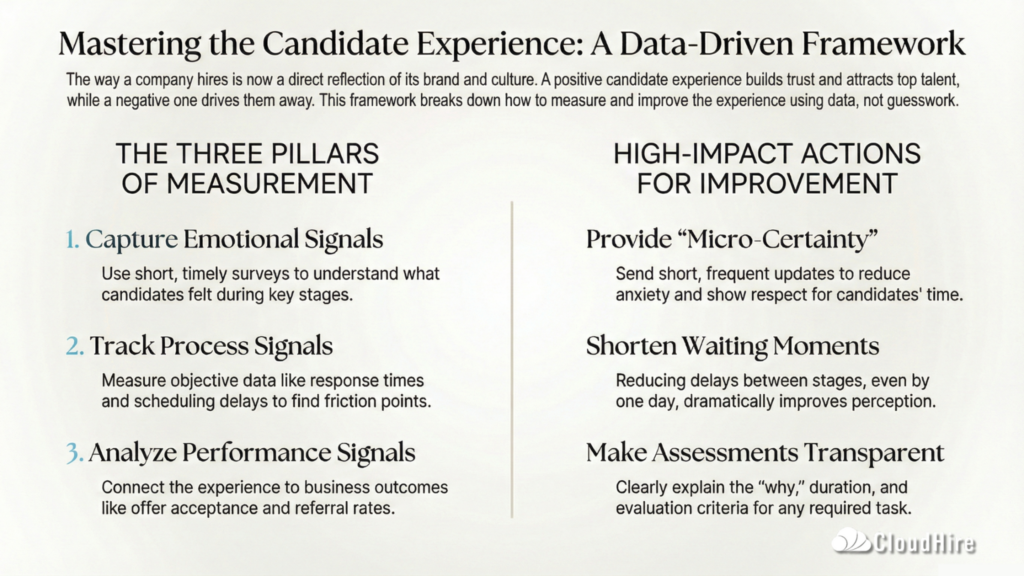
To understand how to measure candidate experience, start by capturing data at three levels: emotional signals, process signals, and performance signals.
1. Emotional Signals: What They Felt
This is the heart of candidate experience measurement. Use short, clear, emotion-focused questions that capture reactions right after key stages. A candidate experience survey is the simplest and most accurate tool for this because memory fades quickly.
Focus on questions like:
- Did the process feel respectful of your time?
- Did communication feel clear and human?
- Did interviewers seem prepared?
- Did you understand what success looks like in this role?
You can create a lightweight candidate experience survey sample or use a candidate experience survey template to make it repeatable. The goal is consistency, not complexity.
2. Process Signals: What Actually Happened
These are the metrics most teams overlook. They are not emotional, but they shape emotions.
Track:
- Response times between stages
- Interview scheduling delays
- Assessment completion rates
- Percentage of candidates withdrawing
- Percentage asking for clarification
- Time between rejection and communication
Expert tip from HR Cloudhire: “Teams that reduced response time by one day often saw offer acceptance rise within a quarter.”
This is your candidate experience journey seen through data. It shows where candidates silently struggle.
3. Performance Signals: What the Experience Produces
You can measure quality by evaluating what improved because the experience was good.
Examples:
- Higher offer acceptance
- Higher return-applicant rate
- More referrals from rejected candidates
- Higher engagement with follow-up materials
- Better alignment between candidate expectations and job realities
This is the foundation of strong candidate experience management. It shows whether your efforts are reshaping outcomes, not just feelings.
How to Improve Candidate Experience Using Real Data
Once you gather insights, the next step is understanding how to improve candidate experience in recruitment without overwhelming your team. The best changes are usually small and operational.
Here are actions that consistently create a positive candidate experience:
1. Give candidates “micro-certainty”
People don’t need full certainty. They need tiny moments of clarity.
Send short updates:
- “You’re still under review.”
- “Your interview feedback is being compiled.”
- “We’ll share an update tomorrow.”
Clear, brief communication is one of the simplest ways to improve candidate experience without extra tools.
2. Shorten waiting moments
Many teams focus on adding stages when the real improvement is reducing delays. Even a one-day reduction in review time changes perception dramatically.
3. Train interviewers in human communication
Not technical training. Human training.
Listening. Pausing. Smiling. Explaining decisions.
Small behaviors add up.
4. Make assessments transparent
Candidates are more willing to complete tasks when they know:
- Why it matters
- How long it will take
- What it evaluates
Transparency is a major part of candidate experience best practices.
5. Audit fairness in every stage
Review language tone, time given for tasks, accessibility, and interviewer consistency.
This is essential when improving experience candidate fairness and trust.
The Tools That Make Measurement Easier
Good candidate experience software does not replace human judgment. It amplifies it.
Look for tools that:
- Capture surveys at the right moments
- Track process delays automatically
- Aggregate sentiment
- Highlight friction points
- Integrate with ATS systems
- Provide benchmarks over time
The right tools let you focus on action rather than collection.
What Makes a Candidate Experience Strategy Actually Work
The teams that succeed share three habits:
- Short surveys, sent at the right time. Long surveys get ignored.
- Action-oriented reviews. They choose one improvement per quarter.
- Cross-team visibility. Recruiters, hiring managers, and operations all see the data.
This turns measurement into momentum.
Sample Questions to Include in Your Candidate Experience Survey
If you want a few starting points, here are reliable candidate experience survey questions that teams often use:
- How satisfied were you with the clarity of communication?
- Did you feel respected during each interaction?
- Were the expectations explained clearly?
- Did interviewers help you understand the role?
- What could have made the process smoother?
Ask no more than five questions unless you are studying a specific stage.
Conclusion: Build Processes Candidates Trust
Great hiring is not about perfection. It is about clarity, respect, and intentional communication. When you measure candidate experience well, you understand where your process strengthens trust and where it weakens it. This becomes the foundation for genuine improvement, stronger offers, and better long-term relationships.
Platforms like CloudHire are designed to support this by giving hiring teams visibility into friction points while creating clearer, more respectful experiences for candidates on the other side. When both sides feel aligned, hiring becomes faster, more human, and more effective.
If you’re exploring your next role or want to discover opportunities aligned with your experience, you can browse new openings directly on CloudHire. It’s a simple place to find roles that match your skills and aspirations.
Frequently Asked Questions
What is candidate experience?
Candidate experience is how a job seeker feels about your company from the moment they see the job post until after you say yes or no. It includes the application, communication, interviews, decisions, and onboarding, and becomes part of your employer brand in their mind.
How to improve candidate experience?
You improve candidate experience by making the process speed, communication quality, fairness, and transparency at each stage.
- Share the hiring steps and timeline upfront, then stick to it.
- Keep applications short, reply quickly, and give basic feedback or closure instead of silence.
- Treat interviews as two‑way: let candidates ask questions and show them what working there is really like.
How to measure candidate experience?
Use emotional, process, and performance data collected at key touchpoints. Most teams measure candidate experience with short post‑interview surveys.
- Candidate NPS (cNPS): “How likely are you to recommend applying here?” rated 0–10; subtract detractors (0–6) from promoters (9–10) for a score.
- CSAT or satisfaction score: ask candidates to rate their overall experience and calculate the percentage giving positive ratings.
Why is candidate experience important?
Candidate experience shapes how people talk about your brand and whether strong talent applies again or refers friends. A good experience, even for rejected candidates, improves offer acceptance, time‑to‑hire, and long‑term reputation; a poor one leads to drop‑offs, ghosting, and negative reviews on sites like Glassdoor.