Job search anxiety in 2026 does not start with panic. It starts quietly.
It shows up when you check your inbox first thing in the morning, even before you are fully awake. When you refresh again in the afternoon, knowing nothing has changed. When another day ends without a response, and the silence begins to feel heavier than rejection ever did.
Most workers are not struggling because they lack skills or ambition. They are struggling because the modern job search places people in a constant state of uncertainty, where effort and outcome feel disconnected. Over time, that uncertainty erodes confidence, focus, and momentum.
Understanding what is actually holding workers back helps turn anxiety into something more manageable.
“Working at Cloudhire, I see every day how much clarity and timing matter to people on both sides of hiring. When the process feels calmer and more human, it becomes easier to keep going without losing yourself in it.” – Content Specialist CloudHire
The Weight of Endless Silence
Silence is the most destabilizing part of today’s job search.
People send applications week after week and hear nothing in return. No acknowledgment, no feedback, no signal that their effort landed anywhere meaningful. The mind fills that gap quickly, often with self-blame. Skills are questioned. Career choices are second-guessed.
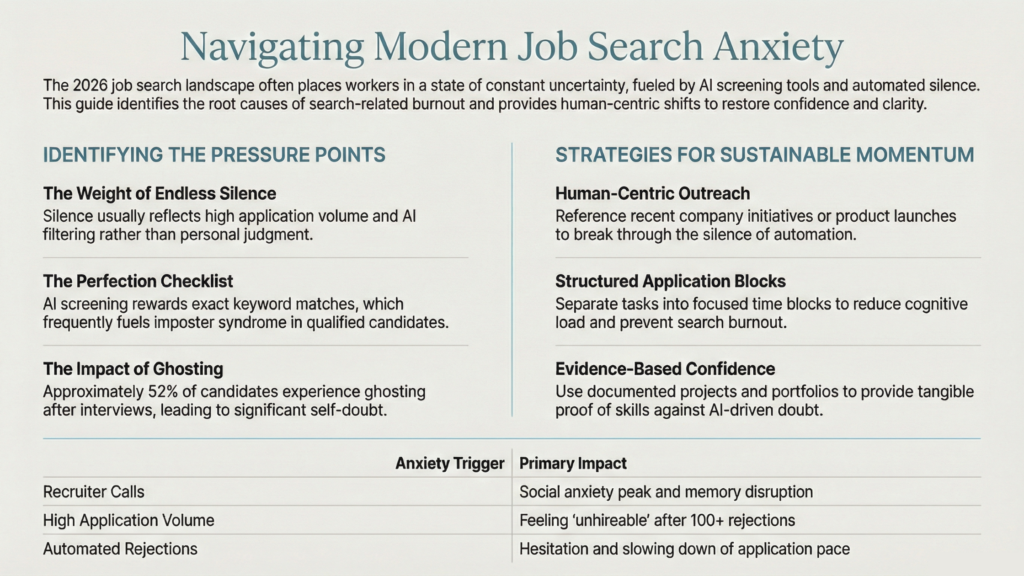
In reality, silence usually reflects volume, not judgment. Many roles receive hundreds of applications. Automated systems filter most before a human ever looks. Recruiters work under time pressure and skim what survives.
That context matters, but it does not remove the emotional impact. What helps is shifting from passive waiting to visible intent. Fewer applications, sent with care, tend to break the silence more often than mass submissions.
Simple changes make a difference:
- Referencing a recent company initiative
- Mentioning a product launch or campaign
- Showing awareness of the team’s direction
Silence loses power when outreach feels human again.
When Rejections Start Feeling Personal
Rejections tend to arrive at the worst moments. Late at night. Between responsibilities. When energy is already low.
After enough of them, the brain stops treating rejection as information and starts treating it as a verdict. People replay interviews, fixate on small mistakes, and assume they were exposed as inadequate. Over time, this leads to hesitation. Applications slow down. Interviews feel heavier.
What helps is reframing rejection as feedback, even when it is incomplete. Writing down interview reflections immediately makes patterns visible. Weak stories, vague examples, or unclear outcomes can be strengthened deliberately instead of guessed at endlessly.
Some candidates take an additional step and ask for feedback. Not everyone responds, but when they do, it often clarifies what actually needs improvement. Rejection becomes directional instead of paralyzing.
Imposter Syndrome in a Skills-Driven Market
Job descriptions in 2026 often read like perfection checklists. AI screening tools amplify this feeling by rewarding exact matches and specific keywords.
This environment fuels imposter syndrome, especially for those returning after layoffs, switching careers, or re-entering the workforce. People wait to feel ready, assuming confidence will arrive first.
It rarely does.
Confidence grows from evidence, not comparison. An honest skills audit grounds self-belief in reality. Most roles require alignment, not mastery. Updating resumes and profiles with clear outcomes and measurable impact helps both screening systems and self-perception.
Building visible proof also matters. Projects, portfolios, and documented work make skills tangible. When abilities are visible, doubt has less room to dominate.
The Exhaustion of Application Overload
Applying for jobs today is mentally draining. Each application demands focus, customization, and emotional investment. Over time, this creates fatigue that looks like procrastination but is actually burnout.
Many people delay applying not because they do not care, but because the process feels overwhelming. Others push relentlessly until they collapse.
The solution is not more effort, but a better structure. Separating tasks into focused blocks reduces cognitive load. Templates protect energy when used thoughtfully, allowing attention to stay on what truly needs tailoring.
Rest is not a reward after productivity. It is what allows productivity to continue.
Interview Anxiety and Performance Pressure
Even experienced professionals struggle with interviews. Anxiety narrows thinking, disrupts memory, and creates blank moments under pressure.
This is not a lack of capability. It is a stress response.
Preparation helps most when it focuses on familiarity rather than perfection. Practicing answers aloud, recording mock interviews, and reviewing delivery builds comfort with one’s own voice and pacing. Breathing techniques and grounding rituals calm the body enough for clarity to return.
Interviews improve when candidates focus less on impressing and more on connecting.
Burnout From Prolonged Searches
Long job searches wear people down quietly. Weeks turn into months. Financial pressure builds. Motivation thins.
Burnout often shows up as:
- Avoiding job portals
- Lowering standards just to escape uncertainty
- Feeling guilty for resting
- Losing confidence in previously solid skills
At this stage, pacing becomes essential. Weekly goals reduce pressure while preserving momentum. Short-term projects, freelance work, or volunteer roles often restore confidence by creating visible outcomes.
Burnout does not mean failure. It means recovery is overdue.
Economic Anxiety and Background Noise
Layoff headlines, AI displacement fears, and constant economic updates create a background hum of anxiety. Doom-scrolling amplifies paralysis and makes the future feel smaller.
Limiting news intake and focusing on controllable actions restores agency. Tracking personal wins, even small ones, counters the narrative of stagnation. Purposeful activity, especially work that helps others, rebuilds perspective and energy.
Listening to the Body and Rebuilding Momentum
Job search anxiety rarely stays in the mind alone. It shows up physically through poor sleep, constant tension, headaches, and lingering exhaustion. When these signals are ignored, the search starts to feel harder than it needs to be, and momentum quietly slips away.
Catching this early makes a difference. Simple daily awareness helps regulate stress before it compounds:
- Noticing sleep quality and energy levels
- Building light movement or time outdoors into the day
- Using grounding practices to calm racing thoughts
For some, professional support becomes necessary. Therapy during a job search is not a last resort. It is often what keeps people steady enough to continue without burning out.
Momentum returns through small, repeatable actions rather than big breakthroughs. One thoughtful application, one warm message, or one skill refreshed is enough to rebuild confidence. Over time, these small steps restore trust in yourself and bring the search back into balance.
Job searches are not only about outcomes. They quietly build resilience and clarity, qualities that matter just as much as technical skills in 2026.
Final Thought
Job search anxiety thrives in silence, isolation, and overwhelm. It loosens its grip when effort becomes intentional and compassionate.
You do not need to fix everything at once. You need to move steadily, with clarity and self-respect.
Start small. Keep going. The door opens more often than it feels like it will.
Job searches are already hard. They don’t need more noise. At Cloudhire, we try to build hiring experiences that feel clearer, calmer, and more human for everyone involved.
Frequently Asked Questions
What is job search anxiety?
That stomach-churning freeze before “Apply,” heart-pounding dread of recruiter calls, 3-day spirals after ghosting. It is sometimes called “subconscious sabotage.” You know you’re qualified, but imposter voice screams “not enough.” It’s mental + physical: insomnia, headaches, rage-quitting apps.
What triggers job search anxiety most?
#1 Recruiter calls (social anxiety peak—stuttering, blanking).
#2 Ghosting (52% after interviews; “did I bomb?”).
#3 Imposter syndrome (“overqualified” rejections).
#4 Application volume (100+ nos = “unhireable”).
Pattern: uncertainty + judgment fear.
Quick fixes that cut job search anxiety now?
- “Hit send + delete tab” – 1 app/day, no cover letters unless dream job. Desensitizes fear (90 apps → 2 interviews).
- 7PM hard stop – Apps 2-4pm only; evenings phone-free.
- Library body doubling – Apply near strangers; momentum kills freeze.