Working as a product manager, owning roadmaps, guiding engineering and design teams, shaping features, and measuring impact always sounded like a job you do in a buzzing office. But over the past few years, remote work has quietly disrupted the model. Today, product manager jobs remote are a real path, not just a perk.
If you’re looking for product manager remote jobs, this guide tells you what’s changed, how to position yourself, what to expect, and how to avoid candidate traps. I’m writing this as someone familiar with tech hiring realities, not to sell a dream, but to show what works (and what doesn’t).
What Recent Data Shows About Remote PM Job Market in 2025
| Metric / Trend | What It Means for Candidates |
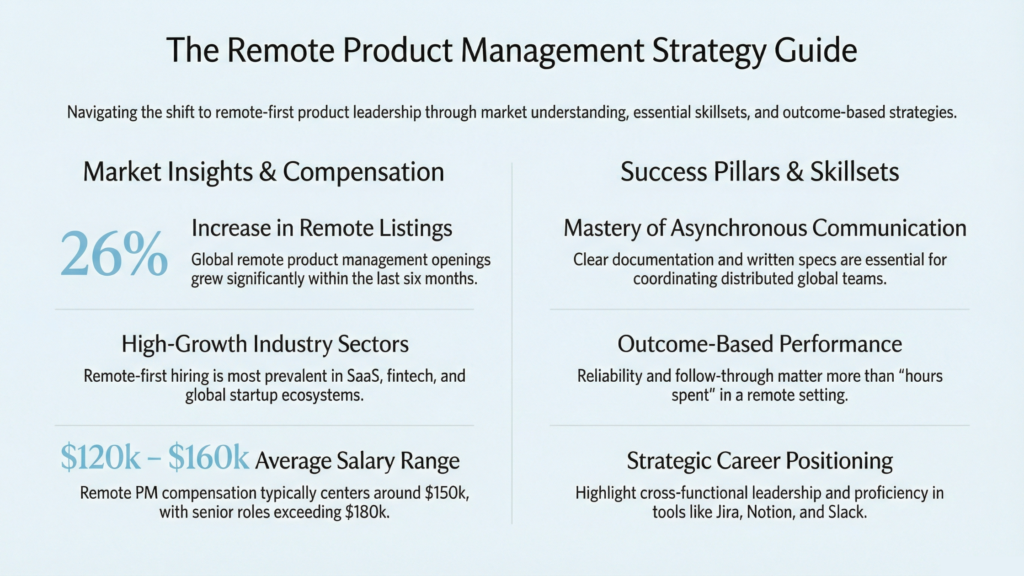
| Remote listings ↑ 26% in 6 months; ↑ 19% YoY | Remote PM jobs are growing; good chance to find openings worldwide. |
| Remote openings are among the fastest-growing work-environment categories globally | Remote is not niche; many firms now prefer remote-first hiring, even for PM roles. |
| More demand, especially in SaaS, startups, and global-tech firms | If you target SaaS/tech globally, chances to land remote PM roles increase. |
| Larger candidate pools for remote jobs vs. local jobs | Expect heavier competition; you must stand out with clarity, product thinking, and remote-readiness. |
Why Remote Product Management Is Real And Growing
Remote product management isn’t a fad; it’s a shift in how companies build products. With distributed teams across countries and time zones, and remote-first startups rising fast, companies can no longer depend only on office-based PMs.
- Global collaboration is now the norm: Remote PMs manage developers in India, designers in LATAM, and data teams in Europe, all working asynchronously.
- The role is about decisions, not desk presence: PMs define product vision, strategy, prioritize backlogs, coordinate launch plans tasks that don’t require a physical office.
- Tooling and communication matured: With platforms like Jira, Notion, Miro, and Slack, remote teams can run sprints, manage design feedback, and track outcomes without co-located meetings.
Because of this shift, more companies are posting remote jobs product manager roles, across early-stage startups, SaaS firms, fintechs, and global SaaS platforms.
What Product Manager Jobs Remote Require Skills, Mindset, & Realities
Being a good remote PM demands more than product instincts. In 2026, companies expect:
- Async communication & documentation – You’ll need to write clear specs, roadmaps, and updates. Many decisions happen in writing, not in meetings.
- Self-management & ownership – When no one’s watching, deliverables matter more than “hours spent.” Reliable follow-through matters more than being “online.”
- Technical fluency & data awareness – Even if you’re not writing code, understanding APIs, data flows, metrics, and user analytics helps a lot, especially in smaller or AI-heavy companies.
- Cultural empathy & global mindset – Remote PMs often coordinate across continents. Understanding timezone differences, cross-cultural communication, and user diversity becomes valuable.
- Ability to handle ambiguity & shifting priorities – Remote teams move fast. Requirements change. Launch timelines shift. You’ll need calm adaptation and strong prioritization skills.
- Flexibility with time zones and asynchronous work – Many remote PMs coordinate globally. That means flexibility, documented communication, and clarity
Becoming effective in these areas separates “remote-ready PMs” from “office-based PMs working remotely.”
Real Challenges: What Candidates Say
Remote PM roles are attractive, but many people struggle to land them or to thrive once hired. Some common issues shared by applicants and remote PMs:
“I have been struggling to find a remote product management job for the past 6 months … despite 8 years of experience.”
“Remote PM jobs are almost non-existent… many ‘remote-first’ companies still expect you to be in a particular timezone or country.”
What this means:
- Many “remote” PM jobs are location-restricted or partially remote.
- Demand for remote PMs is high, but competition is fierce.
- Employers often prioritize those who show prior remote-work readiness, self-drive, and reliable communication.
- Entry level product manager jobs are rarer today. Remote PM jobs skew towards mid and senior levels due to complexity, coordination needs, and product ownership expectations.
Understanding these realities helps avoid wasted applications and frustration.
How to Position Yourself for Product Manager Jobs Remote (Even Without a Traditional PM Background)
If you don’t have a classic PM background, you can still aim for remote roles; many people do. The trick is to highlight overlapping skills and a remote-ready mindset.
What to emphasize
- Times when you organized work across teams, even informally.
- Any remote or asynchronous collaboration experience.
- Projects where you balanced user needs + business goals + technical feasibility even outside product manager roles.
- Clarity in communication is shown with clean documentation and concise reports.
- Evidence of self-management: hitting deadlines, balancing priorities, and being reliable under minimal supervision.
What to build
- A mini-portfolio: small product concepts, usability reviews, or side projects.
- A presence in remote-native communities: open-source projects, forums, Slack groups for PMs.
- Familiarity with remote PM tools: backlog tracking (Jira/Asana), documentation (Notion/Confluence), async communication tools (Slack, Loom), basic analytics (Google Analytics, Mixpanel).
By doing this, you can stand out in applicant pools where many rely solely on formal experience.
Where to Find Product Manager Jobs Remote that Are Actually Remote
Not all job boards are equal. Here are places and strategies where remote PM jobs surface more reliably:
- Niche remote-job boards (remote-first or startup-focused) rather than large general job sites.
- Direct company career pages, some promising firms never post on big boards. Searching with site:company.com “Remote Product Manager” often yields hidden gems.
- Online product-management communities and Slack/Discord groups, remote-first startups often share internal hiring early there.
- Referral networks, remote-first hiring favor referrals. People who already work remotely are more likely to vouch for candidates. Many job-seekers report that this helps them get faster access than blind applications.
What to Expect (And What to Ask) During Remote Product Manager Interviews
Because remote PM roles differ from on-site, interviewers test for things beyond skills:
- Async communication ability: Expect written tasks, asynchronous case studies, or sample product specs.
- Timezone & availability clarity: Be ready to discuss working hours and overlap, communication norms, and deliverables timeline.
- Remote collaboration experience: Even if small, mention any remote or cross-geography work.
- Decision-making and ownership: How you take initiative, manage ambiguity, and coordinate distributed stakeholders.
- Documentation discipline: Remote PMs rely heavily on clear docs, product specs, user stories, release notes, and task boards.
If you can show evidence here, you’ll stand out among many who underestimate these aspects.
What’s Changed in 2026: New Trends Remote Product Manager’s Should Know
- AI-assisted PM workflows: More companies now use AI to analyze data, test hypotheses, and speed up decision-making, but the human PM still drives strategy and trade-offs.
- Remote-first global hiring: Employers are open to hiring PMs from anywhere (especially in SaaS, fintech, digital tools), provided async work, timezone alignment, and strong documentation.
- Hybrid remote plans & remote bias: Some companies call roles “remote” but expect limited time zone overlap. Others still prefer on-site periodic meetings. It pays to verify before applying.
Who Should Consider Remote Product Manager Roles? What Types of Backgrounds Fit
Remote PM jobs aren’t just for software engineers or “traditional” PMs anymore. Consider applying if you:
- Have worked in UX, design, analytics, marketing, operations, or customer-facing roles that involve cross-functional communication.
- Have managed side projects, freelance products, or personal apps, even simple ones.
- Are comfortable writing clear documentation, doing remote collaboration, and self-managing.
- Want flexibility, location independence, and are comfortable working across time zones.
Remote PM roles value judgment, clarity, flexibility, and communication over pedigree.
| Metric or Skill Area | Description and Market Impact | Candidate Requirements |
| Job Market Growth | Remote listings increased 26% in 6 months and 19% year-over-year. Remote is no longer a niche, with many firms (SaaS, startups) preferring remote-first hiring. | Expect heavier competition; candidates must stand out with product thinking, clarity, and remote-readiness. |
| Asynchronous Communication & Documentation | Global collaboration is now the norm; decisions happen in writing (Slack, Notion, Jira) rather than in-person meetings to accommodate distributed teams. | Ability to write clear specs, roadmaps, and updates. Proficiency in async tools like Loom and Miro is essential. |
| Experience Level & Background | Entry-level remote PM jobs are rare; roles skew towards mid ($100k+) and senior levels ($180k+) due to coordination complexity. | Prior remote-work readiness; those from UX, design, or marketing backgrounds can pivot by highlighting overlapping cross-functional skills. |
| Self-Management & Ownership | Remote roles focus on outcomes and deliverables rather than physical desk presence or “hours spent.” | Reliable follow-through, ability to hit deadlines under minimal supervision, and evidence of owning outcomes end-to-end. |
| Global Mindset & Timezone Flexibility | PMs manage cross-continental teams (e.g., developers in India, designers in LATAM). Some roles are still location-restricted or require specific overlap. | Cultural empathy, understanding user diversity, and flexibility to coordinate across varying time zones. |
| AI-Assisted Workflows | A new trend in 2026 is where AI is used to analyze data and test hypotheses to speed up decision-making. | Technical fluency and data awareness; ability to use AI tools while still driving the core strategy and trade-offs. |
Conclusion Is Remote Product Management Right for You?
Remote product management is not easy, but for many, it is deeply rewarding. You get to shape products, influence outcomes, and support users globally, all without being tied to a physical office.
If you’re ready to handle ambiguity, manage teams across distances, focus on outcomes rather than hours, and communicate clearly, then this path could be a great fit.
If you’re looking, check out the open listings at Cloudhire, where we list remote-first PM roles and other global opportunities.
And if you’re applying somewhere else, build a clean portfolio, highlight remote-ready skills, and be honest about timezone flexibility.
The remote product world is wide, but only the thoughtful, prepared, and flexible make it thrive.
Frequently Asked Questions
1. What does a remote product manager actually do?
A remote product manager owns the product vision and roadmap, but runs everything through online tools instead of an office: user research, backlog, specs, experiments, and launch. They work daily with engineering, design, marketing, sales, and support through async docs, standups, and stakeholder calls to ship outcomes, not just features.
2. What skills are needed for product manager jobs remote?
You need normal PM skills plus strong async skills. Core needs: product sense, user research, data literacy, prioritization, and roadmap planning. For remote, written communication, leadership without authority, time-zone coordination, and comfort with tools like Slack, Notion, Jira, Loom, and Miro become essential.
3. How much do remote product managers make?
In the US, remote product managers commonly earn about 120k–160k $ per year, with many roles going higher in senior or niche positions. Averages around 150k+, with ranges stretching from ~100k for mid-level to 180k+ for senior remote PMs.
4. What interview questions are specific to product manager jobs remote?
Remote PM interviews usually ask how you lead without being in the room. Common remote-focused questions include:
- “How have you kept communication from breaking down in a remote setting?”
- “Describe a time you aligned a distributed team across time zones on a roadmap decision.”
- “What tools and rituals do you use to run an async product team?”
Strong answers mention written specs, decision docs, clear success metrics, and using tools like Slack, Loom, Miro, and Notion to replace constant meetings.
5. Are remote product manager jobs harder to get than on-site ones?
They are usually more competitive because companies can hire from a wider talent pool and expect strong self-management. Remote-first firms often filter harder for prior remote experience, clear written communication, and examples of owning outcomes end-to-end. This means fewer roles, but better pay and flexibility for those who pass the bar.