Remote work didn’t kill socialization. It exposed how artificial most workplace socialization already was.
When offices disappeared, so did the casual excuses: hallway chats, lunch table proximity, forced laughter during team outings. What remained was a quieter truth: people don’t bond because they’re told to. They bond because they share effort, respect, and time in ways that feel human rather than performative.
Most writing about remote socialization misses this entirely. It treats connection as something to design, schedule, and optimize. Real remote workers experience it differently. Connection emerges when the work environment removes pressure instead of adding it. When socialization becomes a side effect, not a requirement.
This post isn’t about recreating office culture online. It’s about understanding how social connection actually forms when people are distributed, tired, focused, and protective of their energy.
Socialization Without Forced Intent
The fastest way to kill social connection is to label it as such.
Remote workers repeatedly gravitate toward spaces that are about work, not about bonding. Co-working rooms where everyone is muted. Silent accountability sessions where cameras might be on, but conversation isn’t required. “Working out loud” spaces where people share progress, blockers, or half-formed thoughts without commentary.
What matters here is intent. The primary purpose is productivity socialization happens quietly in the background.
When people sit in the same virtual room for an hour, barely speaking, something subtle forms. You recognize names, notice patterns, and feel less alone. The bond doesn’t come from jokes or introductions. It comes from shared effort.
Belonging, in remote work, doesn’t come from icebreakers. It comes from struggling next to someone, even silently.
Time-Zone Respect as a Social Signal
One of the strongest social cues in remote work has nothing to do with friendliness. It’s a consideration.
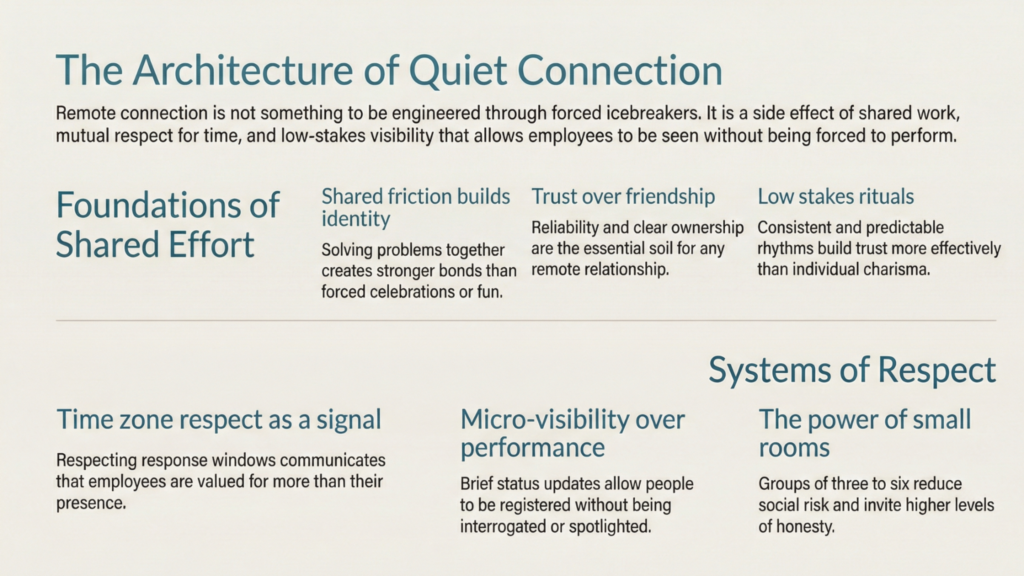
People feel connected to teammates who respect their time zones, their response windows, and their energy cycles. This respect communicates something deeper than politeness. It says: you are not required to be present to be valued.
Async-first environments reduce social resentment in ways most teams underestimate. When responses aren’t expected immediately, people stop reading silence as disinterest. Delayed replies feel safer than constant chatter because they remove the pressure to always be “on.”
There’s also emotional relief in knowing you won’t be penalized socially for logging off. When time is respected, engagement becomes voluntary. And voluntary engagement is the only kind that lasts.
Psychological safety doesn’t start with vulnerability. It starts with not being interrupted at 2 a.m.
Micro-Visibility: Being Seen Without Performing
Most remote workers don’t want to hang out. But they do want to be seen.
Not praised. Not spotlighted. Simply acknowledged.
Low-effort visibility creates a quiet form of social connection. Short status updates about what someone worked on. A note saying they’re blocked. A reaction emoji instead of a comment. These gestures don’t demand conversation, but they signal presence.
This kind of ambient awareness matters more than constant interaction. People feel connected when their existence is registered without being interrogated.
Micro-visibility works because it removes performance. There’s no need to be interesting, articulate, or funny. You can show up as you are, briefly, and move on. Over time, these small signals accumulate into familiarity. Familiarity becomes comfort. Comfort becomes trust.
Interest-Based Gravity, Not Assigned Culture
Remote culture doesn’t scale when it’s assigned. It scales when it’s chosen.
People connect more easily around interests than around value statements. Skill-based clusters, hobby threads, and learning experiments attract participation because they don’t demand identity. You’re not joining “who we are.” You’re joining “what I’m curious about right now.”
Temporary groups are especially powerful. When a space is allowed to dissolve naturally, it feels safer to enter. There’s no pressure to maintain a persona or keep showing up forever.
This is why interest-based gravity works better than company culture. It’s opt-in. It’s flexible. It respects the fact that people evolve.
Remote workers don’t want to be told who they are together. They want permission to orbit what already matters to them.
The Power of Small, Closed Rooms
Large groups make remote spaces feel like stages. Small groups make them feel like rooms.
When the audience is predictable, people relax. In groups of three to six, repeated exposure does the heavy lifting. You don’t need constant conversation. Recognition alone builds familiarity. Familiarity reduces friction. Reduced friction invites honesty.
In smaller spaces, people open up faster, not because they’re closer, but because the risk is lower. You know who’s listening. You know what they’ve seen before. There’s continuity.
Remote teams often overestimate how many people need to be included for socialization to “count.” Intimacy doesn’t scale linearly. Past a certain size, it collapses.
Scale kills intimacy. Small rooms protect it.
Shared Friction Beats Shared Fun
It sounds counterintuitive, but people bond more over friction than over fun.
Entertainment creates moments. Friction creates stories.
Shipping something under pressure. Debugging together. Learning a new tool and failing publicly. These experiences generate narrative. They give people something to reference later. “Remember when we…” becomes shorthand for shared identity.
Fun is fleeting. Struggle sticks.
This doesn’t mean work should be painful. It means that mild, shared difficulty creates meaning. When people solve problems together, they don’t just complete tasks, they build a sense of “we.”
Remote bonding happens less in celebrations and more in recovery.
Social Energy Is a Finite Resource
Not everyone wants to socialize equally, and pretending otherwise creates burnout.
Many remote workers thrive in async social spaces precisely because they can engage on their own terms. Silence, for them, isn’t disengagement. It’s neutrality. Or rest.
Opt-out defaults matter here. When participation is optional and non-punitive, engagement becomes more sustainable. People show up when they have energy, not because they feel watched.
Healthy remote socialization adapts to energy instead of demanding it. It respects introversion, fluctuating capacity, and personal boundaries.
Connection isn’t measured by volume. It’s measured by comfort.
Rituals That Don’t Require Charisma
Most workplace rituals quietly reward extroversion. The strongest remote rituals do the opposite.
Consistency matters more than personality. Simple recurring practices like sharing what you learned that week, or posting a quiet end-of-week reflection, create rhythm without pressure.
These rituals work because they remove performance. No one needs to be funny or insightful on demand. Showing up is enough.
When rituals are predictable and low-stakes, people participate longer. Over time, these small acts create continuity. Continuity builds trust. Trust makes social connections possible without forcing it.
Charisma fades. Rhythm endures.
Trust Before Friendship
Remote teams often chase friendship when what people actually want is trust.
Reliability feels more social than friendliness. Clear ownership builds rapport faster than banter. Predictability reduces social anxiety because people know what to expect from one another.
When trust is present, friendship can grow naturally. When it’s absent, forced friendliness feels hollow.
Friendship is optional. Trust is not. In remote environments, especially, trust is the soil. Everything else is decoration.
When Socialization Fails and Why That’s Okay
Here’s the part most blogs avoid: sometimes people don’t want to socialize at work at all.
And that’s fine.
Work-only relationships are legitimate. Forcing a connection where it isn’t wanted often damages morale more than it helps. Autonomy itself can be a form of respect.
Healthy remote environments don’t require everyone to bond. They create conditions where bonding can happen without obligation.
The goal isn’t constant engagement. It’s a healthy coexistence. When people feel free to choose their level of connection, the connections that do form are quieter, stronger, and more real.
TL;DR
| Connection Strategy | Core Mechanism | Social Benefit |
| Micro-Visibility | Using low-effort gestures like short status updates, blocking notes, or reaction emojis instead of long comments. | Allows employees to be acknowledged and seen without the need to be interesting or articulate, building trust through familiarity. |
| Small Rooms | Restricting group sizes to three to six people to ensure a predictable audience and repeated exposure. | Protects intimacy and reduces social risk, allowing people to relax and open up faster through recognition and continuity. |
| Socialization Without Forced Intent | Participating in silent co-working rooms, accountability sessions, or ‘working out loud’ spaces where conversation is not required. | Reduces isolation through shared effort and ambient awareness; people feel less alone without the pressure of performance. |
| Rituals That Don’t Require Charisma | Establishing consistent, low-stakes recurring practices like sharing weekly learnings or end-of-week reflections. | Removes the reward for extroversion and the need for insight on demand, creating trust through rhythm and predictability. |
| Interest-Based Gravity | Organizing groups around specific skills, hobbies, or temporary learning experiments rather than company values. | Provides a flexible, opt-in environment where people connect over curiosity rather than assigned identity or forced culture. |
| Shared Friction | Collaborating on difficult tasks such as debugging together, shipping under pressure, or failing publicly while learning. | Creates a shared sense of ‘we’ and a lasting narrative/identity rooted in solving problems together rather than fleeting fun. |
| Time-Zone Respect | Implementing async-first environments and respecting individual response windows and energy cycles. | Reduces social resentment and pressure to be ‘on’; communicates that employees are valued without needing to perform presence. |
Frequently Asked Questions
How does remote work change your social battery?
Many people report becoming “homebodies by default”: less in-person hangouts, more evenings zoning out to recover from calls. Others say office used to drain them so much they had no energy left; WFH gave them just enough battery to finally see friends on weekends.
Why does socializing online feel more draining than in-person?
- You watch yourself on camera, self-monitoring every micro-expression.
- Everyone talks over each other; you burn energy just to jump in.
- There is no casual easing in/out. Every call is a performance.
Practical ways to lower the social tax in remote meetings?
The most upvoted, non-obvious tricks:
- Turn off self-view. People report that it instantly makes calls feel like a normal room, not a mirror.
- Schedule 5–10 minutes between calls to walk, stretch, or stare outside; no back-to-back video.
- Default to audio-only for recurring internal check-ins unless visual is truly needed.
Small UI choices change how “heavy” each interaction feels.