

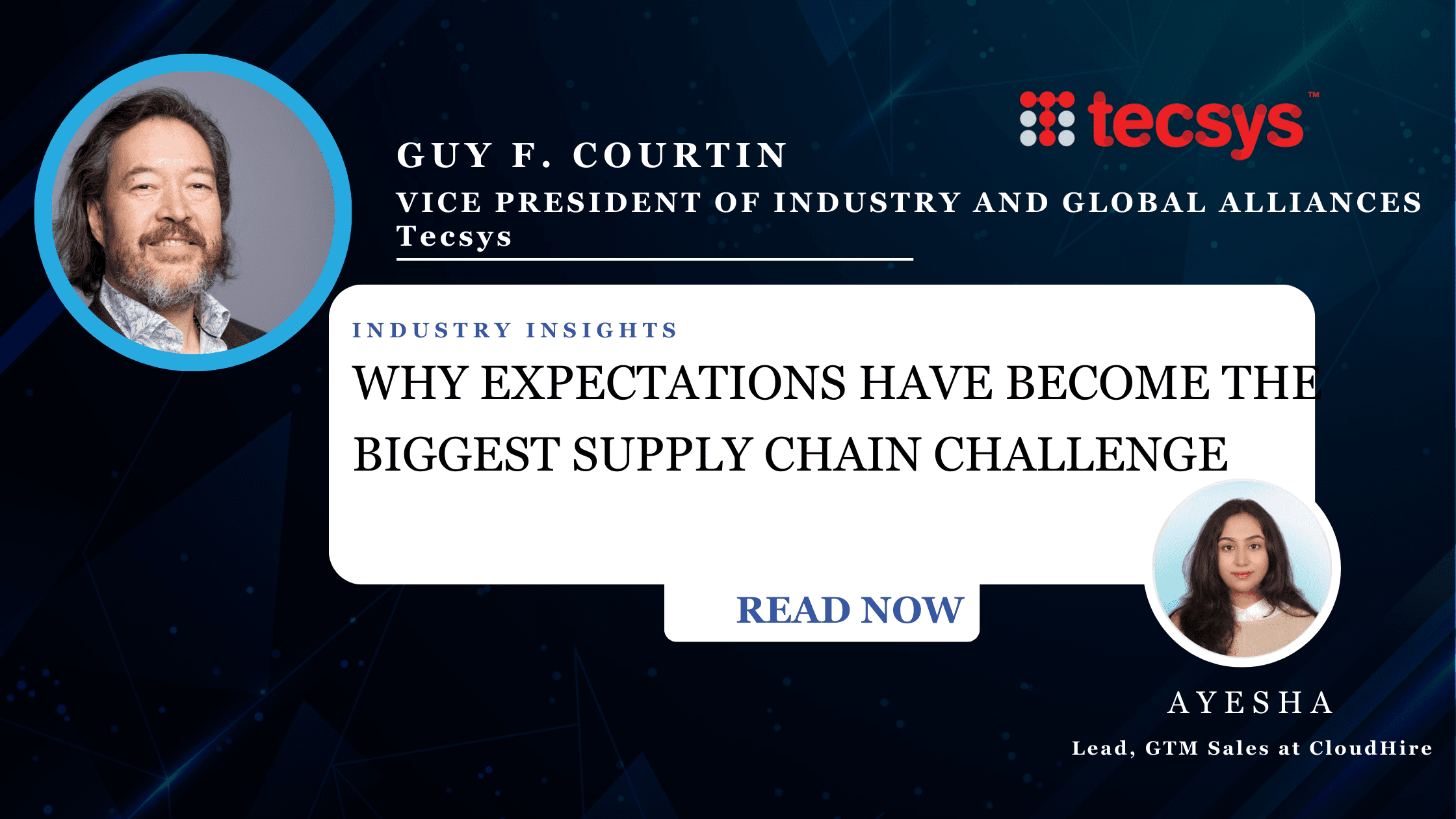
An interview with Guy F. Courtin, Vice President of Industry and Global Alliances at Tecsys, discussing supply chain execution, rising expectations, and the practical use of AI.
For most of us, supply chains are only noticed when they fail. A delayed delivery. An empty shelf. A hospital waiting on critical supplies. Yet behind every everyday expectation sits a deeply complex system under constant pressure.
Guy Courtin shared a grounded, refreshingly honest view of what is actually happening inside modern supply chains, why expectations have quietly become the industry’s biggest challenge, and how technology, especially AI, can help if it is used with discipline rather than hype.
Guy brings more than two decades of perspective to the conversation. As Vice President of Industry and Global Alliances at Tecsys Inc., a 40-year-old supply chain software company, he operates at the intersection of execution, data, and real-world complexity. His experience spans industry analyst roles at Forrester Research, Constellation Research, and SCM World, as well as leadership roles at major supply chain technology providers. That range shows in how he speaks. Clear, pragmatic, and careful not to overpromise.
How a Dot Com Era Lesson Pulled Him Into Supply Chain
Guy did not set out to build a career in supply chain. In his own words, “If you had asked the five-year-old Guy what he wanted to be when he grew up, supply chain would not have been in the top thousand on that list.”
What changed was timing. Starting his career in the late 1990s at Forrester Research, he watched the dot-com boom unfold up close. New internet companies were exploding in number, but many were collapsing just as quickly.
“What I realized at the time was it was the supply chain that was the make-or-break of some of these dot-com startups, especially in retail.”
That insight stuck. After business school, Guy joined i2 Technologies, now part of Blue Yonder, and found himself drawn deeper into an industry that touches everything but often goes unnoticed.
“You can point to any object or business out there and I can point to the supply chain that runs it. It is always evolving, always changing, and always under pressure.”
The Real Challenge Is Not Disruption. It Is Expectation.
When asked about today’s biggest challenges, Guy did not start with pandemics, geopolitics, or natural disasters. He started with something far closer to home.
“Expectations,” he said. “That is the biggest challenge supply chains are dealing with right now.”
He explained how consumer behavior has fundamentally reshaped the rules. Decades ago, ordering something and waiting weeks or months was normal. Today, consumers expect to find anything instantly and receive it in days or even hours.
“What people do not realize is that those B2C expectations carry directly into B2B.”
A procurement leader does not mentally separate their weekend online shopping from their Monday morning supplier negotiations. The same expectations apply. Visibility. Speed. Predictability. Cost control.
Supply chains are now expected to deliver more, faster, and cheaper, all at once.
Why Data Visibility Matters More Than Ever
At Tecsys, the focus is firmly on supply chain execution. Warehouses, transportation, stores, hospitals, and pharmacies. The places where supply chains physically move.
“These environments generate mountains of data,” Guy said. “That data gives us the ability to provide more visibility into what is actually happening.”
He emphasized that this visibility is not about abstract dashboards. It is about real outcomes. A hospital knows it has the right pharmaceutical inventory before a patient needs it. A distribution center replenishes faster because demand signals are clearer.
“If I can get more insight into demand and supply at the execution level, I can be more responsive to the end customer, whether that customer is a patient or a consumer.”
AI Works Best When the Problem Is Finite
Guy’s perspective on AI is where the conversation becomes especially grounded.
“We are absolutely on board with AI,” he said. “But it has to be applied to the right problems.”
Rather than chasing broad, all-knowing AI promises, Tecsys focuses on narrow, well-defined use cases. One example is warehouse labor routing.
“Picking paths in a warehouse is like grocery shopping in a store you do not know. You are inefficient. AI helps us dynamically route labor more efficiently based on real data.”
These models continuously adapt. Seasonality. Demand spikes. Operational constraints. The value, he noted, is immediate and measurable.
“We are seeing tremendous returns because we are solving finite problems with finite rules and good data.”
Where he urges caution is in trying to use AI to predict the future in complex planning scenarios.
“You are still using historical data. No matter how smart the engine is, it is still past data.”
He offered a simple reminder. No AI predicted the pandemic. No AI predicted the iPhone disrupting the mobile phone market.
“That is not a failure of technology. It is a misunderstanding of what technology can realistically do.”
Start With Data, Not the Tool
One of Guy’s strongest cautions was about cost. Not just financial cost, but wasted effort.
“The biggest mistake people make is starting with the AI engine instead of starting with the data.”
He shared an example from earlier in his career where a major retailer sent massive volumes of unstructured spreadsheet data.
“It was great data, but we could not use it. The cost was not the AI. The cost was making the data usable.”
His advice is direct. Before embarking on any AI initiative, organizations need to ask if the data exists, whether it is clean, and what it costs to make it usable.
“If you do not do that first, your costs will go through the roof.”
Disruption Is Not New. It Is Constant.
Guy pushed back on the idea of a “new normal” in the supply chain.
“There is no such thing as a new normal in supply chain. Disruption is constant.”
Some disruptions are small but deeply impactful. A missing medical implant moments before surgery. A recalled drug that must be pulled quickly without shutting down operations.
Others are larger. Weather events. Port strikes. Transportation failures.
“The question is not whether disruptions will happen. The question is how fast you can identify them and how fast you can respond.”
AI can help in recurring scenarios, he acknowledged, but human judgment remains essential.
“There is tribal knowledge that machines do not have. Humans still need to be involved.”
A Culture Built on Trust and Ownership
When the conversation shifted to leadership, Guy described a culture centered on trust.
“At Tecsys, you run your own business. You are given goals, and you are trusted to achieve them.”
Failure is not punished when learning follows.
“If you try something and it does not work but you learn from it, that is not a failure.”
This mindset, he believes, is key to attracting and retaining talent in a competitive market. Tecsys combines stability with challenging problems across healthcare, retail, and distribution.
“These are industries everyone participates in. That makes the work meaningful.”
Why Supply Chain Is a Career With a Future
Guy closed on an optimistic note about the future of work in the supply chain.
“Supply chain is no longer a back office cost center. It is becoming a differentiator.”
The skills are transferable. The problems are real. The opportunities are broad, from technology to operations to strategy.
“If you understand how to move goods from point A to point B, you can work almost anywhere.”
At CloudHire, conversations like this are why we believe thoughtful leadership, realistic technology adoption, and strong teams matter more than hype. Listening to leaders who understand both possibilities and limits helps organizations build smarter, more resilient futures.
Subscribe to the Scaling Remote newsletter for exclusive interviews, tactics, and insights on building high-performing distributed teams.


