
Remote software engineer jobs attract thousands of developers each year. The appeal is obvious: global access, flexible timing, higher pay ranges, and teams that focus on output, not office hours. Yet despite this demand, many engineers feel stuck. They apply to dozens of remote software engineering jobs and hear nothing back. They take coding tests, but interviews stop halfway. They read article after article, but the advice feels repetitive and disconnected from how real hiring works.
TL;DR
- Remote software engineer jobs attract global competition
- So hiring teams filter fast. Beyond coding ability,
- They look for clear communication, consistent delivery, and proof of remote-ready work habits. Engineers who show focused skills, clean portfolios, and strong async collaboration stand out,
- while mass applications and vague profiles get ignored.
This guide fixes that. It’s simple, grounded, and built from real hiring behaviour we’ve seen across global engineering teams. If you’re someone who wants remote software engineer jobs that are stable, long-term, and skill-building, not just random contract gigs, this is for you.
CloudHire works with companies hiring remote engineering talent at scale. We see the patterns every day: what works, what doesn’t, and what engineers underestimate. This guide reflects that reality.
Why Remote Software Engineer Jobs Look Easy but Feel Hard?
On the surface, remote software engineer jobs seem more accessible than office roles. Job boards update constantly. LinkedIn shows hundreds of openings. Many companies claim to be “remote-first.” But the global supply changes everything.
When a company posts software engineer remote jobs, it gets applications from developers across 10–30 countries. Recruiters filter fast. Skill mismatches, unclear portfolios, messy GitHub activity, vague resumes, and slow communication instantly reduce your chances.
Then comes the hidden filter: remote work behaviour.
Teams want engineers who can deliver without constant supervision. Someone who writes clean PRs, communicates asynchronously, and maintains consistent momentum. Many developers have strong coding ability but lack remote-first habits, and that becomes the silent barrier.
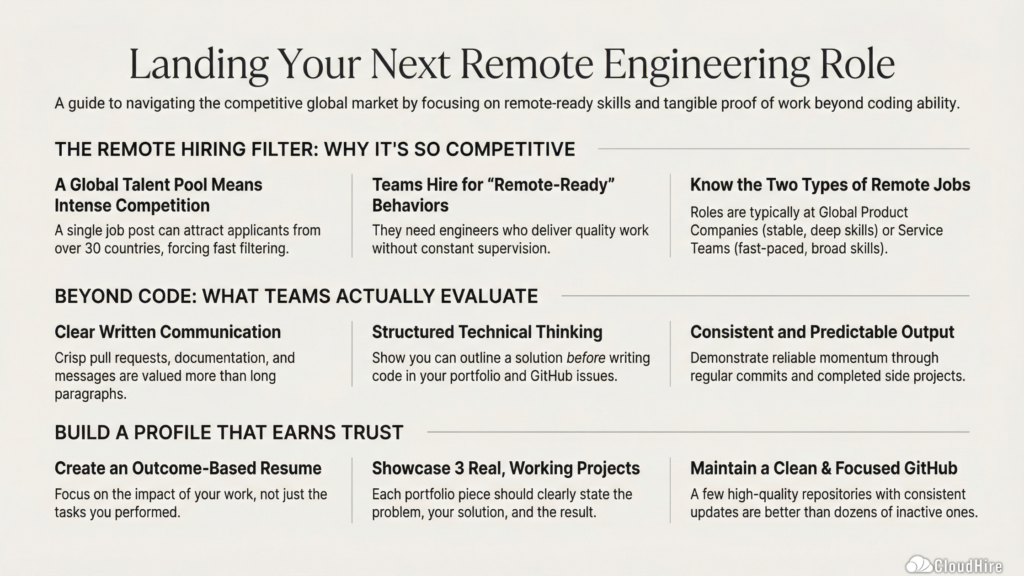
The Two Types of Remote Software Engineer Jobs You’ll Encounter
Every job you apply for will fall into one of these categories. Understanding the difference saves time and reduces random applications.
1. Global Product Companies
These organizations build SaaS tools, platforms, or large-scale products. Their hiring is structured, slow but stable, and focused on great skill.
What they care about:
- Well-structured code samples
- Ownership in past projects
- Writing clarity
- Problem breakdown
- Long-term engineering thinking
Where to find them:
- Company career pages
- Talent networks
- Referrals within product teams
- Niche job boards focused on engineering
These companies often post fully remote software engineer jobs, senior software engineer jobs remote, and the highest paying remote software engineer jobs because they can hire in multiple time zones.
2. Distributed Engineering Service Teams
These are fast-moving engineering groups working with multiple clients.
They value:
- Breadth of skills
- Fast debugging
- Ability to deliver under shifting requirements
- Task ownership
- Comfort with new frameworks
Where to find them:
- Remote job boards
- Contract platforms
- Agencies hiring for global clients
These teams frequently list remote job software engineer roles, remote quality software engineer jobs, or entry level software engineer jobs remote.
How Companies Evaluate Engineers Beyond Coding?
Coding tests are just the start. Remote hiring puts a heavy weight on behaviour patterns because they influence collaboration more than raw skill.
1. Clear Written Communication
Remote development relies on crisp updates. Long paragraphs or unclear messages slow teams down.
How to show it:
- Cleanly written pull request descriptions
- Easy-to-read documentation in repos
- A portfolio with a structured explanation
2. Structured Technical Thinking
Companies want developers who can outline a solution before jumping into code.
How to show it:
- Well-written issue descriptions on GitHub
- Case studies in your resume
- Architecture notes in your portfolio
3. Consistent Output
Remote teams trust people who maintain predictable momentum.
Proof includes:
- Regular commits
- Completed side projects
- Clean sprint summaries
- Clear changelogs
Skills That Actually Matter for Remote Software Engineer Jobs
Don’t follow advice that asks you to learn every technology. Remote teams don’t need “everything.” They need practical, repeatable skills.
Core Technical Skills
- Strong foundation in one major backend or frontend stack
- API design and integration
- Unit and integration testing
- Version control (Git)
- Basic performance optimization
If you’re applying for java software engineer jobs remote, embedded software engineer jobs remote, or software engineering remote jobs, companies expect depth, not tool lists.
Remote Work Skills
These decide whether you’re seen as “easy to work with”:
- Async communication
- Time estimation
- Clean documentation
- Effective standup updates
- Pull request hygiene
- Calm problem reporting
- Time-zone flexibility
These skills often outperform pure technical knowledge in remote senior software engineer jobs and remote software engineering jobs.
What a Competitive Remote Engineering Profile Looks Like?
A strong profile gives two impressions immediately: clarity and trust.
1. Portfolio with Three Real, Working Projects
Each project must show:
- The problem
- Your solution approach
- Code samples
- Screenshots or demos
- Impact or results
Glossy, over-explained academic projects don’t work.
2. Outcome-Based Resume
Avoid task lists. Show impact.
Weak:
Built endpoints for user login.
Strong:
Built a login API that reduced authentication time and added multi-factor support.
3. Clean GitHub
You don’t need 50 repositories. You need 5–7 with consistent updates.
4. Keyword-Aligned LinkedIn
Optimize for keywords recruiters actually search:
- remote software engineer jobs
- software engineering jobs remote
- Your stack + “remote”
- Core tools (React, Java, Go, Node.js, AWS, etc.)
This increases your visibility for remote jobs software engineer searches.
How Hiring Works for Remote Software Engineer Jobs?
Most companies follow this pattern:
1. Recruiter Screening
Focus on clarity, stack alignment, and communication confidence.
2. Technical Evaluation
Includes:
- Coding assessment
- Architecture or system design
- Past project walkthrough
- Pair programming
3. Paid Trial or Task
Common for distributed teams. They want to test async delivery.
4. Final Interview
Checks:
- Culture fit
- Time zone
- Remote habits
- Ownership mindset
Applying Smartly Instead of Everywhere
Random mass applications don’t work in remote hiring.
Targeted Applications
Match your stack with the job.
If they hire for React + Node, don’t apply with Django + Vue.
Short, Personalised Messages
“I have relevant experience with your tech stack and async workflows. My portfolio includes similar features. Sharing it below for clarity.”
This increases response rates dramatically.
Keep a Delivery Log
This small document helps in interviews and keeps your achievements fresh.
Use Platforms That Filter for Fit, Not Volume
Instead of applying everywhere, use platforms that prioritize alignment over scale. CloudHire focuses on matching candidates to roles based on skills, work style, and role requirements, reducing the noise that comes with mass job boards.
This helps ensure you’re seen for relevance, not lost among hundreds of mismatched applications. It also saves time by surfacing roles where your experience actually fits the hiring criteria, making each application more intentional and effective.
Common Mistakes That Stop Engineers From Landing Remote Roles
- Portfolio with no proof
- Unclear communication
- Inactive GitHub
- Poor documentation
- Stack mismatch
- Applying without reading the JD
- No timezone planning
These are the biggest red flags in software engineering jobs remote and remote software engineer job listings.
Building Experience Without a Prior Job
If you’re going for entry level software engineer jobs remote, build proof through:
- Real-world projects solving real problems
- Bug fixes in open source
- Small paid freelance tasks
- Contributing to community tools
- Documenting everything clearly
Proof beats experience when entering the remote market.
What Makes Remote Software Engineer Jobs Worth the Effort?
Remote roles give developers something rare: control. You choose your environment, your workflow, and your learning pace. You get exposure to global engineering cultures, different architectures, and different decision-making styles. You also gain trust-based work, which shapes long careers.
When you commit to consistency, communication, and strong fundamentals, remote software engineer jobs become predictable, not chaotic.
Final Thoughts
Remote software engineer jobs haven’t become harder because standards are higher; they’ve become clearer. Teams now know exactly what remote collaboration requires, and they hire for signals that reflect that reality. When expectations are explicit and processes are structured, outcomes become more predictable on both sides. For engineers who understand how remote teams actually operate, the market is less crowded than it appears. It’s simply more selective.
Frequently Asked Questions:
1. Do remote software engineers earn less than on-site engineers?
Not necessarily. While some companies adjust pay based on location, many remote-first companies pay competitive, location-agnostic salaries. Specialized skills in high-demand areas like AI/ML, Site Reliability Engineering (SRE), and cloud platforms often command premium pay regardless of where the engineer is located.
2. What soft skills are most important for success in a remote software engineering role?
Clarity in communication (especially written), self-management, accountability, and initiative are paramount. Great remote developers are proactive problem-solvers who can work autonomously and communicate effectively without constant supervision.
3. How do I stand out when applying for remote software engineer jobs?
Go beyond a standard resume. Showcase your real-world impact with specific project outcomes, maintain clean pull requests (PRs) on platforms like GitHub, and write good documentation. Engaging visibly in open-source communities or developer forums can also signal reliability and expertise.
4. Will AI replace remote software engineers?
No. AI automates repetitive coding tasks, but it actually increases the demand for engineers skilled in system design, guiding AI tools, complex problem-solving, integration, and security. The engineer’s role evolves to leverage AI as a powerful assistant rather than being replaced by it.